Kadifekale: A Medieval Castle on Smyrna’s Ancient Acropolis


Site at a Glance
- Rating
- 4.2
- Popularity
- Medium
- Country
- Turkey
- Primary era
- Medieval
- External website
- Open
- Eras represented
- Classical, Medieval
- Civilizations
- Byzantine, Roman
- Site type
- Military
- Remains
- Castle
On this page13 sections
History
Kadifekale is a medieval hilltop castle in İzmir, Türkiye, occupying Pagos Hill, the elevated and fortified center of ancient Smyrna. Its earliest fortifications date from the late fourth to early third century BC, while the surviving castle walls belong to the medieval period. The site marks the hilltop settlement of Smyrna, whose history developed alongside the city’s harbor district on the plain below.
The refoundation of Smyrna
The relocation and refoundation of Smyrna on Pagos are traditionally linked with Alexander the Great, the Macedonian king whose conquests created the political setting for the city’s later development. Pausanias, a second-century Greek writer who recorded traditions and sacred places, relates that Alexander dreamed of the Nemeses, goddesses associated with divine retribution and the restoration of balance. They instructed him to move Smyrna to the hill. The oracle at Klaros, an ancient sanctuary in western Anatolia, then promised prosperity to those who settled on Pagos beside the sacred Meles River. This story was frequently represented on ancient coins.
Alexander may have inspired or initiated the relocation rather than carrying it through himself. The movement from Old Smyrna began after his death under Antigonus I Monophthalmus and Lysimachus, two Diadochs, the generals who competed for control of Alexander’s empire. The process took place from the late fourth to the early third century BC, and excavations indicate that Old Smyrna may have been abandoned during Alexander’s lifetime. Lysimachus, who later became king in Thrace and Asia Minor, built the first recorded fortifications on the hill.
Hilltop and harbor settlements
Strabo, an ancient Greek geographer, described Smyrna as divided between a smaller settlement on the hill and a larger settlement centered on the harbor and plain. These two parts sometimes followed separate political and military paths. In the fourteenth century, the Aydinids, a Turkish Anatolian dynasty that ruled parts of western Anatolia, captured the hilltop castle. Genoa retained the port area and its separate fortress until Timur, the Central Asian conqueror also known as Tamerlane, captured it in 1403.
During the thirteenth century, under Emperor John III, repairs to the castle’s defensive walls were accompanied by the construction of a cistern, church, and monastery inside the fortress. After the castle came under Turkish control, the church was converted into a mosque. In the fifteenth century, Sultan Mehmed I ordered the walls demolished, after which they were restored under Mehmed. By the sixteenth century, the castle had declined and no longer served its original function.
Izmir’s modern hilltop
In the nineteenth century, Kadifekale formed part of the chain of hills that made up İzmir’s Turkish urban core, while the lower city remained its cosmopolitan center. During the twentieth century, the slopes were covered by six neighborhoods: Kadifekale, Alireis, Altay, Imariye, Kosova, and Yenimahalle. These settlements were described as gecekondu, or informal housing areas, and were populated chiefly by Kurdish migrants. Their transformation became the subject of sociological studies.
The municipality of İzmir began renovation and restoration work at Kadifekale in 2007. In the early 2010s, buildings in front of the southern walls were demolished during an urban-reconstruction project. Demolition and relocation also affected surrounding settlements, partly through claims of landslide danger. The castle walls were renewed and illuminated in 2015, and the cistern and mosque were restored in 2016. Kadifekale became part of the Historic Port City of Izmir, which Turkey placed on its tentative World Heritage List in 2020.
Remains
Castle walls and interior buildings
Defensive walls and towers
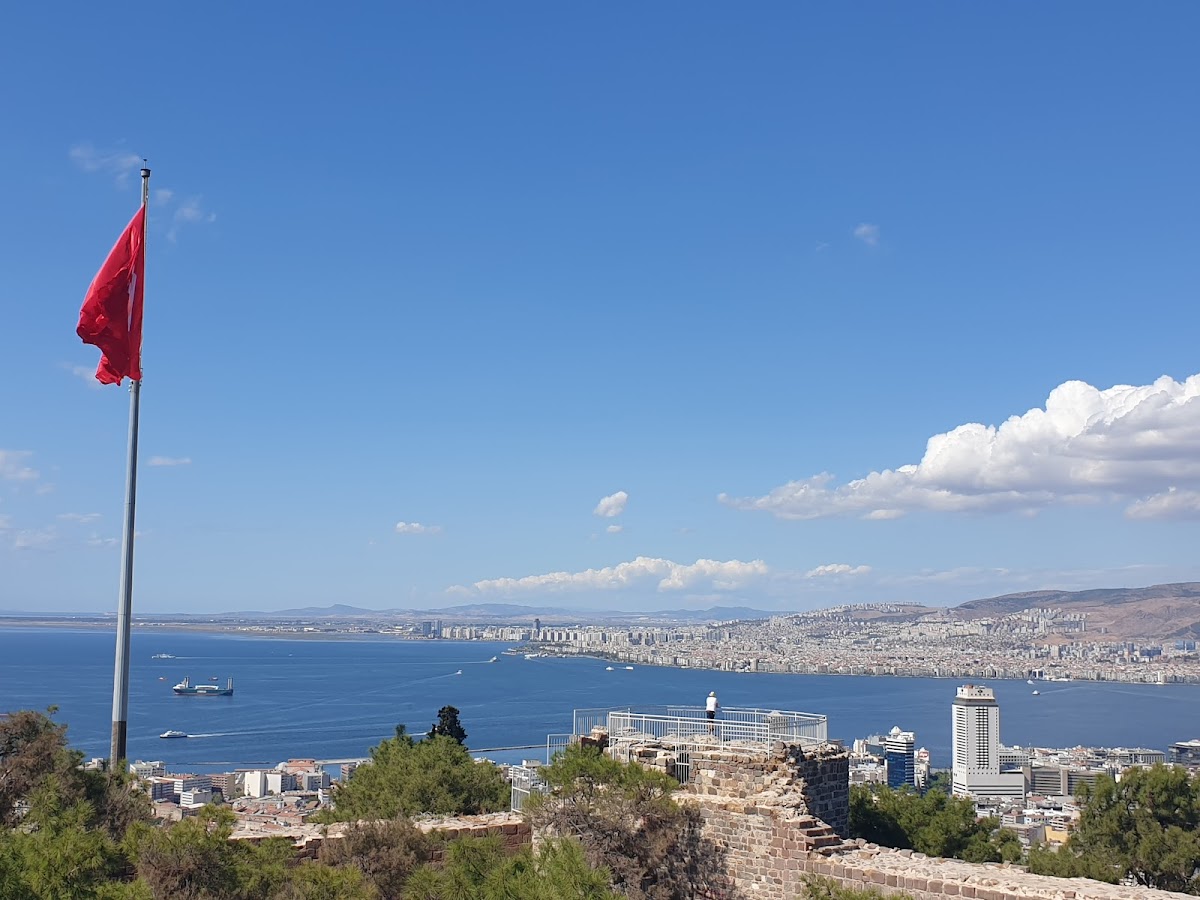
The castle occupies the summit of a 186-metre hill about 2 kilometres from the coast. Its surviving western and southern defensive walls are built of stone and brick and include five towers between 20 and 35 metres high. The present walls are medieval. Fragments of Hellenistic masonry may survive beneath them, although this interpretation has not gained general acceptance. The castle itself is preserved, and its position provides views across much of İzmir and the Gulf of İzmir.
The castle cistern
A cistern, a reservoir for storing water, was cut into the andesite bedrock inside the castle. It contains 40 columns and has a roof formed by rectangular arches supported on 20 piers shaped like elephant feet. The reservoir covers approximately 2,650 square metres and has a capacity of 750 cubic metres. Its restoration in 2016 preserved one of the major water-related structures within the fortress.
Church, monastery, and mosque
A church and monastery were built inside the fortress during the thirteenth-century repairs to the walls. The church was later converted into a mosque after Turkish control was established. The mosque was restored in 2016, retaining the physical evidence of the building’s change from a Christian to a Muslim place of worship.
Waterworks and ancient urban remains
Roman and later cisterns
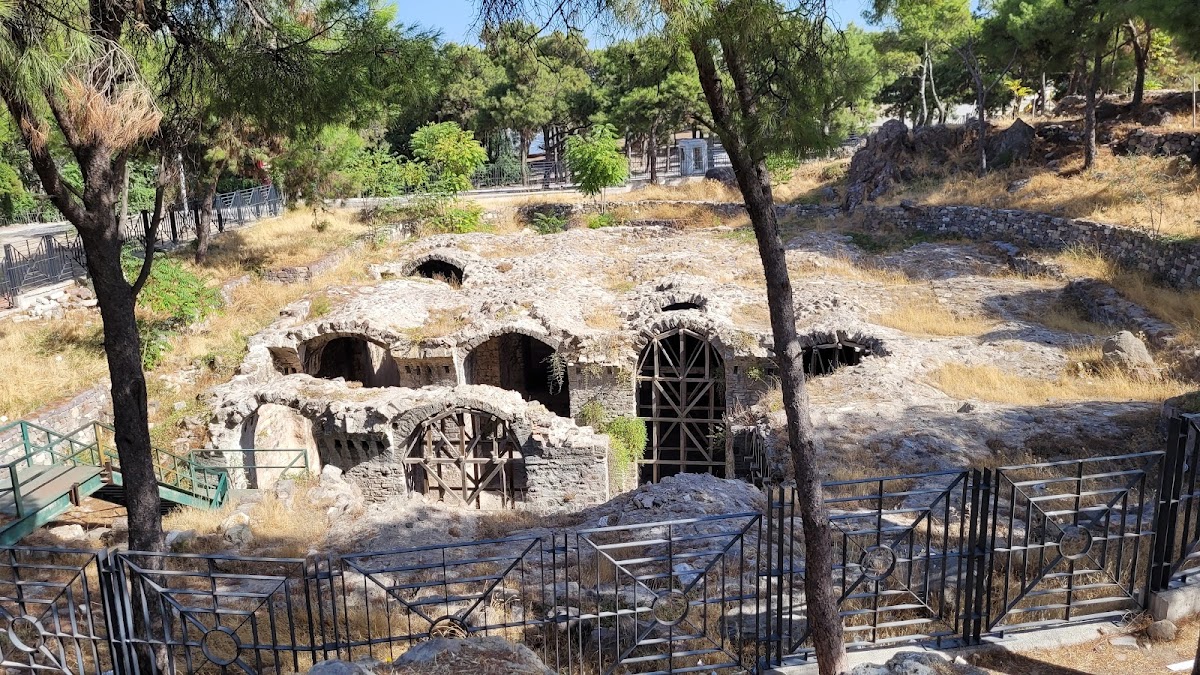
Ruins of cisterns stand beside the castle. They were constructed during the Roman period and repeatedly renewed during the Byzantine and Ottoman periods, forming part of Smyrna’s drinking-water network. Remains of associated pipelines survive at the Agora of Smyrna in lower İzmir, connecting the hilltop water system with the ancient city below.
Stadium
The stadium traditionally associated with the martyrdom of Polycarp of Smyrna, an early Christian bishop traditionally regarded as a martyr, lay in the elongated depression west of the castle. The area is now completely built over, while the castle preserves the elevated setting that once stood above this part of ancient Smyrna.
Theater
The ancient theater stood on the slope east of the castle gate. It has almost entirely disappeared, although some traces remain visible. The surviving remains are associated with rebuilding after the destructive earthquake of AD 178.
Nearby sites