Holy Trinity Cathedral of Saratov: A Russian Orthodox Cathedral
Site at a Glance
- Popularity
- High
- Country
- Russia
- Primary era
- Early Modern
- Eras represented
- Early Modern, Modern
- Civilizations
- Russian
- Site type
- Religious
- Remains
- Cathedral
On this page16 sections
History
Foundation and early history
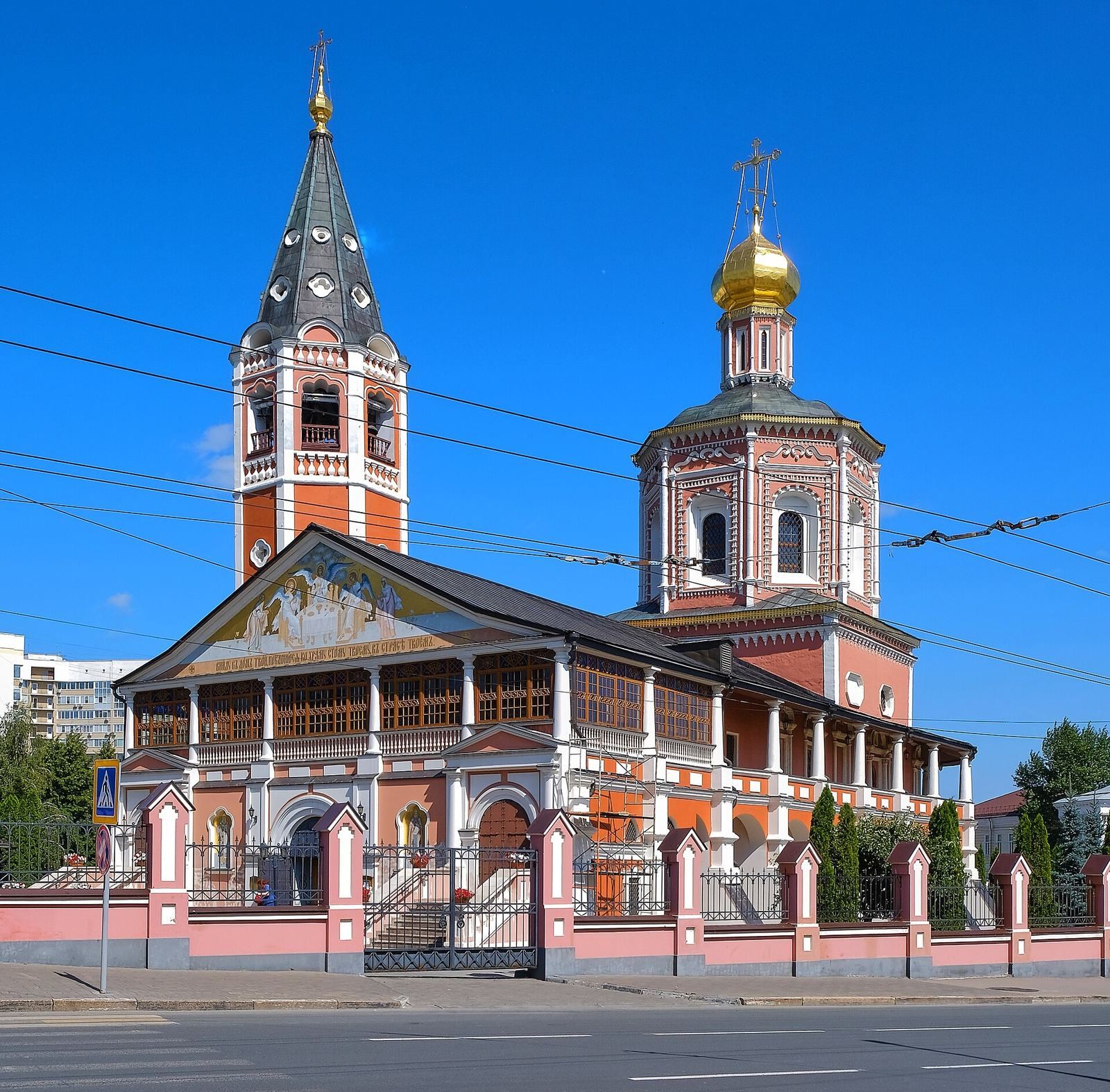
Holy Trinity Cathedral is a Russian Orthodox cathedral on Museum Square in Saratov, Russia. Its stone church was rebuilt by local residents in the late seventeenth century in the Moscow Baroque style, a Russian architectural tradition that flourished in the late 1600s and early 1700s. It is the oldest building in Saratov and the Middle Volga region.
Saratov began as a fortified town established in 1590 by the streltsy, Russian infantry who served the tsars. The town’s first wooden Trinity church was built in 1674–75 on its central square, with the blessing of Parthenius, Bishop of Astrakhan. Fire destroyed the church in 1684. Archpriest Ignatius Danilov and Saratov residents then sought permission to rebuild on the same site and retain its dedication. After five years of discussion with church authorities in Astrakhan, Metropolitan Savvatiy authorized a new building in 1689. Townspeople did most of the work, while specialists handled particular tasks.
The replacement cathedral was ready for consecration by 1694. An inspection in October 1695 appears to have coincided with its consecration: its upper church was dedicated to the Holy Trinity and its lower church to the Dormition of the Mother of God. Its first rector was Archpriest Grigory Spiridonov. In 1696, Danilov petitioned Peter I for land to support the clergy. Peter ordered Saratov’s governor, Andrei Lyapunov, to grant the cathedral 115 desyatinas, a traditional Russian unit of land area, near the Chardym and Sokor rivers. The order was issued on 5 April.
Fire, repairs, and changing use
A major fire damaged the cathedral on 20 May 1712. Repairs and alterations followed, and a bell tower was completed by 1723. The tower may also have served as a lookout: in 1717, forces including Crimean and Kuban Tatars approached Saratov and raided its outskirts. On 10 June 1722, Peter I, then Russia’s ruler, visited with his wife Catherine I. A prayer service was held at the cathedral before he set out on a military campaign in Persia.
After a city fire in 1774, worship continued only in the lower church until the upper church was consecrated again on 1 February 1781. Serious cracks were found in the building in 1786, prompting an order to dismantle it and construct a replacement. Residents delayed carrying out the order, and services continued for a time. The cathedral closed for strengthening work on 5 June 1795 and reopened for worship in 1800. Services were suspended again in May 1811, although some were held on Trinity and Dormition and during visits by bishops.
The Diocese of Saratov and Penza was established in 1799, and the church became its cathedral. Its first bishop, Gaii, soon moved his residence to Penza because Saratov lacked suitable accommodation for him. In 1809, Emperor Alexander I granted the cathedral new vestments after Senator Osip Kozodavlev raised concerns about the clergy’s poor equipment. The vestments were later transferred to Alexander Nevsky Cathedral for use at ceremonies. Architects consulted in 1813 disagreed about the cause of the structural cracks and how to address them. Repairs filled the cracks with new brickwork, and Bishop Afanasy of Penza and Saransk allowed services to resume on 12 September 1814 after no further cracking appeared.
The cathedral lost its cathedral status in 1826, when Alexander Nevsky Cathedral was consecrated, and thereafter served as a parish church. In 1863, Grand Duke Nicholas Alexandrovich, heir to the Russian throne, attended the liturgy and venerated the cathedral’s image of the Savior Not Made by Hands. A major campaign to repair and embellish the church began in 1903 at the initiative of Bishop Hermogen (Dolganyov), but work remained unfinished when the 1917 Revolution began.
Closure, reopening, and restoration
On 30 September 1919, the cathedral’s rector, Archpriest Gennady Makhrovsky, was executed. The church closed in 1934 and became a storage building for the local history museum. Demolition was considered, but parishioners and members of Saratov’s academic and cultural community defended the building.
Regular services resumed on 8 October 1942, during the Second World War, after Bishop Andrew (Komarov) secured permission to reopen church life in Saratov. The cathedral was reconsecrated, though its interior had been damaged by vandalism: the sacristy had been looted, icons and books destroyed, and icon screens broken. After Alexander Nevsky Cathedral was destroyed, Holy Trinity again became the diocesan cathedral. Patriarch Alexy I visited in 1949 and called for the wall paintings to be restored. Palekh icon painters worked in both churches, and from 1950 to 1954 artist P. L. Parilov painted 40 icons for the upper church’s icon screen. Until the late 1980s, Holy Trinity was one of only two functioning churches in Saratov.
Its condition became too poor for continued use during the 1990s, leading to closure and extensive restoration. The first Sunday school in the Saratov diocese opened at the cathedral in 1991; some of its first graduates entered the Saratov Orthodox Theological Seminary when it opened in 1992. In 1993, Patriarch Alexy II celebrated the Divine Liturgy there. Archbishop Pimen was buried in the grounds that year, and Bishop Nektary was buried beside him in 1994.
A major restoration project ran from 2004 to 2014 under the direction of the cathedral’s rector, Abbot Pakhomiy. The lower church was consecrated after its restoration on 10 December 2006. On 26 October 2014, Patriarch Kirill announced that the church had regained cathedral status; Metropolitan Longin consecrated the upper church on 2 November. Holy Trinity serves as a cathedral of the Russian Orthodox Church’s Saratov diocese and metropolitanate, an ecclesiastical province headed by a metropolitan. It is a federal-level cultural heritage monument.
Remains
Layout and architectural fabric
Upper and lower churches
The stone cathedral combines two worship spaces within one building. The upper church is dedicated to the Trinity and the lower church to the Dormition. Both have two attached refectories, halls used for gatherings and sometimes worship, with the spaces linked by arches. A stove in the lower refectory was probably a Dutch-style tiled stove. That hall may have been used for winter services, while worship in summer could take place in the unheated part of the church.
Bell tower and galleries
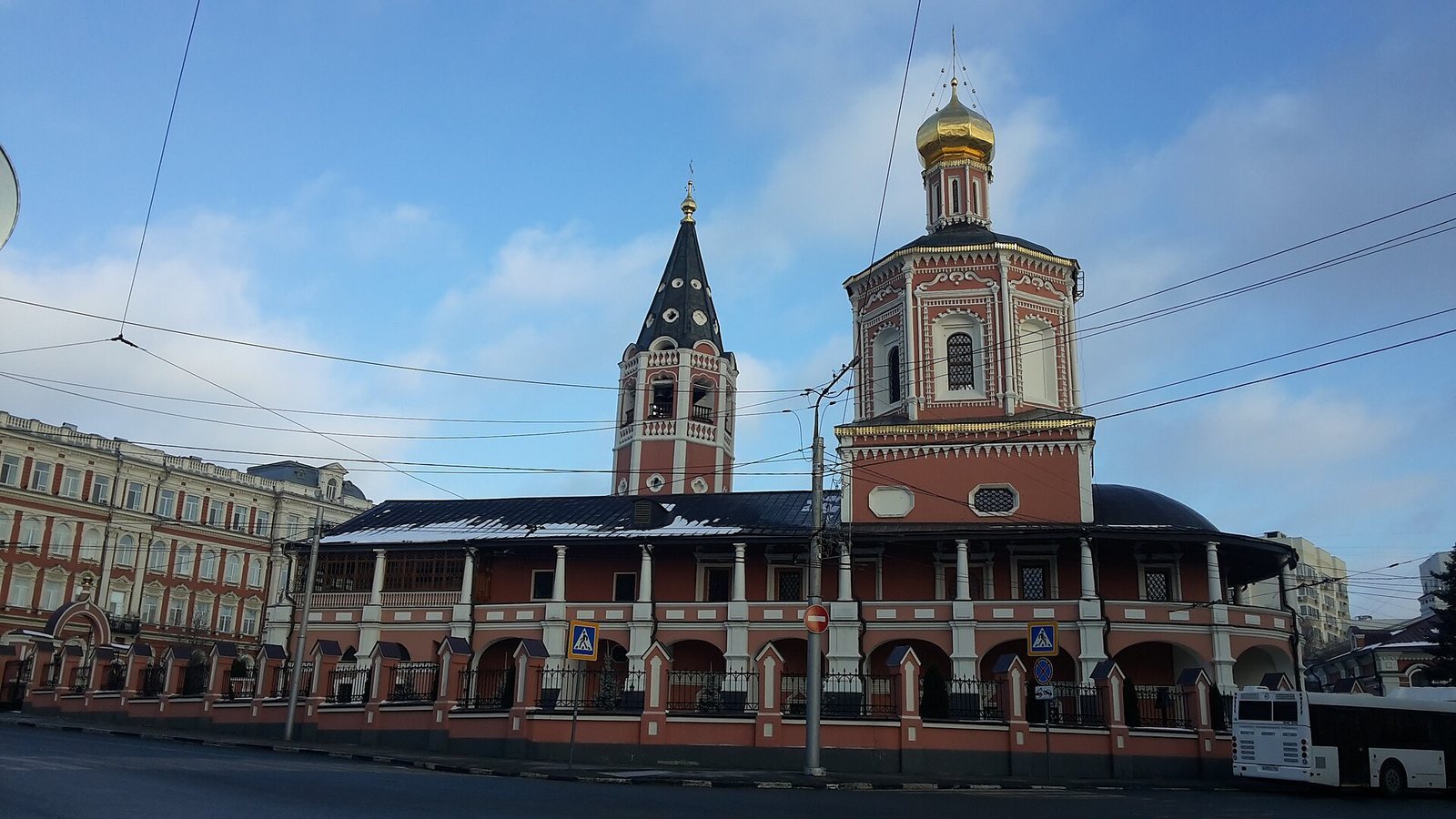
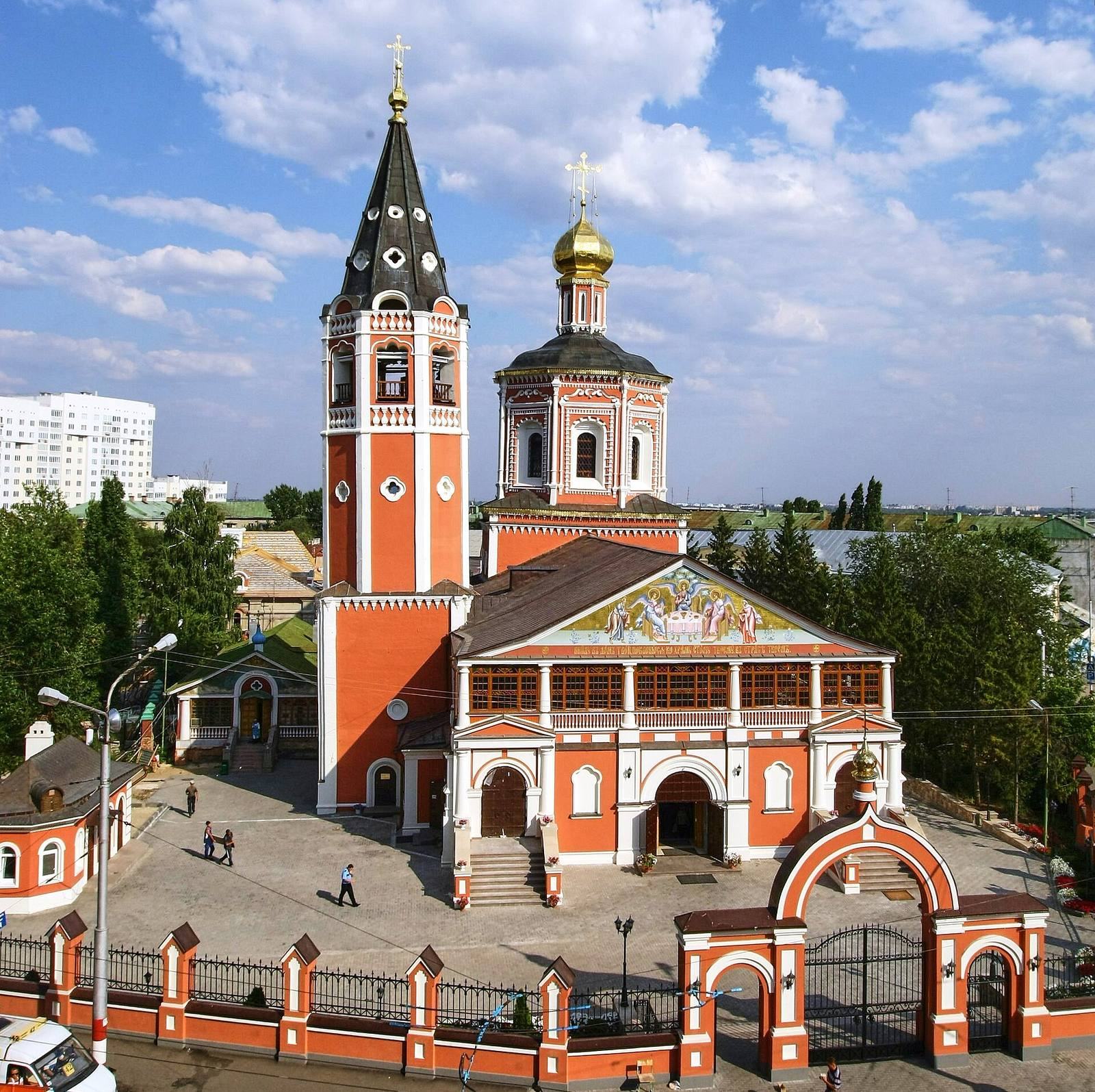
The bell tower has a four-sided lower stage and an octagonal upper one, capped by an eight-sided tent roof. Its cross-shaped windows have rounded ends. An inspection in 1695 noted a tower raised on posts and six bells: one weighing 33 poods, two weighing 8 poods each, one weighing 3 poods, and two weighing 5 poods each. A pood was a traditional Russian unit of weight. By the middle of the eighteenth century, the tower had a clock with chimes. It was initially detached from the church and was connected to it during repairs in 1837. The cathedral also has an open gallery and an enclosed gallery.
Structural additions
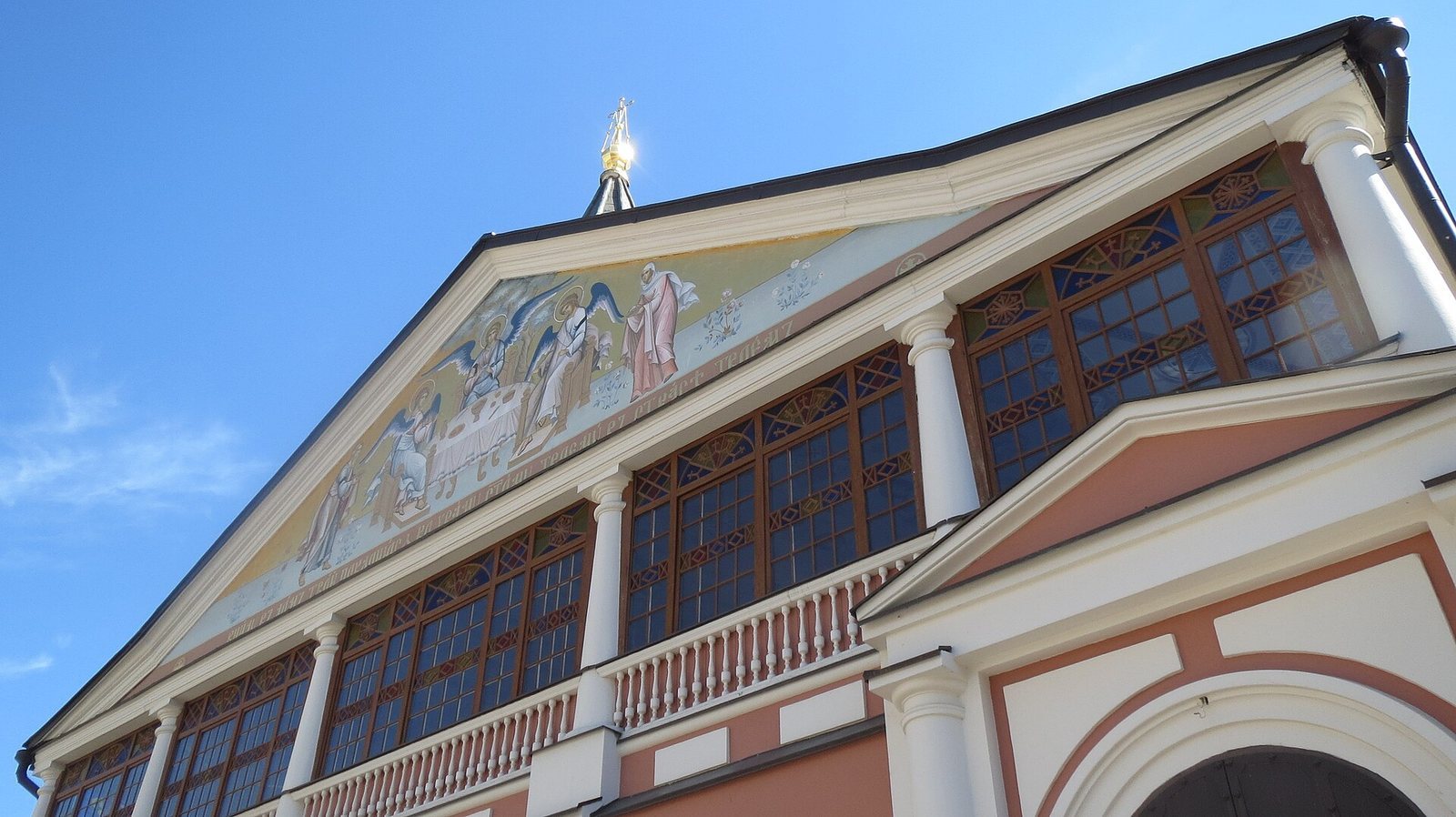
After the 1712 fire, the refectories on both levels were lengthened, and an open gallery and bell tower were added. In response to later cracking, the benefactor M. A. Ustinov paid for buttresses that extend from the foundations. A covered gallery and a large, two-storey western porch with a triangular pediment were also built, probably to make the strengthening work less conspicuous. The wooden roof covering was probably replaced with iron. Two small chapels were added to the lower church’s new refectory, one in 1836 and another in 1837. They were dedicated respectively to Basil the Great, Gregory the Theologian, and John Chrysostom, and to the Apostle James son of Alphaeus and the Martyr Eudokia. Both were dismantled after the church closed.
Interior and devotional features
Icon screens and wall paintings
The icon screen, a wall of icons separating the sanctuary from the main body of an Eastern Orthodox church, was renewed several times. Avraam Dobrynin made the screen for the upper church after the 1774 fire and painted its Trinity and Dormition icons. New, richly furnished screens were installed in both churches during the repairs completed in 1814. Further screens followed in 1860, with icons by Fyodor Soloninin, who painted faces in an ancient Greek manner and avoided exaggerated or overly naturalistic forms.
Small fragments of eighteenth-century wall paintings survive in the lower church. Palekh painters decorated both churches after Patriarch Alexy I’s 1949 visit, but the lower church’s mid-twentieth-century paintings were later removed when its walls were stripped of plaster during structural work. In a later restoration, the lower church’s walls were painted in a seventeenth-century style by the Palekh workshop Lik under O. R. Shurkus. Its new icon screen retained the main artistic forms of its predecessor. The altar paintings include the Assembly of the Apostles, the Great Entrance, and the Service of the Holy Fathers. Porch paintings depict the tradition that Saratov’s founding streltsy brought the image of the Savior Not Made by Hands from the Trinity-Sergius Monastery.
Image of the Savior Not Made by Hands
The cathedral’s revered image of the Savior Not Made by Hands is painted on canvas later attached to a wooden board. Tradition holds that the streltsy who founded Saratov brought it from the Trinity-Sergius Monastery. It may first have served as a sacred military banner. It was probably kept initially in a church in left-bank Saratov, then transferred to the wooden Trinity church when the town moved to the Volga’s right bank.
Veneration of the image grew from 1812, after a clerk told a cathedral priest that his employer, Ryazan merchant Yakov Mikhailov, had been miraculously healed and asked for the image said to be above the church’s south exterior door to be found. The clerk located it and commissioned a silver-gilt cover. Votive gifts, including images of healed body parts, crosses, and small icons, were attached to the cover or kept nearby. Some were melted in the mid-nineteenth century to make silver-gilt crowns for other cathedral icons; the ornaments together weighed about 1,110 grams. In the 1920s, the image and its valuable cover were confiscated separately, and the image went to the local history museum. It returned to the cathedral after 1942. Restored in Saratov in 2006, it had suffered substantial damage, including the loss of part of the image, and its board was in poor condition. Its old cover was restored as well. Since the 1950s, the congregation has sung an akathist, a devotional hymn of praise, before the image each week.
Other icons and the reliquary
Other revered icons at the cathedral include the Kazan and August icons of the Mother of God, the Old Testament Trinity, and the Iveron icon of the Mother of God. Icons of Theodosius of Chernigov and Seraphim of Sarov are associated with relic fragments, physical remains of saints or objects connected with them; the Seraphim icon also holds fragments of his clothing. Several nineteenth-century icons were painted at monasteries on Mount Athos, including images of the Mother of God titled Quick to Hear and Search for the Lost, and an icon of the healer and martyr Panteleimon with scenes from his life. Three further icons contain relic fragments associated with the bishops Innocent of Alaska, Theodosius of Chernigov, and Innocent of Penza.
A reliquary returned to the Saratov diocese in January 2005 after many years at the regional museum. It contains 132 relic fragments. Its cover was restored using an old photograph as a guide.
Restoration and grounds
Exterior and lower church
Restoration reinstated missing exterior details, including window surrounds, decorative caps above the windows, and cornices, and returned the building to a historically based appearance and color scheme. Both domes were gilded in 2007, along with decorative bands on the domes and the four-sided upper structure. The roof trusses were replaced, and copper was used to cover the roof, projecting cornices, and buttresses. Stained glass in the enclosed gallery was replaced, and the mosaic floor of the open gallery was recreated.
The lower church’s floor was lowered to increase the interior space. A fresco of the Hospitality of Abraham was painted on the cathedral pediment and consecrated on 24 October 2008. The restoration also included a new surrounding fence.
Supporting building
A new administrative building, completed in 2012, provides space for a Sunday school, an educational center, and administrative and service functions.