Toropets Kremlin: A Medieval Princely Center and Russian Border Fortress
Site at a Glance
- Popularity
- Medium
- Country
- Russia
- Primary era
- Early Modern
- Eras represented
- Medieval, Early Modern, Modern
- Civilizations
- Russian
- Site type
- Military
- Remains
- Citadel
On this page14 sections
History
Medieval princely center
Toropets is first mentioned in 1074, when a monk from the town, Isaac of the Caves, died at Kyiv-Pechersk Monastery. From the 11th to the 14th centuries, Toropets belonged to the Smolensk lands. In the 12th and 13th centuries, it was also the center of an appanage principality, a territory governed by a prince within a larger realm.
The early Toropets Kremlin served as a princely residence during the 12th and 13th centuries. Lithuanian forces apparently burned it in the mid-13th century, possibly in 1245. The site then fell out of use, and urban life shifted to a settlement known as the Old Large Hillfort. Toropets later came under the Grand Duchy of Lithuania, a major state in eastern Europe, before joining the Russian state in 1503.
Russian border fortress
In the first decades of the 16th century, Moscow authorities built a new fortress at Toropets, which had become an important border stronghold. In peacetime, the Kremlin functioned as a sparsely inhabited administrative district. Its buildings included the military governor’s court, state grain stores, cellars for powder and weapons, a cathedral and other churches, and household plots used for shelter during a siege.
A land and household register from 1540–1541 counted 14 residential yards and 126 siege yards. In 1580, during the Livonian War, a 16th-century conflict involving the Russian state and Stephen Báthory’s forces, the fortress withstood a siege by Báthory’s army. Báthory was king of Poland from 1576 to 1586. In 1586, earth bastions, projecting defensive works that helped resist cannon fire, were built around the fortress towers.
Decline and archaeological study
The fortress declined during the 18th century and deteriorated rapidly after it was left unattended. As the Russian state expanded westward, there was less reason to keep the stronghold ready for combat.
Excavations in 1956 cut through the ramparts of both fortified centers and helped reconstruct Toropets’ defensive system and fortification methods. The Toropets Kremlin is designated a cultural heritage site of federal significance in Russia.
Remains
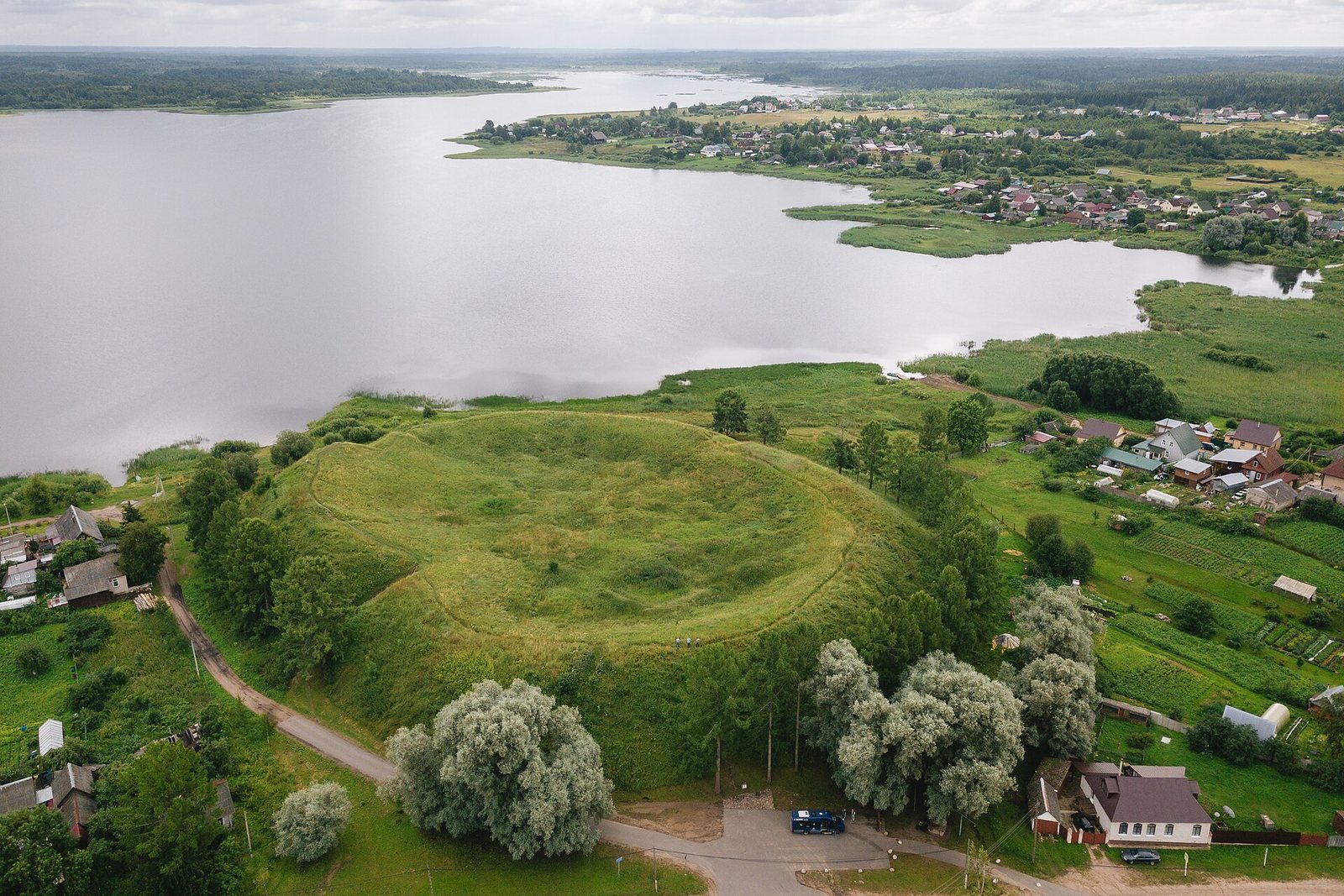
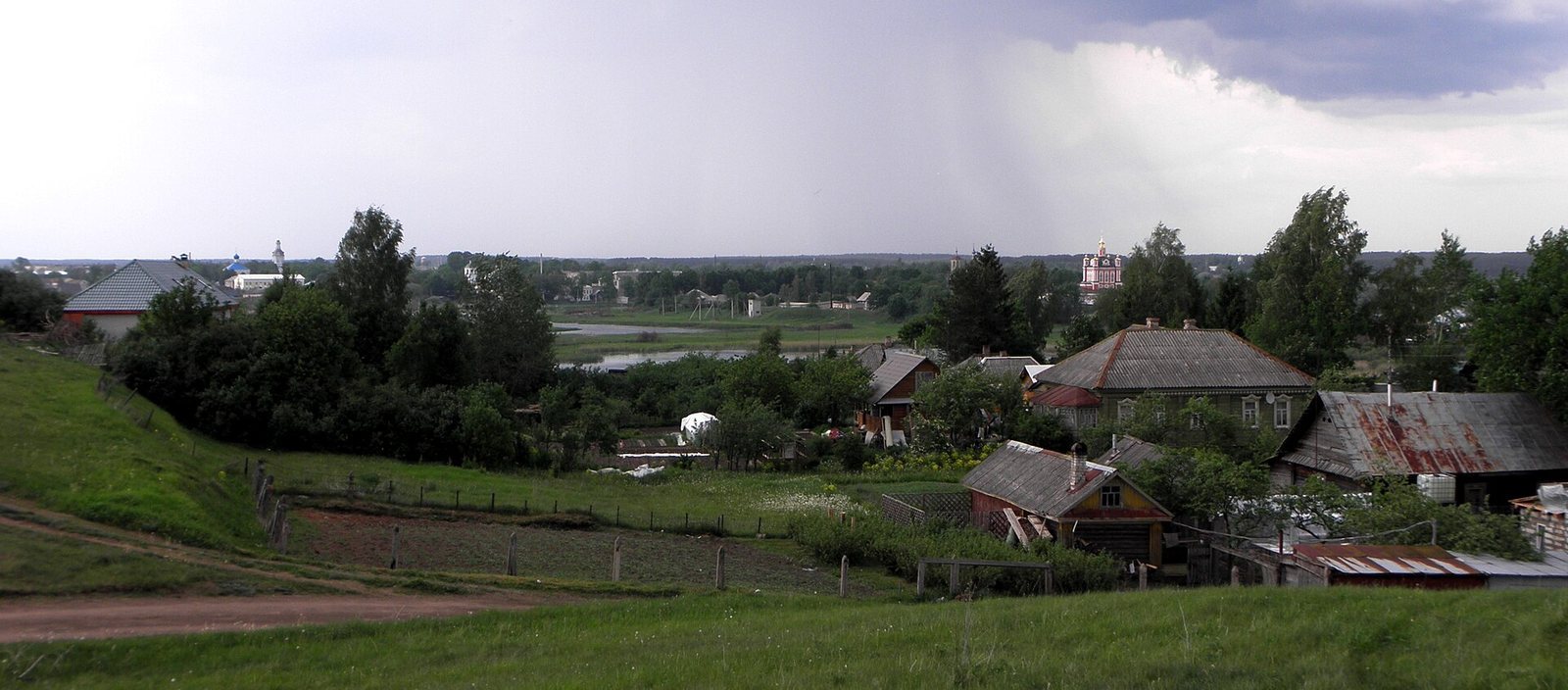
The fortified remains occupy the southeastern edge of modern Toropets and comprise two separate sites. The earlier Small High fortified settlement stands on a rounded shore hill beside Lake Solomenno. The later Red Rampart fortress occupied an island between branches of the Toropa River, where the river leaves the lake. Both sites were enclosed by earth ramparts topped with wooden walls and towers.
Small High fortified settlement
Ramparts and defenses
The settlement measures about 95 by 60 metres and covers approximately 0.6 hectares. Its circular rampart rises 8 to 9 metres, reaching as much as 18 metres above the lake. A timber wall, apparently made from logs, likely ran along the top and included a fighting gallery, a passage from which defenders could engage attackers. Traces of gates remain on the north and south sides. A ditch encircled the landward sides of the settlement and could be filled by lake water. A concealed passage to the lake may also have existed.
Timber buildings and settlement layers
Below the turf, excavated deposits of dark soil contain pottery and animal bones. With a few modern fragments at the surface, the pottery appears to date to the 14th and 15th centuries or earlier. Pottery in the lowest layer may belong to the first half of the 11th century, or even the second half of the 10th. Most vessels were made on a wheel and decorated with straight or wavy lines; their clay was mixed with crushed stone. Hand-built pottery is rare, and many vessel fragments have rims that flare sharply outward.
Timber domestic and utility buildings were found at depths of 0.8 to 1.1 metres, arranged in several successive layers. Logs in the uppermost layer had been burned, while those below showed no signs of fire. From about 1.15 to 1.20 metres down, waterlogged settlement deposits preserved organic material exceptionally well. Wooden structures continued to the underlying coarse glacial sand, at roughly 2.7 metres.
Objects and street surfaces
Finds include a wooden shovel, a barrel bottom, spinning implements, numerous leather offcuts and footwear fragments, an iron knife, and a blue glass bead. Other objects include pottery, weapon fragments, armour fittings, jewellery, and a suspended lead seal belonging to Yaroslav Yaroslavich, a 13th-century prince of Tver. Log-paved streets have also been identified.
Former wooden cathedral
A wooden cathedral, perhaps dedicated to St George, once stood at the early settlement. It may have been the place where Alexander Nevsky, a 13th-century Russian prince and military leader, married. The hillfort is now unoccupied.
Red Rampart fortress
Walls, gates, and towers
The later fortress had a perimeter wall about 978 metres long. Its wooden log walls were packed with clay and lime and stood 20 courses high. Two gates admitted vehicles, the Moscow Gate and the Yegoryev Gate; a third, called At the Ford, served pedestrians. Six towers without passageways formed part of the defenses.
Bastions and layout
The fortress had a trapezoidal plan that predated standardized geometric layouts for fortifications. Its towers stood on earthen bastions arranged to let defenders fire along adjacent walls. The surrounding river rarely froze in winter. A central street ran between the northern and southern gates, and the fortress’s overall layout broadly follows the present arrangement.
Churches and later buildings
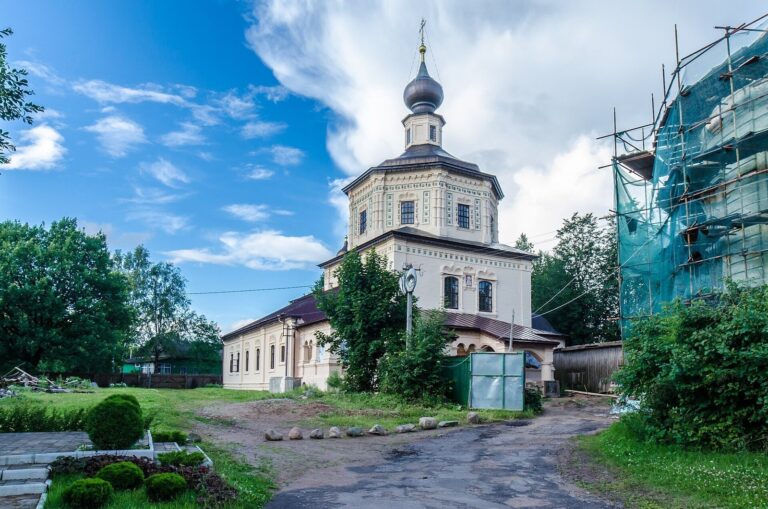
The Red Rampart site contains the Epiphany Church, built in 1771 and now home to the local history museum. The active Korsun Cathedral was first built in 1676. After a fire, it was rebuilt entirely in the Classical style between 1795 and 1804. Several residential and administrative buildings from the 19th and 20th centuries also stand within the fortress, while its ramparts survive.