Ruins of Hippo (Hippo Regius): An Ancient Phoenician, Roman, and Christian City in Algeria


Site at a Glance
- Rating
- 4.5
- Popularity
- Low
- Country
- Algeria
- Primary era
- Classical
- Eras represented
- Iron Age, Classical
- Civilizations
- Phoenician, Roman
- Site type
- City
On this page21 sections
History
The Ruins of Hippo (Hippo Regius) in Algeria preserve the remains of the ancient city near modern Annaba, founded by Phoenicians from Tyre by the eleventh century BC and later transformed into a major Numidian, Roman, and Christian center. Its position beside the Mediterranean harbor and near the mouth of the Ubus River supported maritime trade and urban prosperity for many centuries.
Phoenician and Numidian Hippo
Hippo was first settled by Phoenicians from Tyre by the eleventh century BC. The name is probably related to a Punic word for “harbor.” Punic describes the language and culture of the western Phoenician world, particularly the communities associated with Carthage. Hippo later became a prosperous Punic settlement allied with Carthage.
By the third century BC, the city had become a Numidian royal center associated with King Massinissa. When the Romans later called it Hippo Regius, meaning “Royal Hippo,” the name distinguished it from Hippo Diarrhytus, an ancient city in modern Tunisia.
Roman development
Hippo entered the Roman world after the defeat of Juba I, an ally of Pompey, in 46 BC. It was incorporated into the Roman administrative system and developed into a major maritime city and commercial center. Its market was described as one of the most opulent in the region, and Hippo became one of the principal cities of Roman Africa.
Under Emperor Diocletian, Hippo was included in the Diocese of Africa, a major Roman administrative division. Its location beside the Mediterranean and close to the Ubus River helped sustain its commercial role. The forum, market, and Roman theatre are assigned mainly to the first or second centuries AD. A garum installation, used to produce fermented fish sauce consumed throughout the Roman world, probably dates to the first century AD.
Christian Hippo and Augustine
The Christian diocese of Hippo was established around AD 250 and was suppressed around AD 450. The city hosted councils in 393, 394, and 426, together with synods in 397 and 401. The council of 393 and the synod of 397 were associated with the formation of a list of biblical books that became part of the Catholic canon.
Augustine of Hippo served as bishop from AD 396 until his death in AD 430. A North African bishop, theologian, and Church Father, Augustine made Hippo a major center of Christianity in North Africa. He died during a fourteen-month Vandal siege. The city was captured in AD 431 and became part of the Vandal Kingdom, serving as its capital from AD 435 to 439 before the capital moved to Carthage.
Byzantine, Islamic, and medieval transformations
The Byzantine general Belisarius recovered Hippo in AD 533, returning it to the Eastern Roman Empire. Muslim forces took the city in AD 705. It was later rebuilt in the eighth century under a new name associated with jujube trees.
In the eleventh century, the Sanhaja, a group of Berber peoples, and the Zirids, a Berber dynasty that ruled parts of North Africa, founded Madinat Zaoui about three kilometres from ancient Hippo. The newer settlement later became known as Beled el-Anab and grew more important than the ancient city. It was occupied for periods by the Spanish and French in the sixteenth century. France captured it again in 1832 and renamed it Bône or Bona. After Algerian independence in 1962, the city resumed the name Annaba.
Rediscovery and archaeological work
Interest in the ancient city increased in the early nineteenth century after mosaics and epitaphs were rediscovered in the seafront villa district. The layout of the Roman town was identified in 1935. Erwan Marec directed major clearance and excavation work from 1947 to 1963 and helped prevent industrial expansion from destroying part of the archaeological area.
Modern Annaba has expanded around the ruins, and a road and railway divide the archaeological area into two sections. Conservation has also drawn on scientific study of the site’s masonry. Analyses of twenty joint-mortar samples confirmed some earlier datings and proposed revisions for others, helping clarify the constructional development of the ruins and informing conservation planning.
Remains
The archaeological site is formed by several insulae, or urban blocks bounded by streets, with residential, Christian, commercial, civic, bathing, and theatrical areas. Hippo retained an earlier Phoenician urban fabric that was later Romanized, so its plan does not follow the regular grid often associated with Roman towns. Even so, the principal Roman Cardo and Decumanus, the main north–south and east–west streets, can be discerned within a layout approaching a regular Roman plan.
Streets and the seafront district
Urban streets
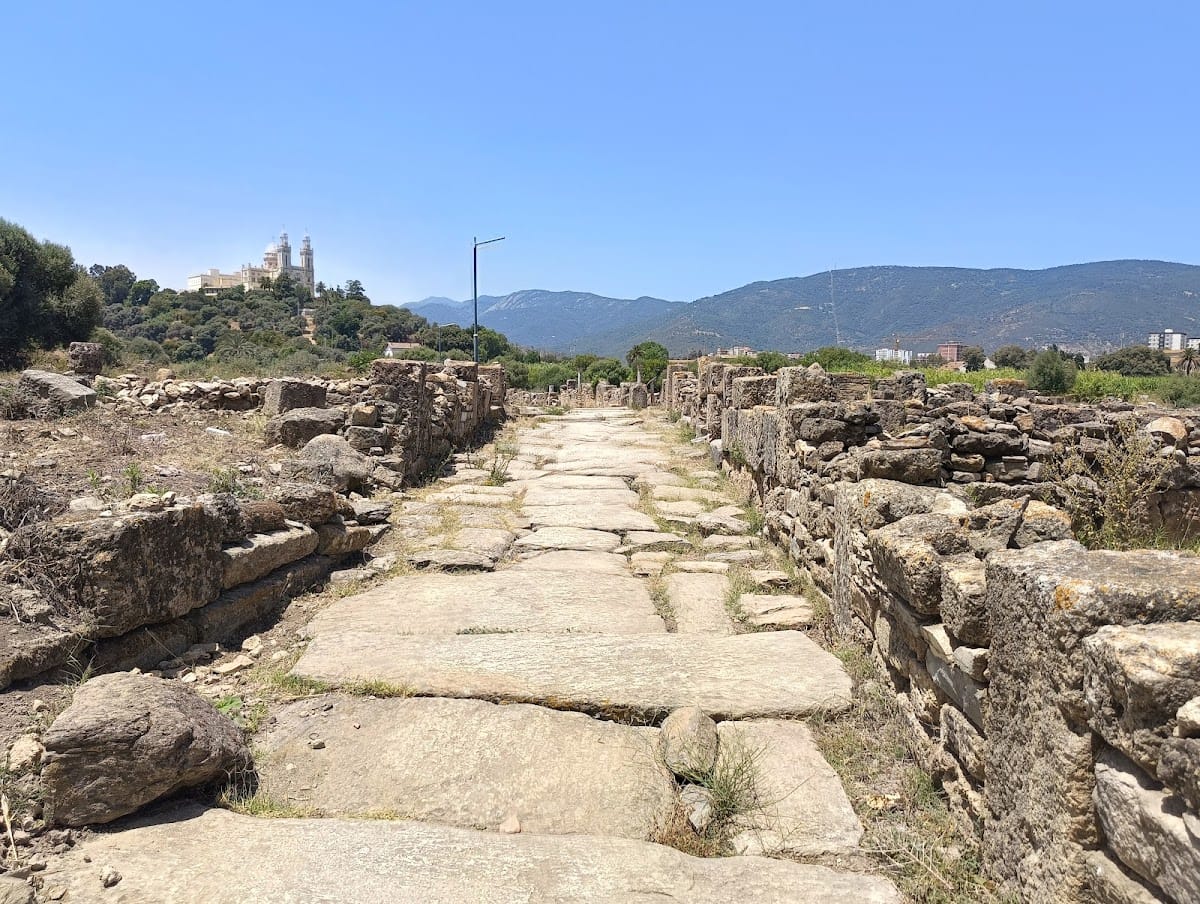
A broad paved street crossed the city from the villa district and ancient harbor toward the forum. Its paving predates the Roman annexation of Hippo in 46 BC. Other internal routes and a street leading toward the forum remain identifiable within the archaeological area.
Seafront villas
The seafront villa district contained large houses with porticoes, fine mosaic floors, and imported cipollino, a veined green-and-white marble used as decorative stone. Alluvial deposits later altered the coastline, leaving the district no longer directly beside the sea. Several layers of mosaic flooring show continuous habitation from the first to the fourth century AD.
The Villa du Front de Mer contained a mosaic depicting the ancient town. The Villa du Procurateur was associated with Q. Allius Maximus, a legate of the Roman proconsul at Carthage, and produced the Mosaic of the Four Nereids. Nereids are sea nymphs in Greek mythology.
Civic and commercial buildings
Forum
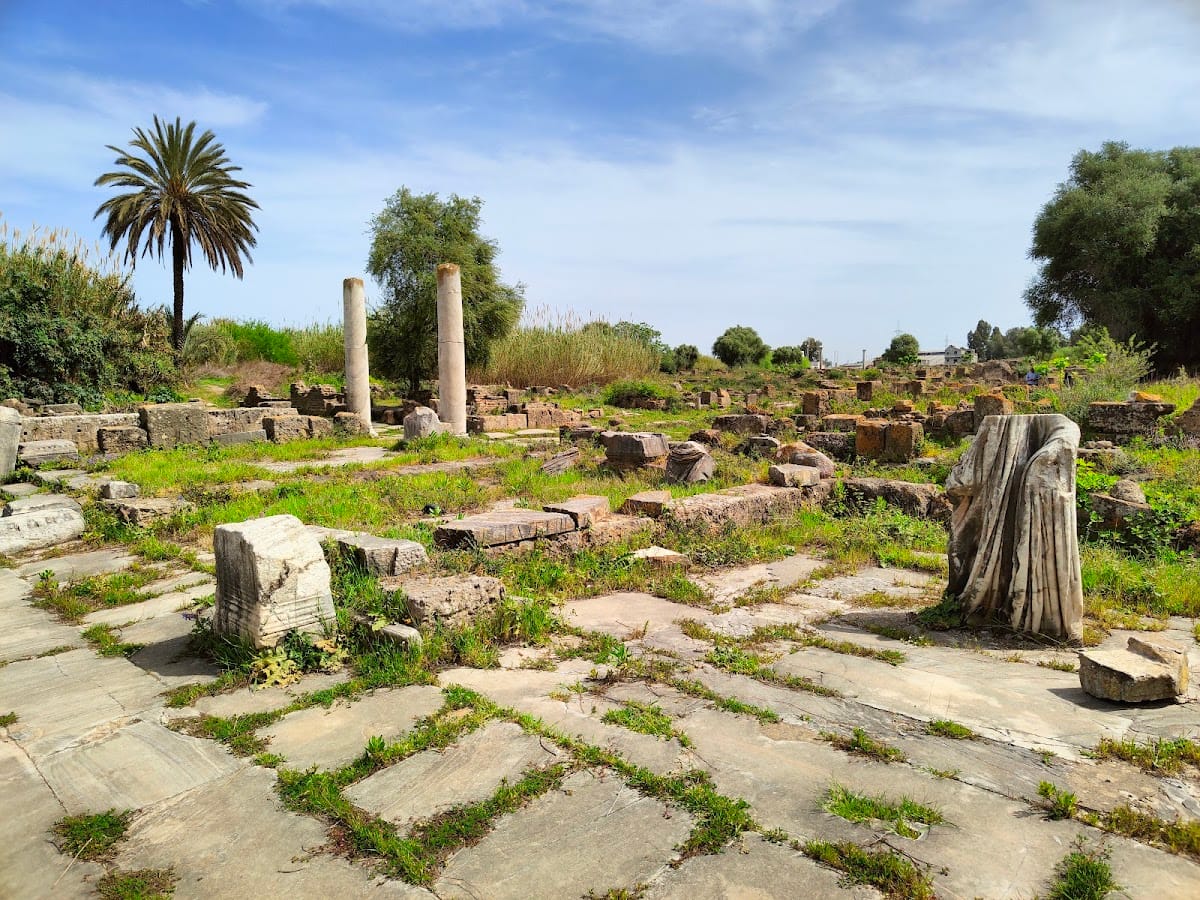
The forum is a rectangular civic space measuring approximately 42 by 75 metres. Blue-gray limestone blocks cover its paved area, which is bordered by galleries or porticoes on the east, west, and north sides. A small temple, approximately 9.60 by 9.10 metres, stood within the forum and was surrounded by a colonnade. Shops and smaller temples occupied the area behind the porticoes, while small monuments and statues lined the sides of the square.
A large floor inscription names C. Paccius Africanus as pontiff, consul, proconsul of Africa, and patron of the municipality of Hippo. The inscription dates the paving to approximately AD 78–79, during the Flavian period, the imperial era of Vespasian, Titus, and Domitian from AD 69 to 96. It also indicates that Paccius Africanus enlarged an earlier forum, possibly dating from the reign of Emperor Claudius.
The forum contained evidence of imperial cult activity, the public veneration of Roman emperors and members of the imperial household. Two busts of Augustus and Vespasian and fourteen inscriptions honoring emperors including Claudius, Titus, Vespasian, Antoninus, Septimius Severus, Gordian, and Valens were recovered. Two monumental marble statues of Minerva and Hercules, carved from Parian marble, were also found. Parian marble is a fine-grained white stone from the Greek island of Paros.
A bronze trophy from the site is preserved in the archaeological-site museum. Other inscriptions record statues that have disappeared, including a monument to a man named Celer, whose name forms the acrostic of a poem celebrating his achievements. The base of an equestrian statue stood at the center of the forum until the site was bombed during the Second World War. Parts of the porticoes, including their columns, have been reconstructed.
Macellum
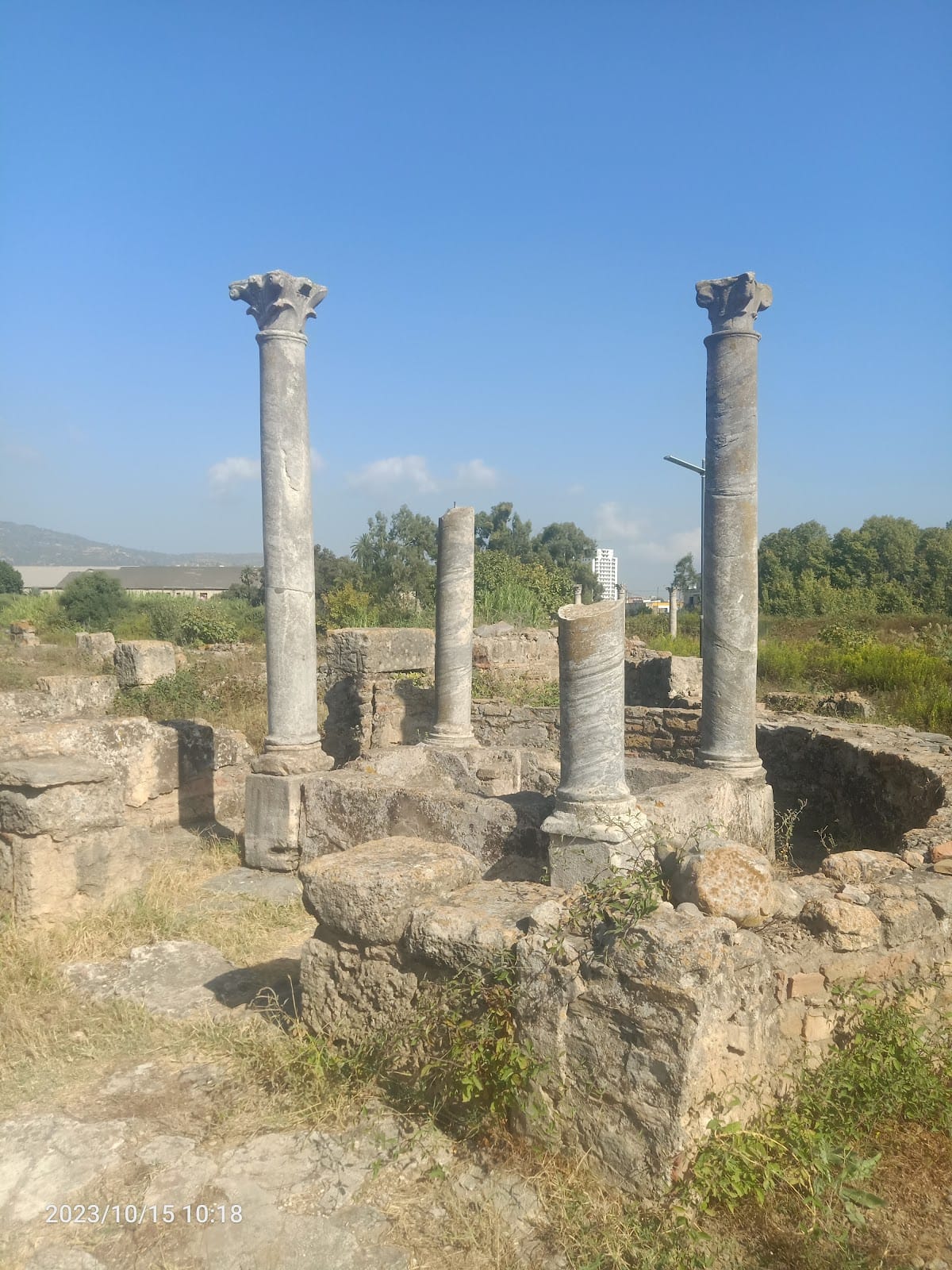
The macellum, a Roman market building arranged around shops and a central architectural or religious feature, was cleared in 1955. It had a square plan with shops on all sides, a colonnade, and a small circular central temple called a tholos. An inscription records restoration under Emperors Valentinian and Valens.
Garum installation
The garum installation was probably built in the first century AD. Its mortar is relatively rich in lime and poor in quartz and rock fragments, distinguishing it from mortars used in the forum, basilica, and Roman theatre. Samples from the installation are also more porous than those from several major civic buildings.
Baths and water supply
Bathing complexes
Approximately ten bathing complexes were distributed among Hippo’s districts, including two public establishments. The large northern baths retain substantial walls and have been assigned to the early third century in one architectural interpretation. Their frigidarium, the cold-water room of a bathing complex, covered approximately 450 square metres.
The baths have a complex building history. Their foundations are attributed to the reign of Caracalla, around AD 211–217, while their upper parts may belong to the fourth or fifth century. These later sections may reflect rebuilding or restoration. Thermal-bath mortar samples also point to repairs or changes in material supply that differed from the original construction phase.
Water system
An aqueduct and extensive water system supplied the city. Large cisterns constructed under Emperor Hadrian stored water, while channels carried supplies continuously to the baths and public fountains. Fountain outlets remain attested within the site. One public fountain was decorated with a Gorgon mask, a representation of a monstrous female figure from Greek mythology commonly shown with snakes for hair. The mask is now preserved in the Archaeological Museum of Algiers.
Christian and theatrical districts
Christian buildings
The Christian quarter includes the great Roman basilica and its ancillary buildings, together with the trefoil chapel. A basilica in the Roman and early Christian world was a large public or ecclesiastical hall. The Christian basilica at Hippo is associated with the fourth or fifth century, placing it within the period when the city served as a leading Christian center in North Africa.
Roman theatre
The Roman theatre forms part of the excavated theatrical district. It is assigned mainly to the first or second century AD. Mortars from the theatre contain more rock fragments and less lime than those from the garum installation and market, providing material evidence for differences in construction and repair practices across the city.
Construction materials and conservation
Hippo’s walls contain joint mortars made from natural lime and locally derived aggregates. These aggregates include quartz, feldspar, mica, plagioclase, fragments of rock, and smaller quantities of clay minerals. The sands probably resulted from marine erosion of the Edough Mountains, while some material was likely obtained directly from those mountains.
Four mortar groups were distinguished. The fine brownish-white M-I mortar has a lime-to-aggregate ratio of about 1:0.5 and contains quartz and metamorphic-rock grains, including quartz gneiss. Pinkish-white M-II has a ratio of about 1:1 and abundant feldspathic sand derived from crushed mica schist. A crustacean-shell fragment confirms the use of sea sand in this group.
Reddish-white M-III is a coarse mortar with a lime-to-aggregate ratio of about 1:2. It contains quartz, mica schist, feldspar, occasional plagioclase, fired-tile fragments, and clay minerals including kaolinite and dickite. Grayish-white M-IV has a ratio of about 1:3 and contains quartz, feldspar, clay minerals, and grains ranging from dust to approximately two millimetres.
The binders are relatively hydraulic, meaning that they can harden through reactions involving water. Most tested binders are moderately hydraulic, while another group is weakly hydraulic. The analyses found no definitive evidence for manufactured pozzolanic mortar. Fired-tile fragments and kaolinite, especially in thermal-bath samples, indicate the use of locally available tile-derived material comparable to the Roman testa tradition.
Measured real densities range from approximately 2.40 to 2.62 grams per cubic centimetre. Calcite proportions range from about 22 to 85 percent among the samples. Chlorine in the mortars indicates probable salt-related decay associated with sodium chloride carried by Mediterranean marine aerosols. High porosity and carbonation of the lime binder also affect the surviving mortar fabric.
