Hanshan Temple: A Historic Chan Buddhist Temple in Suzhou
Site at a Glance
- Rating
- 4.6
- Popularity
- Low
- Country
- China
- Primary era
- Early Modern
- External website
- Open
- Eras represented
- Medieval, Early Modern, Modern
- Civilizations
- Chinese, Qing
- Site type
- Religious
- Remains
- Monastery
On this page15 sections
History
Hanshan Temple is a Chan Buddhist temple of the Linji school in Fengqiao, west of Suzhou in Jiangsu, China. Traditionally founded during the Tianjian era of the Liang dynasty, around 502 to 519, it developed through repeated rebuilding into a temple closely associated with Tang poetry, Buddhist tradition, and the cultural history of the Grand Canal.
Foundation and Tang associations
The temple was traditionally established as the Miaoli Puming Pagoda Cloister during the reign of Emperor Wu of Liang. Its present name is associated with Hanshan, a semi-legendary Tang poet-monk. Tradition places Hanshan at the temple during the Zhenguan era, around 627 to 649, either as a hermit or as its abbot. Hanshan and Shide were also said to have arrived from Tiantai, and both became enduring figures in the temple’s religious tradition.
The main monastic complex is attributed to the Tang Chan master Shitou Xiqian and is dated to the eighth or ninth century. During a prosperous period, the grounds were reputedly so extensive that people said a rider could remain on horseback while still seeing the monastery gate. Travelers approaching Suzhou from the north were also said to visit the temple before entering the city.
Hanshan and Shide are remembered as unconventional poet-monks associated with the mountain monastery of Guoqing. Tradition says that Shide was found and raised there by the Chan master Fenggan. In religious interpretation, Hanshan represents Manjusri, the bodhisattva of wisdom, while Shide represents Samantabhadra, associated with practice and vows. Together with Fenggan, they are known as the Three Saints or Three Hidden Ones.
Song and later imperial rebuilding
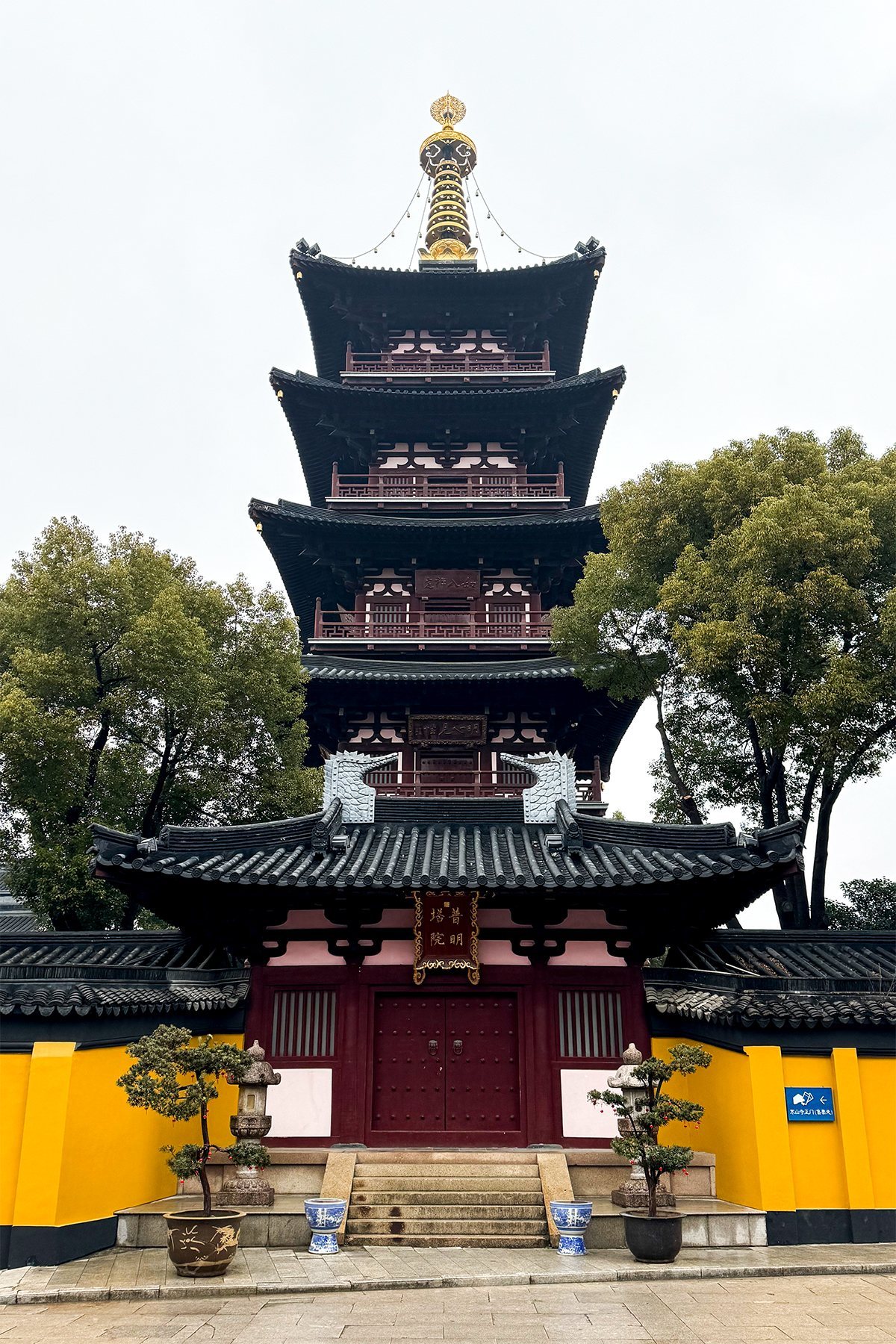
In the early Taiping Xingguo era, around 976, the military governor Sun Chengyou built a seven-story pagoda at the temple. During the Jiayou era, around 1056 to 1063, the institution was renamed the Puming Chan Cloister. The monk Faxuan rebuilt it in 1134.
The temple was burned in 1366 during fighting between Zhang Shicheng and Zhu Yuanzhang, rival military and political leaders during the transition from the Yuan dynasty to the Ming dynasty. Huizhen rebuilt it in 1369, but another fire later destroyed the complex. It was rebuilt again during the Zhengtong era by Wang Kuangzhong. During the Jiajing era, the monk Benji provided a newly cast bell and a bell tower. A further fire in 1618 destroyed the halls and other buildings.
Fire, reconstruction, and poetic fame
Further fires destroyed the temple in 1711 and 1860. The latter destruction took place during the Taiping Rebellion, a large civil war in nineteenth-century China. Reconstruction followed at the end of the Qing dynasty, and the present complex largely derives from work directed by the Qing official Cheng Dequan around 1906.
The temple’s fame is closely connected with Zhang Ji, a Tang poet and government official. His poem A Night Mooring by Maple Bridge describes a traveler hearing a temple bell from a boat at night. The poem made Hanshan Temple widely known in China, Japan, and Korea, and encouraged later poets to visit and write poems connected with the site.
The traditional identification of the poem’s temple with the present Hanshan Temple remains uncertain. Tang-period texts do not securely attest the name Hanshan Temple. An early collection gives the poem’s title as Night Mooring on the Song River, while the phrase Hanshan Temple may originally have referred to a temple on a cold mountain rather than to a proper name. The poem’s exact setting therefore remains unresolved.
The poem’s midnight bell also prompted debate. The Song scholar Ouyang Xiu questioned whether bells were rung at night, but other Tang poems refer to bells sounding at midnight. Bells were also used during the Tang dynasty to announce the time, so the image belongs to a known practice even though the poem’s precise circumstances remain uncertain.
Modern survival and religious revival
A bell traditionally linked with the Tang period had disappeared long before the modern temple was rebuilt. The bell cast by Benji during the Jiajing era, together with its bell tower, was lost between the late sixteenth and early seventeenth centuries. During the late Qing reconstruction, a large bell was cast in China around 1906. A second bell was cast in Japan after the earlier bell could not be located and was donated to Hanshan Temple in 1914. Its inscription was composed by Itō Hirobumi, Japan’s first prime minister.
Claims that the original Tang bell had been taken to Japan caused controversy in China and Korea, but the original bell has not been found. The temple escaped destruction during the Second Sino-Japanese War. During the Cultural Revolution, from 1966 to 1976, its images, ritual implements, halls, and collections were damaged or confiscated. The complex became severely derelict and was used for revolutionary administrative and detention purposes. The monk Xingkong took measures that helped protect inscriptions, scriptures, and the Arhat images.
Repairs began in 1978, after which the temple reopened. In 1980 it became one of the first nationally designated temples in China permitted to resume public religious activity. Further renovations followed the establishment of the People’s Republic of China, with continuing rebuilding, expansion, and repairs during the reform period. The temple became a Jiangsu Provincial Cultural Relic Protection Unit in 1982.
A New Year’s Eve bell-listening observance began in 1979 and continues as an expression of the temple’s religious and cultural identity. The bell is traditionally associated with blessings and with the belief that hearing it makes the listener ten years younger.
Remains
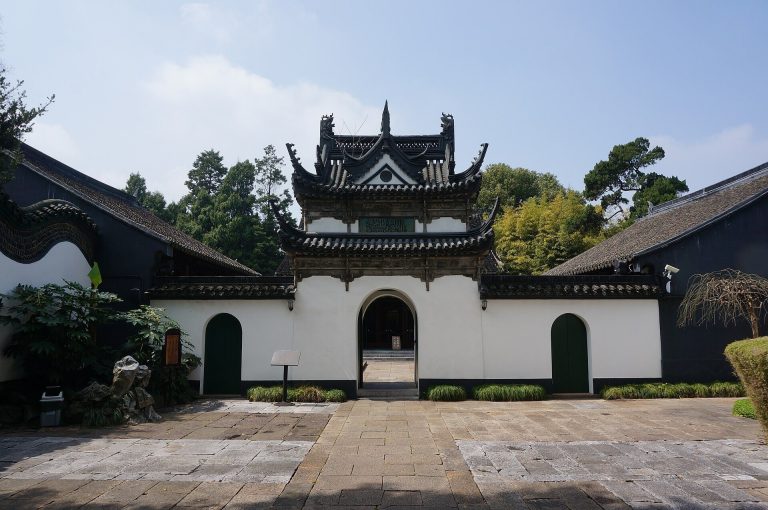
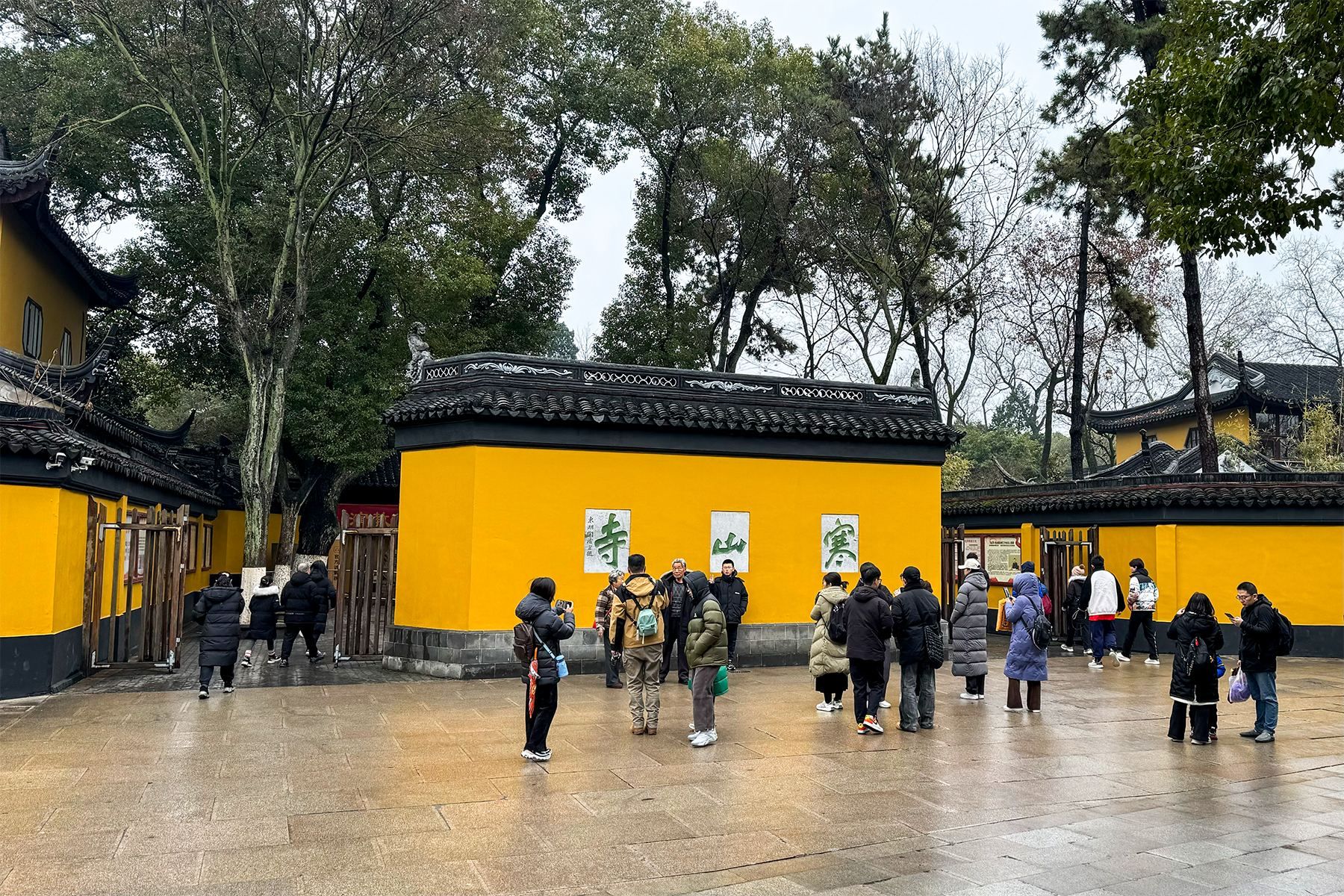
The present temple is arranged on an east-west axis in Fengqiao, facing west toward the ancient canal. Its precinct is elongated from east to west. A yellow screen wall marks the western entrance, while the Mahavira Hall occupies the central part of the complex. The bell tower, bell chamber, Arhat Hall, and Stele Corridor are arranged around it. Hanshan-Shide Hall lies to the east, and Puming Pagoda stands at the eastern end. Most surviving buildings date from the late Qing reconstruction or from later rebuilding and repair.
Temple buildings and inscriptions
Mahavira Hall and associated halls
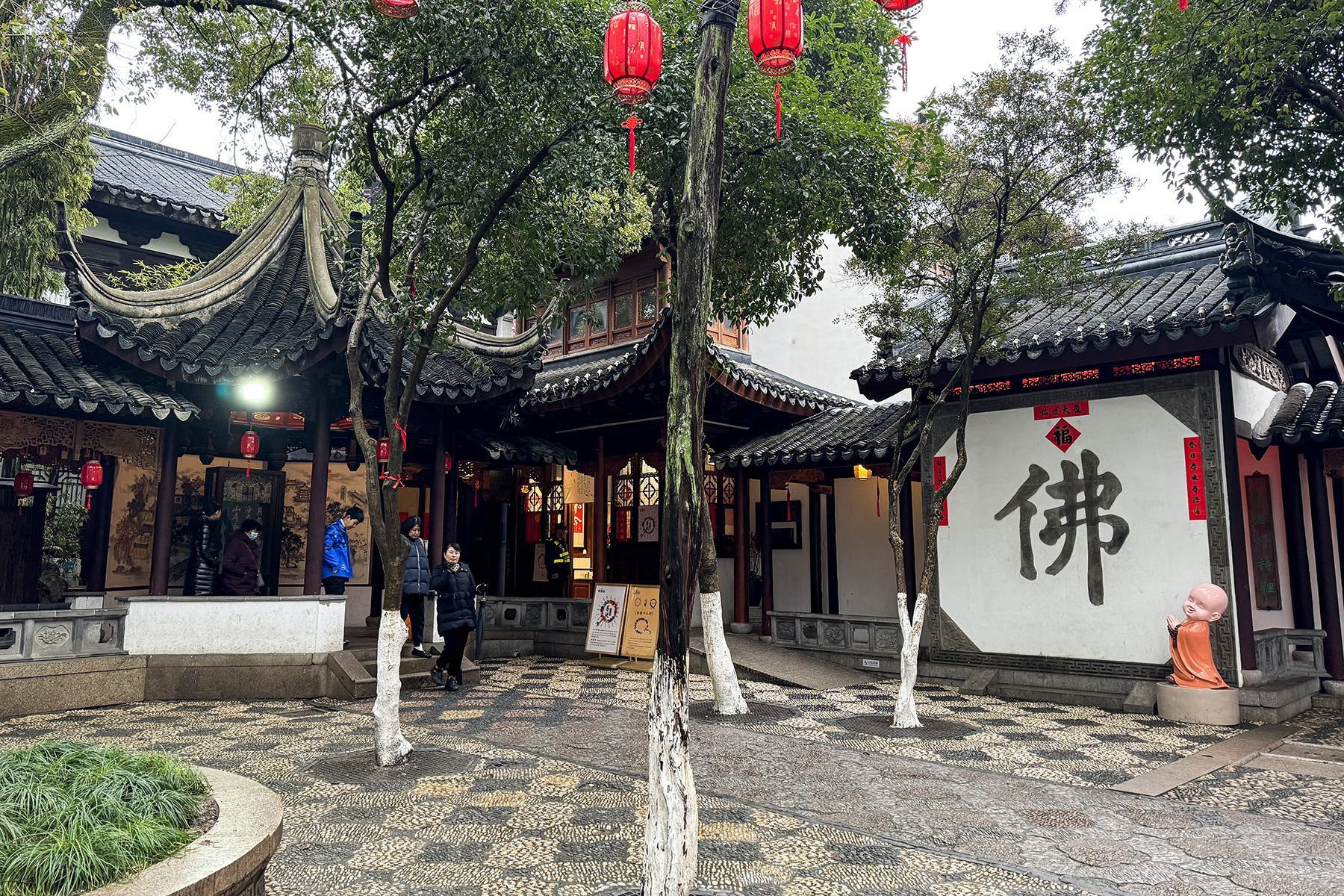
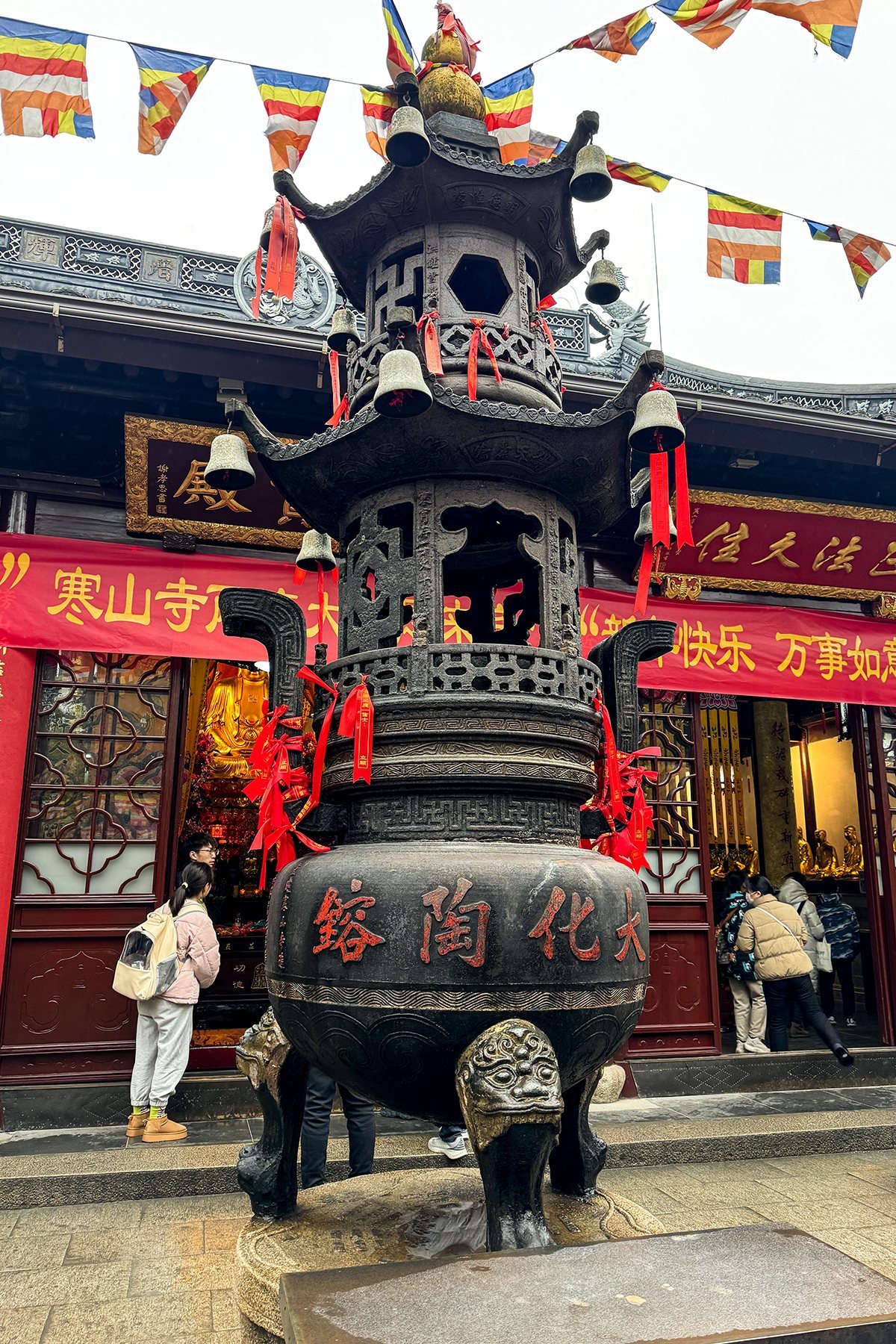
The Mahavira Hall is the principal image hall of the temple and forms the center of the present complex. Around it are the bell tower, bell chamber, Arhat Hall, and Stele Corridor. The Arhat Hall houses representations of the Buddha’s enlightened disciples. Hanshan-Shide Hall, devoted to the two poet-monks remembered in temple tradition, stands east of the central hall. The precinct also contains Buddhist images, ritual objects, Buddhist scriptures, a scripture-storage building, and a stone-carved representation of Hanshan and Shide.
Stele Corridor
The Hanshan Temple Stele Corridor includes a special room for historical stone inscriptions and their rubbings. Among the important inscriptions are versions associated with Wen Zhengming, Yu Yue, and Liu Haisu. A stone stele bearing Zhang Ji’s A Night Mooring by Maple Bridge is associated with the temple. Wen Zhengming wrote the Ming-period version, and Yu Yue recut it in 1906 after deterioration had affected the earlier inscription. Yu Yue’s recut stele remains within the temple precinct.
Temple bells
Early twentieth-century bells
A Chinese bell cast around 1906 is approximately 1.3 meters high, 1.24 meters in diameter, and two metric tons in weight. It is traditionally said to resonate for about 42 seconds. A Japanese-cast bell from the same period stands to the right of the Mahavira Hall and bears an inscription composed by Itō Hirobumi.
Later bells and bell pavilion
Another bell made in 1986 is approximately 2.25 meters high, 1.5 meters in circumference, and 2.5 metric tons in weight. The bell-maker Li Jiren modeled it on Tang-period bells, using records from the Big Bell Temple in Beijing.
A monumental bronze bell commissioned in 2005 and completed around 2007 was cast in Wuhan. It is approximately 8.5 meters high, 5.2 meters in maximum diameter, and 108 metric tons in weight. Its surface bears the words “Ancient Hanshan Temple” and the text of the Lotus Sutra. The bell is housed in a specially constructed pavilion.
Bridges, canal, and historic surroundings
Fengqiao and Jiangcun Bridge
Fengqiao lies about 100 meters north of the temple. It is a stone arch bridge at the junction of Fengjiang and the Beijing-Hangzhou Grand Canal. The bridge was formerly written with a different character for “Feng,” and tradition holds that its name was changed because Zhang Ji’s poem made the present form famous. It is not open to motor-vehicle traffic.
Jiangcun Bridge stands near the southern gate and forms part of the approach used by many pilgrims. Jiangcun Bridge and Fengqiao are collectively called the Ancient Jiang and Feng Bridges. Their histories are traced to the Tang period, although the present bridges were repaired during the Tongzhi era of the Qing dynasty.
Iron Bell Pass and canal setting
The Iron Bell Pass stands beside Fengqiao outside the temple precinct. Built during the Jiajing era, it is described as the only surviving fortified pass among several formerly associated with Suzhou. The Beijing-Hangzhou Grand Canal passes by the temple area and connects Fengqiao with the wider water-transport network linking northern China, Suzhou, Hangzhou, and the route toward Yangzhou and Luoyang.
The historic townscape formerly extended along Fengqiao Street and Hanshan Temple Lane. Later tourist redevelopment substantially altered and reduced the old streetscape, while the temple, bridges, canal setting, inscriptions, and surviving structures continue to preserve the site’s layered historical character.