Hadži Sinan Tekke: An Ottoman Sufi Lodge in Sarajevo
Site at a Glance
- Rating
- 4.7
- Popularity
- Medium
- Country
- Bosnia and Herzegovina
- Primary era
- Early Modern
- Eras represented
- Early Modern
- Civilizations
- Ottoman
- Site type
- Religious
- Remains
- Sufi Lodge
On this page10 sections
History
Hadži Sinan Tekke is a tekke, or lodge for Sufi dervishes, in Sarajevo, Bosnia and Herzegovina. Built between 1638 and 1640 for the Qadiriyya, a Sufi order within Islam’s mystical tradition, it dates to the period of Ottoman rule. The Ottoman Empire was a dynastic state centered in Anatolia that ruled much of southeastern Europe, western Asia, and North Africa for centuries. The tekke is the sole survivor of the seven once in Sarajevo and is regarded as the city’s last significant monument of Ottoman architecture.
Foundation and early role
A traditional account links the project to the Ottoman capture of Baghdad in 1638. Murad IV, an Ottoman sultan interested in Sufism, is said to have planned to support a Qadiri lodge in gratitude for the victory. Baghdad was home to the tomb of Abdul-Kadir Gejlani, a Muslim teacher and mystic traditionally considered the founder of the Qadiriyya. Patronage is associated either with Hadži Sinan, a wealthy Sarajevo merchant, or with his son Mustafa Pasha Silahtar, a senior official at the sultan’s court who held the office of sword-bearer.
In the foundation story, Mustafa proposed Sarajevo for a Qadiri lodge, and an imperial decree tasked Hadži Sinan with overseeing its construction. Hadži Sinan first purchased land at Bistrik, on the left bank of the Miljacka River. A dream, according to local tradition, led him to choose a site on the opposite bank instead, at Pirin Brijeg in the Vrbanjuša quarter. The lodge was designed by Kasim-aga, an Albanian architect who also designed buildings at Topkapi Palace. Hadži Sinan died before work was complete; Mustafa paid for the remaining construction, and the tekke was finished in 1640, the year of Hadži Sinan’s death. Official documents also refer to it as Silahdar Mustafa Pasha’s Tekke.
The lodge served dervishes and provided a setting for learning about Sufism and reading works in Persian, Turkish, and Arabic. Its sheikhs, or spiritual leaders, and dervishes also composed poetry. Sheikh Hasan Kaimija Zrinović, a Bosnian Sufi poet and religious figure, became its best-known poet.
Later uses and the neighboring mosque
In 1768, the tekke was adapted as an asylum for people with mental-health problems. It is described as the first institution of this kind in Bosnia and Herzegovina and as an early step in organized health care among Muslims there. The building burned during a military campaign by Eugene of Savoy, a Habsburg commander, and again during the Austro-Hungarian occupation of Sarajevo.
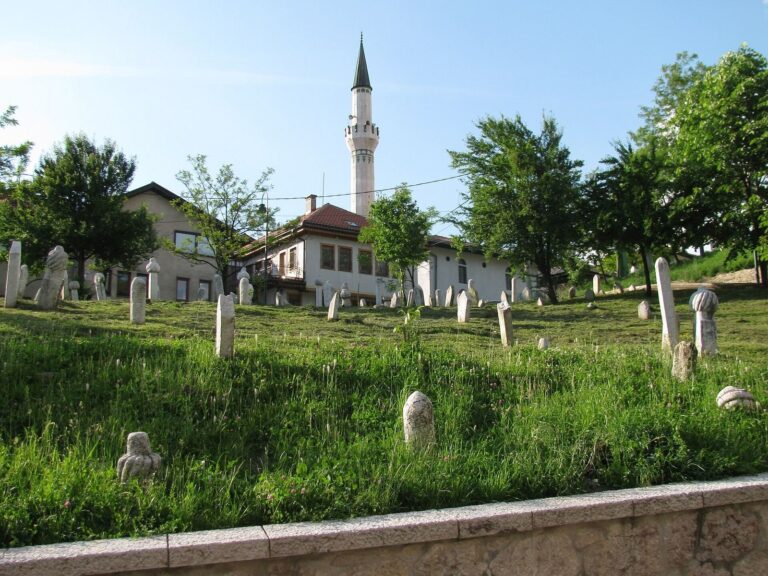
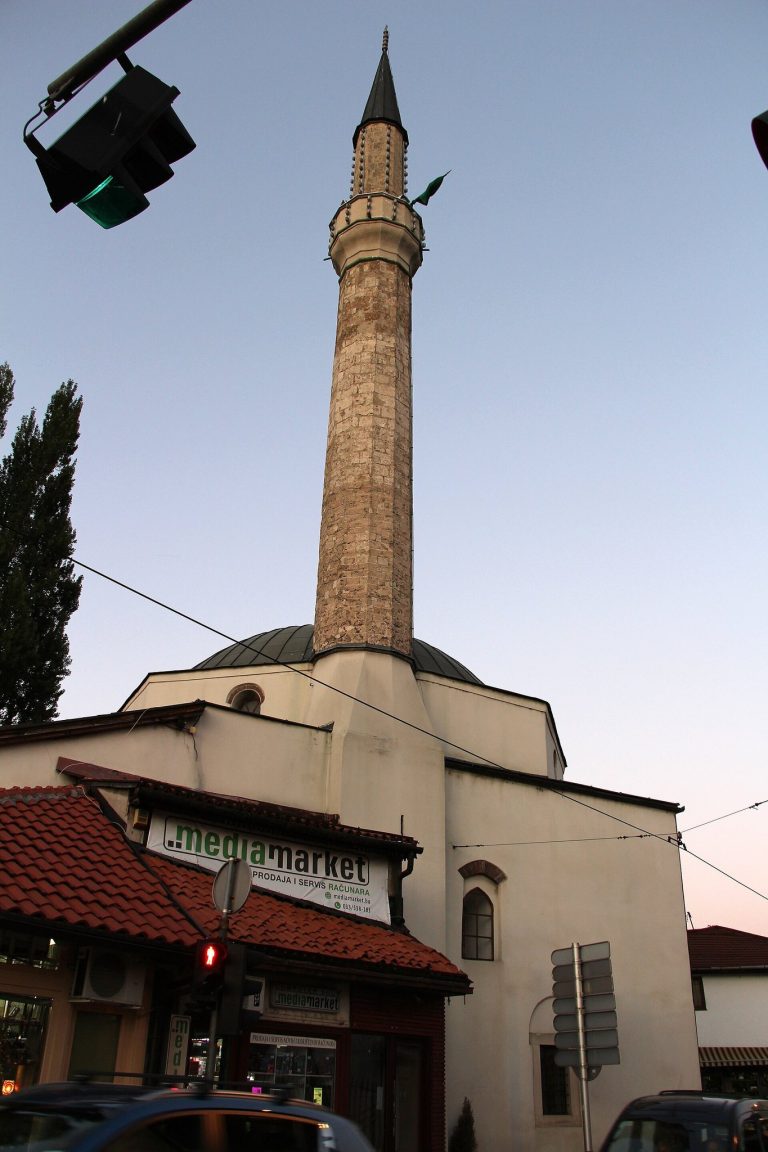
Sarač Alijina Mosque, beside the tekke, is first mentioned in 1528. Its founder was a saddler. The mosque was damaged during Eugene of Savoy’s 1697 incursion and again in 1878, when Austro-Hungarian troops entered Sarajevo.
Closure and revival
In March 1952, the Council of the Ulema, a council of Islamic scholars, and the Waqf Council, which administered religious endowments, closed active tekkes within their jurisdictions. Tekke activity began to return in the early 1980s. Some activities of Bosnia and Herzegovina’s Tarikat Center, an institution for Sufi orders, took place at Hadži Sinan Tekke, and lectures on Islamic doctrine began there shortly before the 1992 war. In 2005, the tekke, Sarač Alijina Mosque, and their cemetery were declared a National Monument of Bosnia and Herzegovina.
Remains
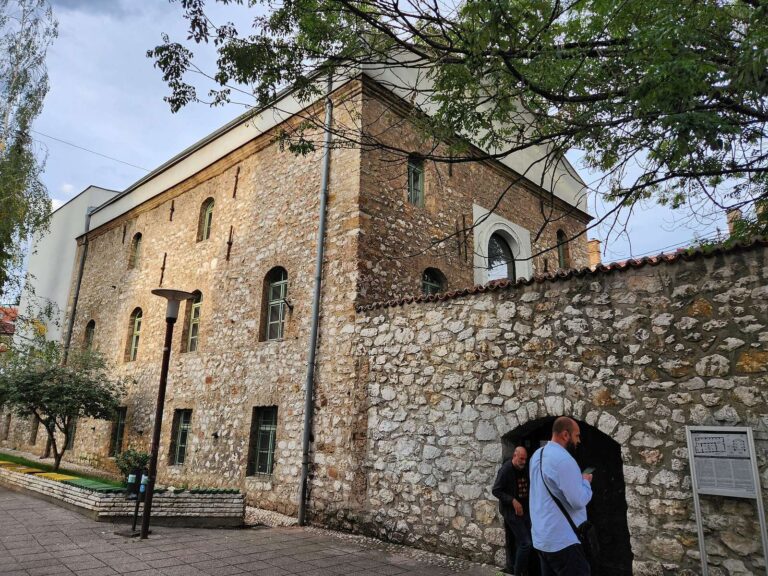
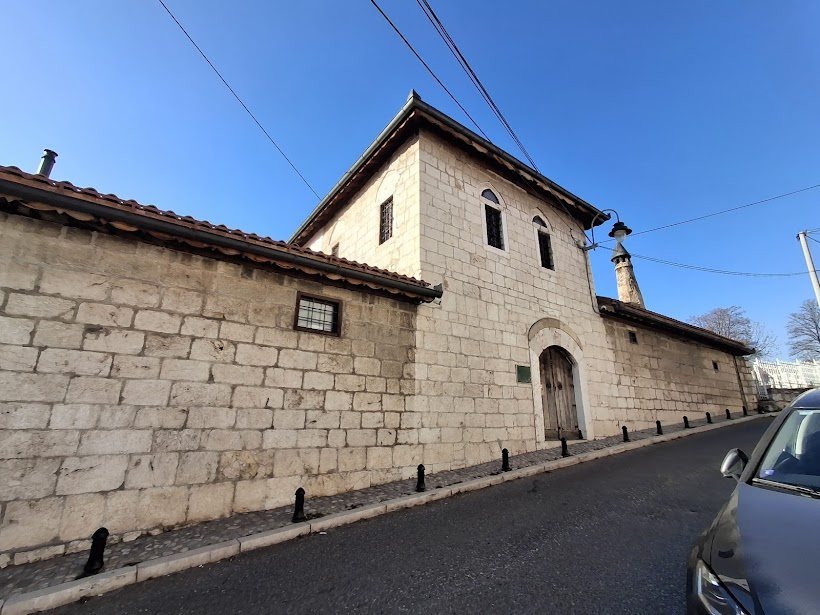
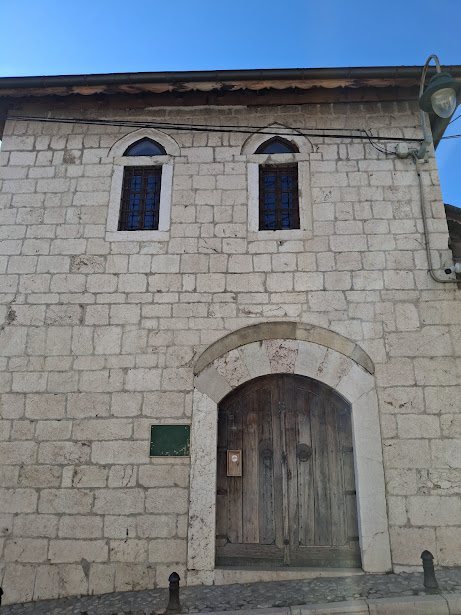
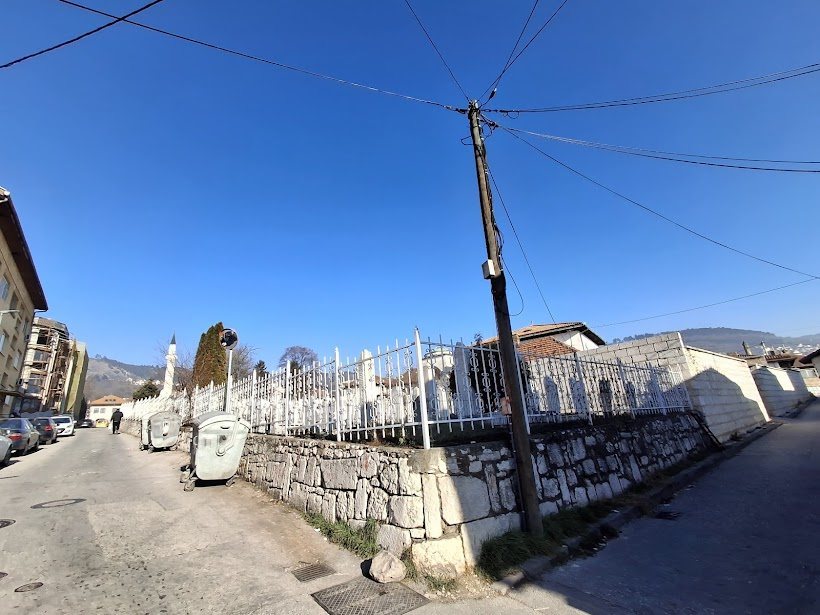
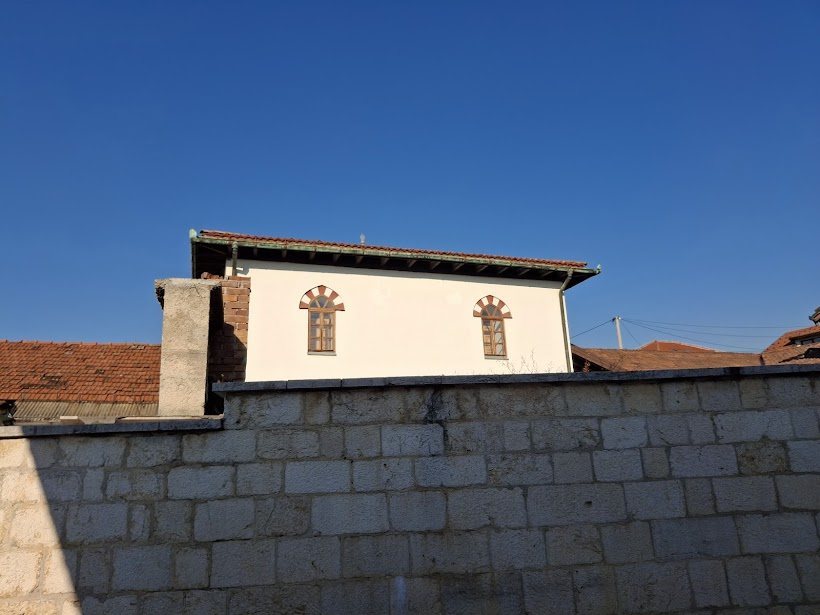
The complex stands in Sarajevo’s Vrbanjuša quarter, between Sagrdžije, Alija Đerzeleza, and Logavine streets. Its L-shaped plan is enclosed by high stone walls and organized around a spacious courtyard. The buildings use dressed and rubble stone beneath multi-pitched, ceramic-tiled roofs. The tekke has an east-facing entrance on Sagrdžije Street, connected to the courtyard by a stone-paved passage.
The lodge building
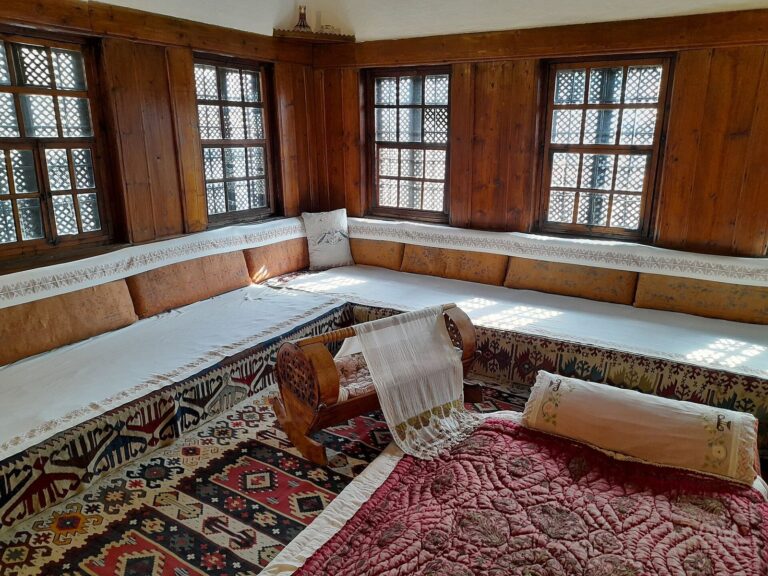
The lodge contains a semahana (ceremony room), with a mihrab (niche marking the direction of prayer) and a musander (built-in wooden furnishing, often with cupboards). Other rooms include accommodation for travelers, a meeting room, a kitchen, and a coffee room. A narrow corridor separates the meeting room from the coffee room. The sheikh’s residence is above the entrance; the space above the entrance and the ceremony room are two storeys high, while the rest of the building is single-storey. The exterior has regularly laid ashlar stone, with projecting joints, while plaster covers roughly dressed surfaces. After restoration, the tekke is in very good condition and retains almost the same appearance as in 1640.
Courtyard and decoration
Fountain and tombs
A charitable public fountain stands at the courtyard entrance. The courtyard also contains two graves and a mausoleum associated with Hadži Sinan and his wife. A women’s house forms part of the architectural complex.
Calligraphic decoration
More than a hundred calligraphic panels decorate the entrance and courtyard areas. Made during the eighteenth century in several forms of Arabic script, they include a courtyard-wall design nearly three metres across. Painted on plaster, its rosette presents the shahada, the Islamic profession of faith, twelve times in Kufic, a formal style of Arabic script. Known as the “Seal of Solomon,” the design’s twelve repetitions represent the twelve Sufi orders conveying the unity of God; the seal itself represents the movement of the cosmos around God. A smaller version appears at the entrance.
Sarač Alijina Mosque and cemetery
The nearby mosque is a single-room building with an open portico, a stone minaret, and a multi-pitched roof. Its elongated rectangular structure measures 12.55 by 11.90 metres; the interior is 5.34 metres high from floor to flat ceiling, and the minaret, including its finial, is about 27.50 metres tall. An inscription above the entrance records repairs in 1892. The mosque complex also includes auxiliary buildings, a fountain, and an enclosing courtyard wall. A cemetery lies between the mosque and the tekke.