Gungnae: An Ancient Goguryeo Capital in China
Site at a Glance
- Popularity
- Very High
- Country
- China
- Primary era
- Classical
- Eras represented
- Classical, Modern
- Civilizations
- Goguryeo, Han
- Site type
- City
On this page8 sections
History
Gungnae was an ancient city of Goguryeo, a Korean kingdom, in China. It became the kingdom’s capital in AD 3 and remained a central seat of power through repeated moves between nearby centers and the transfer to Pyongyang in AD 427.
Early city and capital
King Yuri selected Gungnae in the tenth month of AD 3, moving the capital from a mountain fortress in what is now Huanren County, Liaoning. A defensive wall of earth had already been built at the site, during a period extending from the late Warring States era to the early Western Han, when the area belonged to the Han dynasty’s Xuantu Commandery, a regional administrative district.
When Gungnae became the capital, Goguryeo also established a separate mountain stronghold to help defend the city. King Sansang enlarged the fortress in AD 209, after which it became known as Hwando Mountain City. Gungnae was sacked several times. During the reign of Gwanggaeto the Great, Goguryeo expanded its territory and grew into a formidable power in northeast Asia.
Capital relocations and continued importance
King Dongcheon moved the capital to a place called Pyongyang in AD 247. In AD 342, the capital shifted to Hwando. A few months later, the Chinese state of Former Yan attacked and burned Hwando. King Gogukwon moved the capital again, to East Hwangseong of Pyongyang, in July of the following year.
The location of these early places called Pyongyang remains uncertain. The name may have referred to a Goguryeo city near present-day Ji’an, rather than the modern city of Pyongyang. After Hwando was destroyed, Gungnae may have been repaired and renamed Pyongyang. Another possibility is that Pyongyang and Hwando were fortified satellite cities linked to Gungnae. King Jangsu, who succeeded Gwanggaeto in AD 413, moved the capital to Pyongyang in AD 427, but whether this was modern Pyongyang, a nearby fortified settlement, or the same urban center is also uncertain. Confusion between the places is connected with a further capital move in AD 586.
Despite the transfer in AD 427, Gungnae continued to serve as a political, economic, and cultural center. It later functioned as a secondary capital, an additional seat of government, and was counted among Goguryeo’s three capitals.
Goguryeo’s fall and later rule
In AD 666, General Yŏn Namsaeng, son of the prominent Goguryeo leader Yŏn Kaesomun, surrendered Gungnae to the Silla–Tang alliance, a military partnership between the Korean kingdom of Silla and China’s Tang dynasty. Goguryeo fell in AD 668. Tang forces captured Pyongyang and took King Bojang and Yŏn Namgŏn into custody.
After the kingdom’s fall, Gungnae became the seat of Gomul Prefecture within the Tang dynasty’s Andong Protectorate, a military-administrative jurisdiction. Under Balhae, it belonged to Huan Prefecture within the regional center called the Western Capital; it remained part of Huan Prefecture under the Liao dynasty. In 1902, after Ji’an became a county during the Qing dynasty, Gungnae came under its administration.
Gungnae and the Old City of Hwando received a national-level protected ancient-site designation in China in 2001. In 2004, Gungnae was included with Hwando Mountain City and Onyeosan City in the UNESCO World Heritage property Capital Cities and Tombs of the Ancient Koguryo Kingdom.
Remains
The 59.24-hectare site lies on the Tonggou Plain, north of the middle Yalu River. Mount Yushan is to its north, Mount Long to its east, and Qixing Mountain to its west. The roughly square city was enclosed by stone walls, which archaeological evidence distinguishes from the earlier earthen defensive wall.
City enclosure
Stone walls
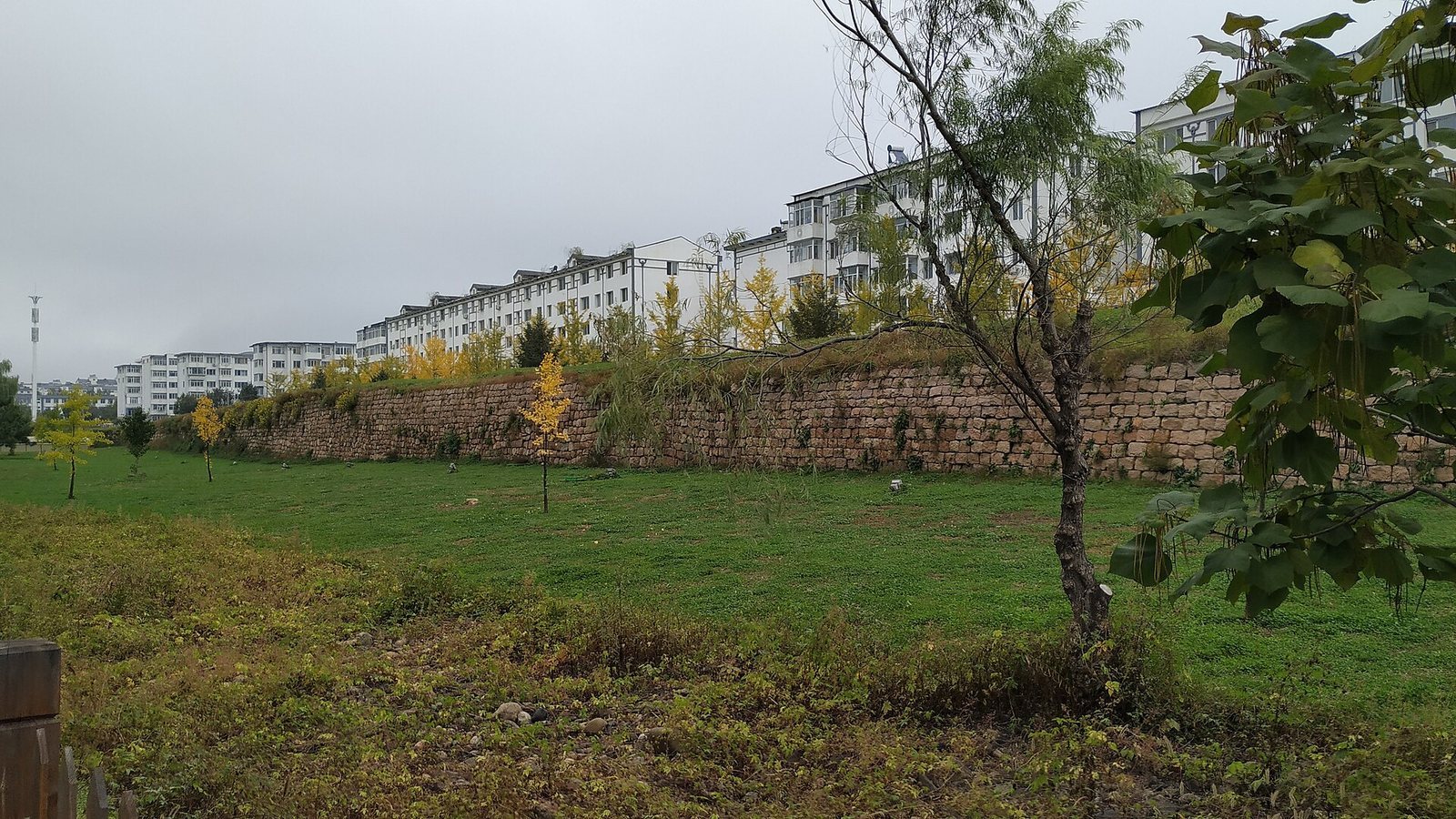
The enclosure has a perimeter of about 2.7 kilometres. Its east wall is 514 metres long, the west 699 metres, the south 749 metres, and the north 779 metres. Surviving sections are 7 to 10 metres wide and reach 3 to 4 metres in height.
Gates
The enclosure originally had six gates: one in each of the north and south walls, and two in each of the east and west walls. In 1921, the east, west, and south gates were renovated, while the three remaining entrances were blocked.