Frösö Church: A Medieval Parish and Pilgrimage Church in Sweden
Site at a Glance
- Popularity
- Medium
- Country
- Sweden
- Primary era
- Medieval
- Eras represented
- Medieval, Early Modern, Modern
- Civilizations
- Norwegian, Swedish
- Site type
- Religious
- Remains
- Church
On this page9 sections
History
Frösö Church is a 13th-century church on Frösön in Sweden and serves as the parish church for Frösö, Sunne and Norderö in the Diocese of Härnösand within the Church of Sweden.
Earlier churches and pilgrimage
Before Frösö Church, the parish probably had a farm chapel at Västerhus, several kilometres to the west. This timber church, known as Västerhus Chapel, was probably erected in the mid-11th century and later replaced by a small Romanesque stone church. Romanesque is a medieval style associated with rounded forms and substantial masonry. The stone church had a nave (the main congregational space) and a narrower choir (the area near the altar). Frösö Church and the Västerhus church were probably used at the same time until the late 14th century.
Excavations beneath the choir in 1984 led archaeologists to interpret the church’s location as an earlier pagan cult site, probably an offering grove where animal sacrifices were hung. Frösö Church also served as a medieval pilgrimage church associated with St Olav’s Way, a route linked to the veneration of Olav the Holy, a Norwegian king later revered as a saint. A long-standing tradition holds that St Bridget of Sweden, a 14th-century religious visionary, passed through Frösön on pilgrimage to Olav’s tomb in Trondheim.
Fire, rebuilding, and later cultural ties
The medieval church was remodelled in the 18th century. In 1898, a fire broke out while a lightning conductor was being soldered to the roof. The insurer had required the conductor as a condition of insuring the church for a higher value. The fire reduced the building to its walls, but its furnishings were saved. The church was partly rebuilt to resemble its earlier appearance, and renovations in 1929–1930 further emphasized its 18th-century form, itself shaped by changes to the medieval building.
Composer Wilhelm Peterson-Berger is buried beside the church, near his home at Sommarhagen. The surrounding area inspired his popular music, including pieces in the Frösöblomster collections, such as Vid Frösö kyrka and Sommarsång.
Remains
Church building and extensions
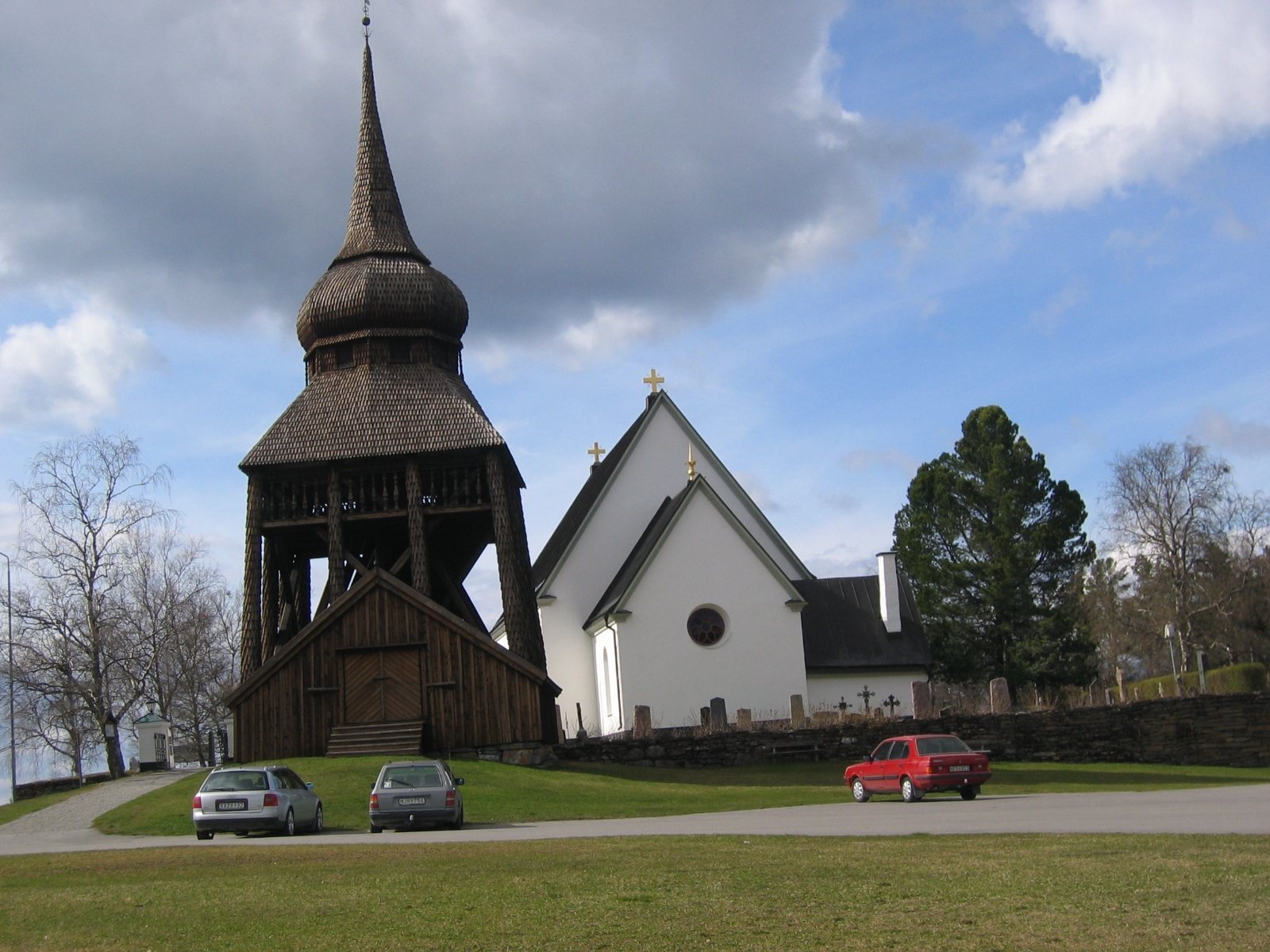
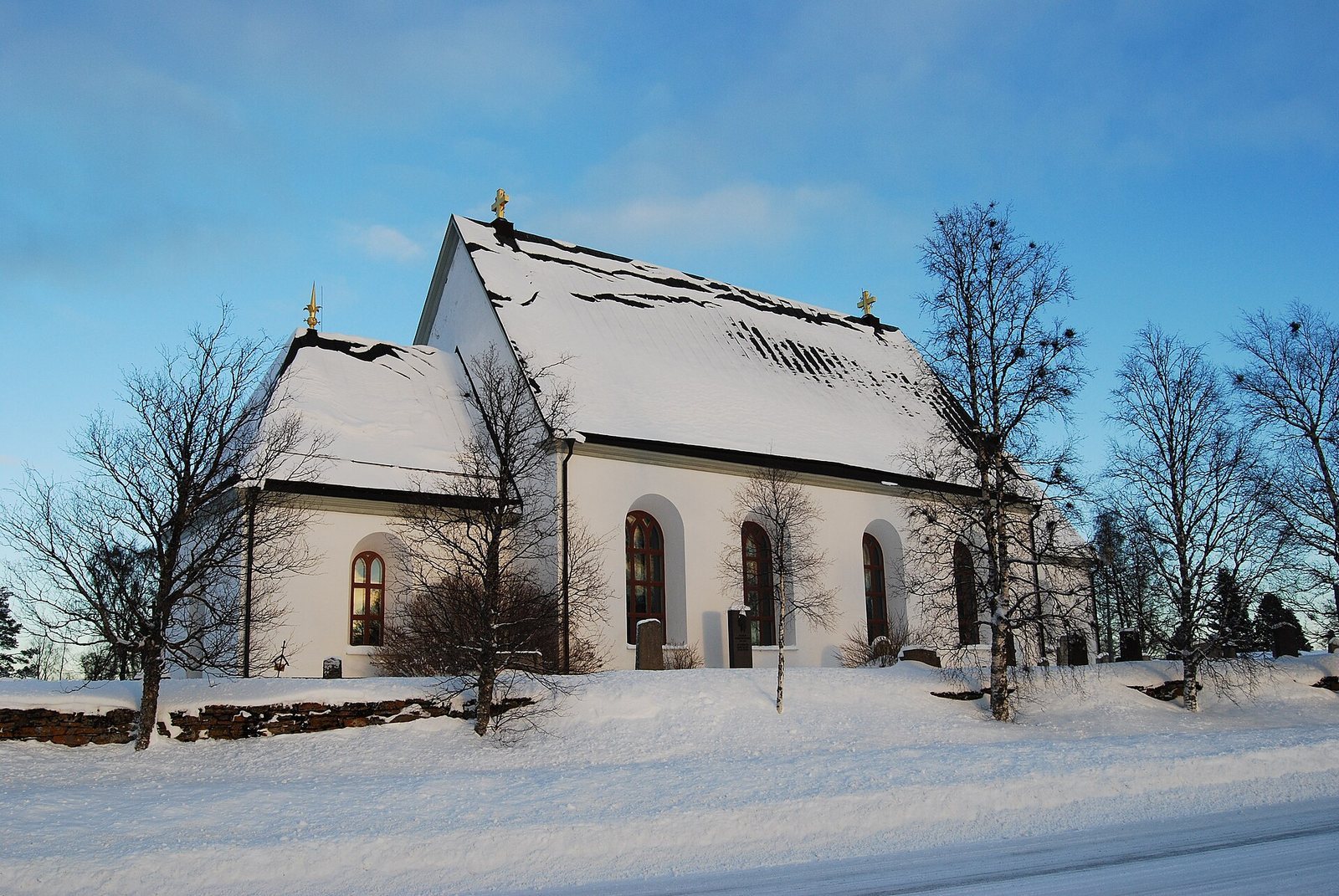
The church follows a medieval plan, with a nave and a narrower choir ending in a straight east wall. Its substantial medieval tower was partly demolished during the 18th-century remodelling, and the surviving lower section now serves as the entrance porch. Windows and doors were enlarged or moved, and new openings were made. An extension added around 1970 lies between the sacristy (a room for clergy and church furnishings), choir, and nave. Another, added around 1984, stands on the north side of the porch.
Bell tower and bells
The freestanding bell tower was built in 1754 by Pehr Olofsson of Dillne village in Ovikens parish. A storage room occupies its base. Above it, twelve shingled posts support an octagonal shingled roof, topped by a shingled onion-shaped dome and spire. The large bell, known as St Bridget’s Bell, bears a casting mark indicating it was cast in Stockholm in the 14th century. The smaller bell dates to the 18th century and was recast in 1749.
Furnishings and images
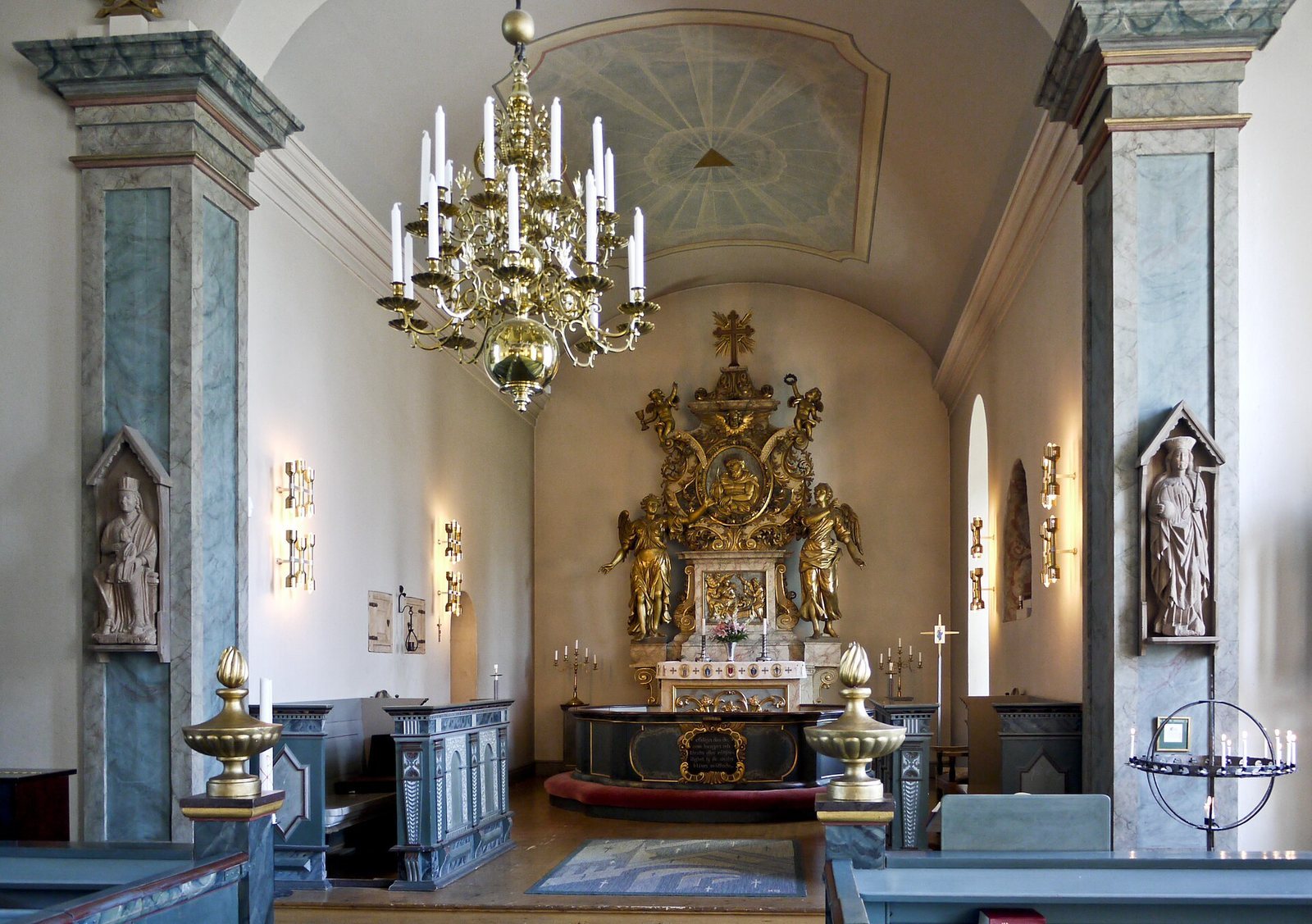
A limestone baptismal font was given to the church in 1698 by Captain Treffenberg and his wife. The altar arrangement, including its altarpiece, dates to 1708, and the altar rail was added in 1778. The Rococo pulpit, in an ornate 18th-century European style, was made in 1781 by sculptor Johan Edler the Elder. A 13th-century reliquary casket, a container for sacred relics, is kept in the choir, alongside images of the Virgin Mary and Olav the Holy.
Organ
The church’s first organ was made by Johan Gustaf Ek of Torp in Medelpad and inaugurated in 1857. It was rebuilt several times, most recently in 1951 by the Danish firm Marcussen & Søn. The instrument has 27 stops, each a set of pipes producing a particular tone, and 1,772 pipes.
Archaeological evidence beneath the choir
Excavations uncovered the remains of a decomposed tree stump surrounded by animal bones. These included bones attributed to five or six brown bears, as well as wild boar, moose, sheep and/or goats, cattle, red deer, squirrels, and horses. Fragments from domestic fowl, capercaillie, salmon, and pike were also present, and young animals predominated among the domestic species. Carbon in soil around the bones was dated to 920 ± 140 CE. Wood from the stump’s roots was dated to 1060 ± 75 CE, probably the time when the tree died.