Grotte du Renne: A Prehistoric Archaeological Cave in France
Site at a Glance
- Popularity
- Medium
- Country
- France
- Primary era
- Stone Age
- Eras represented
- Stone Age
- Civilizations
- Unclassified
- Site type
- Domestic
- Remains
- House
On this page17 sections
History
Grotte du Renne is a prehistoric cave at Arcy-sur-Cure, France, with successive occupations extending from the Mousterian, a Middle Palaeolithic tradition commonly associated with Neanderthals, to the Gravettian, an Upper Palaeolithic tradition. Its deposits make it a key reference site for the Châtelperronian in northern France and the Gravettian in the Paris Basin. It is also the only well-preserved Aurignacian deposit known in the Paris Basin.
Discovery and excavation
French speleologist Pierre Poulain discovered the cave in 1939. André Leroi-Gourhan and his team worked at the Arcy caves from 1946 to 1963, beginning their study of Grotte du Renne in 1949. Most excavation took place between 1956 and 1961. Part of the cave was closed for 50 years to protect its well-preserved deposits for future research. In 1992, the cave was included in a group of 16 caves, cavities and galleries at Arcy listed together as a French historic monument.
Leroi-Gourhan’s 1961 classification grouped 14 horizons into seven broad periods. A later system recognized 15 archaeological levels and 11 successive cultural groups. The levels preserve a sequence of occupation and deposits from the Mousterian through the Gravettian, followed by later horizons.
Mousterian occupations
The oldest cultural occupation is the Typical Mousterian in level XIV. Mousterian activity continued in the denticulate levels XII and XI, where denticulate tools have toothed or serrated edges. Level XII is dated to about 37,500 plus or minus 1,600 to 34,600 plus or minus 850 years BP. BP means before present, conventionally counted from 1950. Dates for level XI differ sharply: some determinations fall between about 33,700 and 31,520 BP, while a 2012 series places it between about 47,680 and 44,800 BP.
Pollen evidence points to an interval between level XI and the overlying Châtelperronian deposits. The beginning of the Cottés interstadial, a relatively warm interval within a glacial period, is consistently represented near the top of level XI, while later parts of that warming appear only sporadically.
Châtelperronian and the Neanderthal debate
The Châtelperronian is a transitional tradition between Middle and Upper Palaeolithic industries. It occupies levels X, IX and VIII in a sequence more than a metre thick. A 2012 dating placed level X at about 45,000 BP and level VIII at about 41,000 BP. The association of Neanderthal remains with ornaments and other Châtelperronian objects at Grotte du Renne became central to debate over whether Neanderthals made objects with symbolic meaning.
Dating tests in 2010 on 31 objects from level X found that roughly one-third did not fit the expected period. Three objects assigned to level X dated to about 21,000 years ago; two objects attributed to level VIII appeared to belong to level VII. A notched reindeer ankle bone from level IX dated to about 32,000 years ago and was judged to have been displaced, while four other objects also suggested movement between deposits. A horse tooth from level X dated to about 48,000 years ago and may have been older Mousterian material disturbed when occupants dug or levelled floors. An awl dated to about 38,000 years ago is among the oldest known in Europe; another, dated to about 37,000 years ago, came from level XII but was found in an area disturbed by Châtelperronian activity.
These results raised questions about whether the ornaments were deposited with Neanderthals. Later arguments noted that two-thirds of the tested objects remained correctly assigned and cautioned against assuming that disturbance affected every deposit. Human remains from the relevant layers were subsequently dated to about 44,500 to 41,000 years ago, and analyses published in 2016 supported the association between Neanderthals and the Châtelperronian assemblage.
A Neanderthal man’s right upper jaw, found in 2008 in the collapsed former entrance, belonged to an individual estimated to have been 35 to 40 years old. Small punctures are consistent with carnivore teeth, and hyenas probably consumed his body. Two isolated teeth found nearby belonged to a young adult and a child. In 2016, researchers identified 28 further Neanderthal remains associated with the Châtelperronian using dating and protein analyses. In 2023, they identified 76 Neanderthal fossils from level X among material excavated in 1949, 1963 and 1976. A separate study that year proposed that a pelvic bone from an infant might belong to an early modern human; its identity remains uncertain.
Aurignacian occupation
The Aurignacian, an Upper Palaeolithic tradition, is represented by level VII. Dating estimates for its lower part do not readily agree. One 2012 series placed the Proto-Aurignacian, an early Aurignacian phase, between about 36,210 and 31,140 BP; another gave dates of about 41,470 to 39,970 BP for level VIII and the lower part of VII.
Gravettian occupation
Gravettian activity is represented by levels VI, V and IV, with most material coming from level V. Bone tools from Grotte du Renne and nearby Grotte du Trilobite are broadly dated to about 33,000 to 24,000 BC and are rare in the Paris Basin. The two caves produced different mixes of finds: tools are more numerous at the Trilobite, while weapons are more numerous at the Renne. This difference may reflect distinct activities or periods of occupation.
Remains
Cave form and archaeological deposits
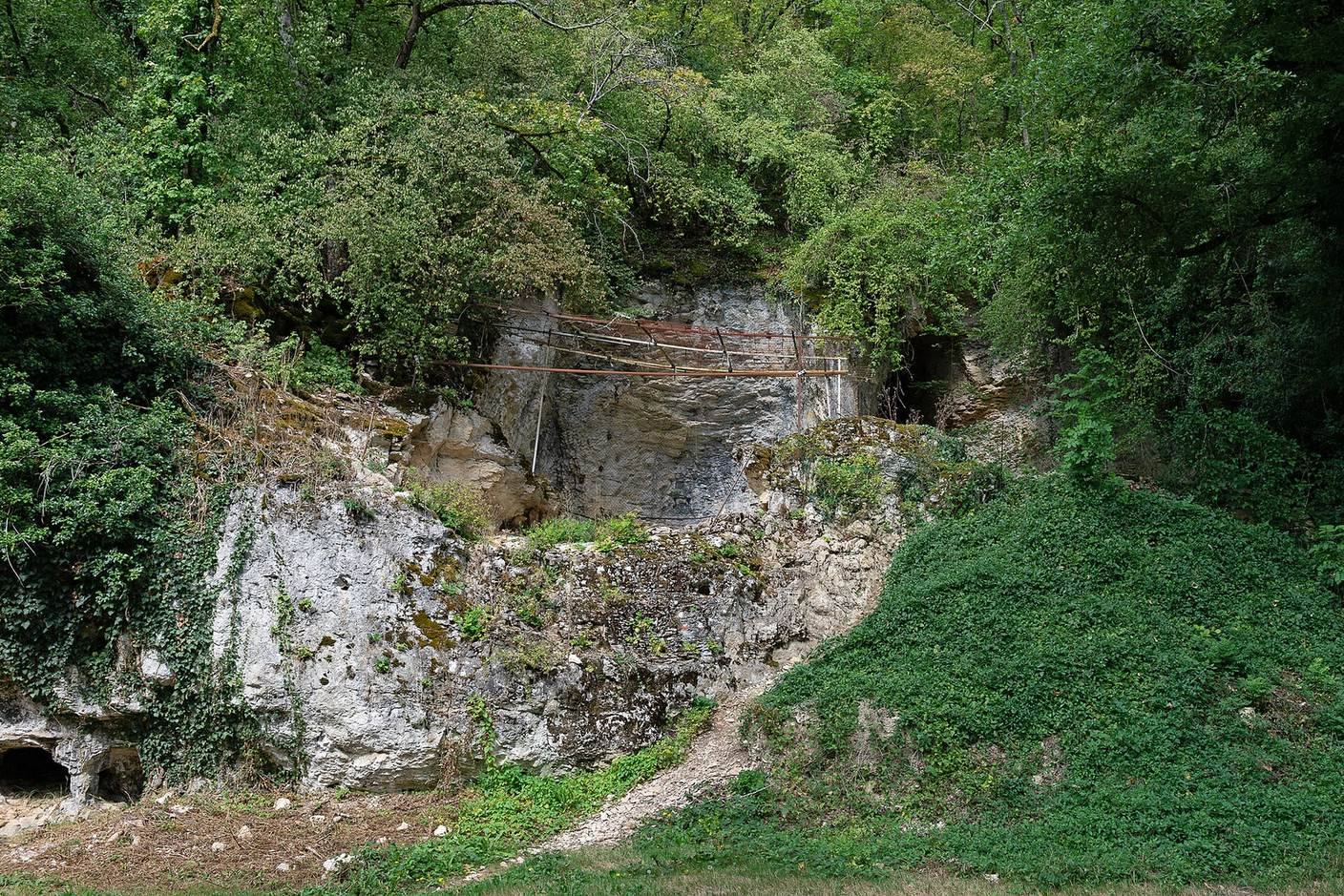
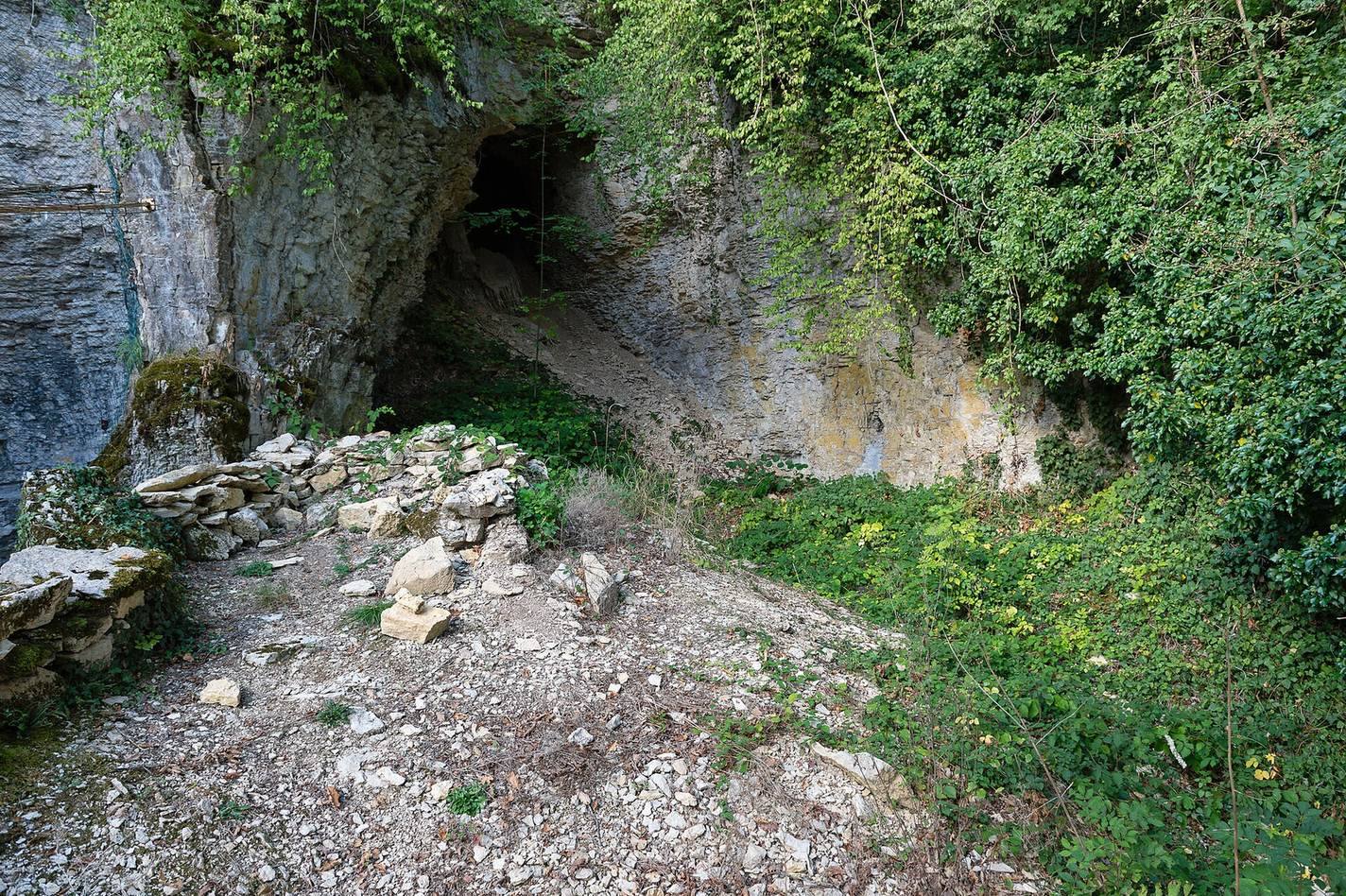
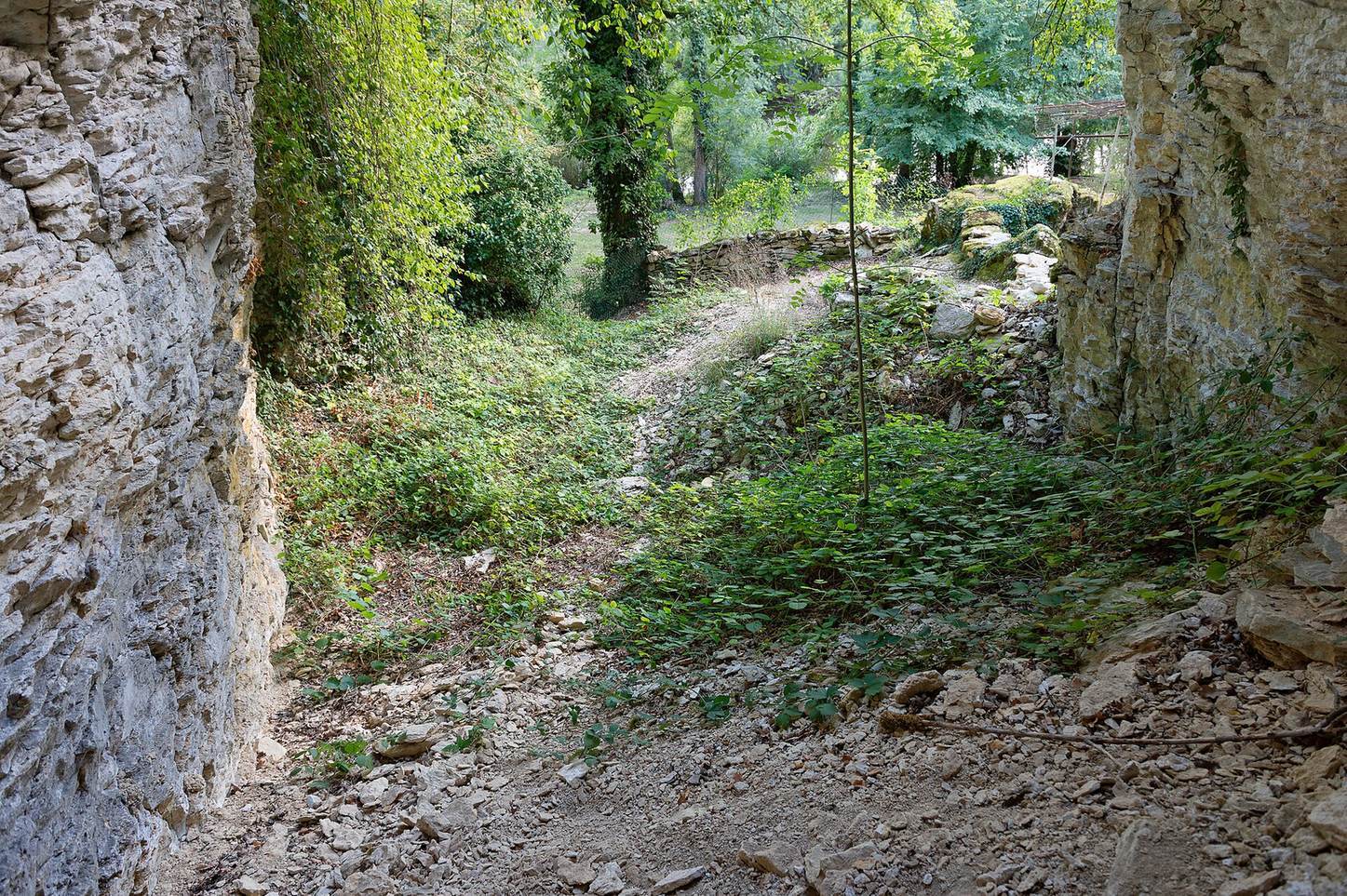
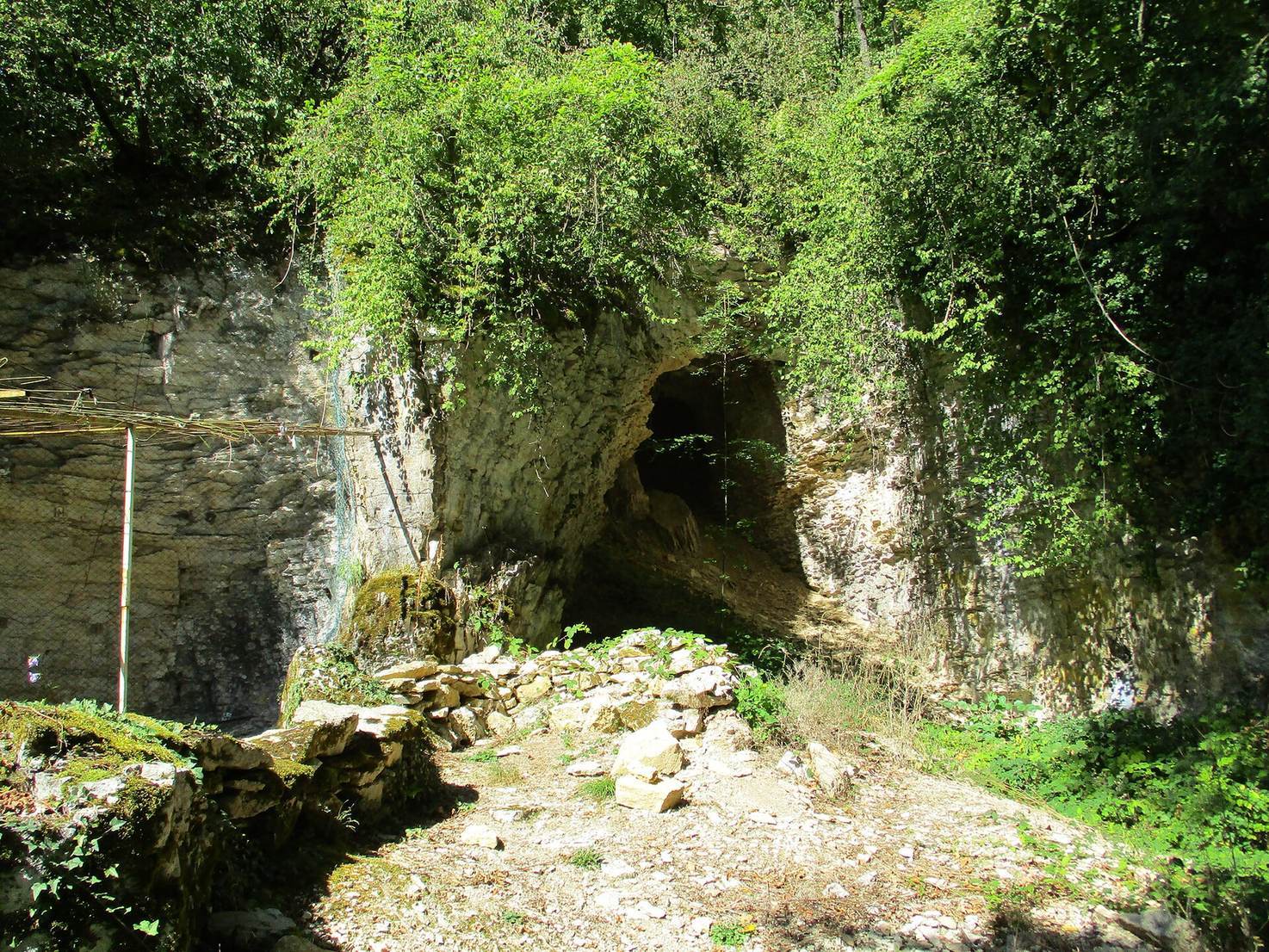
The cave lies on the left bank of the Cure, about 260 metres upstream from the Grande Grotte. Its altitude is about 130 to 140 metres, roughly ten metres above the river’s present level. The known passage extends 104 metres with little change in elevation. It cuts through soft limestone at the boundary between coral deposits and marl, a clay-rich rock. The entrance vault has collapsed across a span of about 15 metres, and the ceiling at the back of the Schoepflin Gallery is only 1.5 metres above the floor.
The 15-level sequence extends through about four metres of deposits. Level XV consists of sandy river sediment and was identified as the latest deposit of a lower cave that collapsed, forming the cave’s general shape before later collapses at the entrance. Above it, the cultural sequence runs from Typical Mousterian in XIV and transitional Mousterian in XIII, through denticulate Mousterian in XII and XI, Châtelperronian in X to VIII, Aurignacian in VII, and Gravettian in VI and V. Level IV is a Proto-Solutrean horizon, an early phase associated with the later Solutrean tradition; levels III and II are pebble horizons, and level I is topsoil.
Mousterian remains
Schoepflin Gallery
Discovered in 1954 by J. P. Schoepflin, a researcher working with Leroi-Gourhan, this gallery is also known as the Mousterian Gallery. A short, low passage led from the cave to a few metres of accessible gallery. Leroi-Gourhan excavated about half of the gallery and half of its access passage, leaving the rest of the original floor intact. The gallery is damper than the main cave, and archaeological remains cover its floor. This contrast prompted the suggestion that a partition made from perishable material once divided the spaces.
The access passage contains ten Mousterian horizons. Its four uppermost levels have the strongest series of tools made using the Levallois method, a prepared-core technique for producing stone flakes. Oak pollen and remains of wild boar and deer indicate a warming phase, which Leroi-Gourhan linked to a glacial interstadial, probably the Gottweig interval. Circles of limestone slabs and postholes associated with mammoth tusks have been interpreted as possible hut locations.
Entrance deposits
Level XIV occupied about 80 square metres near the entrance. Blocks from an early collapse lay among bones and stone tools, indicating continued occupation among the fallen material. Mousterian tools include chert scrapers, notches and toothed-edged implements made from rounded nodules, tablets and blocks.
Upper Palaeolithic remains
Châtelperronian huts and hearths
The Châtelperronian deposits include worn limestone plates and large pebbles in friable ochre-violet sediment. Some assemblages contain as many as ten prepared floors within a deposit up to about 40 centimetres thick. A roughly circular hut is associated with level X and the X/Xb2 deposits. Three huts in the front of the cave, in a layer dating to the end of the Cottés warming, had low circular walls built from flat stones; mammoth tusks were associated with these remains. Small hearths held ochre blocks at different stages of burning, which changed their colours.
Tools and ornaments
Châtelperronian stone tools were made from flint and chert, while other objects used animal materials. The finds include pierced or incised animal teeth made for suspension, a mammoth-ivory ring and pendants. Teeth from wolf, fox, bear, rhinoceros, reindeer, red deer, horse, marmot and cattle occur in level X, with smaller numbers from levels XI and VIII. Some bone tools are decorated. Awls were used heavily to pierce soft materials, probably different kinds of hide, and nine have notches or V-shaped designs.
Pigments and their use
Level X alone yielded about nine kilograms of colouring material, including the largest pigment blocks found at the cave; 1,590 grams came from sublevel Xb. Grotte du Renne supplied most of the roughly 23 kilograms recovered across the Arcy site. More than 1,000 pigment pieces came from level X, and 129 show signs of use. Red and black appear in equal numbers among the used pieces, although red accounts for about three-quarters of the total pigment mass. Yellow is rare in level X. A blue sample weighing 0.5 grams owes its colour to traces of copper and is the only blue pigment known from a French prehistoric site.
Granite pounders, grindstones, handstones and grinders show that pigment was processed at the cave. Red and black materials were generally kept separate, and their distribution marked boundaries between hut interiors and exteriors. Hearths and ash deposits contained fragments at different stages of processing. Awls used to work hides carry substantial red traces, suggesting that red pigment was used in hide-working or applied to hides. Some pigment blocks bear engraved lines, and others were shaped into hollows.
Aurignacian floor
During the Aurignacian occupation, the cave floor was prepared and covered with limestone slabs. Level VII also contained blade cores showing the production of narrow blades and bladelets, as well as 17 collected objects: nine small unworked stalactite fragments, three fossil fragments, three pieces of pyrite and two pieces of unidentified material.
Gravettian deposits and tools
Gravettian levels IV and V form a shallow basin in the middle of the cave and slope south towards the river. Erosion and water movement disturbed the central area, and the boundary between IV and V is unclear. Level V was also affected by animal burrows and runoff; level IV is the most disturbed, while level VI is substantially disturbed as well. Seven objects could be matched across levels IV and V. Leroi-Gourhan suggested that level IV might be material removed from the top of V by the slope rather than a separate occupation floor. Another interpretation places level V on a debris slope formed after the old entrance collapsed, leaving the original position of some objects uncertain.
Level V is the richest Gravettian layer, with nearly 1,000 tools, including about 200 Raysse burins. These specialised stone tools could also serve as cores for making bladelets, and they may have been the layer’s recurring source of bladelet production. Other finds include Gravette points, backed stone pieces, narrow blades, a hearth, stone and bone tools, ornaments and animal remains. The Gravettian deposits also contain abundant mammoth ivory and bone, along with decorated objects made by cutting recessed areas into a surface to contrast with a raised design.
Flint from the Senonian, about 30 kilometres away, accounts for most of the material; occupants also brought flint from southern Touraine, about 200 kilometres west of Arcy. Levels IV and V contained about 16 fossil shells, some perforated, with origins averaging roughly 200 kilometres from the cave. A shell from near Étampes had been perforated by sawing, while other shells show sawing or possible deliberate perforation.