Grotte de l’Arche (Cueva del Arco): A Paleolithic Cave and Rock-Art Site in Spain
Site at a Glance
- Country
- Spain
- Primary era
- Stone Age
- Eras represented
- Stone Age
- Civilizations
- Unclassified
- Site type
- Civic
- Remains
- Rock Art
On this page10 sections
History
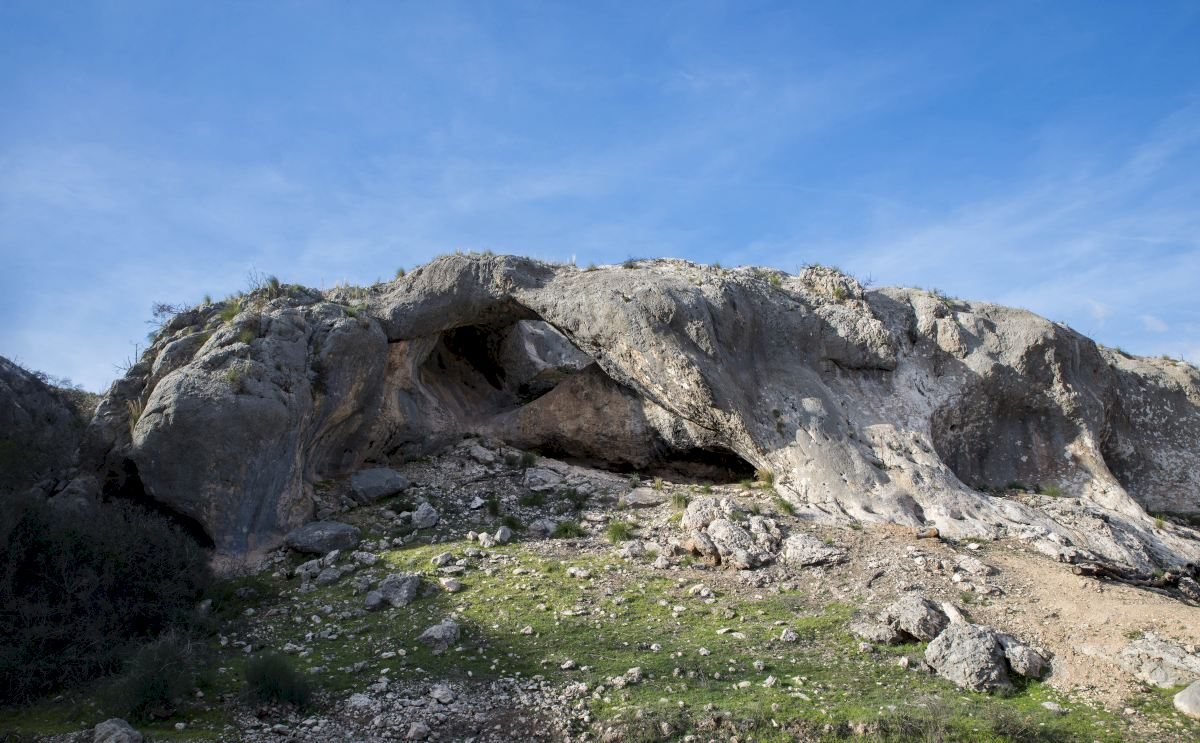
Grotte de l’Arche, also known as Cueva del Arco, is a cave and Paleolithic (Old Stone Age) rock-art site in Cieza, Spain. Its paintings are the oldest known rock art in the Region of Murcia, and the cave preserves an important sequence of prehistoric occupation in southeastern Iberia.
Prehistoric occupations
Excavations have identified occupations from the Middle and Upper Paleolithic, earlier and later phases of the Old Stone Age, through to the Early Neolithic, a later prehistoric period associated with farming. The Upper Paleolithic occupation levels are contemporary with the paintings. Other layers are assigned to the Mousterian, a prehistoric stone-tool tradition, about 50,000 years ago; the Gravettian, an archaeological culture, about 30,000 years ago; and the Solutrean, a prehistoric tool-making tradition, about 21,000 years ago. Early Neolithic levels date to about 7,000 years ago.
This long sequence makes the cave one of the few sites in Mediterranean Iberia where the transition between Neanderthals, an extinct human population, and modern humans, Homo sapiens, can be examined through successive occupations. The evidence also provides insight into the lives of the people who used the site.
Protection and archaeological investigation
Spain designated the cave a Monument of Cultural Interest in 1985. Its rock art became part of the Rock Art of the Mediterranean Basin on the Iberian Peninsula, inscribed on the UNESCO World Heritage List in 1998 under criterion iii, which recognizes exceptional testimony to a cultural tradition or civilization. The paintings were discovered in 1992 by Francisco Morote Martínez and Antonio Vázquez Martínez, members of Grupo Almadenes; GECA is also credited with the cave’s discovery.
In 2014, recognition of stone-tool remains in a cavity established that the site had been used as an occupation place as well as for rock art. A lightning-caused wildfire reached Los Losares in August 2015, affecting Grotte de l’Arche but not the area’s other Paleolithic caves. It burned pines and shrubs and substantially altered the surrounding landscape. Cultural-heritage emergency technicians estimated that temperatures may have exceeded 600°C, raising concern for the paintings, which were later found undamaged.
Excavation began in November 2015, three months after the fire, to investigate how the deposit had formed and to establish the archaeological sequence. Systematic work continued across layers extending from the Middle Paleolithic to the Early Neolithic. On 3 February 2023, the discovery of a previously sealed, kilometre-scale cavity within the cave complex was announced, adding a major geological feature to the site.
Remains
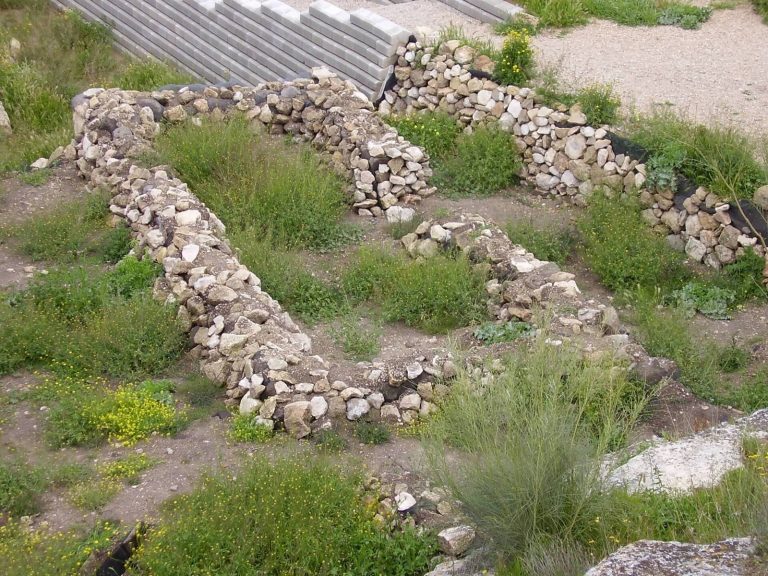
The complex lies in the limestone karst, a landscape shaped by the dissolution of soluble rock, at Los Losares within the Almadenes Canyon natural area. Its cavities and rock shelters are grouped around a large natural arch. The two identified cave openings are Arco I and Arco II. The complex also contains engravings and rock art associated with the Levantine and Iberian schematic traditions, two distinct forms of prehistoric art on the Iberian Peninsula.
Painted galleries
Arco I
Arco I is a gallery 16 metres long, situated across the natural arch. Its four painted figures were made with a brush, using strokes of different thicknesses and placing the images at varying heights and points in the gallery. Two figures appear on each side wall: a horse facing right, a horse’s head facing left, three slender wavy lines arranged vertically and joined at their upper ends, and a deer in profile facing right, set deeper inside the cavity.
Arco II
On the left side of the Arco I complex, Arco II contains 27 painted figures made with a brush or by spraying pigment in a dispersed pattern. Two are naturalistic, forward-facing heads of goat-family animals, an unusual treatment. Another 23 spray-painted figures of varied sizes and indistinct outlines occupy the cavity ceiling.
Other marks include a motif that may be one figure or a composition of two, resembling a divided oval joined at its base to the lower part of the painted area. A separate sign consists of two nearly straight lines that converge toward the animal heads. It lies at the centre of the chamber ceiling and of the overall composition.
Deposits and sealed chamber
Stone-tool deposit
One cavity contains an animal-disturbed sediment deposit with stone-tool remains, including a flint blade whose form is clearly Paleolithic. These remains provide physical evidence of occupation within the cave complex.
Sealed cavity
The newly revealed cavity remains intact after being sealed for tens of thousands of years. Its ceilings reach 20 metres in height. Initial surveys found claw marks made by cave bears on many walls, along with minerals not previously identified.