Grey Friars Monastery: A Franciscan Convent in Medieval Berlin
Site at a Glance
- Popularity
- High
- Country
- Germany
- Primary era
- Medieval
- Eras represented
- Medieval, Modern
- Civilizations
- Holy Roman Empire, Kingdom of Prussia, Margraviate of Brandenburg
- Site type
- Religious
- Remains
- Monastery
On this page12 sections
History
Grey Friars Monastery was a Franciscan convent in Berlin, Germany, where a Franciscan presence is traditionally traced to 1249. The church and monastery were probably completed during the fourteenth century, and the church was Gothic. The convent became closely connected with Brandenburg’s rulers and Berlin’s civic life. Brandenburg chronicler Andreas Angelus linked its name to the friars’ grey habits and placed an early settlement on Spandauer Street, at what is now number 49.
Franciscan foundations and medieval Berlin
The Franciscans, members of the Order of Friars Minor, were a Catholic mendicant order founded in 1210. Mendicant friars preached and lived without requiring a strictly enclosed monastery. They participated in German settlement between the Elbe and Oder and farther east. In Brandenburg, the Ascanian rulers encouraged mendicant orders to establish houses, while residents and rulers in growing towns also supported their work.
In 1250, Herman Langelis served as the convent’s lector, or teacher, and as spiritual adviser and confessor to Princess Mechthild of Brandenburg, indicating a connection to the margrave’s court. The Berlin house belonged to the Brandenburg Custody, a regional subdivision of the Franciscan province of Saxonia. Provincial chapters, assemblies of the province’s friars, met in Berlin in 1252 and on eight later occasions, suggesting that the convent had substantial buildings.
An inscription once kept at the monastery, but lost during the Second World War, stated that Margraves Otto V and Albrecht III granted the friars land near the city wall in 1271. In 1290, the knight Jakob von Nybede donated a brickworks. Its gift made it possible to build a larger monastery and a new church.
Many people were buried at the convent, reflecting its ties to Berlin’s citizens and the Brandenburg margraves. Among them was Louis the Roman, son of Holy Roman Emperor Louis IV and Margaret of Holland. Known in Brandenburg as Louis II, he was a margrave, or territorial ruler, and its first elector, a prince entitled to participate in choosing the emperor.
During the interdict imposed on Berlin from 1325 to 1347 after the killing of the Brandenburg bishop’s provost, a senior church official, the Franciscans continued to provide pastoral care. An interdict restricts religious services, and a papal privilege allowed the friars to minister during the ban, uniquely among the clergy. Their support may also have encouraged the elaboration of the Dance of Death at St Mary’s Church, a medieval theme showing people from different walks of life dancing with Death. In 1412, citizens assembled at the monastery to oppose the city council. Elector Frederick II held a court assembly there in 1441.
Reform and dissolution
The convent sometimes taught new friars in a course led by its lectors. It probably also maintained several outlying friary stations. One such station on Jüdenstraße in Spandau remained in use until before 1493. That year, following observance reforms in Saxonia and pressure from Elector Frederick I, the Berlin Franciscans adopted the Martinian Constitutions, a moderate reform of the order’s rules on poverty. They surrendered ownership of their outlying stations but initially retained permission to use their buildings. In 1540, they transferred the Spandau property to the town council.
After the Saxon Franciscan province divided in 1518, Berlin joined the Province of St John the Baptist, a separate province that included about 75 houses following the Martinian rules. The province later disappeared during the Reformation. In Berlin, the Reformation led to the monastery’s dissolution in 1539. Elector Joachim II secularized its property, although some friars were allowed to remain in the buildings. The last died there on 4 January 1571.
School, damage, and archaeological work
In 1574, a school known as the Berlin Gymnasium at the Grey Monastery opened in the former convent buildings. One of its best-known heads was Michael Schirmer (1606–1673), a writer of church hymns. The school moved to Schmargendorf in 1963.
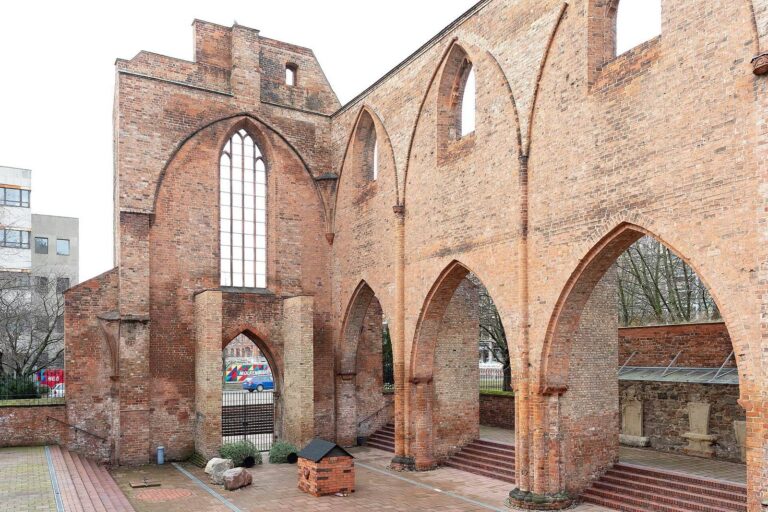
Before the Second World War, the monastery was regarded as Berlin’s most important medieval building. The church and other structures suffered severe damage, and the church ruins were secured after the war and used as a war memorial. In 1951, a subway service tunnel required after the division of Berlin’s transport company caused further major damage to the church, refectory, and chapter house. Other parts of the monastery were cleared between 1959 and 1961. The refectory and chapter house were demolished above ground in June 1968, when Grunerstraße was widened. Excavations on the green space at the former site in 2013–2014 uncovered buried parts of the complex.
Remains
The monastery occupied the Mitte district between present-day Klosterstraße, Grunerstraße, and Littenstraße. It adjoined the margrave’s court on Klosterstraße, stood near the margravial residence known as the High House, and extended to the medieval city wall. The complex comprised a church, a refectory (communal dining hall), a chapter house (community meeting room), and a cloister (covered walkway).
Church and earlier hall church
Gothic monastery church
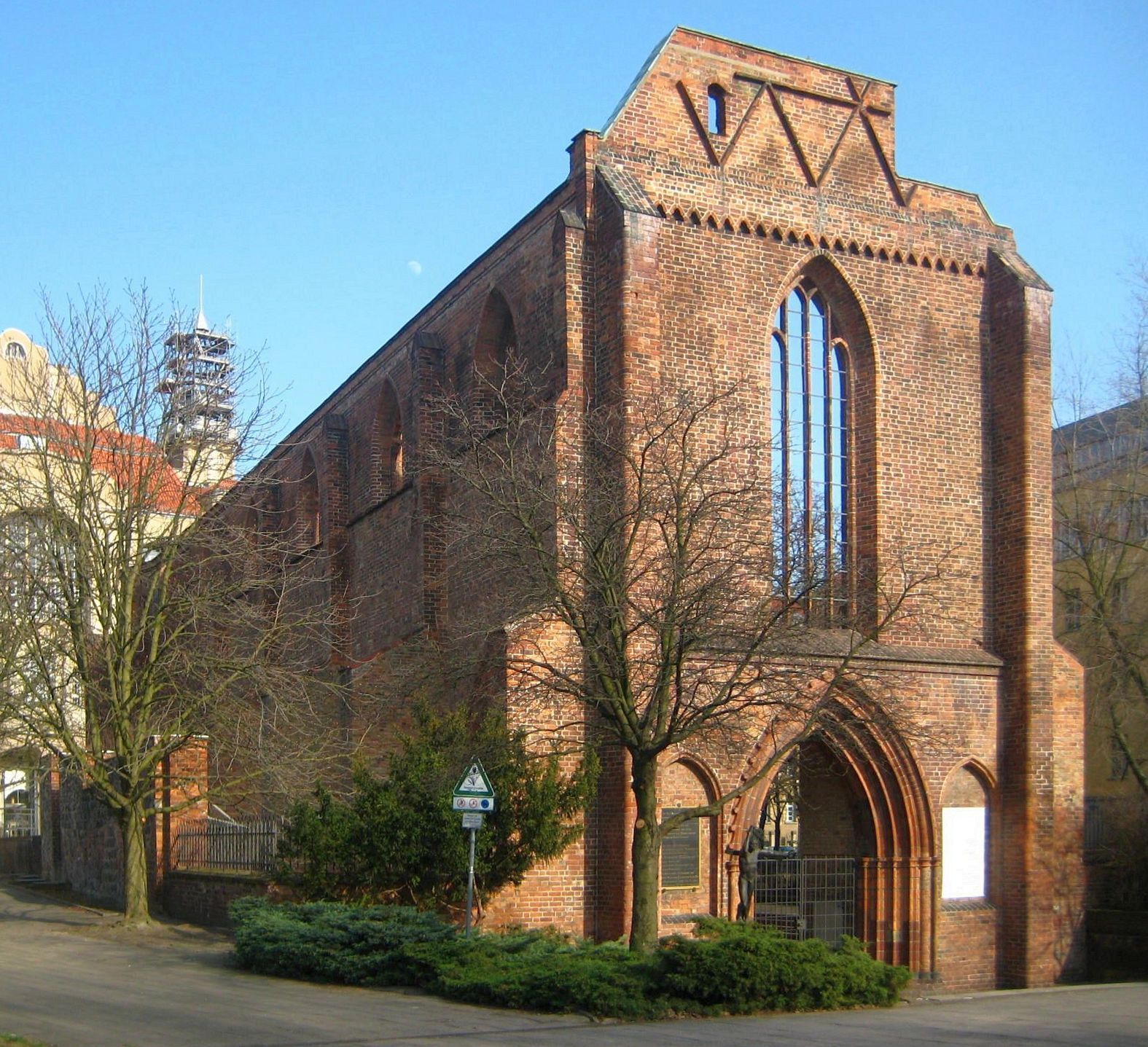
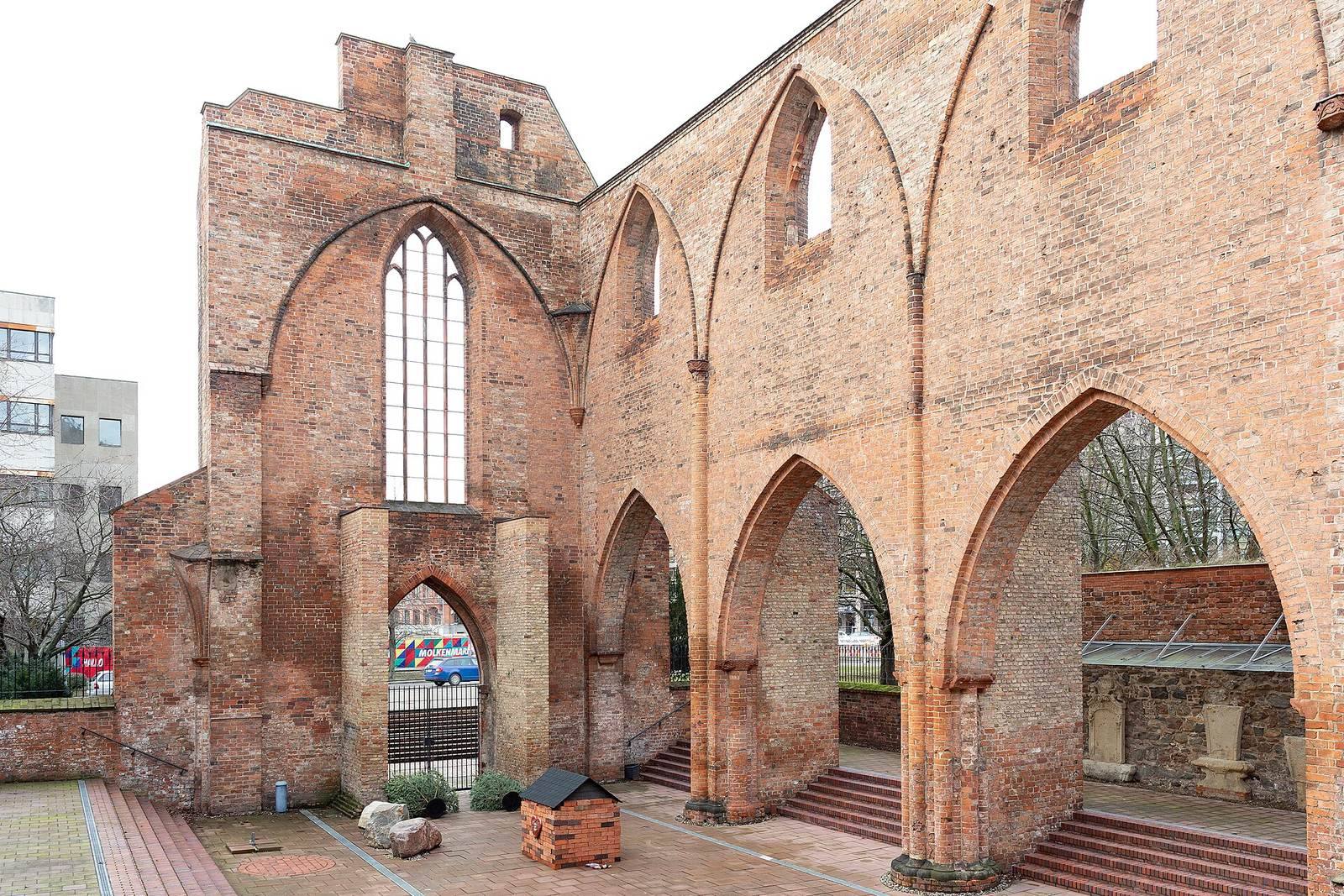
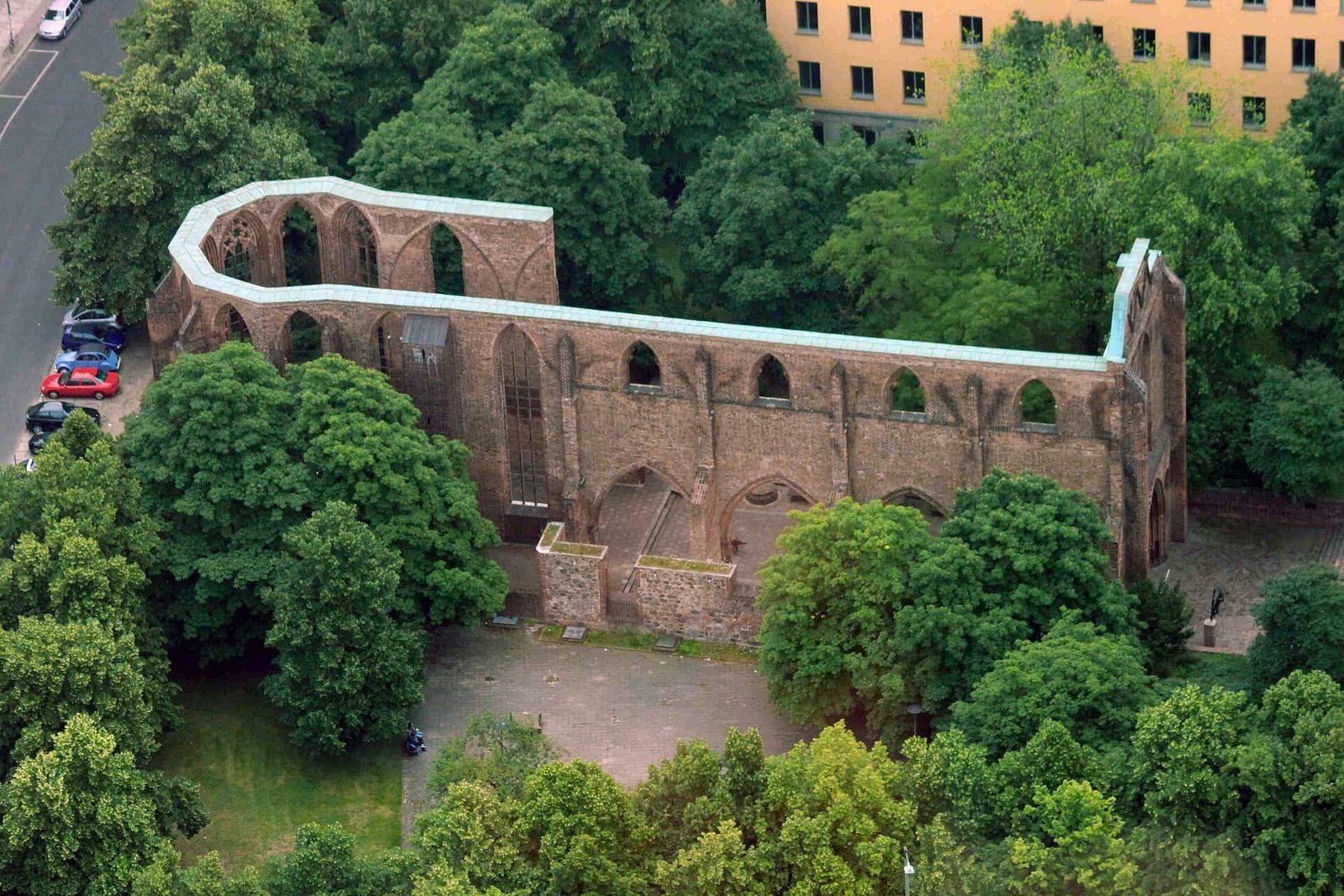
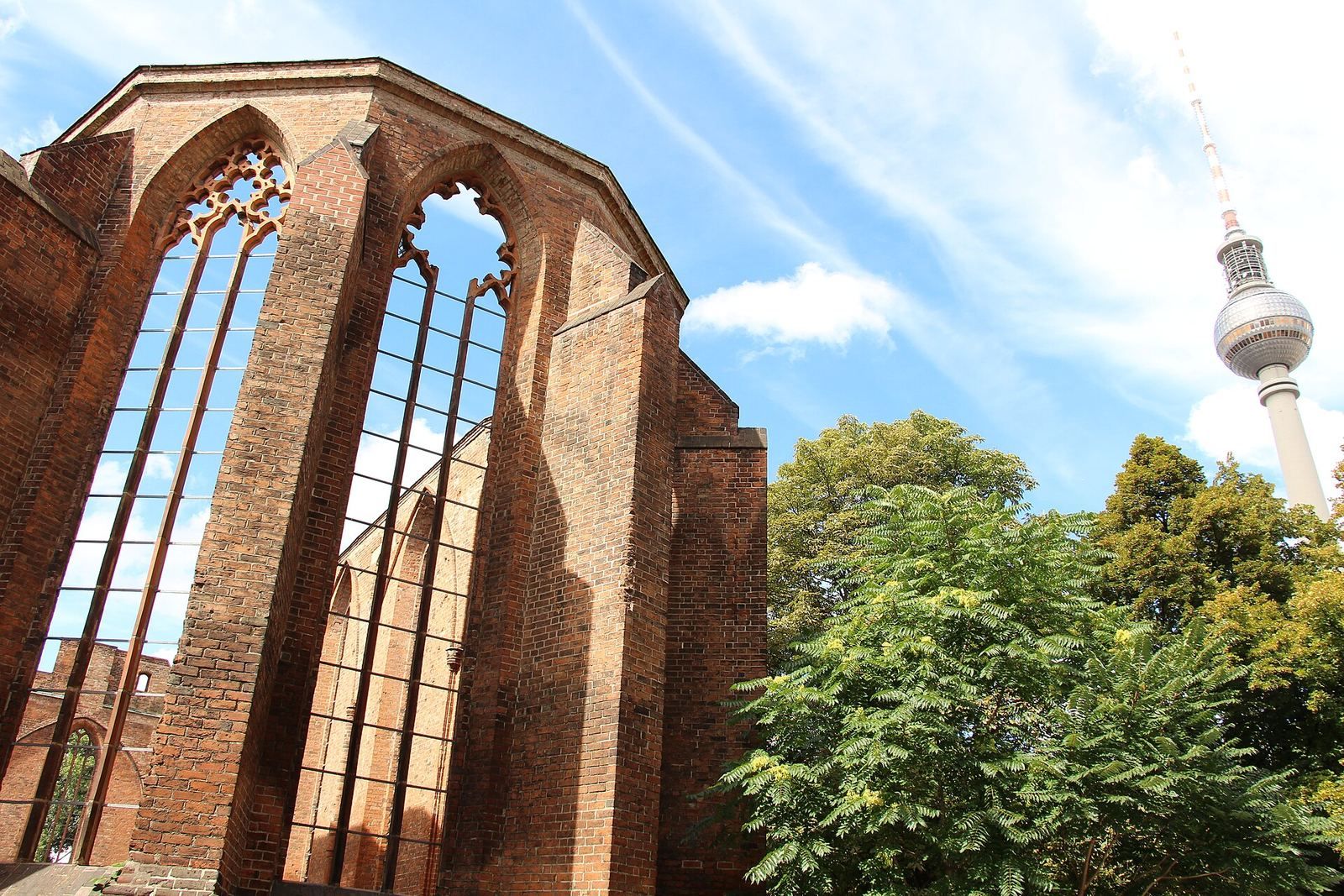
The church ruin is the monastery’s only visible above-ground remnant and is among Berlin’s last surviving Gothic landmarks. It preserves part of the church that formed the central religious building of the convent.
Earlier hall church
Fieldstone remains of a Romanesque hall church dating from before 1250 were found beneath the monastery church. They suggest that the Franciscans may have established themselves at an existing church.
Excavated monastic precinct
Cloister and chapter-house remains
Excavations uncovered foundations of the chapter house, remains of cloister pillars, and floor surfaces. Together with the known arrangement of the church, refectory, chapter house, and cloister, these finds reveal parts of the former convent’s built layout.
Later features and utilities
The excavated remains also include a separate fieldstone foundation, later additions, and a nineteenth-century stair tower. Utility lines from the nineteenth and twentieth centuries cross the site.
Brickworks
Remains of the brickworks associated with the convent’s building history were found near present-day Kreuzbergstraße.