Gonur Depe: A Major Bronze Age Settlement in Turkmenistan
Site at a Glance
- Rating
- 4.1
- Popularity
- Very Low
- Country
- Turkmenistan
- Primary era
- Bronze Age
- External website
- Open
- Eras represented
- Bronze Age
- Civilizations
- Unclassified
- Site type
- City
On this page14 sections
History
Gonur Depe is a large Early Bronze Age settlement in Turkmenistan, near the ancient city of Merv, built by communities associated with the Bactria-Margiana Archaeological Complex between about 2400 and 1600 BCE. This Bronze Age tradition in southern Central Asia was characterized by fortified settlements, monumental buildings, temples, craft production, and long-distance contacts. Gonur is often described as one of its major settlements, or as its capital, and its remains occupy a low hill beside a former channel of the Murghab River.
Early occupation and development
The earliest traces at Gonur Depe consist of two pottery sherds in the Geoksjur style of the Namazga III period, conventionally dated to about 3200 to 2800 BCE. Three radiocarbon samples from narrow walls belong to the Geoksjur-Sarazm period and indicate a short-lived early occupation. Later construction produced the settlement’s principal Bronze Age phases, which archaeological studies divide into five construction or occupation horizons.
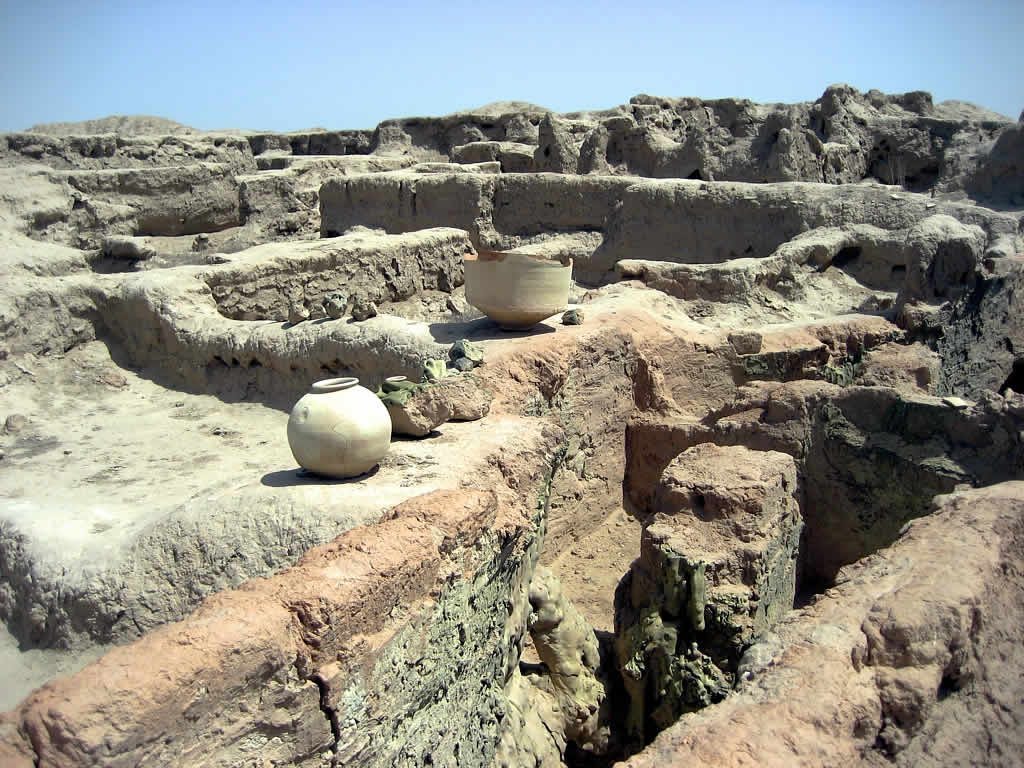
Gonur Depe was divided into three main areas, Gonur North, the Large Necropolis, and Gonur South. Gonur North, the principal fortified complex, was occupied from about 2400 to 1900 BCE. Its central group included the Monumental Palace, associated buildings, ritual areas, temples, water reservoirs, and the Royal Necropolis, a cemetery containing burials linked with an elite or ruling group.
Later settlement and abandonment
Gonur South was inhabited from about 1900 to 1600 BCE. Its enclosed sacred precinct, or temenos, was interpreted by Viktor Sarianidi as a place connected with the Soma cult. Soma was a ritual drink known from the Rigveda, while haoma is its related name in the Avesta, the sacred collection of Zoroastrian texts. The interpretation of Gonur’s equipment and plant traces as evidence for Soma preparation remains a hypothesis. A smaller temple known as “the fort” represented a later and unfinished development in the southern complex.
More than 150 ancient settlements have been identified in the Murghab delta. Communities such as Gonur may have been established by people moving from the Kopet-Dag region as climatic conditions changed. From about 1800 to 1500 BCE, incursions by nomadic groups associated with the Andronovo culture increased. This group of Bronze Age cultures was linked with the Eurasian steppe, distinctive ceramics, pastoral economies, and early horse use. Andronovo pottery at Gonur has been interpreted by Lamberg-Karlovsky as evidence that horses were known to the Bactria-Margiana communities, although Sarianidi rejected a steppe connection as the explanation for the horses.
Gonur Depe and Togolok have been compared with the qila, a type of fortified settlement known historically in South Asia and adjoining parts of Central Asia. The comparison refers to settlements enclosed by one to three walls and containing residential quarters, workshops, and temples. Gonur was probably abandoned after the Murghab River shifted westward.
Discovery and archaeological interpretation
Viktor Sarianidi discovered Gonur Depe in 1972 after collecting pottery sherds from the surface. He excavated the site from 1974 to 2013, uncovering its palace, fortified mud-brick enclosure, temples, cemeteries, and ritual installations. He associated the temples and their fire altars with Zoroastrian religion, although the interpretation of the site’s ritual practices includes continuing archaeological debate.
Excavation of the Large Necropolis began after its identification around 1996 and continued for approximately ten years, revealing evidence from nearly 3,000 burials. Further campaigns in the Royal Necropolis located five royal graves in 2004 and three more in 2009. Genetic analyses indicate that most individuals from Gonur had ancestry primarily related to Neolithic farmers of the Iranian Plateau. Some individuals also had ancestry connected with South Asia, and three genomes showed substantial similarities to an individual from Rakhigarhi in India and to genomes from Shahr-i Sokhta in Iran. These findings provide evidence of connections across regions during the Bronze Age.
Remains
Gonur North
Gonur North formed an almost elliptical fortified area measuring about 330 by 460 metres. Its northern complex included a central citadel-like structure approximately 100 by 180 metres in size. The settlement was built largely of mud brick, with major walls, rectangular towers, enclosed courtyards, ritual buildings, water installations, and burial areas arranged within the fortified zone.
Monumental Palace
The Monumental Palace stood at the centre of Gonur North and measured approximately 150 by 140 metres. A double wall enclosed the building, whose interior contained two large courtyards, an axial corridor, a substantial storage area for products, and inner rooms that may have served as a throne room and audience halls. Near the entrance, water sources connected with ceramic pipes may have been used for the ritual cleansing of visitors.
Temples and water installations
The palace was surrounded by walls with rectangular towers. An early fire temple stood outside its eastern side, while sacrificial-temple structures occupied the western and southern areas. A complex to the north has been interpreted as a place for communal meals. These temple areas were enclosed by a second monumental wall with rectangular towers. South of the walled group lay two basins, including a principal basin about 100 by 60 metres in size. A water temple on its southern bank provides physical evidence for practices involving the veneration of water.
Royal Necropolis
The Royal Necropolis occupied the southeastern part of Gonur North. It contained eight underground burial houses and three large burial pits. The pits also held the remains of animals and servants associated with the royal graves. Objects made of gold, silver, stone, and bronze indicate the elevated status of the buried individuals, while numerous ivory objects belonged to the final phase of the cemetery. That phase was contemporary with late layers at Altyn Depe in Turkmenistan and Mohenjo-daro in Pakistan.
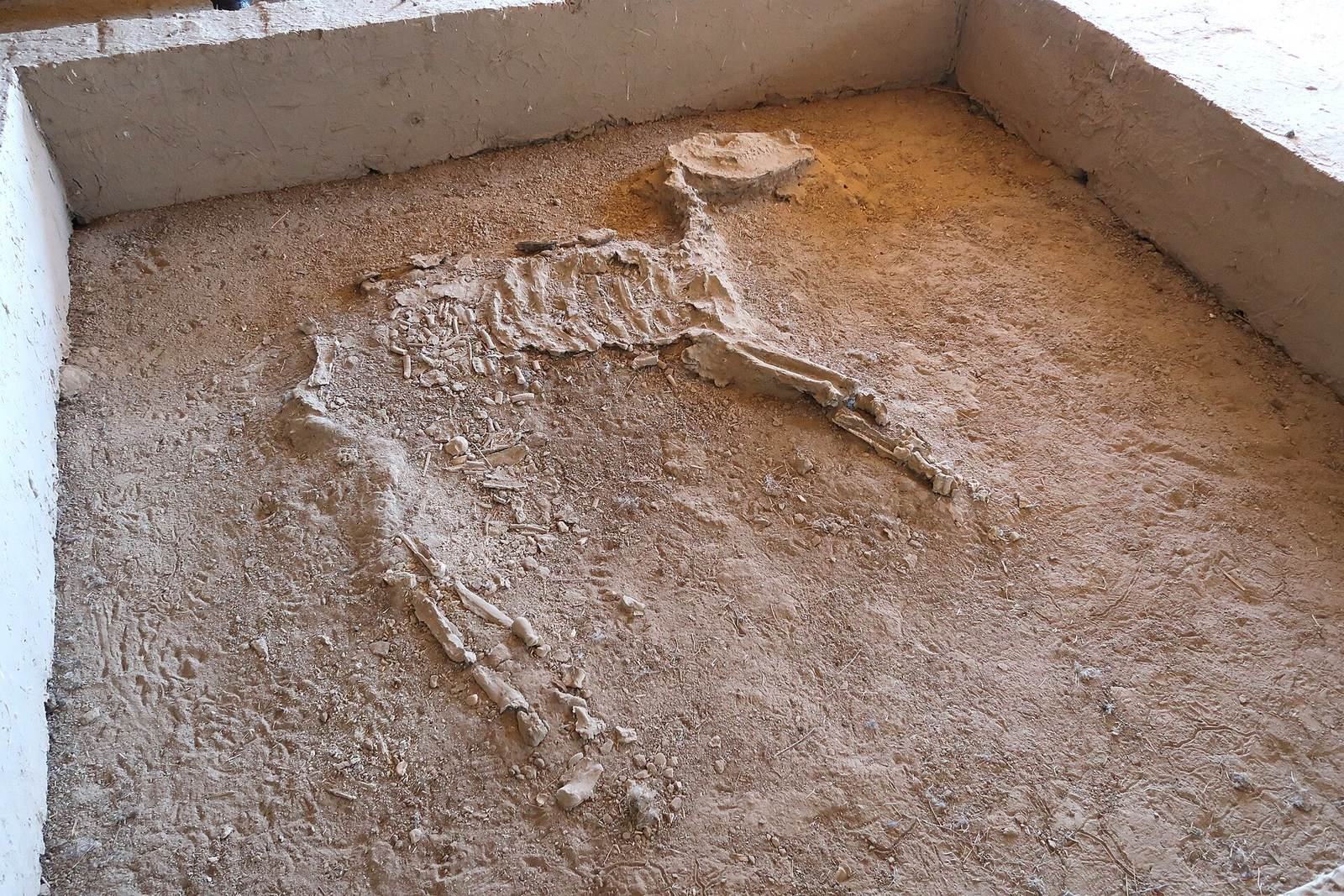
Burial 3200 was a brick-lined pit containing an almost complete foal skeleton and a four-wheeled wooden wagon whose wheels were encircled by bronze bands. It belongs to Period I and dates to about 2200 BCE, with radiocarbon dating giving an approximate date of 2250 BCE. Burial 3210 contained a stone statuette that appears to depict a saddled horse. Burial 3310 contained parts of a stallion, although its head, rump, and tail were not preserved; Sarianidi interpreted the burial as a ritual deposit of a domesticated horse.
Large Necropolis
The Large Necropolis lay about 200 metres west of Gonur North and covered approximately 10 hectares. It contained more than 3,000 graves of different types. Adults and young people over eight years old were buried there, while children were buried near houses or in abandoned buildings. The cemetery therefore formed a distinct burial area while also retaining connections with domestic spaces within the settlement.
Warrior burial and mosaics
Burial 2380, known as the “tomb of a warrior,” contained a bronze mace head decorated with a horse with prominent ears. The necropolis also yielded numerous mosaics that decorated walls and large wooden trunks or boxes used for rich royal offerings. Dating to the end of the third millennium BCE, these mosaics combined painted plaster with inserted stone pieces. Comparable techniques and examples are known from Mari in Syria and the Royal Cemetery at Ur.
Gonur South
Gonur South was a smaller square complex measuring approximately 130 by 120 metres, or about 1.5 hectares. Two massive concentric walls protected it, and round towers stood along their perimeters. Within the complex, the Temenos was a parallelogram-shaped shrine enclosed by strong walls, round corner towers, and half-towers along its perimeter.
The fort temple
Inside the Temenos stood the small temple known as “the fort.” It was a cruciform building with twelve round towers, one at each angle of the cross, and each tower had a narrow doorway. The structure remained unfinished and has been compared with the fire temple at Tepe Nush-i Jan.
Objects and ritual evidence
Excavated material from Gonur Depe includes clay and ceramic vessels, gold and silver ornaments, Mesopotamian cylinder seals, and a square seal from the Harappan cultural sphere. These objects reflect contacts extending beyond the Murghab delta and help place the settlement within wider Bronze Age networks.
Among the ritual equipment was a vessel or installation resembling a boiler, together with dishes bearing traces interpreted as cannabis, poppy, and ephedra. Sarianidi associated these materials with possible ingredients for Soma, but the identification remains interpretive. Similar implements, described as a “pressure set,” were found at Ulug Depe in southern Turkmenistan, although those examples came from Late Bronze Age layers.