Gebel el-Mawta: An Ancient Rock-Cut Necropolis in Egypt
Site at a Glance
- Rating
- 4.5
- Popularity
- Low
- Country
- Egypt
- Primary era
- Classical
- Eras represented
- Iron Age, Classical
- Civilizations
- Egyptian, Ptolemaic
- Site type
- Burial
- Remains
- Necropolis
On this page11 sections
History
Origins and Cultural Exchange
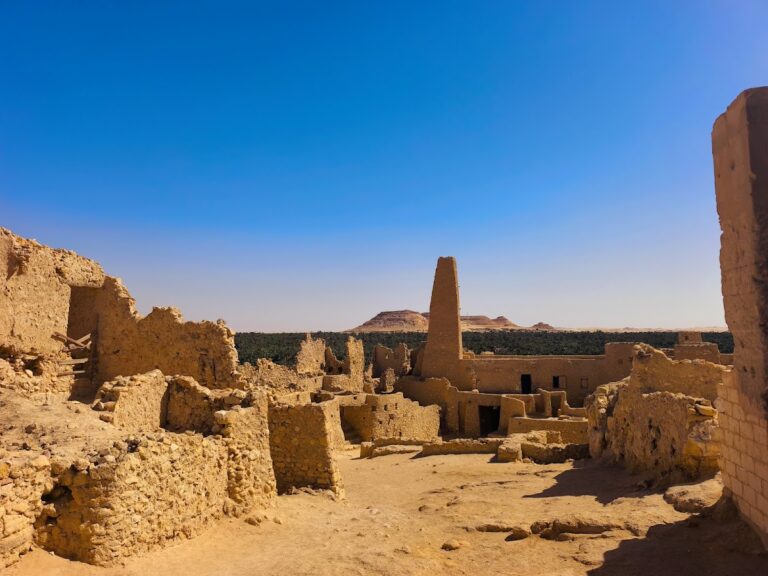
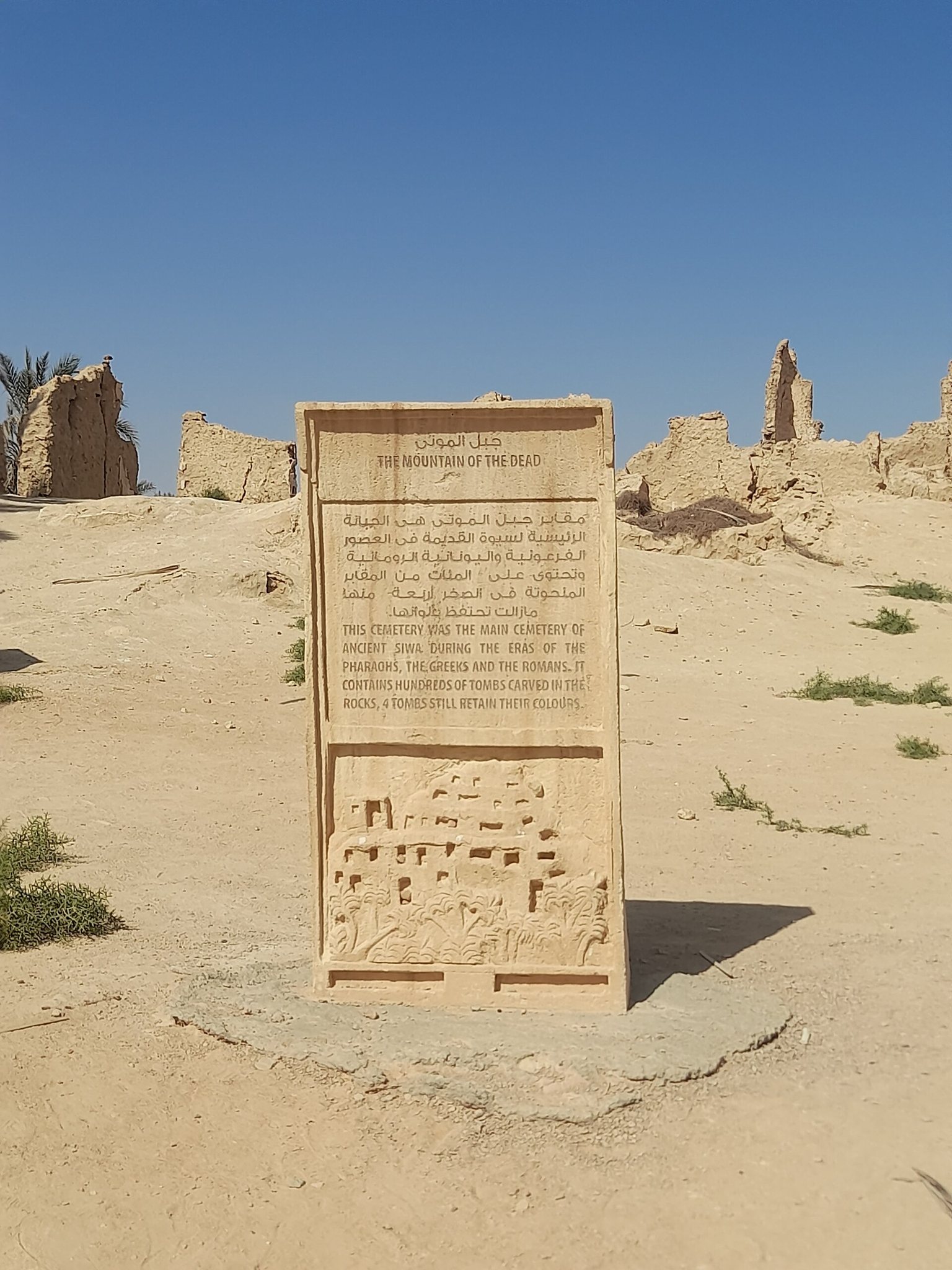
Gebel el-Mawta is an ancient Egyptian rock-cut necropolis north of Siwa in Egypt. Its use as a cemetery began during the Saite period of the Twenty-sixth Dynasty, conventionally dated to the seventh and early sixth centuries BC, and continued into the Roman period. The tombs preserve the interaction of Nile Valley, Greek, and Roman traditions in the Western Desert, combining Egyptian funerary practices and embalming customs with artistic forms and symbols from the wider Mediterranean world.
The necropolis contains burials from the Ptolemaic period, the era of Egypt’s Macedonian-Greek ruling dynasty, as well as from Roman times. Some of those buried there were officials of Greek origin. Roman and Christian burials also formed part of the cemetery’s later history. Together, the tombs record changes in religious belief, funerary art, and architectural practice over several centuries.
Known Tombs and Historical Phases
The oldest dated tomb on the hill is the Badkhut Tomb, which belongs to the Twenty-sixth Dynasty. Its owner, Badkhut, was a priest and a scribe of sacred texts. The Tomb of Si Amun dates to the reign of Nectanebo II of the Thirtieth Dynasty, the last native Egyptian dynasty before Macedonian and Ptolemaic rule. Si Amun was probably a wealthy local man, and inscriptions name his father as Peritu and his mother as Neferhert.
The Mesu-Isis Tomb dates from between the fourth and second centuries BC. Its owner is unknown, although inscriptions identify his wife as Mesu-Isis. The Crocodile Tomb probably belongs to the late Ptolemaic or early Roman period. Its name comes from a yellow crocodile representing Sobek, the Egyptian god associated with the crocodile and the Nile. The four tombs illustrate the changing religious and artistic character of the necropolis.
Rediscovery and Protection
The German traveler Friedrich Hornemann mentioned Gebel el-Mawta in 1788, while formal archaeological investigation began in 1941 under the Egyptian archaeologist Ahmed Fakhry. In 1944, during the Second World War, residents of Siwa sheltered on the hill during air raids and discovered inner corridors and decorated chambers. Sand had preserved the colors in some of the tombs. The cemetery had already suffered partial destruction in 1940 from foreign military forces stationed in the area, while earlier looting had also damaged the burials.
Inscriptions were removed and stolen during the First World War, and the tombs had been looted in antiquity. Local people repeatedly used the chambers as shelters during wartime. The necropolis is supervised by Egypt’s Ministry of Tourism and Antiquities, and four decorated tombs have been fitted with iron doors and locks to protect their inscriptions and natural pigments. A local tradition tells of a passage connecting one tomb with Mount Altkor and the treasures of Siwa’s last king. Gebel el-Mawta remains an important record of religious and architectural development in Egypt’s Western Desert.
Remains
Hill and Cemetery Layout
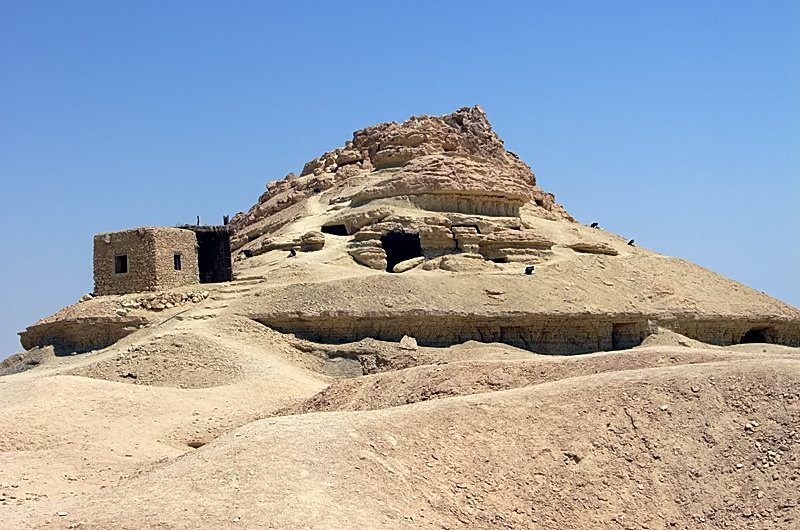
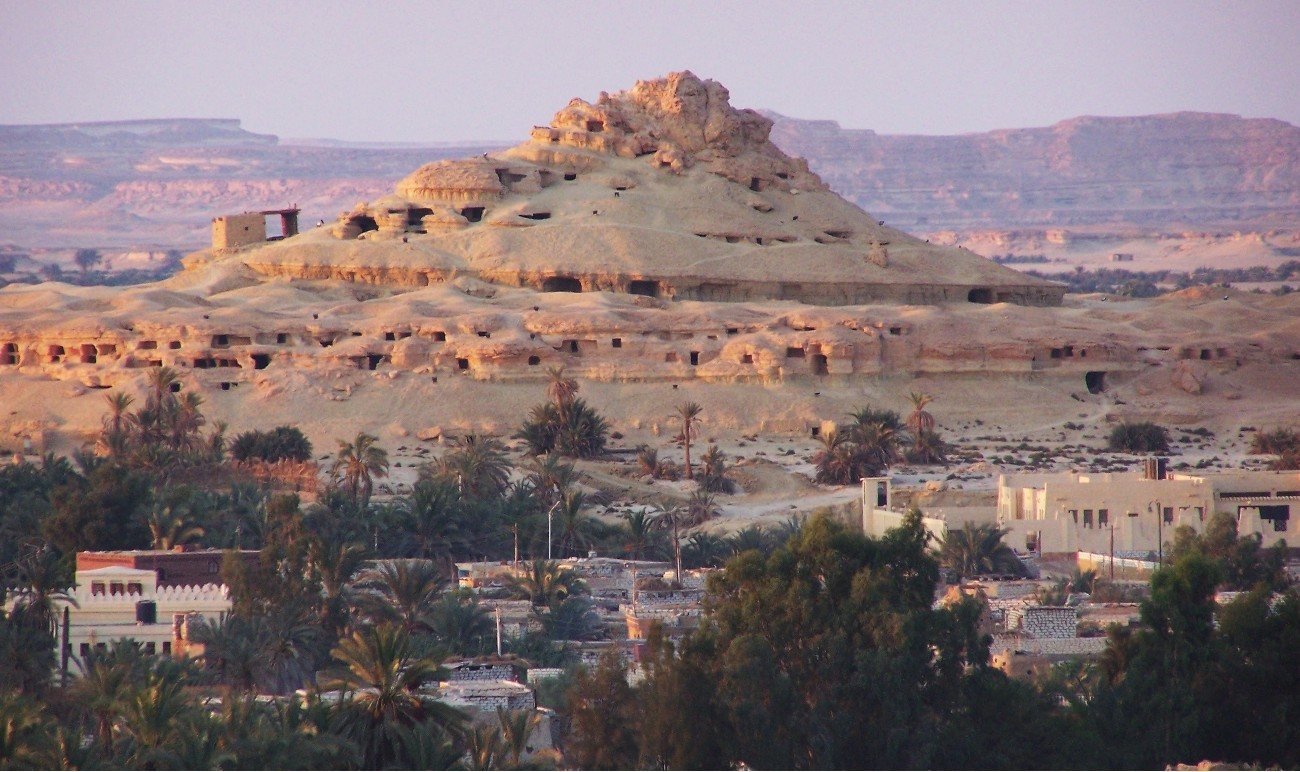
Gebel el-Mawta occupies a conical limestone hill approximately 50 metres high and 500 metres in diameter. Rock-cut tombs are distributed across adjoining terraces on the slopes and within the hill, rising from the base in successive levels. The burial complexes range from undecorated individual graves to family and communal tombs. Long corridors lead in some cases to transverse halls and loculi, small burial niches or compartments for coffins and coffin-like structures.
Ancient artists used natural pigments from the Siwa environment, especially red ochre. Most decorated tombs combine Egyptian and Greek symbols, while the Badkhut Tomb retains exclusively Egyptian decoration. The hilltop provides views across the oasis, including the ruins of Shali village, the remains of the Prince Farouk Hotel built in 1920, and nearby palm and olive groves.
Decorated Tombs
Tomb of Si Amun
The Tomb of Si Amun begins with a staircase that passes through an arched doorway into a narrow passage and ends in a burial chamber. Finely executed paintings cover its plastered walls, although some were damaged by later additions made for the burial of other family members. Si Amun appears twice, as a young man on the eastern wall and at an advanced age on the western wall.
One wall presents a funeral procession in which the mummy rests inside a shrine carried on a vehicle. The ba, an aspect of the deceased’s spirit often shown as a human-headed bird, and the god Wepwawet accompany the procession. Other scenes show Si Amun’s son performing the Opening of the Mouth, a funerary ritual intended to restore the dead person’s ability to breathe, speak, eat, and function in the afterlife. The son wears a leopard skin. Si Amun also appears before Amun, Mut, Hathor, and the lion-headed god Maahes.
The opposite side contains a judgment scene before Osiris, attended by 42 gods, and a distinctive image of Nut beside a sycamore tree offering water to the deceased. One horizontal register, or band organizing figures and inscriptions, shows Si Amun’s younger son in Greek clothing. The ceiling carries astronomical imagery. Its front section shows Nut surrounded by stars and six solar boats, the symbolic vessels of the sun deity’s journey through the sky and underworld. The rear section contains winged vultures and falcons with passages from the Book of the Dead, a collection of funerary spells and illustrations intended to guide and protect the dead.
Mesu-Isis Tomb
The Mesu-Isis Tomb lies 20 metres east of the Tomb of Si Amun and contains two chambers. The first is an undecorated antechamber used for offerings. The entrance to the burial chamber has an obelisk-like design, with Isis standing on the left and Osiris seated on the right.
Above the entrance, the lintel bears 21 royal cobras, each topped by a solar disk, together with two winged solar disks below. This protective funerary arrangement is characteristic of the ancient architecture of the Siwa Oasis during the period represented by the tomb.
Badkhut Tomb
The Badkhut Tomb is a small rock-cut chamber measuring 1.8 metres wide, 2.2 metres deep, and up to 1.8 metres high. Its coffin was carved directly into the floor. Rapidly executed red paintings were applied to the rock, and four columns at the entrance carry texts from Chapters 10 and 13 of the Book of the Dead.
On the left wall, Badkhut presents four calves tied with ropes as offerings. Beside the scene begins a hymn to Thoth, the god associated with writing and knowledge, and the text continues across the rear wall. There Badkhut worships the enthroned Osiris and the goddess Hathor. The right wall shows him holding a sceptre and presenting four chests of colored textiles. Further hymns to Osiris continue from this side and meet the inscriptions on the rear wall.
Crocodile Tomb
The Crocodile Tomb has three chambers, although its principal decoration and inscriptions are concentrated in the front chamber. Hathor appears seated on a throne and holding offerings of water and plant stems. Behind the deceased stands the ram-headed Amun, holding two knives. Beside the shrine, the remains of a vine decoration survive, while further scenes of foxes eating grapes have been lost.
The left side shows the ibis-headed Thoth writing on a tablet before Osiris. Other scenes once showed the tomb owner before Osiris, Isis, and Horus, while two winged goddesses protected Nefertum. Crocodile inscriptions connected with Sobek occur elsewhere in the necropolis, whose surviving tombs preserve Egyptian, Greek, and Roman artistic motifs alongside burials and inscriptions that have undergone varying degrees of survival.