Forum of Constantine: Constantinople’s Imperial Public Square
Site at a Glance
- Rating
- 4.4
- Popularity
- Low
- Country
- Turkey
- Primary era
- Classical
- Eras represented
- Classical, Medieval, Early Modern
- Civilizations
- Byzantine, Ottoman, Roman
- Site type
- Civic
- Remains
- Forum
On this page13 sections
History
The Forum of Constantine was a Roman imperial public square in Constantinople, in present-day Turkey, planned as the civic center of Constantine I’s new capital. Construction began around 328, and the central column was ceremonially inaugurated on 11 May 330, the city’s foundation day.
Foundation and civic life
The square was built just beyond the earlier walls of Byzantium, close to its main gate. Before construction, the ground served as a burial area. Builders raised it by about 1.5 metres with fill to create a level for the new forum.
The forum became a center for public gatherings and trade in costly goods, including furs, silk, linen, leather, clothing, candles, and horse harness. Merchants and beggars alike formed part of the activity around the square. Imperial processions crossed it, including ceremonies held each year on 11 May, while religious processions also began or ended there. During the city’s birthday ceremony, a bronze four-horse chariot, or quadriga, associated with the Senate House was taken to the Hippodrome, an arena for chariot races and public ceremonies. After the ceremony ended in the late fourth century, the chariot remained at the Hippodrome.
The square was also associated with the death of Arius in 336. Arius, a Christian teacher whose ideas sparked a dispute over the nature of Christ, was said to have fallen ill and died in a public latrine behind the forum. Early in Basil I’s reign, a small church dedicated to the Virgin Mary was established in one of the porticoes, or covered colonnades. It was used for victory ceremonies, and church furnishings were sold nearby.
Byzantine repairs and damage
A storm in 418 broke part of the column’s lower section, and its stacked stone sections were secured with iron bands. The column was repaired during Justinian I’s reign. Fires in 465, 475, 497 or 498, 509, 512, 532, 582, and 603 also affected it; the fire of 532 damaged some of the forum’s porticoes. The orb held by the column’s statue fell in 480 and again during earthquakes in 542 and 869.
In the twelfth century, a storm brought down the statue and three upper sections of the column, killing many people. Manuel I Komnenos ordered repairs and had a cross placed on the monument in place of the statue. Later Byzantines called it the Cross Column.
Crusader attack and Ottoman transformation
The forum remained largely intact until the Fourth Crusade, a Latin Christian military expedition. Crusader forces set fire to the square in 1203 and plundered Constantinople in 1204. The forum suffered severe damage, and its statues were looted or melted down. The central column survived, though scarred. The quadriga, which had been transferred to the Hippodrome, was taken by the Crusaders to Venice in 1204.
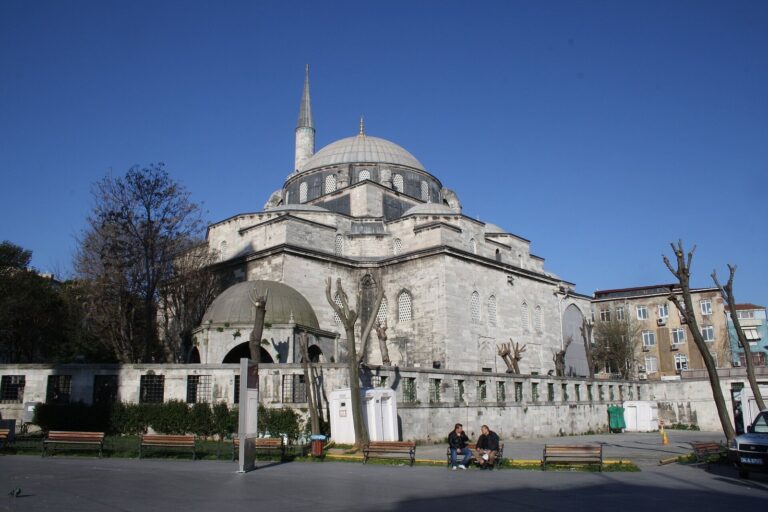
After the Ottoman conquest of Constantinople in 1453, the cross was removed and new buildings encroached on the square, ending its use as an open public space. Construction of the Gazi Atik Ali Pasha Mosque began on part of its western side in 1496. The open ground that remained became the Chicken Market, filled with wooden stalls. On the south side, the Envoys’ Inn housed foreign diplomats before permanent embassies were established.
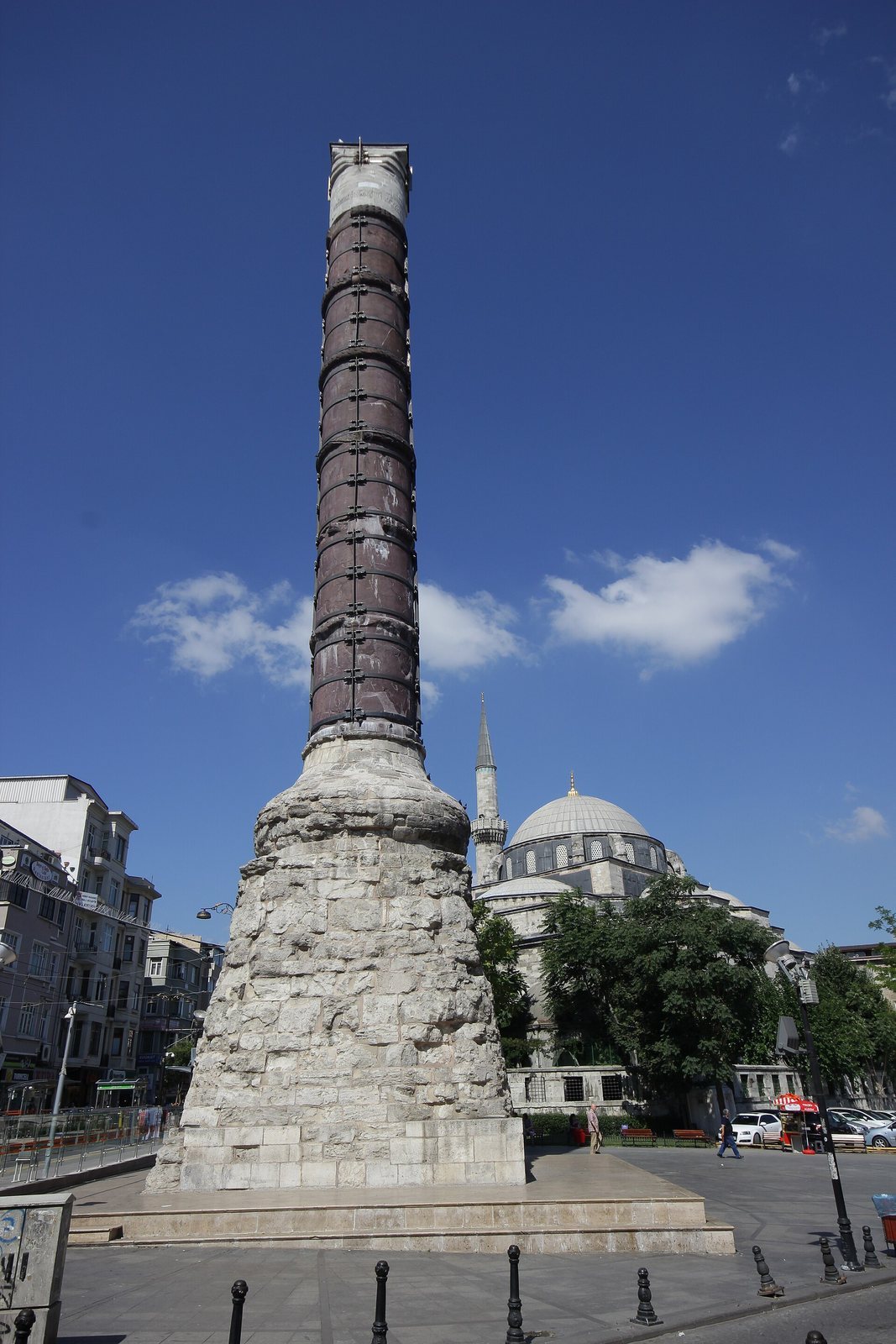
Fire damaged the column in 1515, after which it was reinforced with iron hoops, a repair associated with its Turkish name, Çemberlitaş. Further damage came in a 1587 fire, which also destroyed more than 1,000 nearby houses, an earthquake in 1648, and fires in 1652 and 1660. In 1701, during Mustafa II’s reign, a new masonry base was built over the original. A major fire in 1779 blackened and cracked the column, and Abdülhamid I ordered its restoration.
Modern changes and investigation
The 1865 Hocapaşa fire destroyed surrounding houses and opened a triangular space that became Çemberlitaş Square. A condition report was prepared in 1908, followed by repairs to the column in 1909. From 1919 to 1923, people dug illegally from a nearby coffeehouse after rumors of sacred relics beneath the monument. Archaeological work in 1929–1930 revealed an Ottoman-period water channel and remains of the earlier burial ground.
Restoration in 1955 filled gaps and cracks between the column’s stone sections and renewed its iron hoops. Marble cracks were filled and metal fastenings installed in 1972. Damage from the 1999 earthquake led to further restoration work, begun in 2003 and completed in 2010.
Remains
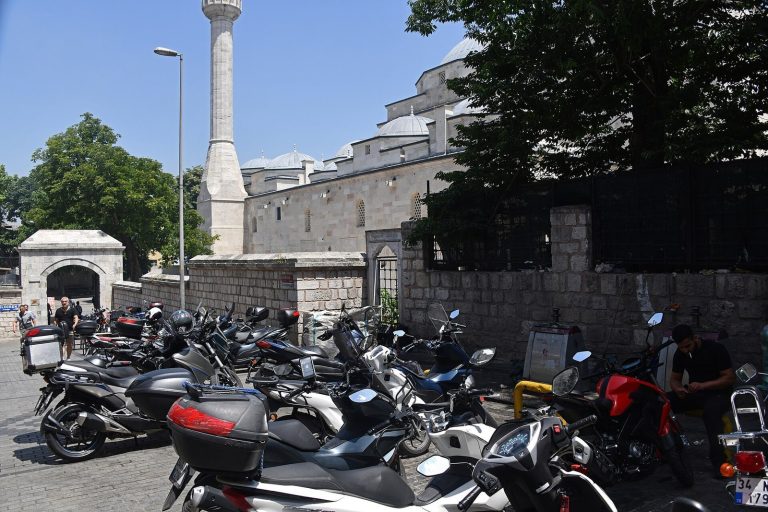
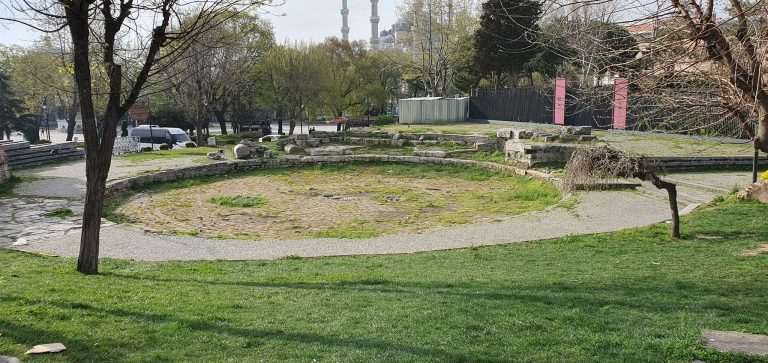
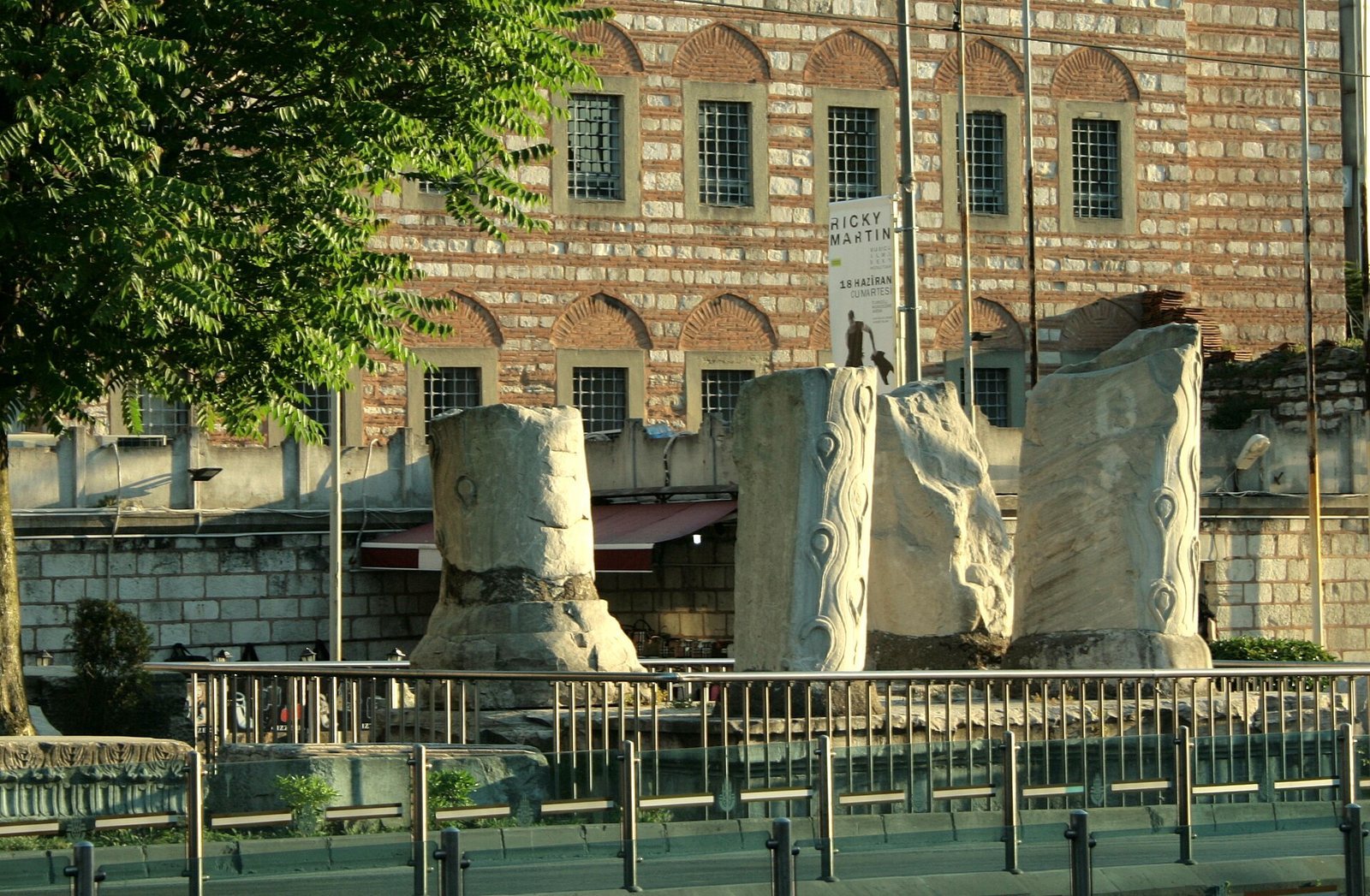
The ancient forum had a rounded plan, enclosed by two-storey colonnaded galleries and semicircular colonnades on its north and south sides. Monumental white-marble arches at the east and west connected it to the Mese, Constantinople’s principal ceremonial street. The square stood on the city’s Second Hill, between the Great Palace and the Forum of Theodosius, at the crossing of the Mese and Makros Embolos, another major street. The Mese linked the area eastward to the Milion, a monument marking the point from which distances were measured, the Augusteon public square, and the Great Palace, and westward to other forums. Today, Çemberlitaş Square occupies a much smaller area. The Gazi Atik Ali Pasha Mosque lies to its west, Nuruosmaniye Mosque to the north, and the former Vezir Hani inn to the east.
Central column
The forum’s central monument was a porphyry column, made from a hard stone often purple in color, and originally about 37 metres high. Its stacked porphyry drums supported a bronze statue of Constantine with a crown of rays, a globe in his left hand, and a spear in his right. The image presented him in solar guise, but its identity has been interpreted in different ways: as Constantine, as Apollo, or as Constantine represented as Helios, the Greek sun god.
The surviving column is about 35 metres high. Its visible structure includes a 10.9-metre masonry casing around the base, six porphyry drums, and a marble Corinthian capital, the carved crown at the top of a column. The capital bears an inscription associated with Manuel I’s restoration. The column’s original base lies 2.35 metres below the present street level. A keystone from one of the forum’s arches is held in the Istanbul Archaeology Museums.
Other architecture
Senate House
The first Senate House, the meeting place of the civic and political council, stood on the north side. An eleventh-century description presents it as a circular building with a portico supported by four large columns. A bronze Athena stood before its entrance, beside another figure identified as either Amphitrite or Thetis. The building also housed a bronze quadriga showing Constantine as the Sun God driving four horses.
Southern fountain
A monumental fountain stood south of the square. It was probably a public nymphaeum, a monumental fountain, decorated with sculpture and water jets.
Monuments and sculpture
Statues and sculpted groups
About 30 monuments stood in the forum apart from its central column. Among them was the Palladion, a legendary protective image of Athena. Sculptures also included figures connected with the Judgment of Paris, among them Paris and the Greek goddesses Hera, Aphrodite, Athena, and Thetis. Other named statues represented Artemis and, possibly, Poseidon, Asclepius, and Dionysus. Dolphins, hippocamps, sea creatures with the front half of a horse and the tail of a fish, sea nymphs, and elephants were also described among the decorations.
Figures associated with the entrances
Figures called the Roman Woman and Hungarian Woman were associated with the western entrance. Decorations linked to the eastern entrance included a cross, Helena Augusta, Constantine, Tyche, and two figures of Victory. Helena Augusta was Constantine’s mother and a Roman empress; Tyche personified fortune and civic prosperity. Other described works included Tritons and Nereids, sea-associated figures, Daniel in the lions’ den, the Good Shepherd, a Christian image of Christ as shepherd and protector, and figures of Constantinople’s patriarchs, senior bishops of the church. The exact placement and appearance of many of these works remain uncertain.