Loŭčycy Mosque: A Tatar Congregational Mosque in Belarus
Site at a Glance
- Popularity
- Medium
- Country
- Belarus
- Primary era
- Early Modern
- Eras represented
- Early Modern
- Civilizations
- Grand Duchy of Lithuania, Polish–Lithuanian Commonwealth
- Site type
- Religious
- Remains
- Mosque
On this page6 sections
History
Loŭčycy Mosque is a Tatar Muslim congregational mosque in Belarus. The present timber building is commonly dated to 1688, although another proposed date places its construction between 1820 and 1840. Its congregation is regarded as one of the oldest Muslim communities in the former Grand Duchy of Lithuania, an eastern European state whose territory included lands now in Belarus and Lithuania.
Origins and congregation
Local tradition places the beginnings of the Muslim Tatar congregation at Loŭčycy around 1420. Tatar historian Stanisław Kryczyński proposed that date on the basis of local legends. Researcher Stanisław Dumin dates the first mosque there to the 1530s. In the early sixteenth century, the village and surrounding lands belonged to Prince Mortuza Bohatyrewicz, an interpreter for Sigismund the Old, king of Poland and grand duke of Lithuania. Land for a mosque had been set aside by 1558 at the latest.
The mosque served as the congregation’s jami, or congregational mosque, and its religious territory extended across Novogrudok County. A mullah, a Muslim religious leader, served the community. During the eighteenth century, the office passed from father to son in the Asanowicz family; a mullah was selected in 1783.
Expansion and modern history
In 1792, the Tatars of Novogrudok received their first royal privilege to build a mosque of their own. Opened in 1796, it remained a branch of the Loŭčycy congregation. At the turn of the twentieth century, the congregation was still active, while the village had about 100 residents and 12 farms.
During the interwar period, the Polish state, known as the Second Polish Republic, placed the mosque under legal protection as a historic monument. After the Second World War, the communist authorities of the Byelorussian SSR, the Soviet republic that preceded independent Belarus, prohibited repairs and eventually closed the building. Its roof collapsed and its floor rotted. A rebuilding plan was prepared and funds secured in 1990. Restoration began in June 1999 with the participation of the Union of Tatars of the Republic of Poland and the Polish foundation Res Publica Multiethnica. The work was completed in 2002, and the mosque returned to use.
Remains
Mosque building
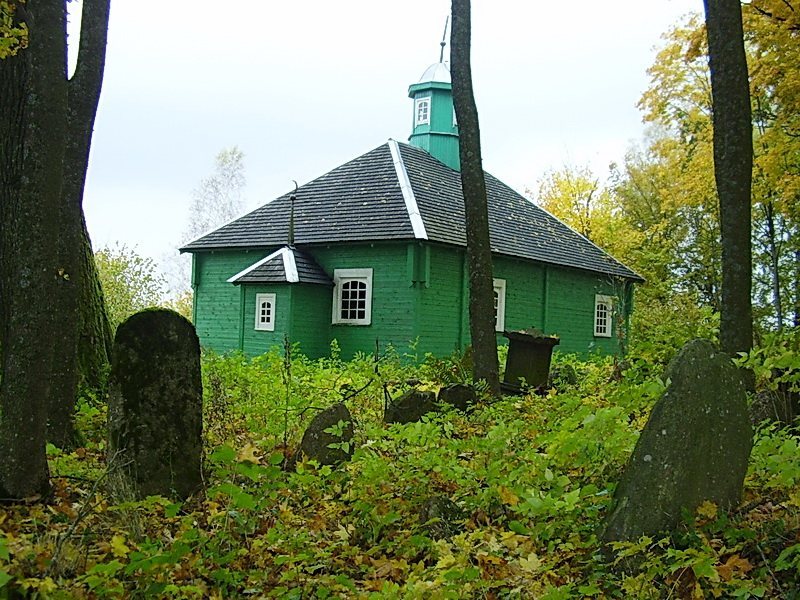
The mosque is an elongated rectangular timber building made from logs. A small vestibule projects from the front, and a hipped roof carries a tower-like minaret, a tower associated with a mosque, at its center. The minaret’s form recalls cupolas on sixteenth- and seventeenth-century Orthodox and Uniate churches. Uniate churches are Eastern Christian churches in communion with the Roman Catholic Church. Inside the mosque, a mihrab, the niche indicating the direction of prayer, has a two-pitched roof.
Cemetery and Kontuś’s grave
A Tatar cemetery, or mizar, lies beside the mosque. Its gravestones belong to several Tatar families who lived in Loŭčycy, including families that owned the village and nearby lands. The cemetery also contains a venerated grave attributed to the legendary Kontuś, regarded by Tatars as a Muslim saint. The grave is associated with a tradition of saint veneration described as the sole surviving example of that cult. Tales written down in 1859 and 1861 say Kontuś could travel instantaneously between Loŭčycy and Mecca.