Fort van Koningshooikt: Belgian concrete fort in Antwerp’s defensive ring


Site at a Glance
- Rating
- 4.1
- Popularity
- Low
- Country
- Belgium
- Primary era
- Modern
- External website
- Open
- Eras represented
- Modern
- Civilizations
- Belgian
- Site type
- Military
- Remains
- Fort
History
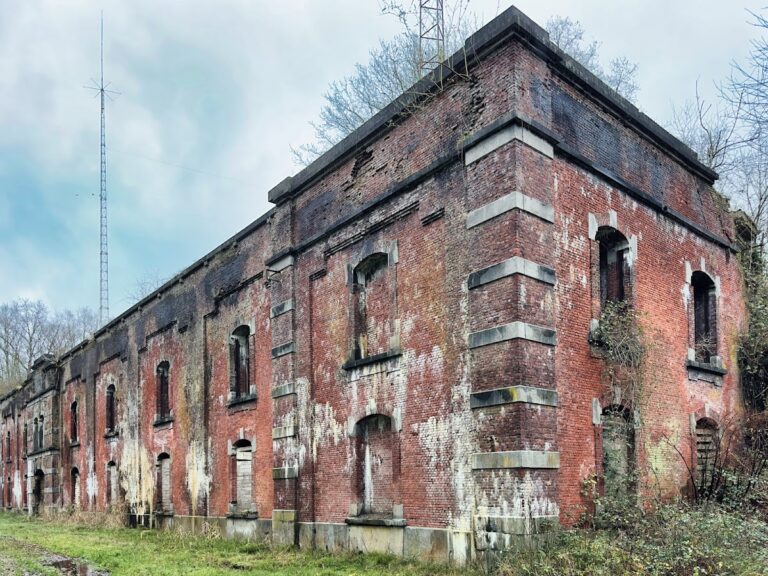
Fort van Koningshooikt in Lier, Belgium, is an early twentieth-century Belgian-built concrete fort that formed part of the outer ring of defenses for the city of Antwerp. Constructed as a component of the National Redoubt, a state plan to hold Antwerp as a final defensive stronghold until allied relief could arrive, the fort belongs to the era of modern fortification that used large concrete works rather than traditional masonry. Its role was to help secure Antwerp against siege and to serve as part of a coordinated network of forts and controlled inundations around the city.
Planning for Antwerp’s modernized defenses began after an 1859 decision to designate the city as the National Redoubt, followed by shifting approaches after the Franco‑Prussian War of 1870, which exposed the need for updated artillery-proof works. An earlier band of Brialmont forts dated to 1859, but the final scheme moved toward an outer line better suited to more powerful guns. The Belgian parliament approved the completed plan by law on 30 March 1906. The main defensive disposition called for sixteen forts and ten redoubts on the right bank of the Scheldt and five forts with two redoubts on the left bank. Following land acquisition, construction of Fort van Koningshooikt was awarded on 27 February 1909 with a contractual completion date of 1 July 1912. Built as a first-order fort from unreinforced concrete, it was originally intended to withstand 21-centimeter artillery; the concrete mix was adjusted after 1905 to increase cement content in an effort to resist larger 28-centimeter guns.
At the outbreak of the First World War the fort garrison numbered about 450 men. It came under heavy German artillery fire beginning at the end of August 1914 and functioned as an infantry support point while held by Belgian forces. A major German offensive against the Antwerp position began on 27 September 1914, conducted by the Third Reserve Corps of the German First Army under General von Beseler. Shelling opened on 28 September by four 30.5-centimeter Skoda mortar pieces from Battery 8, commanded by Amann. On 30 September and 1 October German forces brought 42-centimeter siege artillery into action; two direct hits detonated ammunition magazines within the fort. The damage rendered the position unusable and Belgian troops neutralized the fort on 2 October and withdrew. German forces occupied it on 3 October 1914. The fall and neutralization of Koningshooikt, together with the losses of Walem and Sint‑Katelijne‑Waver on 2 October, Kessel on 4 October and Broechem on 7 October, broke the Antwerp fortress position.
Between the wars the fort’s heavy guns were removed and replaced with machine guns, ventilation systems and emergency exits were altered, and an anti‑tank ditch was dug to adapt the site to newer defensive concepts. During the Second World War the fort did not see combat; it formed part of the Koningshooikt‑Waver defensive line and was used by German occupiers for storage. After 1945 the site passed into private ownership. The defensive moat around the fort is today accessible for walking, while the interior has been used for sports and recreational events, including fishing, off‑road vehicle competitions and airsoft. The fort also serves as an overwintering habitat for bats. Conservation steps taken for bat protection include seasonal closure of wintering areas beginning in October, installation of shutters to reduce drafts and unauthorized entry, provision of managed access to a watercourse, and removal of soot deposits. The Antwerp fort belt is recognised as an important bat habitat within the Natura 2000 network and a 2009 count recorded 134 individual bats representing roughly eight species overwintering in the forts.
Remains
The fort occupies roughly twenty hectares and follows a trapezium-shaped plan set within a surrounding moat that measures about forty to fifty metres across. The primary fabric is unreinforced concrete, constructed in the early twentieth century to the standards of its time. This concrete was originally proportioned to resist bombardment from 21-centimetre guns, and after the 1905 siege of Port Arthur the mix was adjusted to increase cement content in an attempt to better withstand heavier shells.
Long-range gun positions were arranged in armored turrets. Two turrets each held a pair of 15-centimetre guns, two turrets were fitted for 12-centimetre howitzers, and four turrets carried 7.5-centimetre guns. The fort also contained two observation cloches, armored observation cupolas that provided protected lookout positions. Close-in defense along the moat relied on rapid-fire pieces, with sixteen 5.7-centimetre guns placed to defend the ditch and flanking sectors. A mutual-fire arrangement, here described as a grand flanking layout, grouped two 7.5-centimetre and two 12-centimetre guns so neighboring forts could support one another with crossfire.
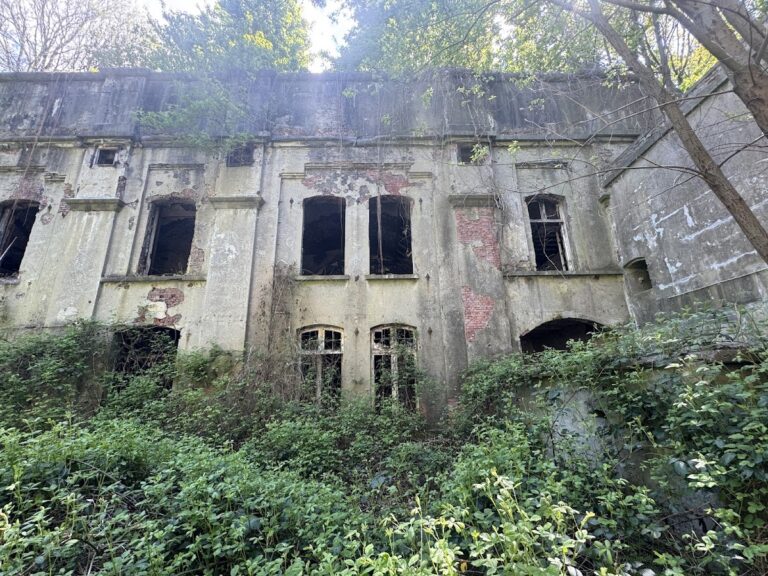
The interior included ammunition magazines to supply the turreted and close-range guns. Two of these magazines were struck and destroyed during the German bombardment at the end of September and beginning of October 1914, which contributed directly to the fort’s neutralization. In the interwar years the original heavy gun mounts were removed and machine guns took their place, while alterations were made to ventilation and emergency exits and an anti‑tank ditch was cut into the surrounding ground.
Later twentieth-century interventions left visible traces inside the perimeter. An off‑road circuit was laid out within the fortland, and on a hilly three and a half hectare interior plateau two large bunkers stand amid a network of passages, niches and rooms that have seen use for airsoft and similar activities. The defensive moat remains in situ and is used for recreational fishing, with day and annual permits established. Physical conservation measures to protect wintering bats have been implemented on the fort, including fitted shutters, a seasonal closure regime from October, managed access between fort and watercourse, and removal of soot from internal surfaces to improve roosting conditions. These elements survive as part of the site’s layered history and current use.
Nearby sites