Fort Takapuna / O Peretu: A Coastal Defence Fort in Auckland
Site at a Glance
- Rating
- 4.8
- Popularity
- Very Low
- Country
- New Zealand
- Primary era
- Modern
- External website
- Open
- Eras represented
- Modern
- Civilizations
- British
- Site type
- Military
- Remains
- Fort
On this page9 sections
History
Fort Takapuna / O Peretu is a coastal fortification in Auckland, New Zealand, built between 1886 and 1889 as part of the defences around Auckland Harbour. The land was purchased in 1886 for £17,000, although the sale was controversial because the seller was rumoured to have failed to sell it for £3,000 the previous year. Major Tudor-Boddam, a Royal Artillery officer, designed the fort.
Construction and harbour defence
The early fort included a barrack building and an underground battery intended to protect the Rangitoto Channel. Its armament comprised two 6-inch disappearing guns, which could be lowered behind protective cover after firing, and two smaller Nordenfelt guns. An underground steam-engine room and two searchlights were added in 1899. The guns were scrapped in 1926, while the searchlights continued in use until the end of the Second World War.
Military training and wartime uses
From 1900 to 1914, Fort Takapuna served as a depot for the Volunteer and Territorial Forces, part-time military forces intended to support the regular army. During the First World War, it became a training area for Māori and Cook Island reinforcements. German prisoners of war were housed there in 1918, and the fort was used as a hospital during the Spanish Flu pandemic in 1919.
At the beginning of the Second World War, the site was divided between the 4-inch guns and searchlights and the District School of Instruction. Forty-eight additional buildings were constructed, along with roads and parade grounds. Several barrack buildings were restored in 2014.
Naval occupation and later development
The Royal New Zealand Navy first occupied Fort Takapuna in 1927, after the fort had been considered obsolete for the Royal New Zealand Army. The navy used it as a munitions depot from 1927 to 1937, and a naval base remains on part of the site. In 1963, the Royal New Zealand Navy transferred its New Entry Training School from Motuihe Island to Fort Takapuna and added Gunnery and Officer Training schools. The Officer and Trade Training schools remain on part of the site.
Historic reserve
Fort Takapuna Historic Reserve, including the old fort and gun emplacements, opened on 18 June 2000. The site is administered by the Department of Conservation and is a Category 1 Historic Place, the highest heritage classification used by Heritage New Zealand for places of special or outstanding historical or cultural significance. Its heritage designation was recorded on 4 April 2001.
Remains
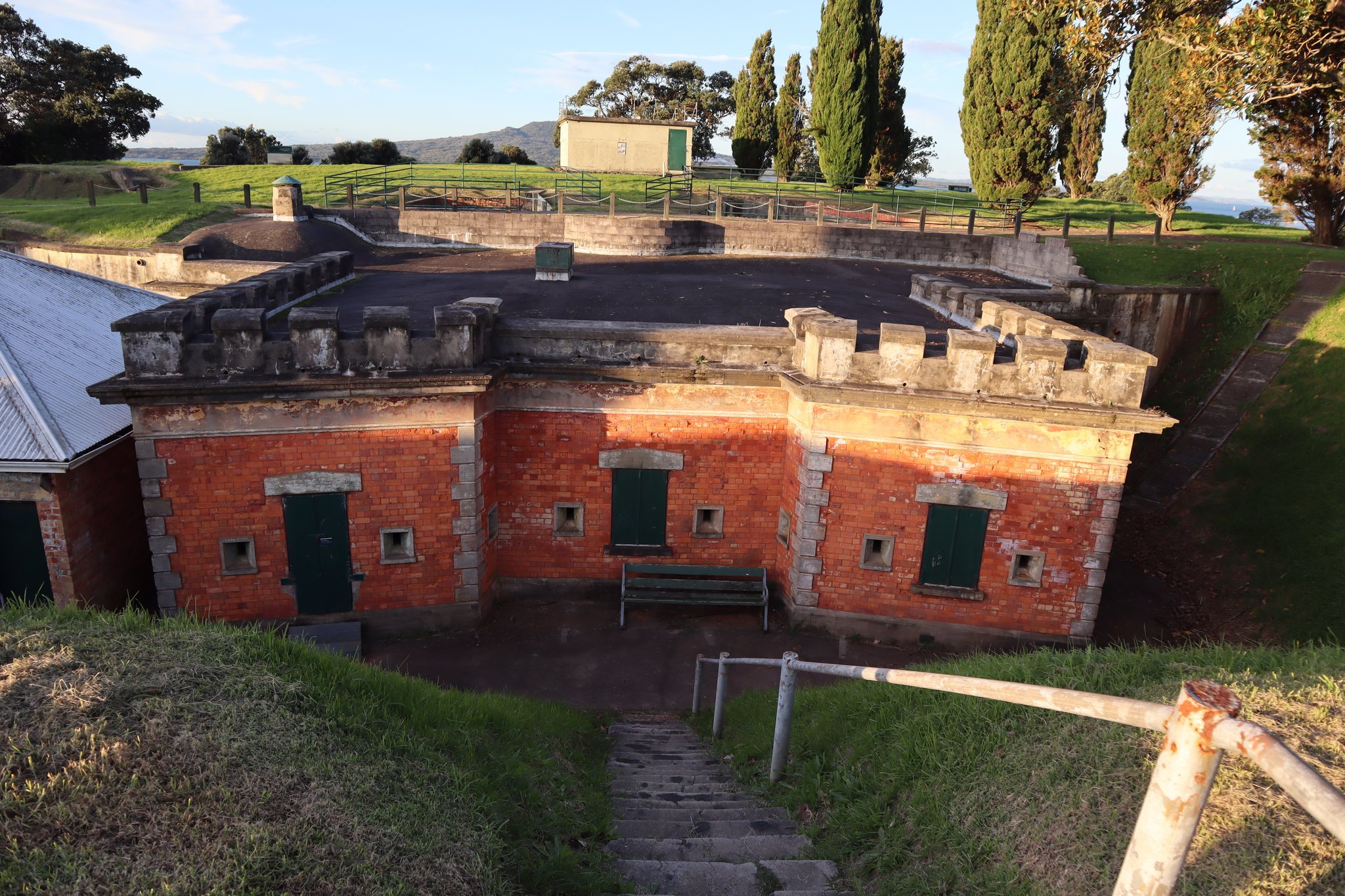
The site consists of fortifications and military buildings added during successive phases. Its principal elements include the early underground battery, tunnels and engine room, later munitions facilities, cliff-top gun emplacements, and buildings associated with observation and training.
Underground battery and searchlights
The underground battery contained two circular gun pits for the 6-inch disappearing guns and positions for two smaller Nordenfelt guns. The guns were directed towards the Rangitoto Channel. The underground steam-engine room was added in 1899, together with two searchlights. One searchlight stood in a tunnel on the right side of the courtyard, while the other was west of the engine room and reached through a tunnel at its rear.
Munitions and later gun positions
When the fort was converted for munitions storage in 1927, the gun pits and the building beside the old barracks were roofed over. Additional magazines were built near the area now used as playing fields. These changes altered the earlier artillery layout for naval storage.
Three 4-inch gun emplacements were constructed on the cliff top in 1938 as white concrete structures. The guns had originally belonged to HMS New Zealand, a British Royal Navy warship funded by New Zealand and associated with the country’s naval defence before the First World War.
Observation and military buildings
Two naval observation-post buildings from the Puna Observation Post station are associated with Fort Takapuna. A naval observation post was a military position used to watch an area and support the direction of fire. The wider site also includes the early barrack building, later military structures, roads, and parade grounds added during its changing use.