Fort Senneville: A French Colonial Defensive Fort
Site at a Glance
- Popularity
- Medium
- Country
- Canada
- Primary era
- Early Modern
- Eras represented
- Early Modern
- Civilizations
- French
- Site type
- Military
- Remains
- Fort
On this page9 sections
History
Fort Senneville is a French colonial fort near the western end of Montreal Island in Canada. Residents of Ville-Marie, the French settlement that became Montreal, established its first stockade in 1671, when the area formed part of New France, France’s colony in North America. The outpost helped defend French settlements against Iroquois incursions. The Iroquois were Indigenous peoples of northeastern North America, including the Haudenosaunee Confederacy.
Foundation and defensive rebuilding
In 1672, the Sulpicians, a Catholic association of priests active in New France, transferred the surrounding fief, a grant of land under the French seigneurial system, to Michel-Sidrac Dugué de Boisbriant. After he gave it up to settle a debt, fur traders Jacques Le Ber and Charles Le Moyne took ownership and used the property as a trading post. By the 1680s, Le Ber held the land alone and named it Senneville, after his birthplace in France.
At Governor Denonville’s request, Le Ber had a stone building and windmill constructed in 1686. The mill soon served as a watchtower and defensive position. In October 1687, Iroquois attackers struck both the mill and nearby Fort Sainte-Anne. They were driven back, but several settlers died. A later assault in 1691 burned the fort, while the mill survived.
After the 1690 Battle of Quebec and the 1691 attack, Governor-General Louis de Buade de Frontenac ordered a larger, more strongly defended fort. Jacques Le Ber de Senneville arranged further rebuilding in 1702–1703, placing the work in the hands of his son, also named Jacques. The fort was completed in 1703. A large stone house was built that year, and a seigneurial manor house, the residence associated with a landholding, followed locally in 1706.
Trade, garrison, and changing use
The fort protected fur trading and offered refuge to local inhabitants. Its position on the Ottawa River served the trade, which faced competition from a post across the river at Vaudreuil, established by Governor-General Philippe de Rigaud de Vaudreuil. During the eighteenth century, as French trading posts and forts spread into western territories, Senneville’s trading role declined. Farmers and millers then used the property. Around 1748, it again took on a military role against Iroquois threats and housed a garrison.
Following the 1763 Treaty of Paris, the fort lost its military function and did not become a British military post. In 1774, its owner, Montreal fur trader Jean-Baptiste-Jérémie Testard de Montigny, arranged repairs so it could serve as a residence, depot, and shop. American troops under Benedict Arnold burned it in 1776 during the American Revolutionary War, in military manoeuvres associated with the Battle of the Cedars. The fort was abandoned, and its stones were later reused in nearby construction.
Later ownership and preservation
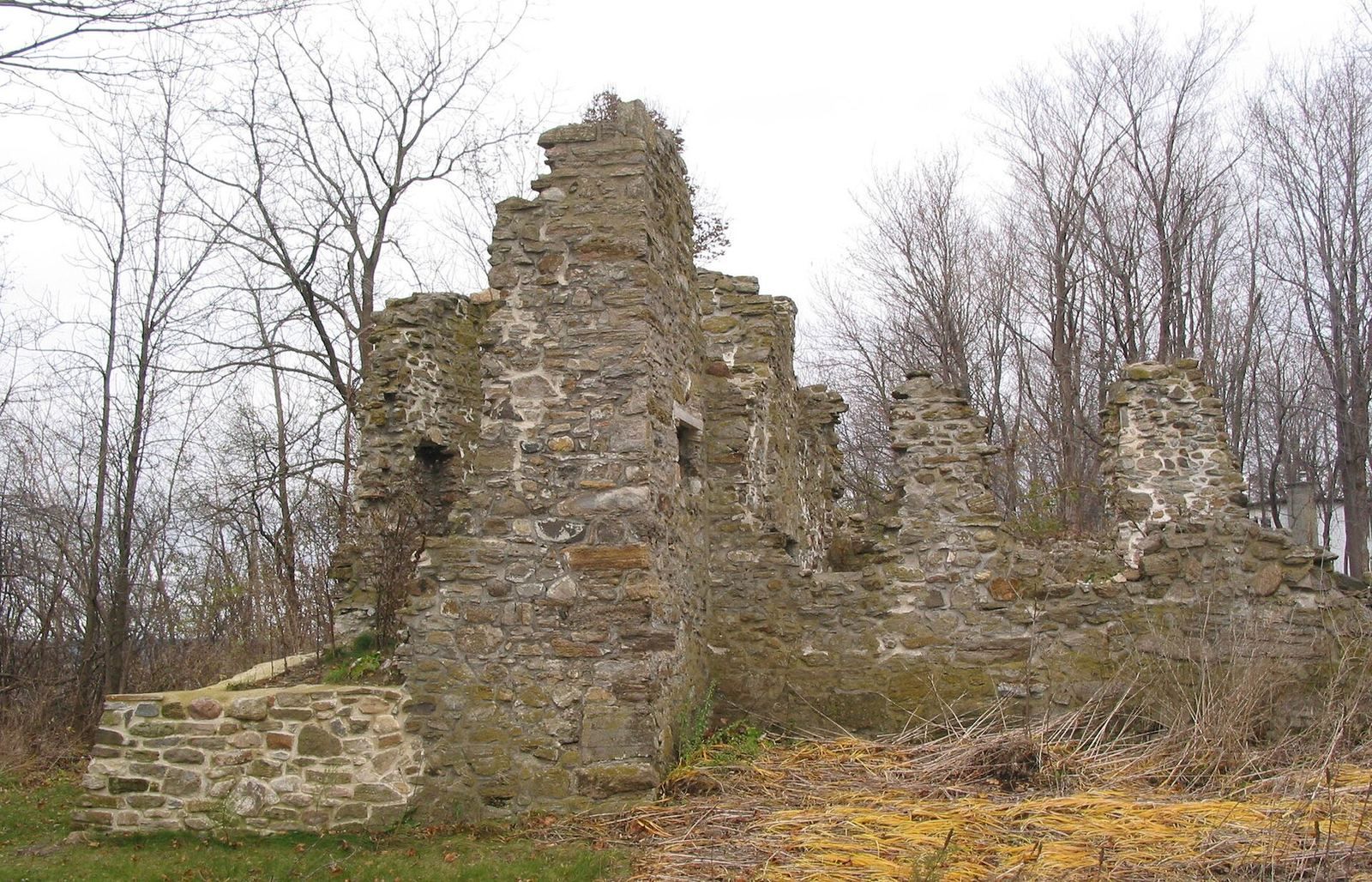
John Joseph Caldwell Abbott acquired the property in 1865 for use as a summer residence. Edward Seaborne Clouston purchased the domain from Abbott’s estate in 1898. In 2003, Quebec classified Fort Senneville as a historic and archaeological site under its Cultural Property Act. Provincial research and archaeological work examined the fort and its ownership, while repairs helped consolidate the ruins. The site is considered evidence of the small, isolated forts used to defend the colony. It is one of two forts identified as surviving on Montreal Island; the other is Fort de la Montagne des Sulpiciens, erected around 1686.
Remains
Fortifications and mill
The ruins occupy a site measuring about 4 hectares, while the fort itself is described as approximately 20.11 by 9.14 metres. Its earliest form was a stockade, a defensive barrier of upright stakes or logs. The later fort was a castle-like structure built of stone and wood, with thick walls and defensive projections at its corners.
Windmill and watchtower
Built on a hill in 1686, the large stone windmill overlooked the Ottawa River, Lake of Two Mountains, and the mouth of the Des Prairies River. Its thick walls contained square openings for muskets. Openings in the overhanging upper wall, called machicolations, allowed defenders to drop hot liquids or stones on attackers below. The mill was rebuilt in 1700 and probably remained in use until the 1780s.
Later fortifications
The fort’s corner bastions, projecting structures designed to direct defensive fire along the walls, carried cannons and swivelling wall guns. Several cannons stood at the four corners of the ramparts. The surviving site consists of ruins, including remains of the fortified complex.
Shoreline setting
The remains lie west of Chemin de Senneville, just north of the Île-aux-Tourtes Bridge. The shoreline retains a semi-natural condition and provides habitat for the rare map turtle. Between Lake of Two Mountains and the Senneville Forest ecoterritory, the site may also form part of a wildlife corridor linking the lake and forest.