Fort de la Montagne: A Sulpician Fortified Domain in Montreal
Site at a Glance
- Rating
- 4.7
- Popularity
- Very Low
- Country
- Canada
- Primary era
- Early Modern
- Eras represented
- Early Modern, Modern
- Civilizations
- British, French
- Site type
- Military
- Remains
- Fort
On this page9 sections
History
Fort de la Montagne, also called Fort des Messieurs or Fort Belmont, is a former Sulpician fortified domain in Montreal, Canada. Established in the late seventeenth century in the French colonial and Baroque traditions, it protected a mission and its inhabitants from the Iroquois.
The Mission at Mount Royal
A mission intended to Christianize and francize Indigenous people was established at the foot of Mount Royal in 1675. In 1683, about 210 Iroquois, Hurons, and Algonquins lived there. The mission operated within New France, the French colonial territory in North America before the British conquest of Canada.
François Vachon de Belmont, a Sulpician missionary, arrived in New France around 1680 after being sent by the superior of the Society of the Priests of Saint-Sulpice in Paris. This Catholic priestly society was involved in religious education, missionary work, and parish administration. Belmont paid for the fort’s construction himself around 1685, creating a protected domain for the mission.
Relocation and Later Use
The fort remained in use from 1685 until 1854. In 1696, a major fire broke out, helping accelerate the transfer of the inhabitants to the Indigenous mission at Sault-au-Récollet, where Fort Lorette was built. The relocation was intended in part to remove neophytes, or recent converts, and catechumens, people receiving religious instruction before baptism, from the drunkenness and seduction associated with the cities.
The mission at La Montagne closed permanently in 1705. The land was then leased to farmers, and some of them temporarily lived within the fortifications. In 1825, an additional floor was added to the Château des Messieurs, the domain’s principal residence, and a chapel was installed in the east tower.
Destruction and Preservation
Construction of the present Grand Seminary in 1854 destroyed the fort’s ramparts, palisades, and four bastions. A bastion is a projecting defensive structure, while a rampart is a defensive wall and a palisade is a fence of stakes or posts. Only the two southern towers survived. The building that now houses Collège de Montréal was constructed beside the Grand Seminary in 1867.
The surviving towers were restored between 1984 and 1986. They became part of the classified historic site of the Domaine des Messieurs-de-Saint-Sulpice in 1982. The towers had already been designated a National Historic Site of Canada in 1970 under the name Sulpician Towers / Fort de la Montagne National Historic Site of Canada, and Quebec classified them as historic monuments in 1974. The property is owned by the state.
Remains
Surviving Fortifications and Waterworks
Southern Towers
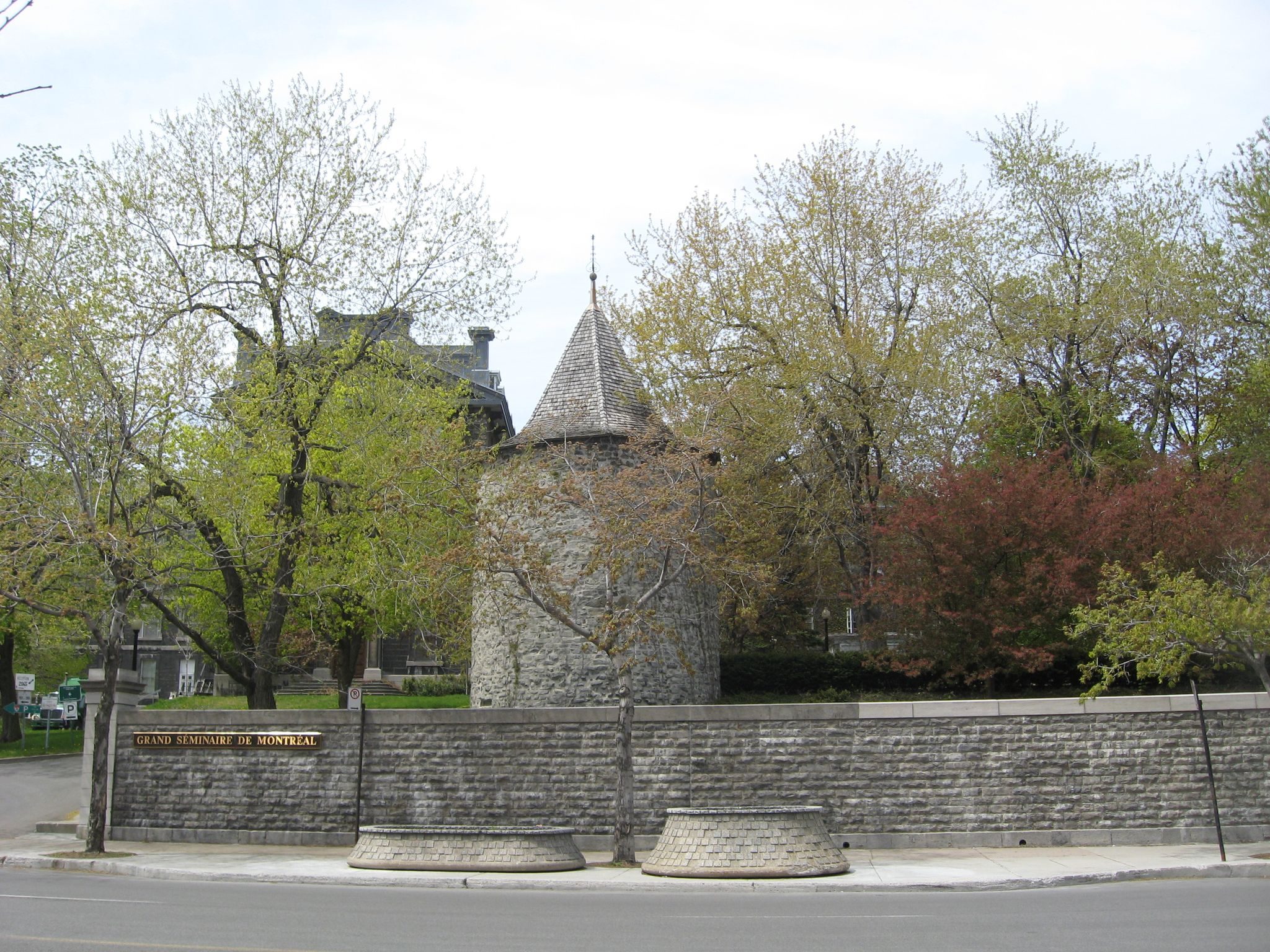
The surviving remains are the two southern stone towers, built in 1694 as bastions of the fort. They stand beside the Grand Seminary and Collège de Montréal on Sherbrooke Street and rise approximately 13 metres. They are among the oldest surviving structures on the Island of Montreal. Their restoration in the 1980s preserved the principal visible remains of the fortified domain after the destruction of its other defensive elements.
Domain Basin
Three successive basins were built on the Sulpician domain. The first may have been established before the towers, when the mission was founded around 1675. The basin visible today remains functioning and was restored by the Sulpician Antoine-Alexis Molin in 1801.
Principal Residence
The Château des Messieurs served as the principal residence of the domain. An additional floor was added in 1825, and a chapel was arranged inside the east tower during the same year. These changes formed part of the later use of the former fortified property after the mission had moved to Sault-au-Récollet.