Fort of Coimbra: A Portuguese Colonial Border Fort in Brazil
Site at a Glance
- Popularity
- High
- Country
- Brazil
- Primary era
- Early Modern
- Eras represented
- Early Modern, Modern
- Civilizations
- Portuguese
- Site type
- Military
- Remains
- Fort
On this page9 sections
History
The Fort of Coimbra is a Portuguese colonial border fort at the São Francisco Xavier narrows of the Paraguay River in Brazil. Planned after the 1750 Treaty of Madrid, an agreement concerning Spanish and Portuguese territorial claims in South America, it was founded in 1775 to mark the frontier, obstruct Spanish expansion, and help deter raids by Payaguá and Kadiwéu communities. King Joseph I of Portugal commissioned the project.
Foundation and early attacks
Captain Matias Ribeiro da Costa led 245 men in 15 canoes from Cuiabá on July 22, 1775. Their orders directed them to establish the fort near Fecho dos Morros, about 300 kilometres farther downriver, but the expedition misidentified the location. The men founded the post at the São Francisco Xavier narrows on September 13, and it was inaugurated four days later under the dedication of Our Lady of Mount Carmel. It was also called the Coimbra presidio (fortified military post).
The first enclosure was an earthen and clay palisade with a rectangular, many-sided plan. Its long side measured about 40 braças, a traditional unit of length. Four small bastions, projecting defensive sections that covered adjoining walls with gunfire, occupied the corners. They were dedicated to Saint Gonzalo in the north, Saint James in the east, Saint Anne in the south, and Our Lady of the Conception in the west. Buildings within included a command house, troop quarters, stores, and warehouses. The artillery came by river from Belém do Pará because Spain barred Portuguese military supplies from passing through the Río de la Plata basin.
A local tradition held that Thomas the Apostle had passed through Fecho dos Morros on his way to Peru, making that intended location sacred and unsuitable for a military post. Another tradition connected Matias with the blessing of the fort’s image of Our Lady of Mount Carmel. Officers who attained the rank of general were said to return one of the gold stars from their epaulettes to her shrine, and her feast day on July 16 was observed at the fort.
Fire badly damaged the original fort within months. Guaycuru forces attacked in 1777, and later Kadiwéu attacks also caused damage. In 1789, Captain-General João de Albuquerque de Melo Pereira e Cáceres ordered Joaquim José Ferreira to establish peace with Indigenous communities. The effort succeeded with the participation of chiefs João Queima and Paulo Ferreira. A further attack in 1791 killed 54 members of the garrison and prompted replacement of the first fort.
Masonry rebuilding and the 1801 siege
Work on a masonry fort began in 1791, when the existing defenses were in poor condition. Captain-General Caetano Pinto de Miranda Montenegro sought a stronger position, partly in response to Spanish construction of Fort Borbón and Fort San Carlos in the border region. Military engineer and geographer Ricardo Franco de Almeida Serra directed the works from 1796, which continued in 1797.
In September 1801, before construction was complete, an expedition led by Lázaro de Ribera, governor of Paraguay, attacked the fort. The force included 600 men carried in four schooners and two canoes, while the garrison had 42 defenders. Spain claimed the fort stood on its territory under the Treaty of Madrid. News that the War of the Oranges, an 1801 conflict between Portugal and Spain, had ended had not yet reached the region. Kadiwéu allies warned the Brazilian defenders of the approaching expedition.
The garrison held out through a siege lasting from September 16 to 25. The attackers withdrew after shortages and storm damage to their ships; Paraguayans lost 20 men. Serra died on January 21, 1809, and a monument at the fort later became the resting place of his remains.
Expansion and the Paraguayan War
In 1851, the fort received four 24-pounder guns, named for the weight of shot they fired, along with smaller 9- and 6-pounder guns. Stored on the Guaporé River since 1820, the weapons had originally been intended for the Royal Fort of Príncipe da Beira. Repairs and enlargement followed in 1855–1856. Amid tensions with Paraguay, provincial president Augusto Leverger temporarily transferred the government of Mato Grosso to the fort in 1855.
Shortly before the Paraguayan War, also known as the War of the Triple Alliance and fought from 1864 to 1870, the fort was judged to be in unsatisfactory condition, though capable of resisting ships and possibly a land assault. Repairs were ordered. Plans also called for strengthening the Navy’s position across the river so that the two defenses could support one another with crossfire.
On December 27, 1864, Paraguayan forces demanded the fort’s surrender at the start of the Mato Grosso campaign. Colonel Vicente Barrios commanded 3,200 men, supported by 12 rifled guns, a French rocket battery, and warships. Captain Benito de Faria was the fort’s regular commander, but Lieutenant Colonel Hermenegildo de Albuquerque Porto Carrero, visiting on an inspection, took charge and refused to surrender.
The Brazilian garrison had 11 serviceable bronze smoothbore guns, whose barrels lacked internal grooves, and 20 more awaiting repair. Its personnel included 125 regular officers and soldiers, about 30 national guardsmen, customs guards, six prisoners, and 24 Indigenous allies. During two days of heavy fighting, soldiers’ families helped load weapons and tend the wounded. With limited means to continue the defense, the garrison evacuated in good order aboard the gunboat Anhambaí on the night of December 28–29. Paraguayan losses were about 200 in failed assaults and reconnaissance, while the Brazilians suffered none.
A tradition about the siege says that on its second day a musician raised an image of Our Lady of Mount Carmel above the walls at Porto Carrero’s wife’s request. In the story, Paraguayan troops stopped firing and shouted in response, allowing some of the fort’s women to go discreetly to the river for water.
Paraguayan forces occupied the fort and its guns until April 1868, when they withdrew with the artillery and stores. After the war ended in 1870, Major Joaquim da Gama Lobo d’Eça began reconstruction under orders from the imperial government. Major Francisco Nunes da Cunha carried out further enlargement in 1872 and strengthened the western defenses.
Later military use and preservation
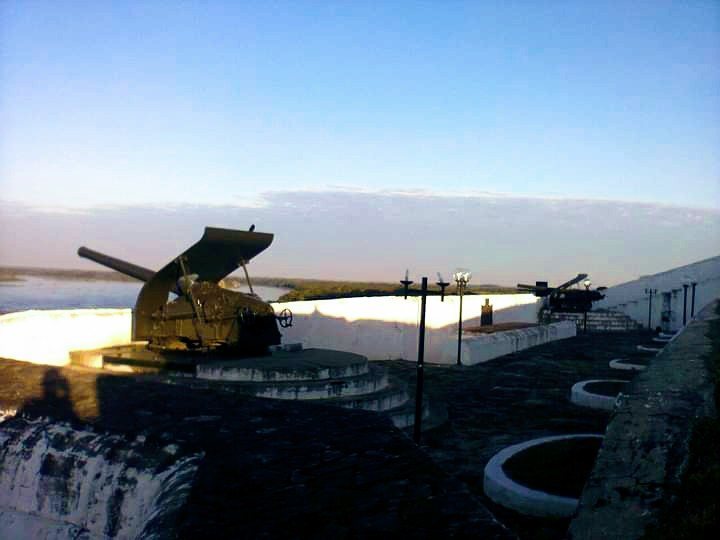
Two 120 mm Armstrong guns taken from the cruiser Barroso were installed in 1907–1908. A 1942 decree formally renamed the fort Porto Carrero in honour of Hermenegildo de Albuquerque Porto Carrero. At that time, the garrison was the 1st Battery of the 6th Coast Artillery Group, and the fort’s armament included four 152.4 mm Armstrong guns.
The National Institute of Historic and Artistic Heritage, Brazil’s federal heritage-protection agency, began acquiring the complex in 1974, the year the fort received national historic heritage status. The Brazilian Army continues to occupy the site.
Remains
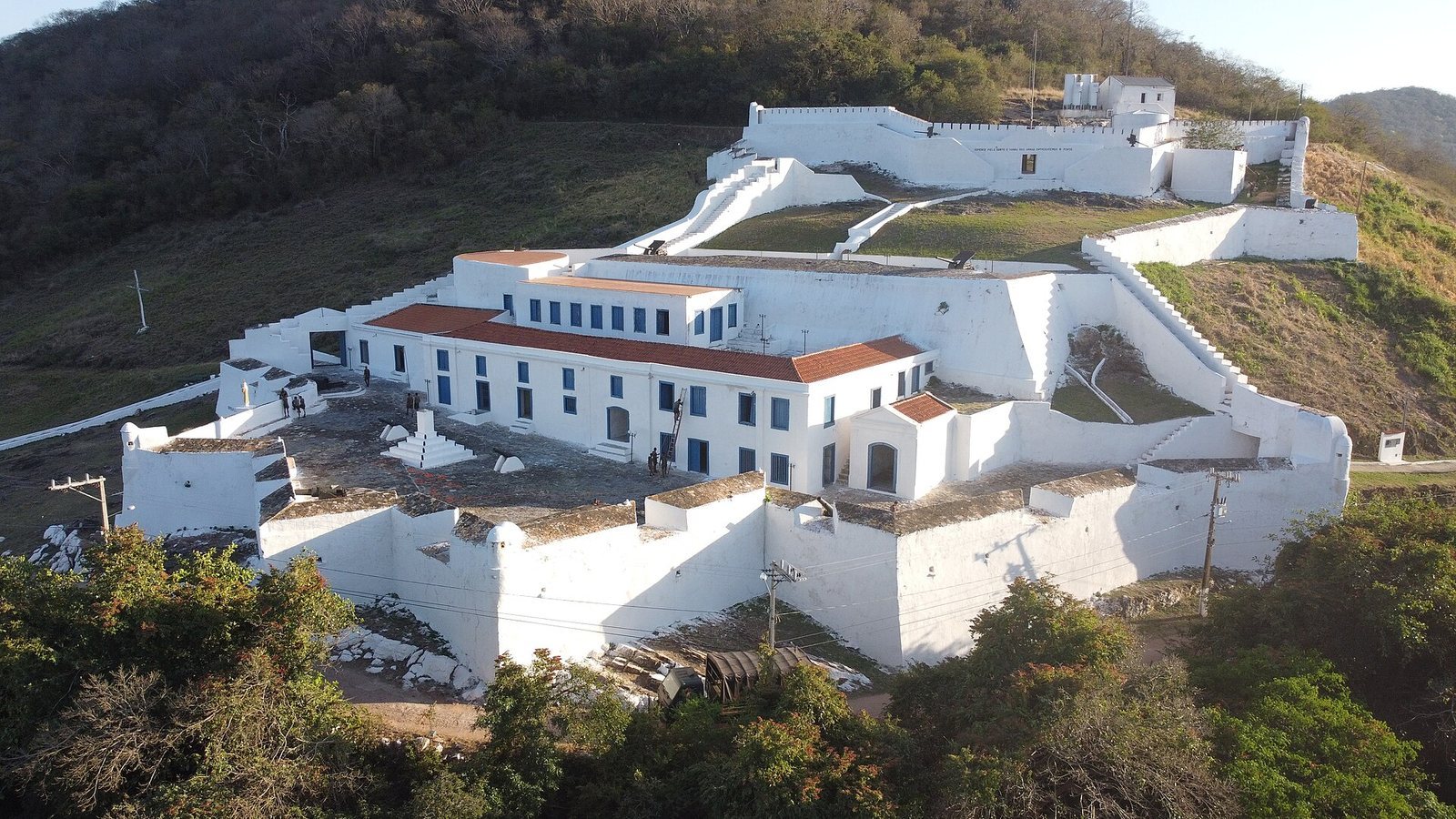
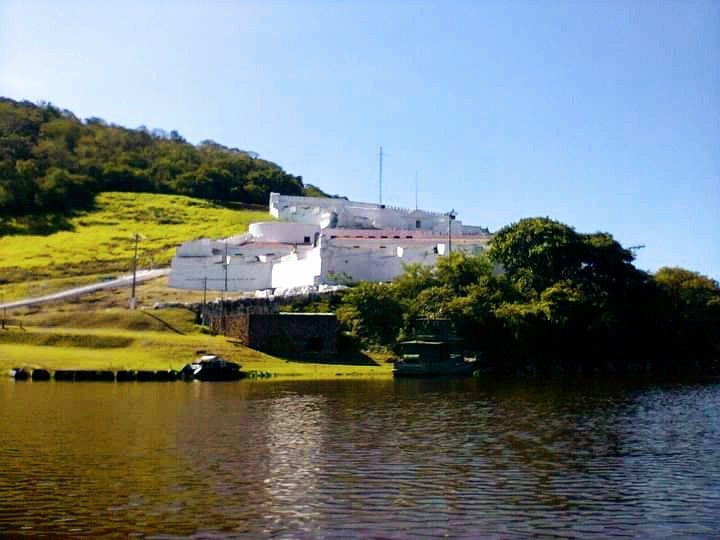
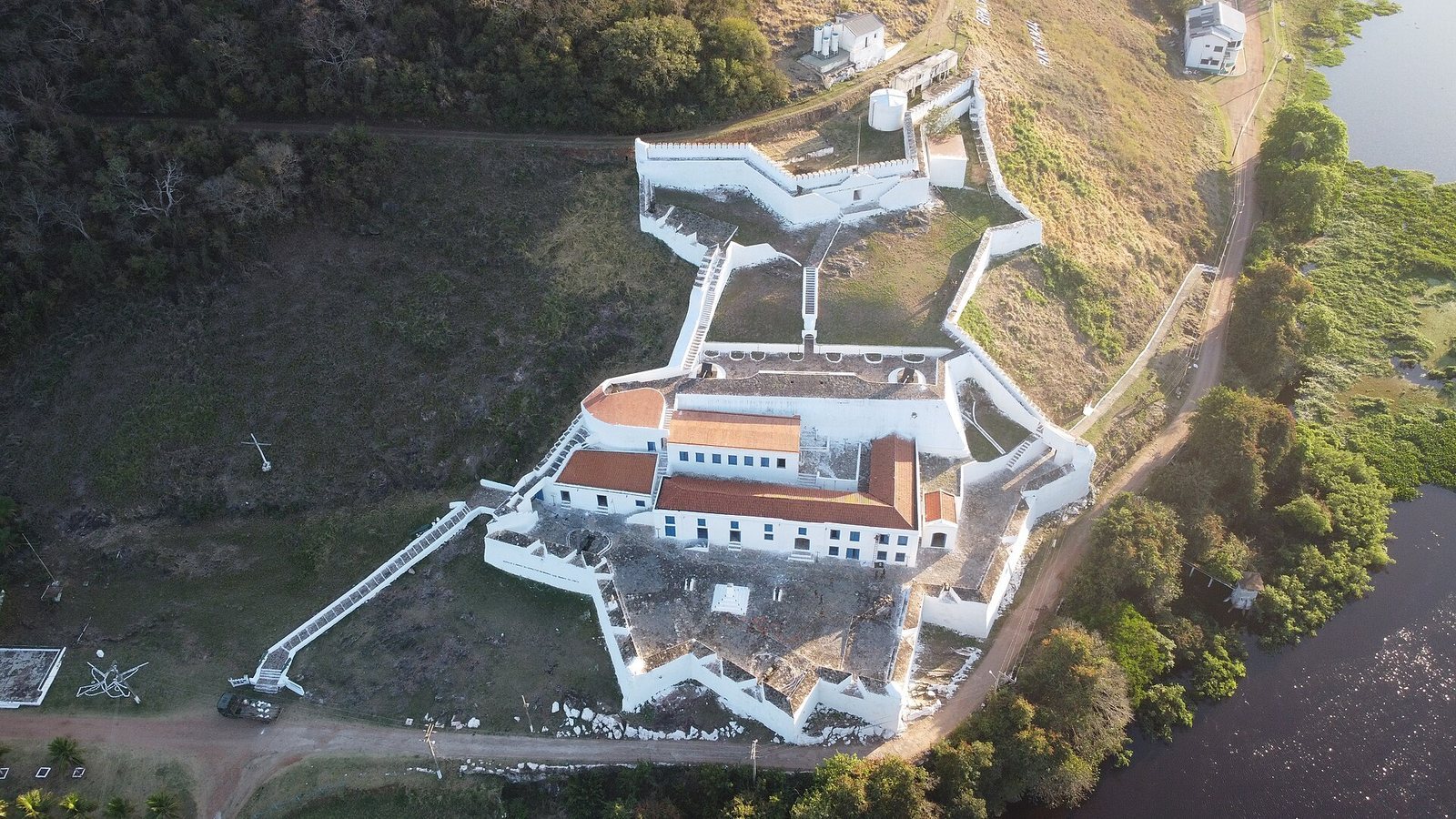
The fort stands on a hill above the São Francisco Xavier narrows, overlooking long reaches of the Paraguay River. Its later defenses follow the hillside, with positions directed toward both the river and the landward approach. A separate frontier position stood on the opposite bank.
Masonry fort
The later fort is built of stone and lime in an irregular, star-shaped plan adapted to the terrain. Its angled sections were designed to give overlapping fields of fire. Enclosing walls follow the slope and contain openings through which weapons could be fired; a moat protected the landward side. Two gun batteries were arranged to fire across one another over the river, with eight gun positions facing the water and eight facing inland. The interior includes a chapel, an arsenal, a secure store for gunpowder, and troop quarters. The fort still stands and displays historical artillery pieces.
Memorial to Ricardo Franco
A monument at the site contains the remains of Ricardo Franco de Almeida Serra, the engineer who directed the masonry works.
River defenses and quarters
A separate artillery position stood on Morro da Marinha, across the river from the fort. By 1942, two Armstrong guns were positioned on the fort hill and two on Morro da Marinha. Quarters built beside the fort in 1930 form another part of the military complex.