Citadel Hill: Halifax’s Historic British Fortress in Canada
Site at a Glance
- Rating
- 4.7
- Popularity
- Medium
- Country
- Canada
- Primary era
- Modern
- External website
- Open
- Eras represented
- Early Modern, Modern
- Civilizations
- British
- Site type
- Military
- Remains
- Citadel
On this page15 sections
History
Citadel Hill is a British-built fortified summit in Halifax, Canada, whose present star-shaped masonry fort was constructed from 1828 to 1856 during the Victorian era. Halifax was founded in 1749 under Governor Edward Cornwallis as a British counterweight to Louisbourg, the French stronghold returned to France the previous year. The settlement became a strategic centre in the continuing imperial rivalry for control of the region, and the hill formed part of Halifax’s defence against attacks by French forces, colonial Acadians, and the Wabanaki Confederacy, an alliance of Indigenous nations that included the Mi’kmaq.
Foundation and early fortifications
Edward Cornwallis arrived on 21 June 1749 with a sloop of war and 13 transport vessels carrying between 1,176 and 2,500 settlers. The first Citadel, built that year, was a small redoubt, or compact fortified work, near the summit. It formed part of Halifax’s western defensive perimeter, which included five stockaded forts. The British also established related positions at Bedford, Dartmouth, Lunenburg, and Lawrencetown, while Fort Charlotte was built on Georges Island in Halifax Harbour in 1750.
During the French and Indian War, the Halifax fortifications supported British operations against the Acadians. Many Acadians were imprisoned on Georges Island before their deportation. During Father Le Loutre’s War, an eighteenth-century conflict in Nova Scotia involving the British, French, Acadians, Mi’kmaq, and other Wabanaki groups, Halifax and Dartmouth endured at least 12 raids. Four were directed against Halifax. In 1757, Pierre Gautier led three raids from Louisbourg, and during the last, in September, he and four Mi’kmaq warriors killed and scalped two British men at the foot of Citadel Hill. Another raid killed Cornwallis’s gardener, his son, and four other people.
The Second and Third Citadels
The first fortification deteriorated, and a replacement was planned in 1761. Construction was delayed during the Seven Years’ War, a major eighteenth-century conflict between Britain and France and their allies, but the rebellion of the Thirteen Colonies created a renewed threat. The Second Citadel was therefore built in 1776. It guarded Halifax during the American Revolutionary War, while the garrison remained alert because of American privateer raids in Nova Scotia and naval battles offshore.
By 1784, the Second Citadel was largely in ruins apart from its blockhouse. The works were dismantled when construction of the Third Citadel began. Designed in 1794 and completed around 1800, the third fort was officially named Fort George by General Orders of 20 October 1798 in honour of King George III. Prince Edward, Duke of Kent, who commanded British forces in Halifax from 1794 to 1800, influenced its design and improvement. The fort received hurried repairs and a new magazine during the War of 1812, but by 1825 it was largely ruinous apart from its powder magazine.
Construction of the present Citadel
Construction of the present Citadel began in 1828 and continued until 1856. Britain built it during heightened tensions with the United States to protect Halifax and its Royal Navy dockyard from attack by land or sea. The design is attributed to Colonel Gustavus Nicolls of the Royal Engineers, the British Army corps responsible for military engineering. It drew on the principles of Sébastien Le Prestre de Vauban, the French military engineer whose seventeenth-century system of projecting bastions and overlapping fields of fire influenced later European fortresses.
The fort’s role changed after more powerful rifled artillery, with spiral grooves inside the barrel, was introduced in the 1860s. Its weapons were upgraded, and the Citadel became a command centre for more distant harbour defences as well as a place for barrack accommodation. British forces occupied the hill until 1906, when the fort was transferred to Canada’s Department of Militia and Defence. Canadian troops subsequently used it during the First World War.
Twentieth-century military use and preservation
The 78th (Highlanders) Regiment of Foot was stationed in Halifax from 1869 to 1871, with soldiers billeted at the Citadel and Wellington Barracks. During the American Civil War, the garrison remained on alert during the Chesapeake Affair and after Confederate officer John Taylor Wood escaped from Halifax Harbour aboard the Tallahassee.
From September 1914 to October 1918, Fort George contained one of Nova Scotia’s internment camps for enemy aliens. The internees there were mainly ethnic German reservists. During the Second World War, the fort served as temporary barracks, a signalling station, and the central coordinating point for Halifax’s anti-aircraft defences.
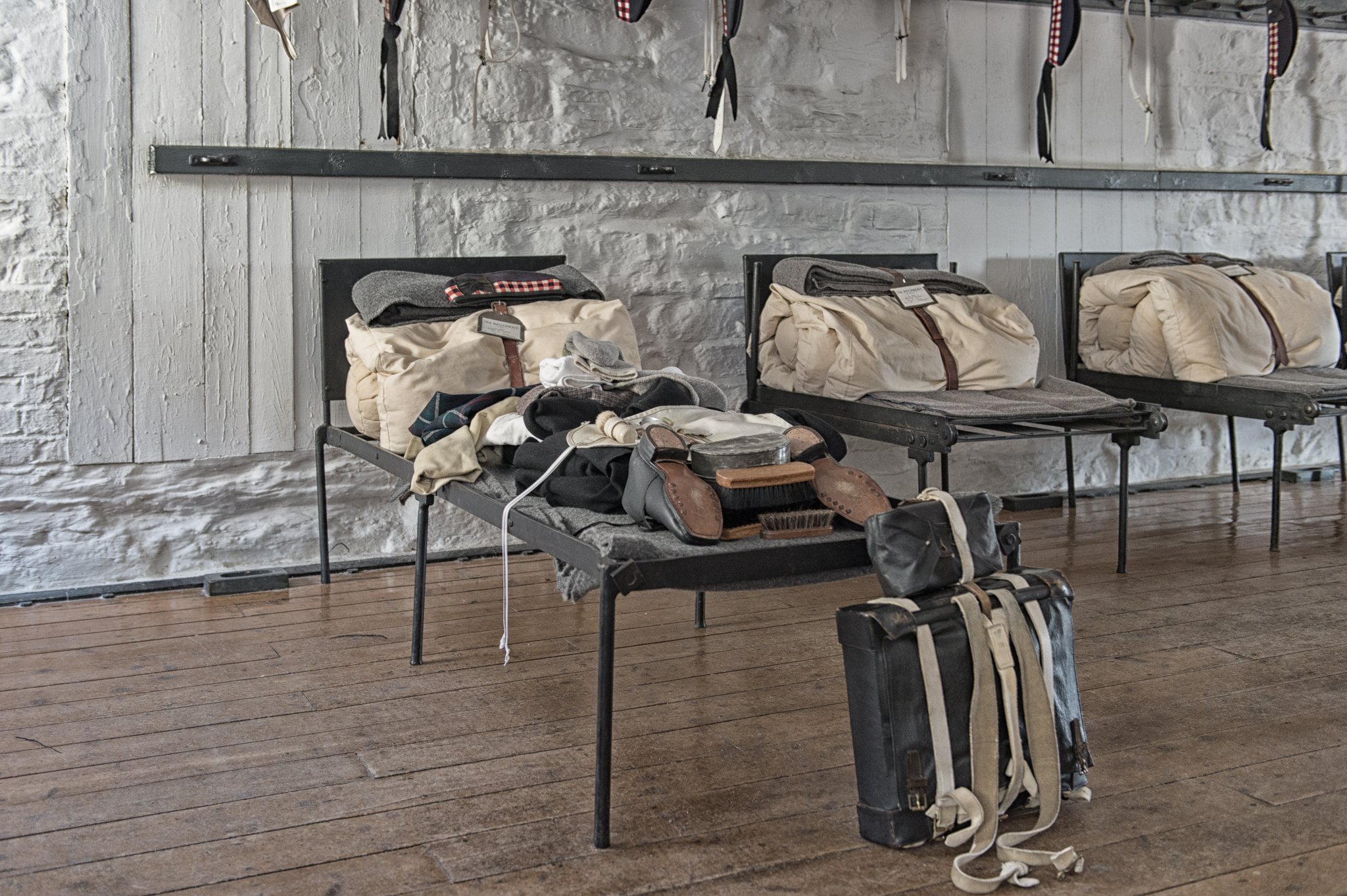
Citadel Hill and its fortifications became a National Historic Site of Canada in 1935 and received stabilization work during the Depression. After the Second World War, proposals called for the fort to be demolished and the hill levelled for parking. Research by historian Harry Piers, together with growing recognition of the site’s historical importance, instead led to preservation and restoration. The partially restored fort opened as a historic site and as the home of the Halifax Army Museum in 1956. It also housed the Nova Scotia Museum and the Maritime Museum of the Atlantic before purpose-built museums were constructed. Parks Canada restored the fort to its 1869 appearance during the 1990s and continues to manage it.
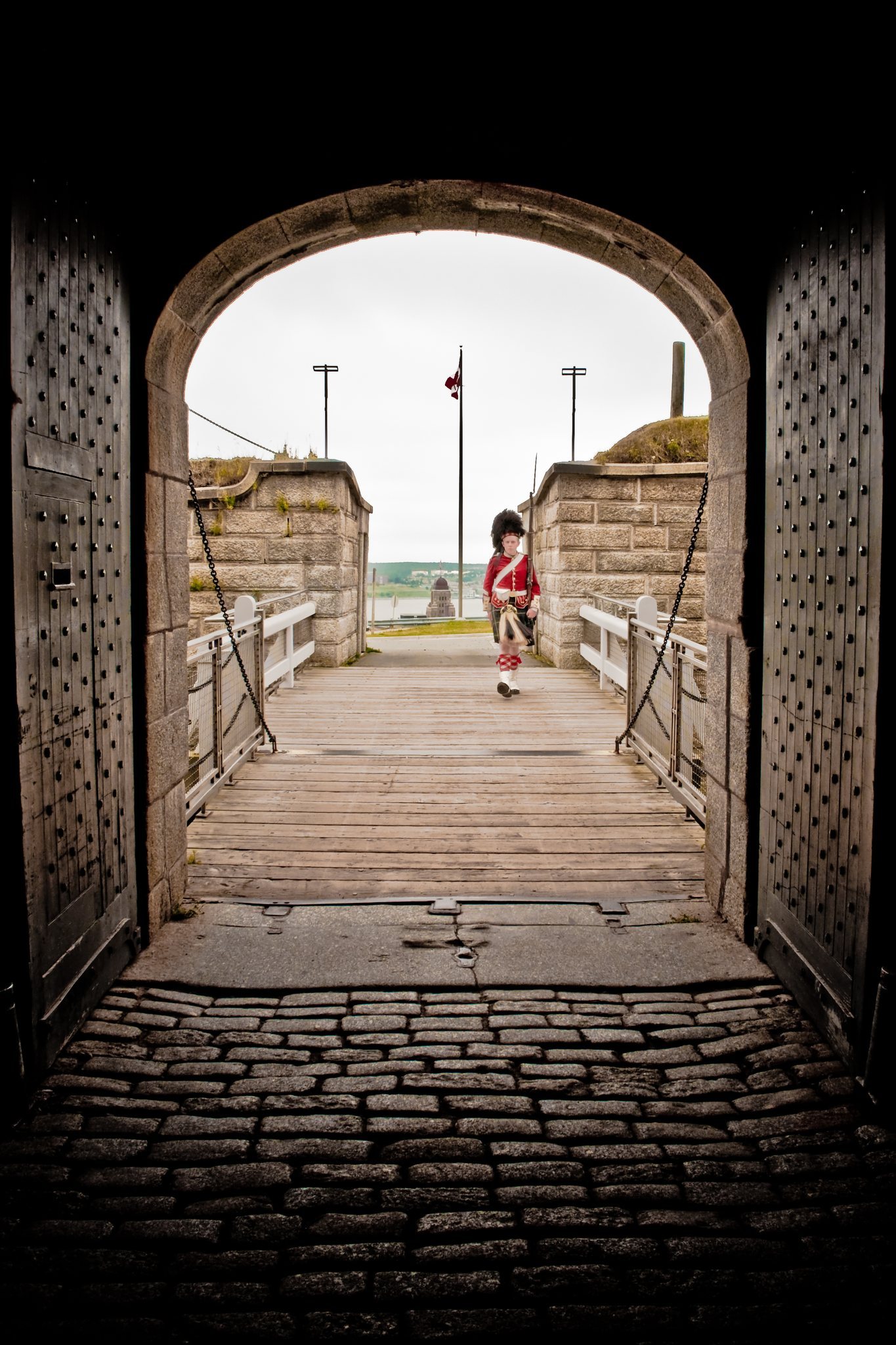
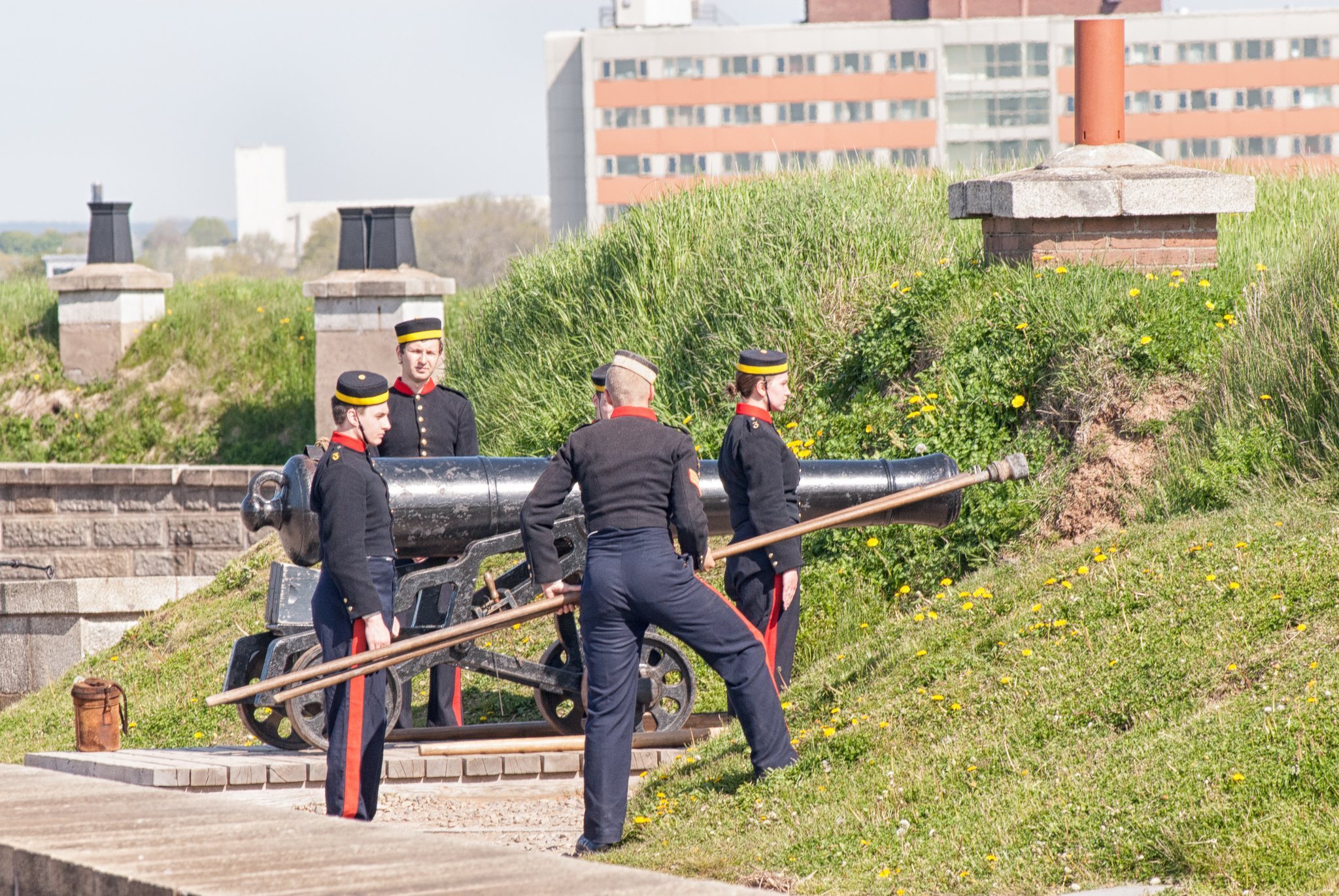
Historical interpretation at the fort includes living-history programs based on the 78th Highlanders, the 78th Highlanders Pipe Band, the Third Brigade of the Royal Artillery, soldiers’ wives, and civilian tradespeople. A ceremonial noon gun is fired daily throughout the year, and the artillery is also used for formal occasions such as 21-gun salutes.
Remains
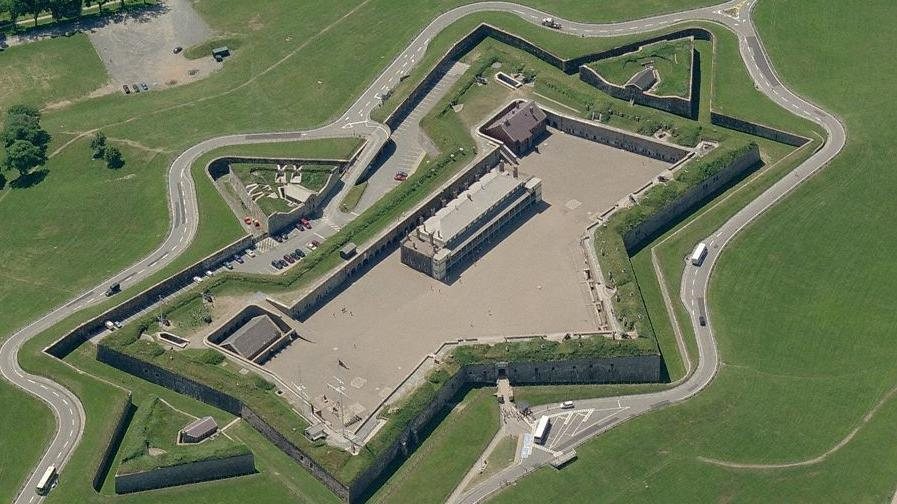
Citadel Hill is the fortified summit overlooking Halifax and its harbour. Four successive defensive works occupied the summit, and repeated construction and levelling lowered the hilltop by approximately 10 to 12 metres. The Third Citadel alone required a further reduction of about 4.5 metres. The surviving fort is a star-shaped masonry enclosure with four projecting bastions, an internal courtyard, armoured ramparts, and a surrounding moat area that supported several lines of fire against attacks from land or water.
Successive defensive works
First Citadel
The First Citadel was built in 1749 as a small redoubt near the summit, just east of the present fort’s south ravelin. A ravelin is a detached triangular defensive work placed before a fortification wall or bastion. The early work contained a flagstaff and guardhouse and formed part of Halifax’s western perimeter. That perimeter used five stockaded forts and double rows of pickets approximately 10 feet long and 6 inches thick, with a cleared space about 30 feet beyond the line.
Second Citadel
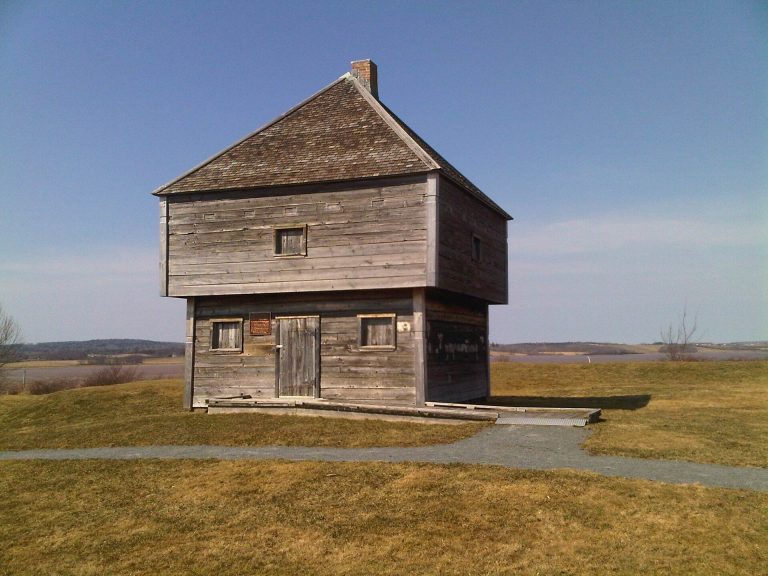
Completed in 1776, the Second Citadel consisted of overlapping earthen redans, projecting angular earthworks, behind a large outer palisade. At its centre stood a three-storey octagonal blockhouse with a 14-gun battery and accommodation for 100 troops. The entire fortress mounted 72 guns.
Third Citadel
The Third Citadel, officially called Fort George, was built directly on the hilltop between 1794 and around 1800. Four bastions surrounded a central barracks and magazine. A bastion is a projecting fortified platform that allows defenders to fire along the faces of adjoining walls. The fort relied mainly on earthwork walls and contained a barracks, provisions store, and powder magazine. One bastion was constructed by Jamaican Maroons transported from the Caribbean.
Present Citadel
The present fort occupies approximately 226,000 square metres. Its construction lasted 28 years and cost £242,122. Four bastions project from the masonry walls, while the internal courtyard organizes the barracks and other military spaces. The fort’s two large ammunition magazines also served as the central explosive store for Halifax’s wider defences.
Defensive systems and restored structures
Explosive tunnels
Parts of the hill contain T-shaped tunnels intended to be packed with explosives and detonated from within the fort if an attacking force overwhelmed the outer works. The tunnels extended approximately 100 feet from the outer walls. The top of the T was about 50 feet wide, and its brick walls were about 4 feet high and 4 feet wide. Stone slabs, gravel, earth, and sod covered the structures, with the gravel intended to act as shrapnel.
Cavalier Block
The fort’s military layout included barrack accommodation, signalling facilities, command spaces, and positions for defensive artillery. The Cavalier Block now contains the Army Museum, whose collections include weapons, medals, and uniforms connected with Nova Scotia’s military history.
Masonry and ramparts
Restoration involved dismantling and re-engineering sections of the masonry, installing 100-millimetre conduits for wiring and waterproofing, and replacing stones in their original positions. Repointing used historically appropriate mortar and techniques, while modern materials were placed inside the walls. The wall tops were reconstructed with their original dimensions, angles, and materials, including staggered layers of sod secured by cedar spikes 300 to 410 millimetres long. The restored fort presents its Victorian-era, specifically 1869, appearance.