Fort Diemerdam: An Open Coastal Battery in the Defence Line of Amsterdam


Site at a Glance
- Rating
- 4.1
- Popularity
- Very Low
- Country
- Netherlands
- Primary era
- Modern
- External website
- Open
- Eras represented
- Early Modern, Modern
- Civilizations
- Dutch
- Site type
- Military
- Remains
- Fort
On this page8 sections
History
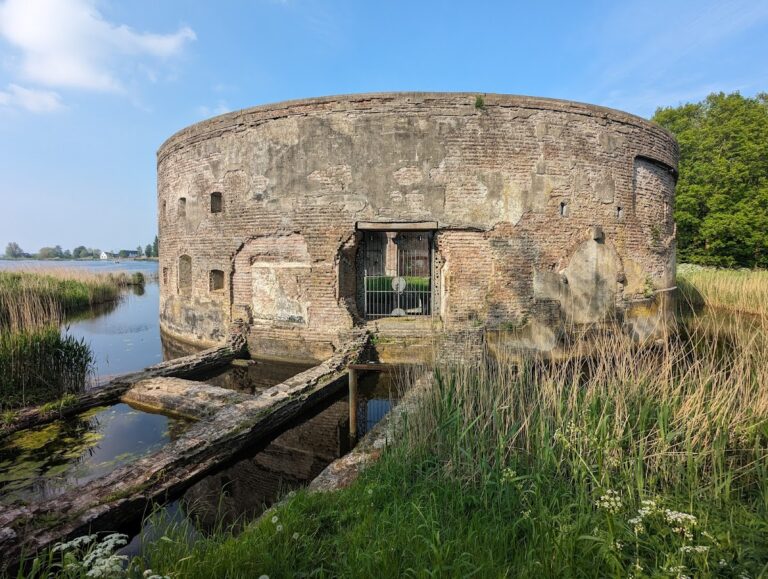
Fort Diemerdam is a nineteenth-century open coastal battery in the Netherlands, built as part of the military defenses protecting Amsterdam. Officially called the Coastal Battery at Diemerdam, and also known as the Work on the IJ in front of Diemerdam, it belongs to the Defence Line of Amsterdam, a ring of military works that combined artillery with controlled flooding to hinder an attacking army. “Fort Diemerdam” is its popular name rather than its official designation.
From battery to military post
A double battery occupied the site in 1787, when it was intended to defend Amsterdam against a possible Prussian attack. The position was modified and strengthened between 1799 and 1810, then altered again in 1827 and 1889. After 1805, it was identified as Post No. 6 in the series of defenses organized around Amsterdam by Cornelis Krayenhoff, a Dutch military engineer and statesman.
The battery guarded the Zuiderzee and the approaches to Amsterdam. Its duties included preventing landings, repelling attacks, and protecting the Diemerdammer Lock. In 1883, it became part of the Defence Line of Amsterdam. The Diemerdammer Lock and the nearby Ipensloter Lock supplied water for inundating the land in front of the defensive works, turning the surrounding landscape into part of the defense system.
Wartime use and later protection
Before the Second World War, a Dutch army searchlight unit operated at the site. Its lights were used to locate enemy aircraft so that anti-aircraft artillery could engage them. During the night of 11–12 June 1943, a British Vickers Wellington bomber, HE154 of 466 Squadron, crashed near the fort after German anti-aircraft fire struck it while it was flying toward Germany. All five Australian crew members died and were buried at De Nieuwe Ooster Cemetery in Amsterdam.
A Royal Decree issued in 1954 decommissioned Fort Diemerdam as a military work. The Defence Line of Amsterdam received monument protection and was inscribed on the UNESCO World Heritage List in 1996. Fort Diemerdam is also a protected provincial monument. Stadsherstel Amsterdam owns the site and began restoring its buildings and grounds in 2012. The grounds are used for storage and as a private horse pasture, while a pavilion with a restaurant occupies the former conductor’s residence site. The former fort keeper’s house is owned by Stadsherstel Amsterdam, which is developing plans for it with the Municipality of Amsterdam.
Remains
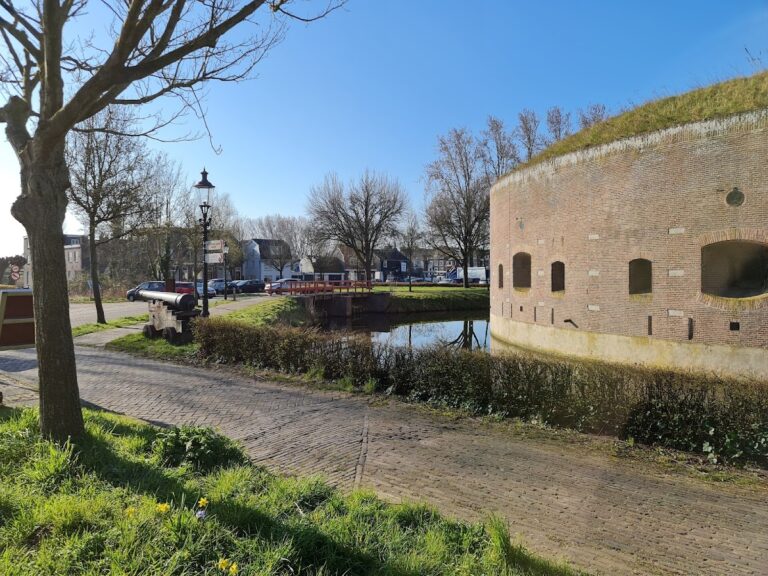
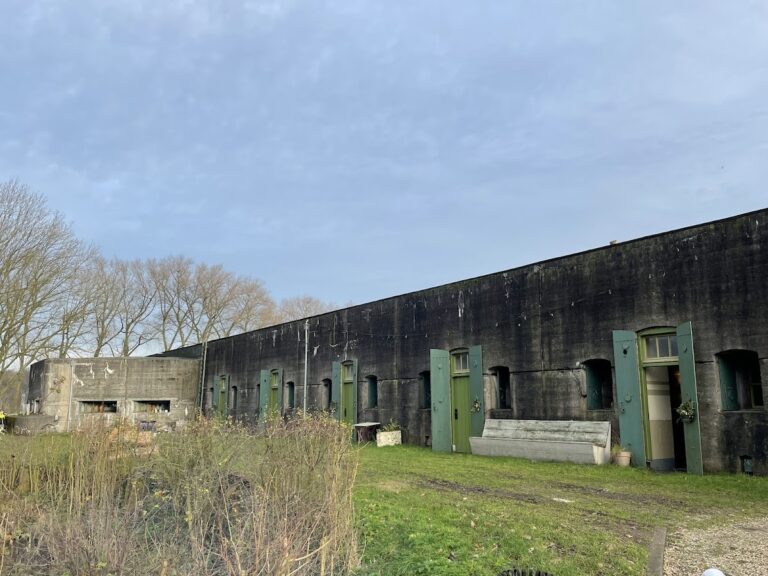
Fort Diemerdam survives as an open coastal battery built of concrete along the Diemerzeedijk, beside the Third Diem and the IJmeer in the eastern part of Diemen. Unlike enclosed fortifications elsewhere in the Defence Line of Amsterdam, its gun positions were placed in the open. The battery stood near the area now called Diemer Vijfhoek, beside the eastern access road to IJburg. The Diemerdammer Lock lies to the northwest, and the Diemerzeedijk continues westward from the lock toward Diemerpark.
Battery structures
Gun emplacements and ammunition buildings
The 1889 modernization added the gun emplacements and small ammunition buildings. A remise, a military shelter for artillery equipment or ammunition, and another ammunition building followed in 1896. Together, these structures formed the surviving military core of the open battery. The Diemerdammer Lock was also a protected part of the position because it served as a water inlet for the inundation system.
Coastal setting
The battery originally looked across the IJmeer toward Pampus and Vuurtoreneiland, where the Coastal Battery at Durgerdam stood. The view now extends toward IJburg’s Haveneiland. Nearby PEN Island was created by the former electricity producer PEN and is now known as Diemer Vijfhoek; the present-day Diemen power station operated by Vattenfall stands there.
De Zeehoeve farmstead
East of the fort stands De Zeehoeve, a Kringenwet farmstead. Such farms were built within restricted zones around Dutch military works, where military regulations influenced their design and use. Johann Georg Mezger, physician and owner of the Uijlenbosch polder, had the farm built in 1880. It supplied food to the soldiers, while its livestock kept vegetation around the battery low.
The stable section was rebuilt in 1924–1925 after an explosion at a nearby ammunition-storage shed belonging to the De Krijgsman gunpowder factory. A second brick stable was added in 1948. De Zeehoeve was restored around 2005 and is now a protected provincial monument.
Nearby sites