Firuzabad: Successor to the Sasanian City of Gor
Site at a Glance
- Popularity
- Very Low
- Country
- Iran
- Primary era
- Classical
- Eras represented
- Classical, Medieval
- Civilizations
- Achaemenid, Parthian, Sassanid
- Site type
- City
On this page11 sections
History
Firuzabad, Iran, is the modern successor to Gor, a Sasanian city founded by Ardashir I in the final years of Parthian rule. The modern city lies about 3 km east of the ancient settlement in Fars Province, the historic southwestern Iranian region that formed the Sasanian heartland. Gor was also called Ardashir-Khwarrah, meaning “the glory of Ardashir,” and served as Ardashir’s capital during his revolt against Artabanus V.
Origins and foundation
Gor is traditionally associated with the Achaemenid period, the era of the ancient Persian imperial dynasty that preceded the Parthians and Sasanians. A later historical tradition says that Alexander the Great diverted a river into the low-lying city, flooding it and creating a lake that lasted for centuries. Ardashir I reportedly drained the water by constructing a tunnel before establishing a new city on the site. The Firuzabad River remains a permanent river in the area, and the modern Tangab Dam stands on it.
Ardashir founded the new city while he was governor of Fars under Artabanus V, the Parthian ruler. He named it Ardashir-Khwarrah and made it the center of his revolt against Parthian authority. The city retained particular importance throughout his reign and became associated with the rise of the Sasanian Empire, the Persian dynasty founded by Ardashir that ruled Iran from the third to the seventh century.
Sasanian administration
After Ardashir’s reign, Gor gradually lost prominence to other Sasanian centers such as Bishapur and Ctesiphon. It nevertheless remained one of the principal cities of Fars and the administrative center of Ardashir-Khwarrah, one of the five provinces of the region. Sasanian rulers Shapur I and Shapur II were born there. During this period, the abbreviation ART, written in Inscriptional Pahlavi, a Middle Persian writing system used for royal, religious, and administrative purposes, served as Gor’s mint signature.
Before the Arab conquest, Gor’s population was predominantly Zoroastrian. Zoroastrianism is the Iranian religious tradition associated with the worship of Ahura Mazda and the preservation of sacred fire. Conversion to Islam took place gradually over subsequent centuries, and the majority of the present population is Muslim and Twelver Shiite.
Conquest and early Islamic prosperity
Gor and nearby Istakhr resisted the Arab-Muslim conquest of Fars repeatedly. After several years of fighting, Abdallah ibn Amr conquered Gor in 649–650. A later tradition connects the discovery of a concealed underground entrance with a dog carrying food into the city. At the time of the conquest, Gor was said to contain thousands of houses, shops, barracks, and government buildings.
The city remained important and prosperous during the early Islamic period. Its surroundings were associated with plentiful water, orchards, gardens, agricultural production, and the export of rosewater and other plant products. By the fifth Islamic century, Gor reportedly possessed a congregational mosque, a hospital, a school, and a large library said to contain 7,000 volumes.
Buyid revival and abandonment
Gor’s importance revived under the Buyid dynasty, a Persianate Shiite ruling house that controlled much of western Iran and Iraq during the tenth and eleventh centuries. During the reign of Fanna Khusraw, also known as Adud al-Dawla, the city was frequently used as a residence. In the third and fourth Islamic centuries, it was described as a relatively large fortified settlement enclosed by an earthen wall and an encircling ditch, with four gates.
The older name Gor gradually gave way to Firuzabad during the Buyid period. One tradition says that Adud al-Dawla disliked the name because gor was associated in Persian with the word for “grave.” He therefore ordered the city and district to be called Perozabad, or “City of Victory.” A seventh-century Arab-Sasanian coin from Ardashir-Khwarrah also uses Perozabad as a mint designation.
By approximately the seventh Islamic century, the ancient city was gradually abandoned, while a settlement called Koshk developed outside its walls. The present city of Firuzabad grew from that settlement. During the Qajar period, the older city was eventually abandoned and replaced by the nearby modern town. The Firuzabad area now contains 107 nationally registered historical works. Five of them, including the ancient city of Gor, form part of the UNESCO-listed Sasanian Archaeological Landscape of Fars.
Modern Firuzabad includes Persian-speaking residents and a substantial Qashqai Turkic population, including traditionally nomadic Qashqai groups. This modern population history forms the latest phase in the long development of a place whose urban origins belong to the foundation of the Sasanian state.
Remains
The ancient remains of Firuzabad center on Gor, a highly precise circular city laid out in the Sasanian manner. The settlement had a diameter of approximately 2 km and was surrounded by a ditch about 50 m wide. Four principal gates were positioned at the cardinal points: the Hormozd Gate to the north, the Ardashir Gate to the south, the Mithra Gate to the east, and the Wahram Gate to the west.
Urban plan and central platform
The royal compounds occupied the center of a circle approximately 450 m in radius. At the heart of this area stood the Terbal, a tall central platform or tower about 30 m high with a spiral design. Its original purpose remains uncertain. Its form has been regarded as a possible architectural predecessor of the distinctive minaret of the Great Mosque of Samarra.
Gor’s circular urban plan was later imitated widely. Tradition holds that nearly 400 cities were built according to similar principles by the Middle Ages, with Darabgerd and Hamadan cited as other examples of circular cities. The plan therefore connects the surviving earthworks and central structures with a broader history of Iranian urban design.
Royal and defensive monuments
Palace of Ardashir
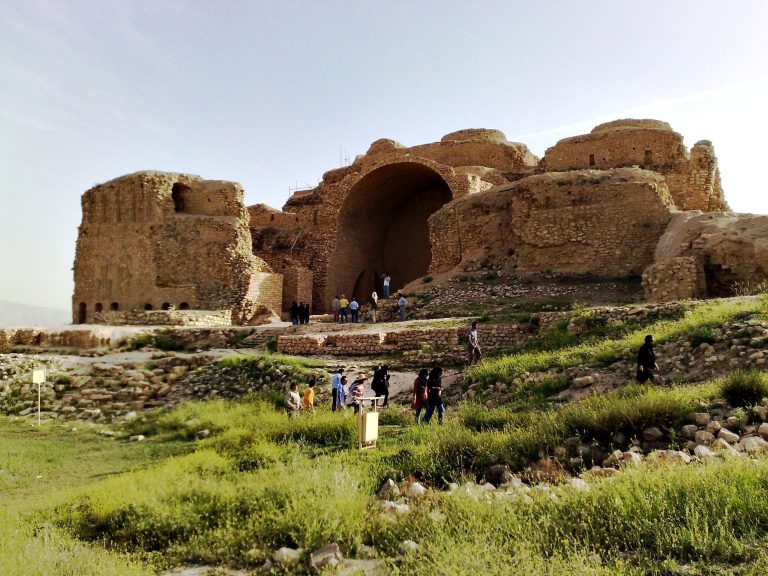
The Palace of Ardashir was ordered by Ardashir I as a major fortified structure associated with the foundation of the new city. It is also described as a fire temple and remains one of the principal surviving Sasanian monuments in the Firuzabad area. Its place within the archaeological landscape preserves the connection between Ardashir’s political revolt, the establishment of his capital, and the construction of an imposing royal complex.
Qal’eh Dokhtar
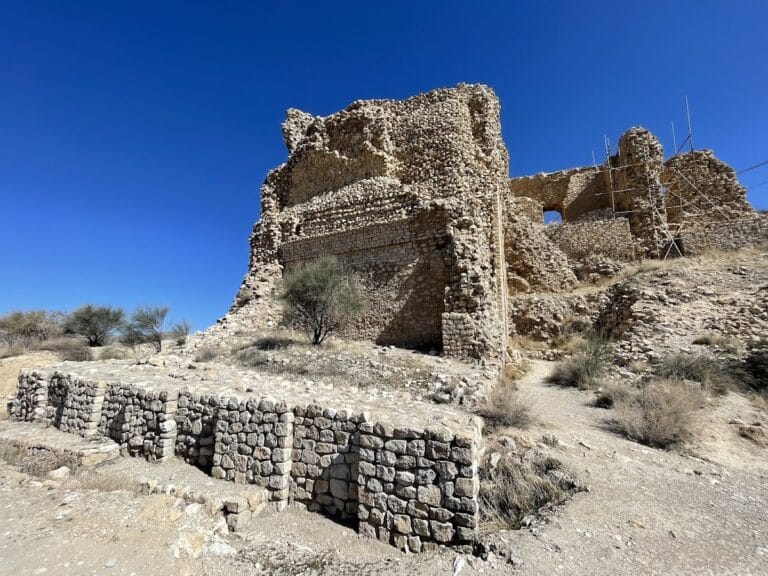
Qal’eh Dokhtar, meaning “Maiden Castle,” stands on the summit of Tangab Mountain. It functioned as a watch fortress with military and defensive purposes and overlooked the road between Firuzabad and Shiraz. Stairways connect its internal spaces, while the high walls survive in broken and partly collapsed form.
The castle was built with stone and gypsum. Large dressed stones form its facing, contrasting with the roughly piled river cobbles used in the foundations and within the walls. At the corners, squinches, which are corner constructions that convert a square room into a form suitable for a dome, support the transition to a domed roof. This method differs from the gradual corbelling technique associated with Roman architectural solutions to the same structural problem.
Rock reliefs and associated structures
Two Sasanian rock reliefs are among the monuments associated with ancient Gor. A rock relief is an image carved or sculpted into a natural rock surface or stone face. Together with the Palace of Ardashir, Qal’eh Dokhtar, and the ancient city, these reliefs form components of the Sasanian Archaeological Landscape of Fars.
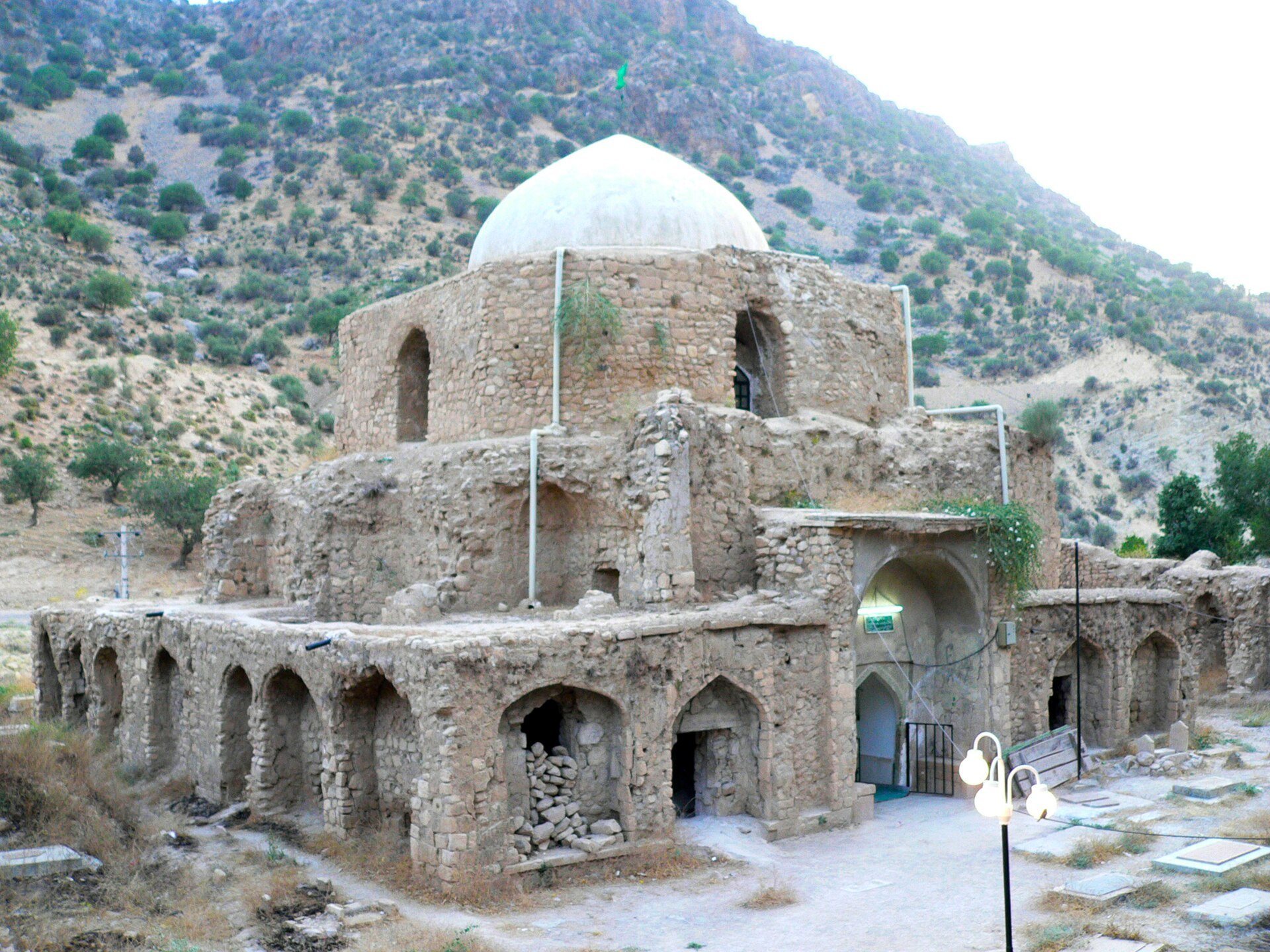
Other associated remains include the Mehr Narseh Bridge and the inscription of Mehr Narseh, a prominent Sasanian statesman and high official. The Jabal al-Naruiyeh chahar-taqi and the Konar Siah chahar-taqi are also linked to the Firuzabad area. A chahar-taqi is a four-arched Iranian structure in which four supports carry a domed roof, a form commonly associated with fire-temple architecture in the Sasanian religious context. The Konar Siah structure lies about 20 km from Firuzabad.