Duggleby Howe: A Late Neolithic Burial Mound in North Yorkshire
Site at a Glance
- Rating
- 4.3
- Popularity
- Very Low
- Country
- United Kingdom
- Primary era
- Stone Age
- Eras represented
- Stone Age, Bronze Age, Medieval
- Civilizations
- Unclassified
- Site type
- Burial
- Remains
- Burial Mound
On this page12 sections
History
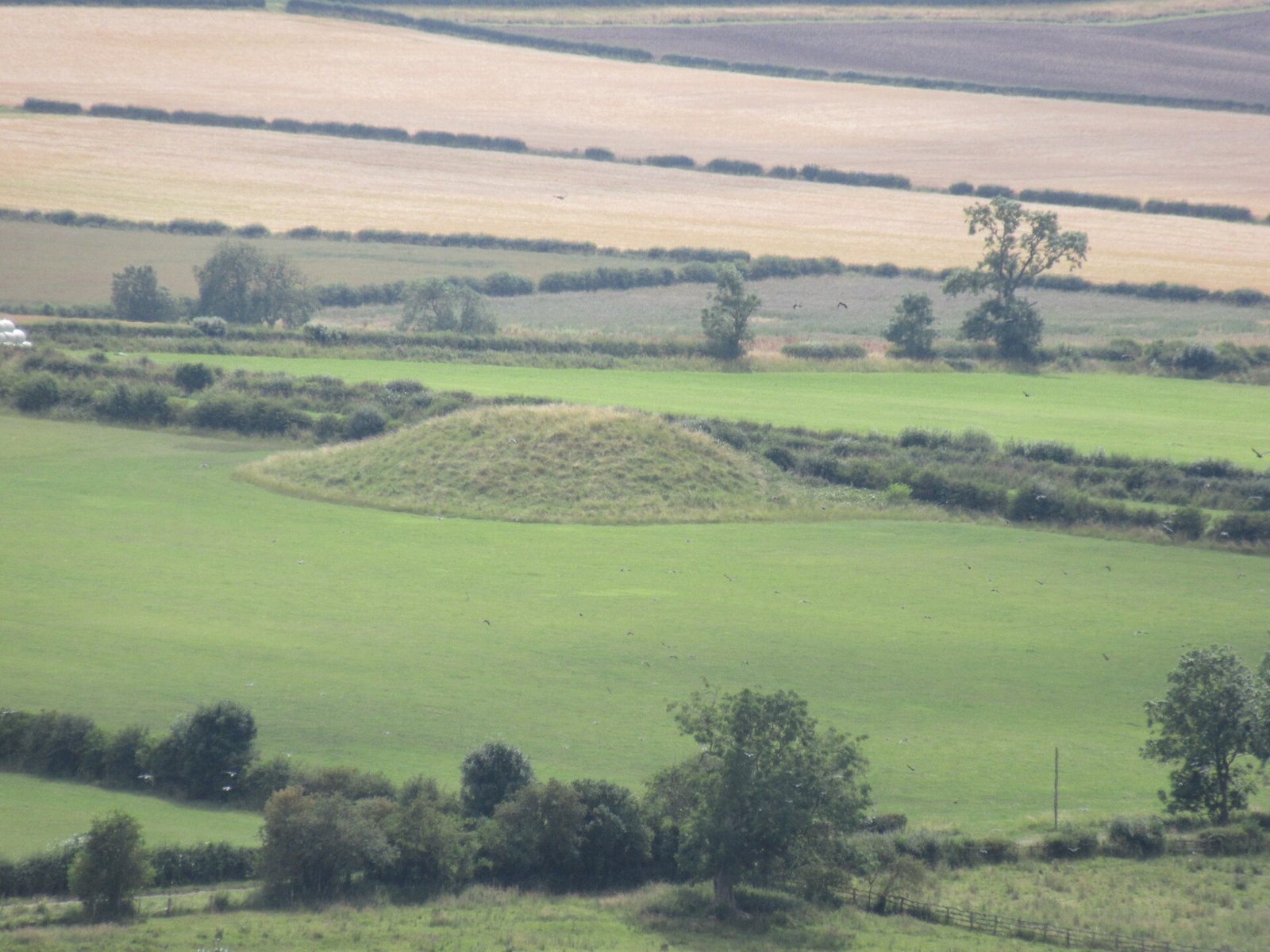
Duggleby Howe is a Late Neolithic round barrow near Duggleby in North Yorkshire, United Kingdom. One of Britain’s largest barrows, it is one of four monuments known collectively as the Great Barrows of East Yorkshire. The earliest burial dates to about 3500 BC, while the mound covering the burials was built around 2800–2700 BC. The Late Neolithic was the closing phase of the New Stone Age.
Neolithic monument
The name Howe is thought to come from the Old Norse haugr, meaning a mound or hill. The large enclosure around the barrow may have originated with the first burial, as a boundary around a sacred place. Its date and relationship to the barrow remain uncertain. It may have been a henge, a prehistoric enclosure defined by earthworks, or a causewayed camp, an enclosure with gaps in its ditches.
Later activity
Pottery fragments and bone in an upper layer of chalk indicate that the mound was reused during the Anglo-Saxon period, the early medieval era associated with Anglo-Saxon peoples and kingdoms in England. A post mill, a windmill whose body turns around a central post, was later built on the mound, probably in the medieval period. It may have contributed to the reduction of the summit.
Excavation and interpretation
The clergyman Christopher Sykes first excavated Duggleby Howe in 1798 or 1799. On 21 July 1890, the antiquary and archaeologist J. R. Mortimer began a more extensive excavation, supported by Yorkshire landowner Sir Tatton Sykes. His work continued for more than six weeks and covered a 40-foot-square area across the centre and part of the eastern side.
Aerial photographs taken by archaeologist D. N. Riley confirmed the enclosure’s existence in 1979. In 1983, Ian Kinnes, Timothy Schadla-Hall, Paul Chadwick and Philip Dean reassessed Mortimer’s excavation and interpreted the site as a cemetery used over an extended period in the Late Neolithic. Roy Loveday and Mortimer had proposed instead that the burials might mark the death of a powerful person, perhaps the man at the bottom of the grave. Blunt-force injuries on a skull from the burial have also prompted a suggestion of human sacrifice. Mortimer’s record of the excavated layers was not clear enough to resolve these interpretations.
Remains
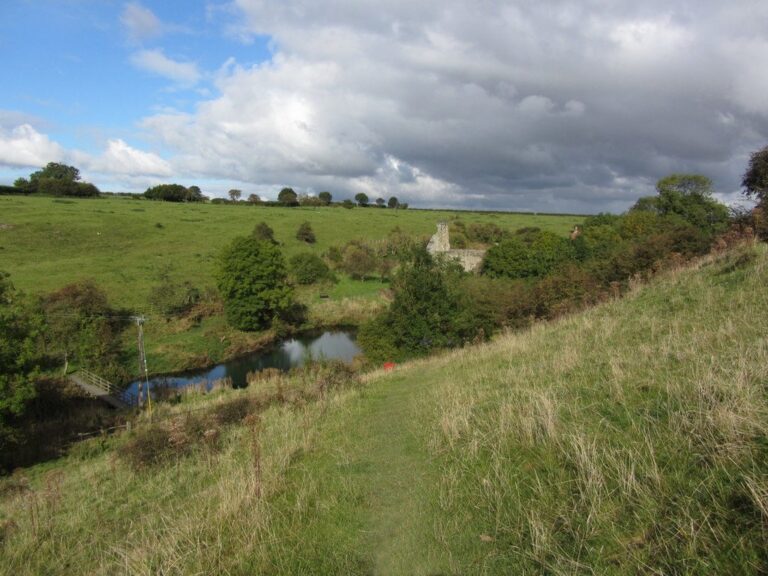
On the southern side of the Great Wold Valley, the site is arranged around a large mound within a broad circular enclosure, with two circular ditches to the east. The earthworks and burials reflect several stages of construction and use.
Earthworks
Barrow mound
The mound’s base measures about 37 metres across, and its fill is estimated to weigh roughly 5,000 tonnes. Earth, clay and chalk form its mass. It stands about 6.7 metres high at the eastern end and between 5.5 and 5.8 metres at the western end. The summit has been cut down to a nearly level platform about 14 metres across, where the post mill was built. The mound began with a core of clayey or earthy material and was enlarged with roughly quarried chalk to reach its final shape.
Enclosure and ring ditches
The roughly circular enclosure measures about 370 metres across and is open to the south. Interrupted ditches define it, with a broad inner ditch, a narrower outer ditch and a series of banks. Ploughing and silt have softened the earthworks, making them difficult to discern at ground level. Two ring ditches, or circular ditches, lie east of the barrow, one within the enclosure and one beyond it. They are thought to date to the Bronze Age, the period associated with widespread use of bronze.
Burials and finds
Shaft grave
The earliest burial lay in a shaft grave, a burial cut down into the ground, about 2.7 metres deep. An adult man was placed crouched at its base with a Towthorpe bowl, two flint cores and flint flakes; he may have been laid in a wooden coffin. Higher in the grave’s fill were a crouched adult and an infant. An adult skull without its lower jaw, known as Cranium J, was placed at the adult’s feet and has blunt-force injuries on both sides. After the grave had filled, two more adults were placed in a hollow formed as the fill settled, accompanied by flint and antler tools. Finds associated with the early burials also include an antler implement, a broken arrowhead, a polished flint axe and a polished flint knife only 1.5 millimetres thick.
Shallow grave
A shallow grave east of the shaft grave held another crouched adult. The accompanying objects included flint arrowheads, among them a transverse arrowhead, flint flakes, a bone pin, and implements made from boar tusk and beaver tooth.
Mound burials and cremations
The primary mound’s earthy or clayey material contained the remains of four infants, three children, an adolescent and an adult. Small chalk grit covered its surface, beneath a thinner layer of Blue Kimmeridge clay. Fifty-three cremations were placed in heaps in the crest of the mound, rather than in vessels. Each heap measured about 15 to 46 centimetres across and 2.5 to 15.2 centimetres high. Three fragments of burnt bone pin were associated with them. Because the excavation covered only part of the mound, Mortimer considered that the total number of cremations might have been about twice as large.