Dev-Kesken: Ancient and Medieval Fortress Settlement in Turkmenistan
Site at a Glance
- Popularity
- Very Low
- Country
- Turkmenistan
- Primary era
- Medieval
- Eras represented
- Iron Age, Classical, Medieval, Early Modern
- Civilizations
- Khanate of Khiva
- Site type
- City
On this page12 sections
History
Dev-Kesken, also known as Devkesen and historically as Vazir, is an ancient and medieval fortress settlement in Turkmenistan, about 60 to 62 kilometres west of Koneurgench in the Dashoguz Region. Built and occupied by communities of ancient and medieval Khorezm, it stands beside the Ustyurt escarpment and preserves a history extending from the fourth century BCE to the seventeenth century.
Ancient settlement
The oldest layers date from around the fourth century BCE through the first centuries BCE and CE. During this period, one subdivision of the Massagetae, the Apasiacae, lived at the site. The archaeologist Sergei Tolstov identified the Apasiacae with the Pechenegs, an Oghuz-related people of the Aral region. The foundations of the settlement’s walls and citadel belong to this ancient phase.
Vazir and the Arabshahid dynasty
The medieval city of Vazir was established on the site of the abandoned ancient settlement. Its final urban phase belonged mainly to the sixteenth and seventeenth centuries, when it served as the capital of a western Khorezmian principality. The population included Oghuz and Turkmen groups, and Islam was the city’s stated religion. The Turkmen name Döwkesen means “fortress carved by a div.”
In the early sixteenth century, the Chingisid ruler Muhammad Shaybani conquered Khorezm. The Chingisids were descendants of Genghis Khan who established ruling dynasties across Central Asia. After Shaybani’s forces were defeated by the Safavids, the dynasty that created a major Iranian state in the early sixteenth century, Khorezm became part of the Safavid state. The inhabitants of northwestern Khorezm, particularly Vazir, opposed Iranian rule.
In 1511, the people of Vazir invited the Chingisid prince Abul-Mansur Ilbars and his brother from Desht-i Kipchak. Ilbars was proclaimed khan of Khorezm at Vazir, which briefly became the capital of the state later known as the Khanate of Khiva. He founded the Arabshahid dynasty, a Chingisid line that ruled Khorezm into the second half of the eighteenth century. Sultan Haji Khan and Haji Muhammad Khan, also Arabshahid rulers, later acceded to the throne at Vazir.
Decline and archaeological investigation
The restoration of irrigation networks in southern and central Khorezm followed their destruction during the Mongol invasions and Timur’s campaigns. This work reduced the amount of water reaching the Daryalyk Canal, which supplied Vazir, Koneurgench, and other settlements. The resulting shortage contributed to the decline of both cities during the seventeenth century.
As Khorezm’s political center shifted to Khiva, Khan Abulgazi moved the remaining populations of Vazir and Koneurgench to southern Khorezm. A new city, Yangy Urgench, was built there, and Vazir with its surrounding area was abandoned during the second half of the seventeenth century.
Sergei Tolstov and the Khorezm Archaeological and Ethnographic Expedition carried out the first archaeological study of Dev-Kesken in September 1946. They identified the surrounding ruins with the ancient city of Vazir. In October 1947, Tolstov used Qora Qum at Dev-Kesken as a base for aerial surveys of the surrounding area and the Uzboy Valley.
In 2024, local residents found a hoard near the Devkesen fortress and Lake Sarykamysh. It contained 18 gold coins, three silver coins, 61 fragments of gold coins, and eight multicolored artifacts. The coins bear the names of the Khwarazmshah rulers Ala ad-Din Tekesh and his son Ala ad-Din Muhammad II, successive rulers of the medieval Khwarazmian state in the late twelfth and early thirteenth centuries.
Remains
Dev-Kesken occupies the edge of an escarpment approximately 30 kilometres long and rises above a cliff about 30 metres high. The settlement is organized around an upper fortress, a lower enclosure, and a rectangular late-medieval park. Stone walls, mud-brick defenses, towers, a ditch, and religious and memorial buildings preserve the relationship between the ancient defensive foundations and the later city.
Fortress and upper city
The fortress forms a huge rectangle enclosed by stone walls, with numerous towers and a complex entrance structure. Its sides facing the plateau were also fortified. A deep ditch was cut into the slope around the enclosure, while a powerful mud-brick citadel tower stood above the escarpment. The ancient fortifications remained relatively well preserved and were extensively reused as the foundation of the medieval defensive system. Numerous late-medieval stone structures survive within the fortress.
Lower city and park
Lower city
At the foot of the upper city, close to the rock, stands a second rectangular enclosure known as the lower city. Its walls and surviving mud-brick defensive wall belong to the late-medieval period. Numerous ceramic objects were found in this area, adding material evidence for its occupation and use.
Late-medieval park
Southwest of the upper and lower cities lies a third rectangular area. It represents an extensive late-medieval park, also described as a rectangular charbagh, a formal quadripartite garden or park organized around intersecting water channels or paths.
Memorial and religious buildings
Mausoleums
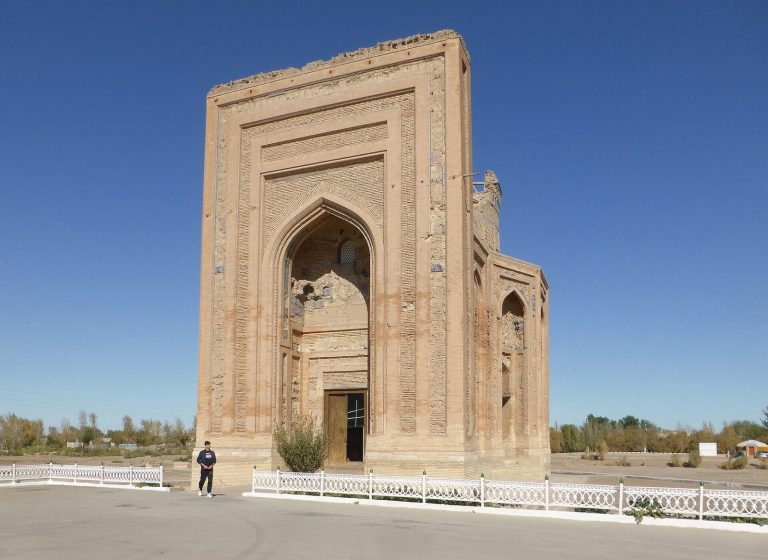
A row of late-medieval mausoleums extends along the escarpment, running parallel to the fortress wall. One religious and memorial ensemble contained a mosque and three mausoleums. The names of the mausoleums have not survived, and their decorative elements are no longer preserved. The principal mausoleum has a high portal on its main facade, vaulted niches on its other sides, and a dome above. The two other mausoleums follow the same general structural and compositional principles. All three stand parallel to the fortress wall and date from the fifteenth century.
Mosque
The mosque is almost completely ruined. During its use, an internal courtyard was surrounded by arched galleries resting on pillars. The walls and pillars were built of stone, while the arches and domes were made of baked brick. Together with the mausoleums, the mosque formed the late-medieval religious and memorial ensemble within the settlement. The ruins of Dev-Kesken are regarded as one of the picturesque monuments of medieval Khorezmian architecture.