Cuàn Lóngyán Stele: A Fifth-Century Tomb Monument in Yunnan
Site at a Glance
- Popularity
- Medium
- Country
- China
- Primary era
- Classical
- Eras represented
- Classical
- Civilizations
- Unclassified
- Site type
- Burial
- Remains
- Tomb
On this page8 sections
History
The Cuàn Lóngyán Stele is a Chinese tomb monument in Xueguanbao Village, Majie Township, Luliang County, Qujing, Yunnan, China, erected in September 458 under the Liu-Song dynasty, the first of the Southern Dynasties. The Liu-Song was a different regime from the later Song dynasty founded in 960. The stele commemorates Cuàn Lóngyán, a powerful local official, and was commissioned by his grandsons twelve years after his death. Alongside the Cuan Baozi Stele of 405, it forms the pair known as the Two Cuans. The larger monument is also called the Great Cuan.
Cuàn Lóngyán’s career
The stele’s chronology places Cuàn Lóngyán’s birth in 384 in Jianning Commandery, a regional administrative district in present-day Yunnan. It gives his death as December 446, at the age of 61. His father had held senior military posts and served as governor of both Jianning and Jinning, reflecting the family’s standing in the region.
Cuàn initially declined an appointment as chief clerk from the governor of Ningzhou. He later accepted a position assisting the provincial governor after the offer was made three times. In 414, the province recommended him to the imperial court, where he became a mid-level official. He subsequently served on the staff of a general leading a western expedition and at the headquarters of the Southern Man, a historical label for peoples in southern regions beyond the central Chinese heartland. He also became governor of Jianning, the post once held by his father.
Cuàn retained his position when the Eastern Jin, the preceding dynasty in the south, was replaced by the Liu-Song. In 432, he suppressed a rebellion near Dali. His titles by then included Dragon-Soaring General, Colonel for Protecting and Pacifying the Southern Man, governor of Ningzhou, and Marquis of Qiongdu County.
Family history and commemoration
The inscription traces the Cuan family’s migration to Yunnan and recounts the careers of three generations. The clan claimed descent from Zhuanxu, a legendary ruler counted among the Five Emperors in traditional Chinese history. One interpretation takes this ancestry claim to place the Cuans among Han Chinese lineages. Another regards them as a southern indigenous elite, drawing on historical labels for western Cuan White-Man and eastern Cuan Black-Man groups in southwest China. Those labels do not resolve the question of the clan’s origins.
Cuàn Lóngyán’s son began planning the commemorative stele but died before finishing the work. After the eldest grandson also died young, three younger grandsons took up the project with help from provincial authorities. The family obtained the stone, and another member of the clan composed the inscription. The monument was raised in 458, twelve years after Cuàn’s death.
Later study and recognition
In the 1820s, the Qing-dynasty scholar and official Ruan Yuan brought the stele to wider notice, although rubbings had appeared in earlier research. Its lettering became an important subject in the study of Chinese calligraphy. It was once treated as evidence that writing was moving from clerical script to regular script, and the late-Qing scholar and calligrapher Kang Youwei praised it as an exemplary form of that transition. Later evidence established that regular script already existed at the time. The stele is now understood as transitional in style, but not as proof that regular script was then emerging. Its lettering has also been interpreted as evidence of the deep reach into southern China of Central Plains culture associated with the northern dynasties. In 1961, the monument entered China’s first group of nationally protected major cultural relics.
Remains
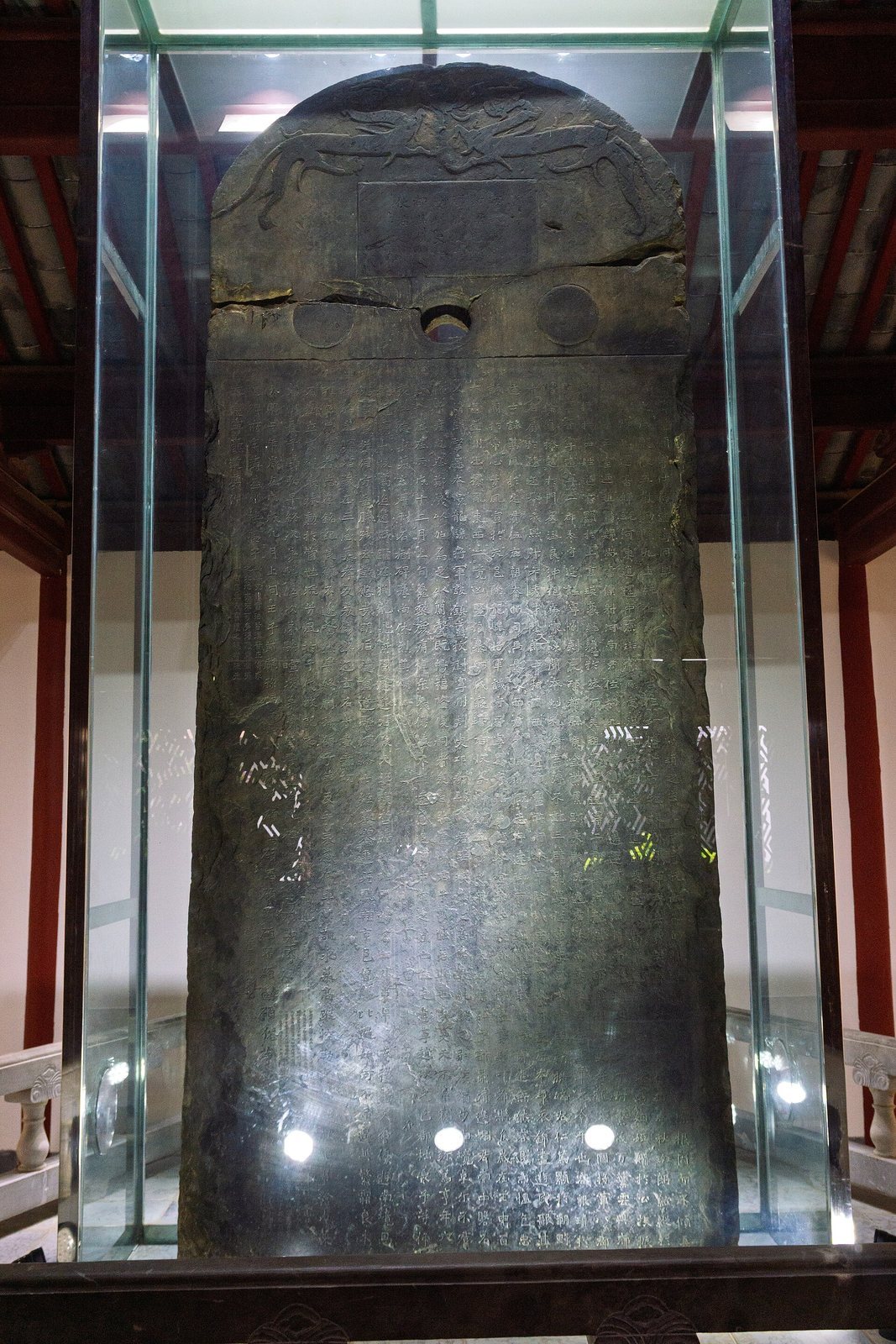
The stele stands within the grounds of Zhen Yuanbao Primary School, at a site traditionally identified as a burial ground of the Cuan clan. The location is about 14 km south of Zhongshu, the county’s main town. Made of blue sandstone, the monument consists of a body and a cap and measures 3.38 m in height.
Stonework and inscription
Body and cap
The rectangular body widens toward its base. It is 1.35 m across at the top and 1.46 m across at the bottom, with a thickness of 0.25 m. The semicircular cap rises 0.88 m above it. Raised carvings of auspicious creatures on the cap include an Azure Dragon, a White Tiger, and a Vermilion Bird. At the center, a short inscription contains 24 characters. Below it is a circular opening 0.18 m in diameter, with sun and moon motifs carved on either side.
Inscribed faces
The front face carries 24 lines, with between 7 and 45 characters in each line and 904 characters in total; wear has erased more than 20. The back has three rows of names and official titles, comprising 313 characters, with nine worn away. The lettering resembles regular script, a Chinese writing style, while retaining features of clerical script, an older and distinct form. It also uses many alternate and commonly used character forms.
The text follows the conventional structure of a tomb inscription, recounting lineage and achievements and explaining the monument’s erection. Its praise-filled prose uses parallel prose, a form built from balanced, patterned clauses associated with the Six Dynasties, successive regimes that ruled southern China between the third and sixth centuries. It also quotes the Analects in praise of Cuàn Lóngyán’s virtue.