Cremona Cathedral: Romanesque Cathedral and Episcopal Seat in Italy


Site at a Glance
- Rating
- 4.7
- Popularity
- Medium
- Country
- Italy
- Primary era
- Medieval
- External website
- Open
- Eras represented
- Medieval, Early Modern, Modern
- Civilizations
- Habsburg, Holy Roman Empire
- Site type
- Religious
- Remains
- Cathedral
On this page21 sections
History
Cremona Cathedral, officially the Cathedral of Santa Maria Assunta, is the principal Roman Catholic church of Cremona, Italy, and the episcopal seat of the Diocese of Cremona. Built by the medieval Christian community of the city, it was founded in the Romanesque period and consecrated in 1190 under Bishop Sicardo. Its position near the centre of the earlier Roman fortified settlement, or castrum, placed it at the highest point of the medieval city and helped protect the building from flooding by the Po, which then flowed much nearer to the historic centre.
Foundation and Romanesque rebuilding
The cathedral emerged during a period of Cremona’s military success and economic prosperity. Two earlier churches on the site, dedicated to Saint Stephen and Saint Mary, were demolished to make way for the larger foundation. The first stone was laid on 26 August 1107, but a major earthquake on 3 January 1117 severely damaged the newly begun structure. Reconstruction followed on an almost complete scale, and work resumed in 1129 after the relics of Saint Himerius were discovered beneath the earthquake rubble.
The twelfth-century church was a Romanesque basilica, a large church with massive masonry and rounded architectural forms, built without a transept. Its initial design apparently envisaged two towers beside the western facade, in a manner associated with imperial cathedrals north of the Alps. The plan was later affected by the construction of the much taller Torrazzo bell tower beside the facade. The cathedral was consecrated in 1190, establishing its role as the central church of the Cremonese diocese.
Expansion and later transformation
The north and south arms of the transept were added between the late thirteenth and mid-fourteenth centuries. These additions gave the building its present cruciform plan and introduced new exterior fronts, galleries, and portals. The facade received marble facing from 1274, followed by the construction of its loggias and portico late in the thirteenth century. The upper facade was remodelled in 1491 by Alberto Maffiolo da Carrara, while Lorenzo de Trotti built part of the portico connecting the cathedral with the Torrazzo and completed it early in the sixteenth century with the Renaissance Bertazzola loggia.
These successive works produced a building whose predominantly Romanesque structure incorporates Gothic, Renaissance, and Baroque elements. The Gothic phase included the installation of pointed, ribbed vaults in the main nave during the fourteenth century, replacing the earlier Romanesque vaults. Renaissance interventions reshaped the upper facade and added sculpture, portico architecture, choir furnishings, and new works in the transept and presbytery. Later Baroque campaigns further altered the interior decoration and the presentation of the chapels.
Fresco campaigns and religious life
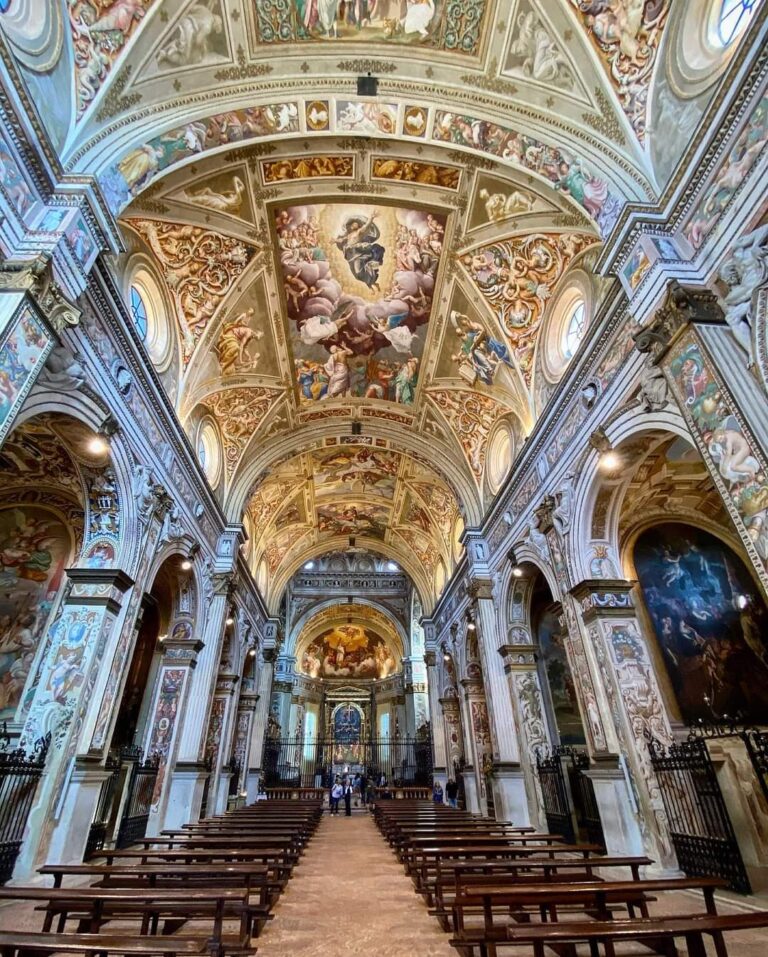
The cathedral’s principal fresco program developed through several campaigns in the first decades of the sixteenth century. Boccaccio Boccaccino painted the apse between 1506 and 1507, showing the Redeemer with Saints Marcellinus, Himerius, Homobonus, and Peter the Exorcist, who were regarded as protectors of the city. He also painted the Annunciation on the triumphal arch. From 1512 to 1516, he decorated the first four arches of the nave with scenes from the life of the Virgin, including the angel’s appearance to Joachim, the meeting of Joachim and Anna, the Nativity of Mary, the Marriage of the Virgin, the Annunciation, the Visitation, the Adoration of the Shepherds, and the Circumcision.
Giovanni Francesco Bembo painted the Adoration of the Magi and the Presentation in the Temple in the fifth arch. From 1516, Altobello Melone added the Massacre of the Innocents and the Flight into Egypt, as well as two scenes from the Passion near the presbytery. Girolamo di Romano, known as Il Romanino, painted Christ before Caiaphas, the Flagellation, the Crowning with Thorns, and Ecce Homo in 1519. After his commission was withdrawn in 1520, Giovanni Antonio de Sacchis, known as Pordenone, completed further scenes, including the Deposition, and painted the Crucifixion and Lamentation on the counterfacade. Bernardino Gatti completed the cycle in 1529 with the Resurrection of Christ.
The cathedral was also associated with a long musical and intellectual tradition. Its church musicians and scholars included Marc’Antonio Ingegneri, who served as chapel master; Antonio Dragoni, a mathematician and canon; Ruggero Manna, chapel master from 1835 to 1864; Vincenzo Petrali, organist from 1849 to 1853; and Federico Caudana, organist and chapel master from 1907 to 1963.
Modern conservation and civic setting
In 1931, the houses attached to the cathedral’s northern side were demolished. This created the present Largo Boccaccino and helped separate the cathedral, Torrazzo, and Baptistery from the surrounding urban fabric. The cathedral has been an Italian national monument since 1940. A major silver and gilt altar cross made between 1470 and 1478 by the Cremonese goldsmiths Ambrogio Pozzi and Agostino Sacchi was restored between 1991 and 1994. It is now preserved in the Diocesan Museum beside the cathedral.
Remains
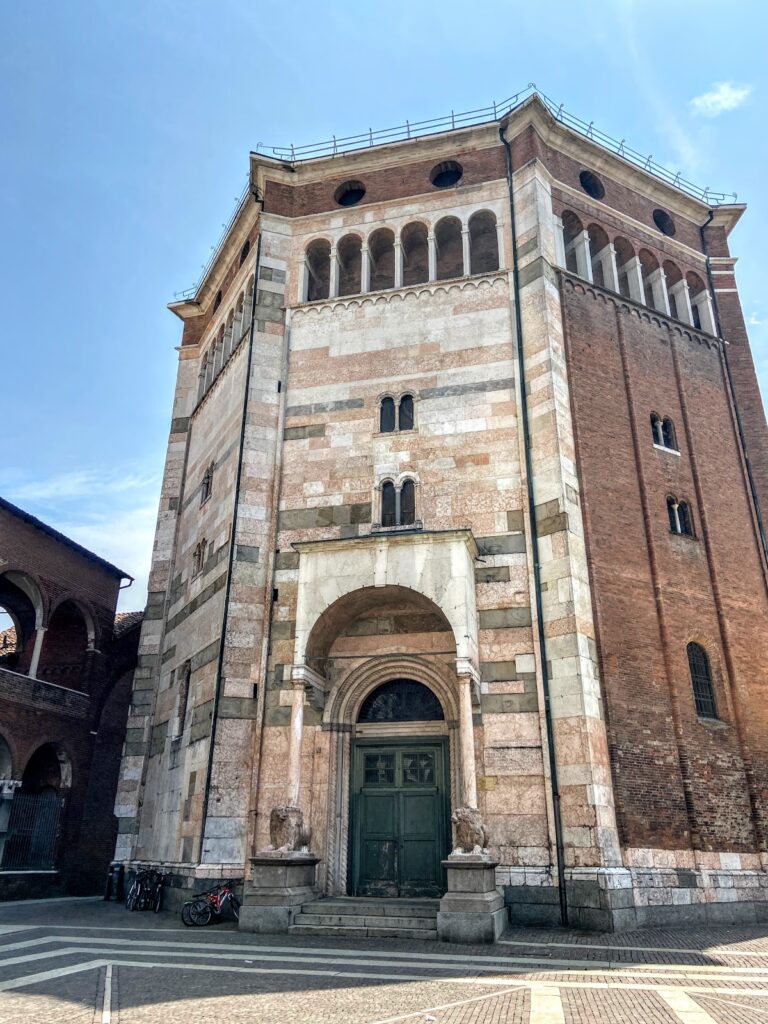
Cremona Cathedral is a large Romanesque building expanded into a cruciform complex beside the Torrazzo and Baptistery. Its principal facade faces Piazza del Comune, the medieval Platea Maior, and stands opposite the Palazzo Comunale. The exterior combines white Carrara marble with red Verona marble, while the interior preserves three aisles, elevated galleries, medieval and Renaissance sculpture, extensive fresco cycles, chapels, organs, and a large crypt beneath the presbytery.
Facade and connected exterior buildings
Main facade
The main facade is arranged around a large rose window by Giacomo Porrata of Como, a two-storey loggia, and a projecting portico topped by a three-arched gallery. Three statues in the gallery represent Saint Himerius, the Virgin and Child, and Saint Homobonus. Marco Romano made them around 1320. The two lions supporting the portico columns were sculpted in 1285 by Giovanni Bono of Bissone.
The portal preserves reliefs of the prophets Jeremiah, Isaiah, Daniel, and Ezekiel, together with a lion and a bull at the base of the lunette. These sculptures belong to the primitive cathedral and are attributed to the Master of the Prophets. Their style combines Byzantine-Ottonian features with Burgundian influences and elements associated with Wiligelmo. Above the portico arch is a marble frieze of the Months, interspersed with a relief of Bishop Sicardo, dating from approximately 1220 to 1230.
Renaissance upper facade
Alberto Maffiolo da Carrara completed the Renaissance upper facade in 1491. It includes an attic with four niches, a pediment, volutes, and a central spire. The niches contain statues of Saints Peter, Paul, Peter the Exorcist, and Marcellinus, carved in 1507 by Giovanni Pietro da Rho. Fifteenth-century medallions of Bianca Maria Visconti and Francesco Sforza are also set into the facade.
The facade originally included three spires. Renaissance alterations replaced the central one with the present turret. Ten spires rise across the building in total: three above the north facade, three above the south facade, two above the apses, and two above the main facade.
Transept facades
The north and south arms of the transept each end in a gabled facade with an upper gallery, a rose window, and smaller openings. Giacomo Camperio and Bartolino Bragerio built the north facade in 1288, and it was repaired in 1319 after earthquake damage. Its late-thirteenth-century portico rests on two lions attributed to Giambono da Bissone. Reliefs of the Archangel and the Annunciation are attributed to Wiligelmo, while the portal architrave incorporates a frieze from the older church.
Franceschino and Canino Toselli built the south transept facade between 1342 and 1374. It follows the general arrangement of the north facade but has a less elaborate treatment. The cathedral facade is linked to the Torrazzo by a portico begun by Lorenzo de Trotti in forms inspired by Bramante. The work was completed early in the sixteenth century with the Renaissance Bertazzola loggia. A statue of the legendary Cremonese figure Giovanni Baldesio stands against the cathedral’s right side, and two later tomb monuments are set into the facade, including one made in the mid-fourteenth century after a design by Bonino da Campione.
Interior structure and chapels
Nave and apses
Two rows of massive alternating cruciform piers and circular columns divide the interior into three longitudinal aisles. The side aisles have matronea, or elevated galleries, which open toward the main nave through large paired windows divided by central supports. Pointed, ribbed Gothic vaults cover the nave. At its eastern end, the main nave terminates in a large semicircular apse whose half-dome contains the fresco of the Redeemer.
The smaller side aisles end in semicircular apses. The right apse contains the richly decorated Chapel of the Blessed Sacrament, while the left contains the Chapel of the Madonna del Popolo. Beside the latter stands a polychrome maiolica statue of Saint Joseph with the Child by Marco Silecchia. The wooden choir was designed by Antonio delle Corna, Antonio Cicognara, and Bernardino di Lera, and Giovanni Maria Platina carved and inlaid it between 1482 and 1490.
Crypt
A large three-aisled crypt lies beneath the presbytery. Excavated during the Romanesque period, it was renovated in 1606 by Francesco Laurenzi. Giuseppe Dattaro and Giovanni Battista Maiolo continued the work after the vault collapsed. The crypt contains the Ark of Saints Marcellinus and Peter, a 1506 Renaissance reliquary originally made by Benedetto Briosco for the church of San Tommaso in Cremona.
During the Baroque period, the ark was transferred to the cathedral and reconstructed by Matteo Galletti with Briosco’s original panels. Its central panel, showing the Risen Christ, came from Amadeo’s Ark of Saint Areald. Six relief scenes depict Peter exorcising Paolina, the baptism of the family of Artemius, the saints’ interrogation before Judge Serenus, their beheading, the miraculous dove legend associated with the battle of Castelleone, and the transport and burial of their bodies.
Transept chapels and furnishings
The Chapel of Saint Roch at the end of the left transept contains works by Luigi Miradori, known as Il Genovesino, dated 1646. A large gilded and richly decorated wooden altarpiece holds a statue of the saint and paintings of episodes from his life. The scenes include Saint Roch and the Dog, the Healing of Plague Victims, the Procession with the Statue of Saint Roch, Saint Roch Healing Animals, his birth, his distribution of goods to the poor, the ending of the plague, the cardinal’s authorization, his encounter with wild beasts in the desert, and the announcement of his death in prison.
Reliquaries and sculptural works
Ark of the Persian Martyrs
Two matching pulpits made in 1820 use Carrara marble panels originally carved for the Renaissance Ark of the Persian Martyrs. The panels depict Saints Marius, Martha, Audifax, and Abacius before the emperor, their condemnation, scourging, burning, the severing of their hands, decapitation, the casting of their bodies onto the pyre, and Martha’s martyrdom.
Antonio Meli, abbot of the Benedictine monastery of San Lorenzo in Cremona, commissioned the ark from the Milanese sculptor Giovanni Antonio Piatti on 15 March 1479. It was intended to hold the relics of Marius and Martha and their children Audifax and Abacius, a Persian family said to have been martyred in Rome. Giovanni Antonio Amadeo continued the decoration after Piatti’s death. Other elements are now dispersed, including two Annunciation reliefs in the Louvre, a Nativity relief in Sforza Castle in Milan, and three freestanding statues in the Philadelphia Museum of Art and the John and Mable Ringling Museum of Art in Sarasota. Four angels with instruments of the Passion were also intended for the monument and are associated with the Sforza Castle collection.
Works by Giovanni Antonio Amadeo
In 1480, Amadeo produced eight panels that were later reused in the cathedral’s two nineteenth-century pulpits. In the following year, the cathedral administrators commissioned his relief of Saint Himerius Giving Alms, now set into the right side of the high altar. In 1482, Canon Isaac Restalli commissioned Amadeo to create the Ark of Saint Areald. Four signed marble reliefs from that dismembered monument, dated 1484, are now mounted in the transept.
Silver and gilt altar cross
The cathedral’s three-metre silver and gilt cross consists of more than 1,000 pieces, including 160 large and small statues and 50 busts of saints. Ambrogio Pozzi and Agostino Sacchi made it between 1470 and 1478. Its eighteenth-century silver base was designed by Giovanni B. Manfredi and produced by the Cremonese silversmith Giuseppe Berselli. Following restoration in the 1990s, the cross has been kept in the Diocesan Museum beside the cathedral.
Frescoes and musical instruments
Nave and counterfacade paintings
The central nave presents the Stories of the Virgin on the left wall and the Stories of the Passion of Christ on the right. Boccaccino’s first four arches contain scenes from the Virgin’s life, while Bembo, Melone, Il Romanino, Pordenone, and Bernardino Gatti completed the larger narrative cycle in stages. Pordenone’s Crucifixion and Lamentation occupy the counterfacade within an illusionistic architectural setting, and Gatti’s Resurrection of Christ appears in its lower left section.
The presbytery contains later frescoes by Bernardino and Antonio Campi. The opening of two apse windows altered the earlier apse decoration by Boccaccino. The smaller aisles of the transept preserve a fifteenth-century cycle of scenes from the Old Testament. Parts of the cycle in the central body were later concealed by seventeenth-century painting.
Organs
The cathedral contains two pipe organs. The Mascioni Opus 1066 was built in 1984 and has 54 stops distributed across three manuals and pedal. It is housed in a finely decorated mid-sixteenth-century case painted by Francesco Pesenti and carved with Renaissance ornament. A positive chest organ built by Daniele Giani in 2003 has eight stops, one manual, and no pedal, and is used to accompany liturgical singing.
Nearby sites