Corpus Christi College in Oxford: A College of the University of Oxford
Site at a Glance
- Rating
- 4.6
- Popularity
- Medium
- Country
- United Kingdom
- Primary era
- Early Modern
- Eras represented
- Early Modern, Modern
- Civilizations
- British, English
- Site type
- Civic
- Remains
- University
On this page22 sections
History
Corpus Christi College in Oxford, United Kingdom, is a constituent college of the University of Oxford, founded in 1517 by Richard Foxe, Bishop of Winchester and a statesman. Its principal buildings were begun in 1513 in a late-medieval Oxford college style and were probably complete by about 1520. It is the university’s twelfth-oldest college.
Foundation and early growth
Foxe assembled the site from a former nunnery, two halls, two inns and Merton College’s Bachelors’ Garden. Henry VIII granted the college royal letters patent, formal documents issued under royal authority, in 1516. Foxe established its governing statutes the following year. They provided places for 20 fellows, senior members of the college, and 20 students, as well as three lecturers, two priests, two clerks and two choristers.
The foundation was supported by Hugh Oldham, Bishop of Exeter, and William Frost, Oldham’s steward, or property manager. Oldham gave £4,000 and land in Chelsea. Foxe named him the principal benefactor, and the college remembered him in daily prayers and established a scholarship for students from Lancashire. Frost left his estate at Mapledurwell to the college. An annual prayer commemorated Frost and his wife, and a scholarship was created for Frost’s descendants. Reginald Pole, one of the founding fellows, later became the last Catholic Archbishop of Canterbury.
Religious scholarship
During the college’s first century, several of its members took part in debates that shaped the Church of England and the Anglican tradition. John Jewel, its Reader of Latin, defended Protestant positions in the Church and in the Elizabethan Religious Settlement, the religious settlement established under Elizabeth I. Richard Hooker, author of Of the Laws of Ecclesiastical Polity, served as deputy professor of Hebrew.
John Rainolds, elected president in 1598, proposed the creation of the King James Bible, an English translation commissioned under James I, and contributed to its text. The work of Corpus members on the translation became an important part of the college’s history. Juan Luis Vives also taught at Corpus during the 1520s while tutoring Mary Tudor, later Queen Mary I.
Academic life and changing membership
From the Tudor era, the period of rule by England’s Tudor dynasty, the college’s academic interests were chiefly classical studies, including languages, literature, art and history. John Keble studied at Corpus in the early nineteenth century. He later became a fellow of Oriel College and a leading figure in the Oxford Movement, a revival within the Church of England.
Women graduate students joined the college from 1974, and its first female undergraduates were admitted in 1979. The Bishop of Winchester serves as the college’s Visitor, a formal office with a supervisory role in its affairs.
Remains
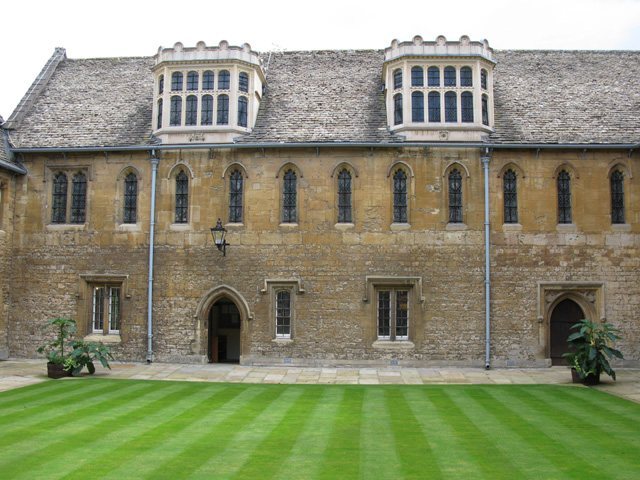
The principal site occupies Merton Street between Merton College and Christ Church. Its buildings include the Front Quad, West Building, Fellows’ Building, Gentleman-Commoners’ Quad, Thomas Quad and MBI Al Jaber Auditorium. The chapel and library adjoin one another just off the Front Quad, while gardens and student residences form other parts of the college’s physical setting.
Main-site architecture
Front Quad
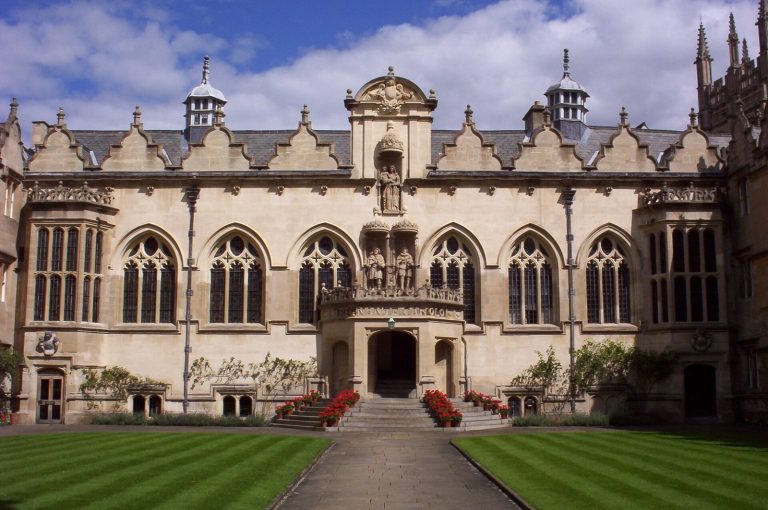
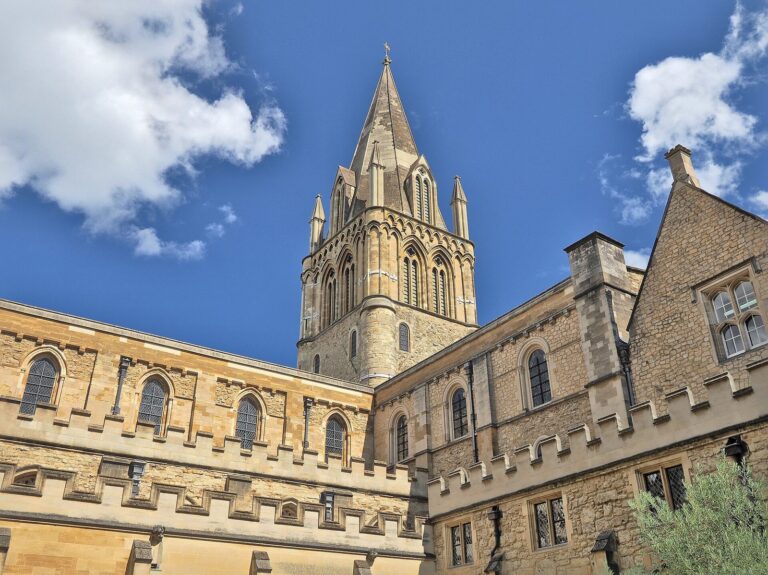
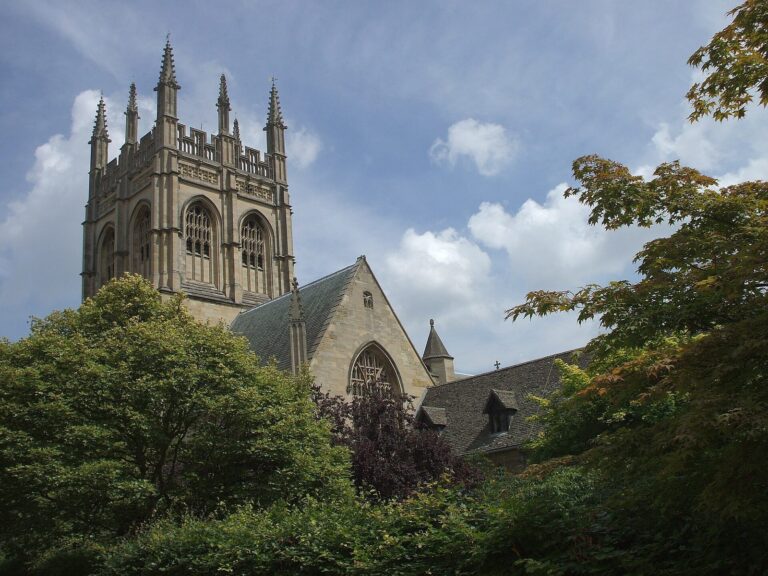
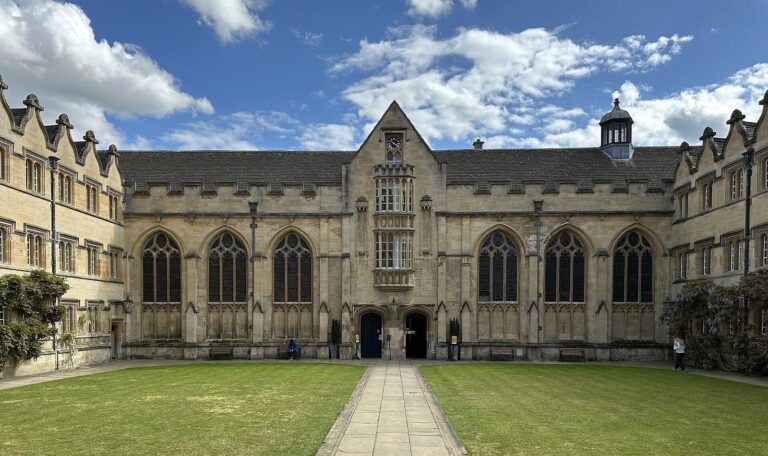
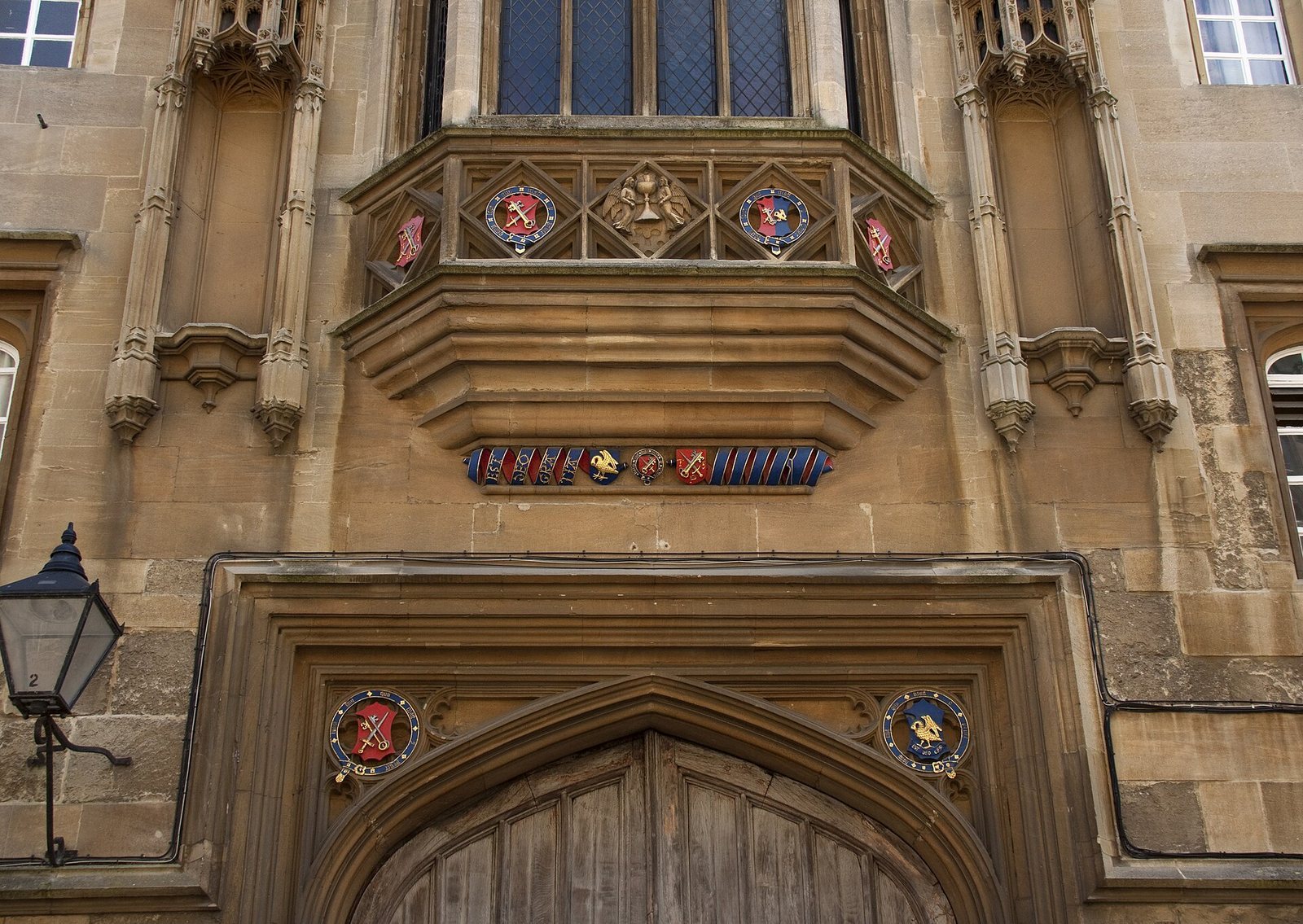
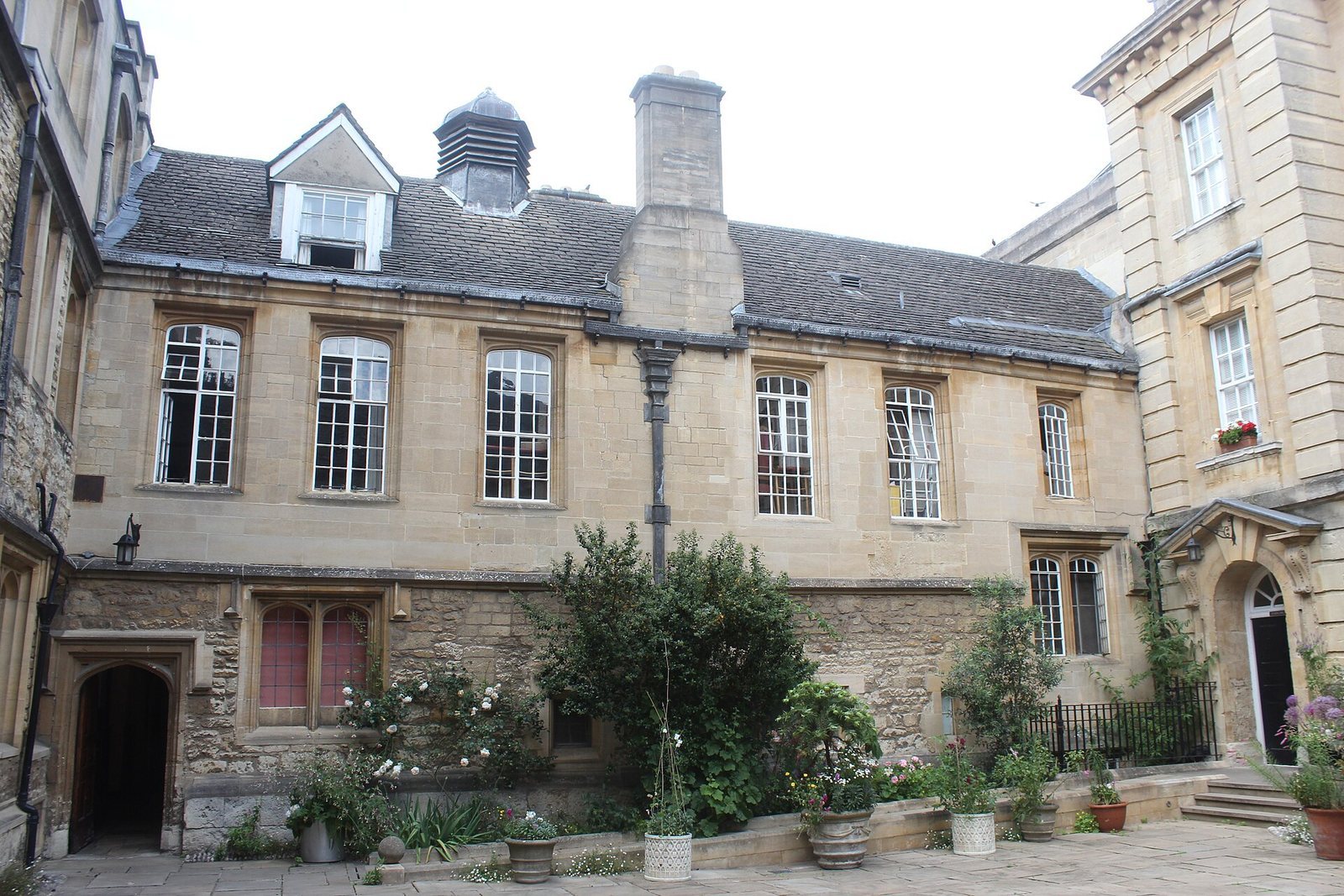
The Front Quad, an enclosed courtyard, was built in the late-medieval Oxford college style, with a tower above its main entrance. The master masons William Vertue and William East and carpenter Humphrey Coke, all associated with Henry VIII’s Office of Works, worked on the original buildings. Battlements were added in 1625. The architecture later inspired buildings at Oglethorpe University in Georgia.
Chapel and library
The chapel stands beside the library and close to the Front Quad. Its bronze eagle lectern, given by the college’s first president, is among Oxford’s earliest examples of this type and is the city’s only pre-Reformation bronze eagle lectern. A copy of Rubens’s Adoration of the Shepherds, presented by the antiquarian Sir Richard Worsley, serves as the chapel’s altarpiece.
The library was probably Europe’s largest and best-furnished when completed. In a letter to the first president, John Claymond, in 1519, Erasmus praised it as one of Britain’s chief beauties and described its collection as three-language, with books in Latin, Greek and Hebrew.
Later college buildings
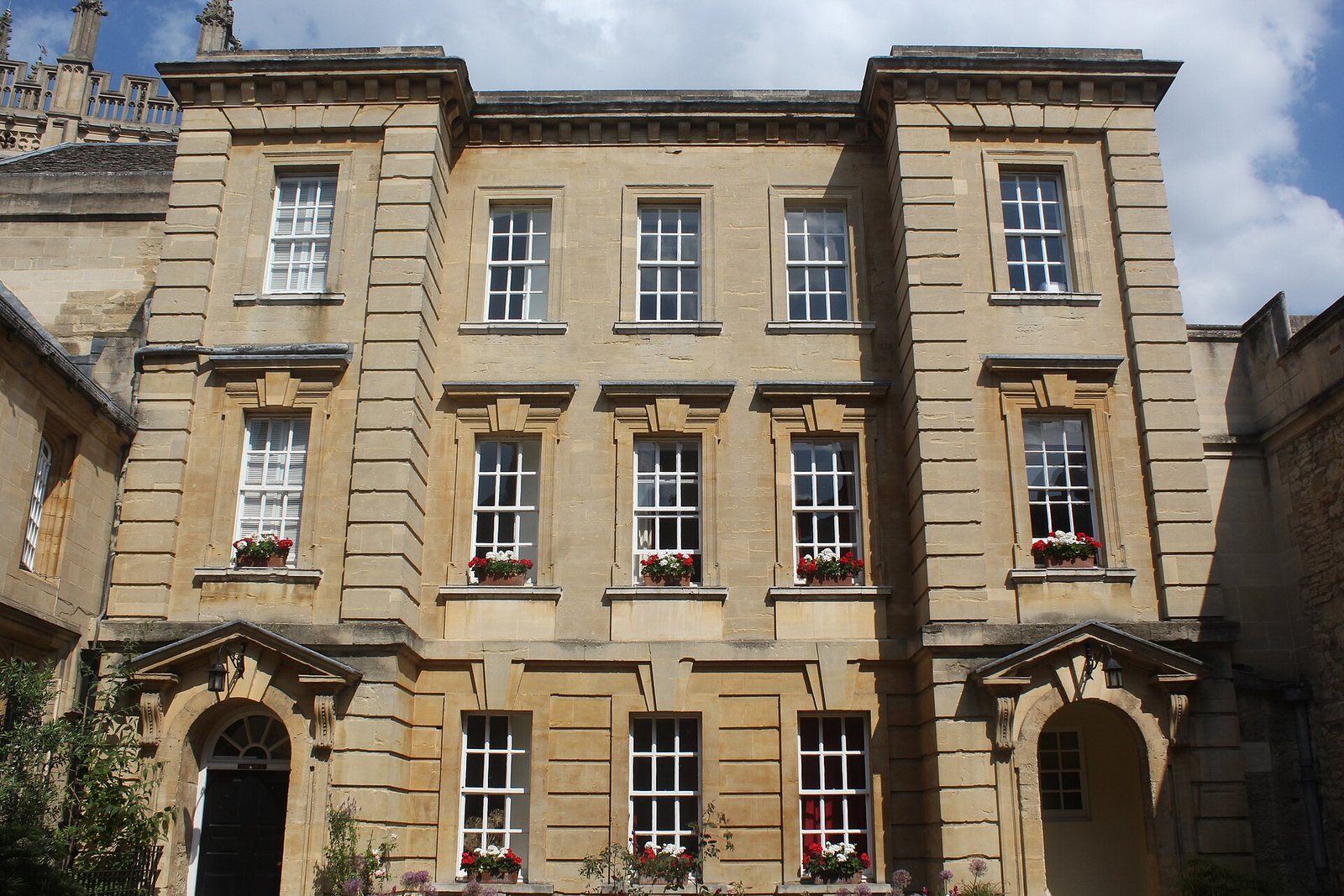
The Fellows’ Building dates from 1706–1716, the Gentlemen Commoners’ Building from 1737, and the Emily Thomas Building from 1928. The main site also includes West Building and Thomas Quad, among the college’s later architectural groups.
Auditorium and greenhouse
The MBI Al Jaber Auditorium occupies land that formed part of the fellows’ private garden. Its rooftop Handa Terrace overlooks the remaining gardens and their surroundings. The associated greenhouse is almost frameless and contains horticultural and informal displays watched over by a mannequin called Madame Lulu.
Student residences
Magpie Lane buildings
At the corner of Merton Street and Magpie Lane, student accommodation includes the Jackson and Oldham buildings and Kybald Twychen. In 1884–85, a New Building and Annexe replaced town houses on Magpie Lane. A further block, added in 1969 in a beehive-shaped modernist design, left Jackson’s Annexe substantially intact. Its local limestone rubble and large windows sit within an exposed concrete frame. The design responds to the nearby plain wall of Oriel College, Merton’s Gothic chapel and the decorated Annexe. Following renovation in 2017, the New Building became the Oldham Building and the Annexe became the Jackson Building.
Other accommodation
The college also owns the Liddell Building on Iffley Road, built jointly with Christ Church in 1991; the Lampl Building on Park End Street, completed in 2014 and named after Sir Peter Lampl; and houses on Banbury Road.
Gardens
Development of the garden layout
A 1578 map shows regularly planted trees below the city wall and a smaller, formally arranged garden area to the east. Around 1623–24, a raised terrace was made against the wall. A depiction from 1675 shows a two-storey pavilion at its western end, trees along the terrace and two rows of shrubs to the north; a similar arrangement appears in 1726. By 1733, the smaller eastern enclosure had also been formally laid out. By 1814, most formal divisions and features had been removed, the wall’s eastern end had been lowered, and an open lawn remained, partly bounded by the terrace to the south.
Present garden landscape
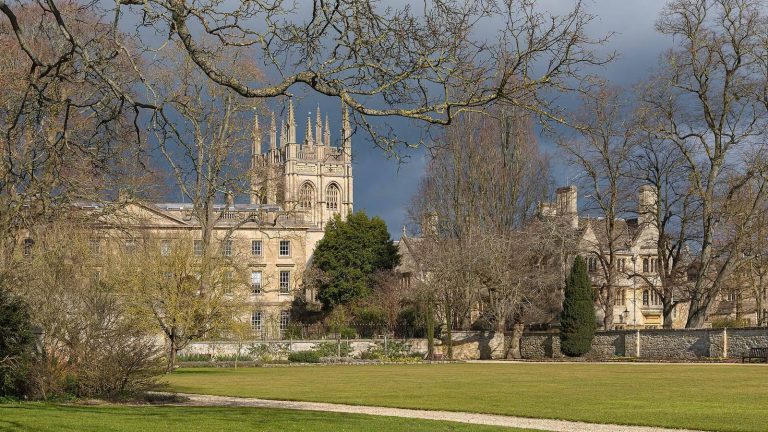
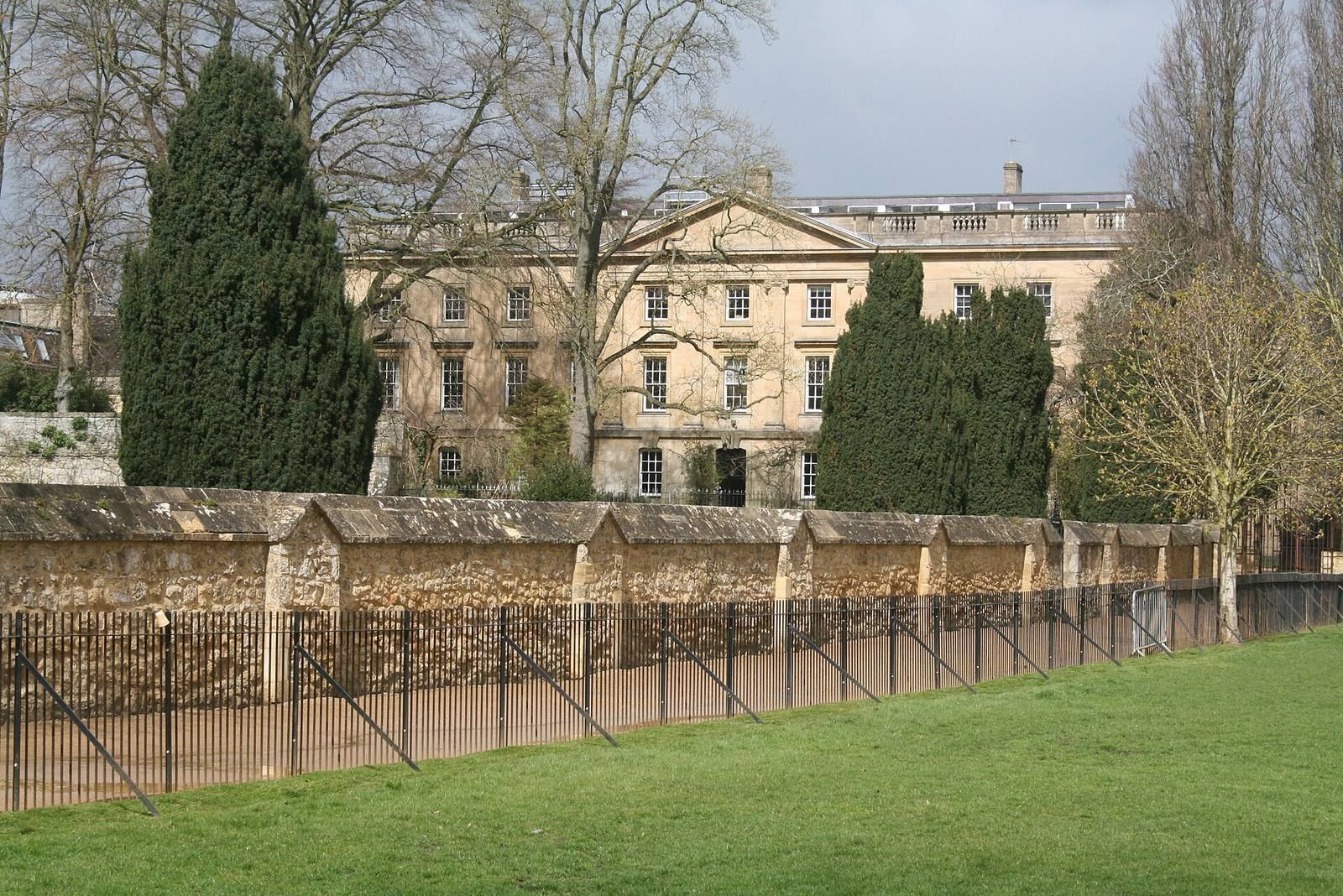
By the turn of the nineteenth century, strict geometric designs had given way to a more informal garden, with a main lawn bordered by dense shrubs. A small garden now links the Front Quad to the main garden behind the college. The main garden is bordered on one side by the Fellows’ Building’s classical-revival architecture, ornamental shrubs, perennials, climbing roses and wisteria. A bank shaded by a copper beech leads to a viewpoint on the old Oxford city wall above Dead Man’s Walk. Three lime trees mark the line of the raised terrace avenue created in 1623, and the viewpoint looks across Christ Church Meadow and neighbouring college gardens.
Planting and care
Tended by David Leake since 1979, the gardens combine wild and cultivated flowers. Their management avoids herbicides and fertilisers, and self-seeded plants are allowed to grow on the main lawn. Plantings include trumpet vine, dragon lily, Brazilian giant-rhubarb, littleleaf mock-orange and arum lily, as well as a Wollemi pine and a quince whose fruit is given to college fellows and friends. Seven bamboo plants frame the library windows, and beekeeping is practised in the gardens.
Sundials
Pelican Sundial
The Pelican Sundial stands as a large pillar at the centre of the main quadrangle. Dated to 1579, it was erected in 1581 and designed by Charles Turnball, so it is also called the Turnball Sundial. A gold-painted pelican stands on an armillary sphere, a model of circles representing the heavens. The pillar carries 27 dials. Nine are readily visible on the square section below the pelican, beneath the coats of arms on the block below, and on the south-facing curved shaft. Other dials occupy recessed and scalloped areas around the east and west arms. Symbols around the pillar indicate feast days and signs of the zodiac.
Calendar tables and restoration
Three tables on the shaft give dates for movable feasts, which change each year, and fixed feasts, which recur on the same date. They also set out Oxford academic terms and legal terms, the periods when courts sit, provide a perpetual calendar for dates across multiple years, and explain how to tell the time by moonlight. The tables follow the Julian calendar, introduced under Julius Caesar, and have no modern practical use. The pillar’s stone panels were loosely packed with rubble rather than resting on a solid foundation. Its markings were replaced several times, while errors accumulated in the tables despite restorations overseen by Robert Gunther. The pillar’s lean was corrected in 1967 after its inadequate foundation was discovered. Philip Pattenden restored the dial and corrected its tables in 1976, bringing it close to its condition around 1710; another restoration followed in 2016.
Earlier garden sundial
A fixed sundial attributed to Nicholas Kratzer stood in the garden until about 1706, when the garden was remodelled for construction of the Fellows’ Building.
Arms and symbolism
The college’s arms combine three vertical panels: Foxe’s gold pelican on blue; the arms of the See of Winchester, with keys and a sword; and Oldham’s arms, with a gold chevron, three silver owls and red roses. The pelican also appears by itself on the college flag. In Christian imagery, a pelican feeding its young with its own blood represents Christ. The college’s name refers to the Body of Christ, commemorated in the Eucharist, the Christian rite in which bread and wine recall the Last Supper.