Citadel of Ghent: A Nineteenth-Century Fortress in Belgium


Site at a Glance
- Rating
- 4.2
- Popularity
- Medium
- Country
- Belgium
- Primary era
- Modern
- Eras represented
- Modern
- Civilizations
- Belgian
- Site type
- Military
- Remains
- Citadel
On this page7 sections
History
The Citadel of Ghent in Belgium was a nineteenth-century fortress of the United Kingdom of the Netherlands and later Belgium, planned in 1819 and constructed from 1822 as part of the second fortified line of the Wellington Barrier. This chain of fortifications was created after the Napoleonic Wars to protect the southern frontier of the United Kingdom of the Netherlands, a buffer state established by the Congress of Vienna between France and the German states. The citadel was built on elevated ground south of Ghent’s medieval core, where earlier defenses had guarded an exposed approach to the city.
Planning and construction
King William I approved the project during his reign. Final plans were approved on 4 October 1821, and construction began on 27 May 1822 after administrative delays. The estimated cost was 3,175,000 Dutch florins, with another 153,250 florins allocated to land acquisition, expropriation, and the demolition of existing houses. The foundation stone was laid on 15 April 1823 at the angle of Bastion No. 2, a projecting part of the fortified enclosure designed to let defenders fire along adjacent walls.
The fortress replaced an earlier military work. Monterey Fort had been built outside Ghent’s walls in 1671 under Spanish rule, between the former Kortrijk Gate and Heuvel Gate. It defended the southern side of the city during the period of Louis XIV’s expansionist wars. Emperor Joseph II, the Habsburg ruler of the Austrian Netherlands, ordered its demolition in 1782. The later citadel therefore occupied a site with a long defensive history.
The first artillery units entered the new citadel on 18 August 1830. The fortress was still unfinished during the Belgian Revolution, the uprising in the southern provinces of the United Kingdom of the Netherlands that led to Belgian independence. Belgian civil engineers completed the works from 1831, and the fortress became operational during the early Belgian period.
The Belgian Revolution and surrender
At the beginning of the revolution, the citadel was commanded by Andries Jan Jacob des Tombe. On 1 October 1830, Ghent’s bourgeois guard surrounded the fortress. The following day, about 2,800 soldiers under Colonel Destombes broke through the insurgents’ barricades and entered the unfinished stronghold.
The garrison included about 1,900 men of the 17th Infantry formation under Colonel Bogelaer, a 600-man battalion of the 5th Infantry formation under Captain Langerok, an artillery battery commanded by Captain Kuypers, part of the 8th Hussars under Captain Delfosse, and the headquarters of the military command of East Flanders. They were joined by 120 men expelled from the Kezelfort at Oudenaarde.
Discipline soon deteriorated. On 3 October, many Belgian soldiers of the 17th Infantry formation mutinied. After negotiations, 240 Belgian officers and soldiers were permitted to leave on 4 October under the pretext of unloading a boat of straw. A larger mutiny followed that afternoon and involved about 1,000 soldiers, who were held back by eight cannon. On 5 October, a further 240 mutineers were allowed to depart and deserted.
After Belgium declared independence, the Belgian-Parisian Free Rifle Corps arrived in Ghent on 11 October under the French military leader Louis Adolphe Le Doulcet de Pontécoulant. The corps joined the city guard and other Belgian revolutionary volunteers in besieging the citadel. Other formations, including the Belgian-Parisian Legion, later joined the operation.
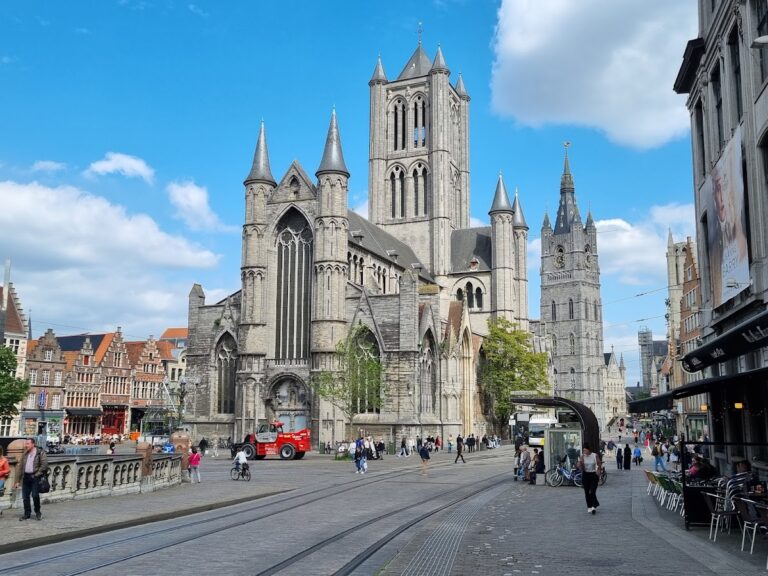
The fighting also involved Ghent’s firefighters. On 15 October, the city regency and the governor of East Flanders, Hendrik Jacob van Doorn van Westcapelle, called on them to intervene. Major Van de Poele led 30 men and two guns into combat near Saint Nicholas Church, causing several deaths and injuries. The firefighters then moved to the Kouter, where their commander sided with the revolutionaries and agreed to obey the volunteers and the provisional Belgian government, the revolutionary authority established during the uprising.
On 16 October, Major De Haan was sent to negotiate with Belgian General Ignace Louis Duvivier. Formal discussions between Colonel Destombes and Duvivier began on the fortress glacis, the sloping ground outside a fortification that exposed attackers to defensive fire. The Dutch garrison was allowed to surrender and leave during the night of 18–19 October while retaining its weapons.
The Dutch contingent departed shortly before sunrise with 700 men and four loaded artillery pieces. At the closed Damme Gate, representatives of the provisional Belgian government ordered the remaining Belgian hussars to turn back. The column threatened to fire on the gate, which was then opened, allowing the entire contingent, including the hussars, to leave for Antwerp.
Belgian military use and declassification
From 1831, the Belgian army occupied the completed citadel with the 9th Regiment of the Line and the 2nd Regiment of Mounted Chasseurs. The fortress escaped the dismantling imposed on several other works of the Wellington Barrier by the Convention of the Fortresses, and it continued to serve as a military installation.
On 29 January 1849, an explosion destroyed the left powder magazine in Bastion No. 5. The artillery second lieutenant Bernard caused the blast by detonating 65 barrels of gunpowder and killed himself in the act. Two other soldiers died and about fifteen were wounded.
Its military value later came into question. In 1863, the Belgian fortification specialist Henri Alexis Brialmont judged the citadel ineffective against a major invasion because it stood too close to the city centre. On 22 April 1870, Ghent and the military authorities agreed in principle to declassify the fortress, based on a preliminary project by Mayor Charles de Kerchove de Denterghem. The city formally agreed to purchase the entire fort on 25 April.
The Franco-Prussian War delayed the purchase and dismantling. Belgium mobilized its army during the conflict because of fears of an invasion, but after the armistice of 28 January 1871 the agreement was finalized on 7 March and demolition began progressively. The grounds had been transferred to the city in 1870. An urbanization plan for the district was approved in 1874, and Citadelpark opened in 1875 as boulevards, side streets, and a new urban district developed around the former fortress. Much of the remaining citadel was demolished in 1907. By the 1913 World Exhibition, the gatehouse remained, while the former barracks immediately north of the citadel had been rebuilt as the Leopold Barracks.
Remains
Fortress setting and layout
The citadel occupied elevated ground in the former Sint-Pietersdorp, an area associated with Saint Peter’s Abbey, between the Lys and Scheldt rivers and south of Ghent’s medieval centre. It stood between the former Kortrijk Gate and Heuvel Gate, where the terrain was not protected by the inundable marshes used elsewhere around the city. Earlier defenses in this area included bastions incorporated into Ghent’s walls and known as the ‘s Gravenbollewerk. A seventeenth-century barracks stood north of Monterey Fort within the city walls.
The fortress was organized around numbered bastions, including Bastion No. 2, where the foundation stone was placed, and Bastion No. 5, whose left powder magazine exploded in 1849. It originally stood higher than the present park. During dismantling, substantial quantities of earth were excavated, lowering the site and changing the physical relationship between the surviving remains and the surrounding ground.
Surviving entrance gate
The city-side entrance gate is incorporated into present-day Citadelpark and forms the principal surviving element of the citadel. Its original Dutch lion was replaced by a Belgian lion after Belgian independence. The fortress motto, Nemo me impune lacesset, meaning “No one will attack me with impunity,” survives in a Latin inscription on the gate.
Nearby sites