Kibyra Ancient City: A Greek and Roman Regional Center in Türkiye
Site at a Glance
- Rating
- 4.8
- Popularity
- Medium
- Country
- Turkey
- Primary era
- Classical
- External website
- Open
- Eras represented
- Classical
- Civilizations
- Ancient Greek, Lydian, Roman
- Site type
- City
On this page11 sections
History
Kibyra Ancient City is the remains of an ancient Greek city near Gölhisar in Türkiye, in the region of modern Burdur. It developed as the chief city of the independent state of Cibyratis and became a powerful regional center during the second century BC. The settlement later flourished under Roman rule, especially after reconstruction following a major earthquake in AD 23.
Origins and the Cibyratis
Strabo wrote that the Cibyratae claimed descent from Lydians who migrated into the area, subdued neighboring Pisidians, and then moved their settlement to a new city. The earlier location may have been at Uytuptnar, approximately 18 kilometers from Kibyra. That site contains Iron Age remains and material dating to around the third or fourth century BC, linking it to the tradition of an earlier settlement before the relocation.
Kibyra stood outside the northwestern boundary of ancient Lycia and controlled the state of Cibyratis. During the reign of Eumenes II of Pergamon, from 197 to 159 BC, it appears to have been ruled by the Kingdom of Pergamon. After the Treaty of Apamea in 188 BC, the city became part of the Attalid Kingdom. The Attalids were the ruling dynasty of Pergamon, which controlled parts of western Asia Minor before its territory passed to Rome. Kibyra’s exact political position after the creation of the Roman province of Asia in 133 BC remains uncertain.
Regional power and Roman intervention
Livy first mentioned Kibyra in connection with the campaign of the Roman general Gnaeus Manlius Vulso in 189 BC, during the Galatian War. Vulso approached through Caria and demanded 100 talents and 10,000 medimni of wheat from Moagetes I, the tyrant of Kibyra. Moagetes also controlled Syleum and Alimne.
By the second century BC, Kibyra exercised authority across a wide territory extending from Pisidia and Milyas to Lycia and the Rhodian Peraea. Milyas was an ancient region of southwestern Anatolia, while the Rhodian Peraea was the mainland territory controlled by Rhodes. Ironworking, leather processing, horse breeding, and intensive pottery production supported the city’s economy, alongside regional trade and a possible grain trade involving the Indus valley.
Kibyra joined Bubon, Balbura, and Oinoanda in the Tetrapolis, a four-city political and military confederation. Each of the other cities held one vote, while Kibyra held two. Its larger voting share was attributed to its reported military capacity of 30,000 infantry and 2,000 cavalry.
In 83 BC, during the First Mithridatic War, the Roman general Lucius Licinius Murena deposed Moagetes II, the last tyrant of Kibyra and son of Pancrates, and dissolved the Tetrapolis. Balbura and Bubon were assigned to the Lycian League, a political federation of Lycian cities.
Language, earthquake, and Roman reconstruction
In the early first century AD, Strabo recorded that the inhabitants spoke Pisidian, Solymian, Greek, and Lydian. Kibyra is therefore the last locality where Lydian is attested, even though the language had already disappeared from Lydia itself.
A major earthquake struck Kibyra in AD 23, during the reign of the emperor Tiberius. A senatorial decree, meaning a formal decision of the Roman Senate, granted the city a three-year exemption from tributum, a Roman tax. Most of the surviving buildings date from the reconstruction that followed. Later emperors, particularly Claudius, also assisted in rebuilding the city. In gratitude, the inhabitants added Caesarea to Kibyra’s name, established games, and began a new era dated from AD 25.
Hadrian visited Kibyra in AD 129 while traveling through the eastern provinces and granted privileges to the city and its inhabitants. Kibyra also served as the center of a Roman conventus, a judicial district where legal proceedings were administered for several cities. The district contained 25 cities, including Laodicea on the Lycus among its principal communities. Kibyra later became one of the early bishoprics of Christianity.
Late Antiquity and archaeological investigation
A second earthquake struck in AD 417, after which the city could not be fully rebuilt. Its last inhabitants left during the eighth century and settled at Horzum, now known as Gölhisar.
Systematic excavations began in 2006 under the Department of Archaeology of Mehmet Akif Ersoy University in Burdur. Excavations in 2011 to 2013 uncovered a bilingual Greek and Latin inscription recording an alliance treaty between Kibyra and Rome from 174 BC. The site has been included on Türkiye’s Tentative List of World Heritage Sites since 2016, with its proposed value associated with the regularity of its urban plan, the quality of its monuments, and the technical skill visible in its artworks.
Remains
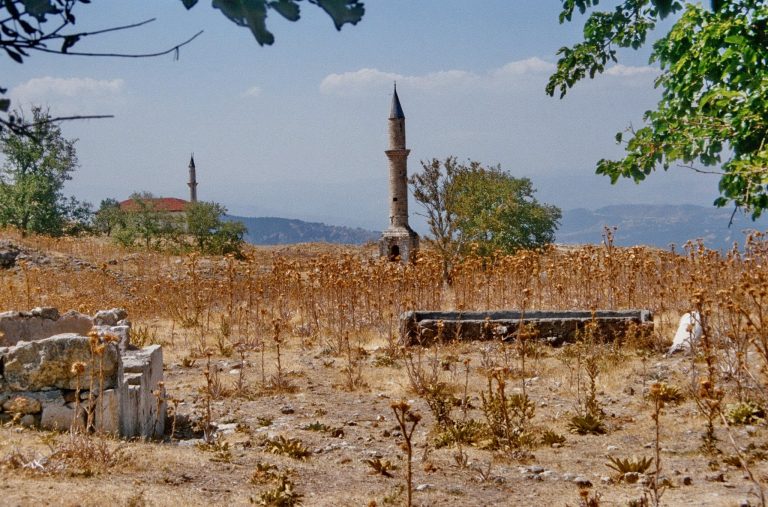
The ruins occupy the crest of a hill rising approximately 90 to 120 meters above the surrounding plain. Buildings were constructed mainly from locally quarried limestone. The Cibyratic plain lies about 300 meters above sea level, within the upper part of the Xanthus basin and the upper, and possibly middle, basin of the Indus River. Mount Cragus bounded the region to the west and separated it from Caria. The Indus was described as rising in the hills of the Cibyratae and receiving 60 perennial tributaries.
Theatre and temple remains
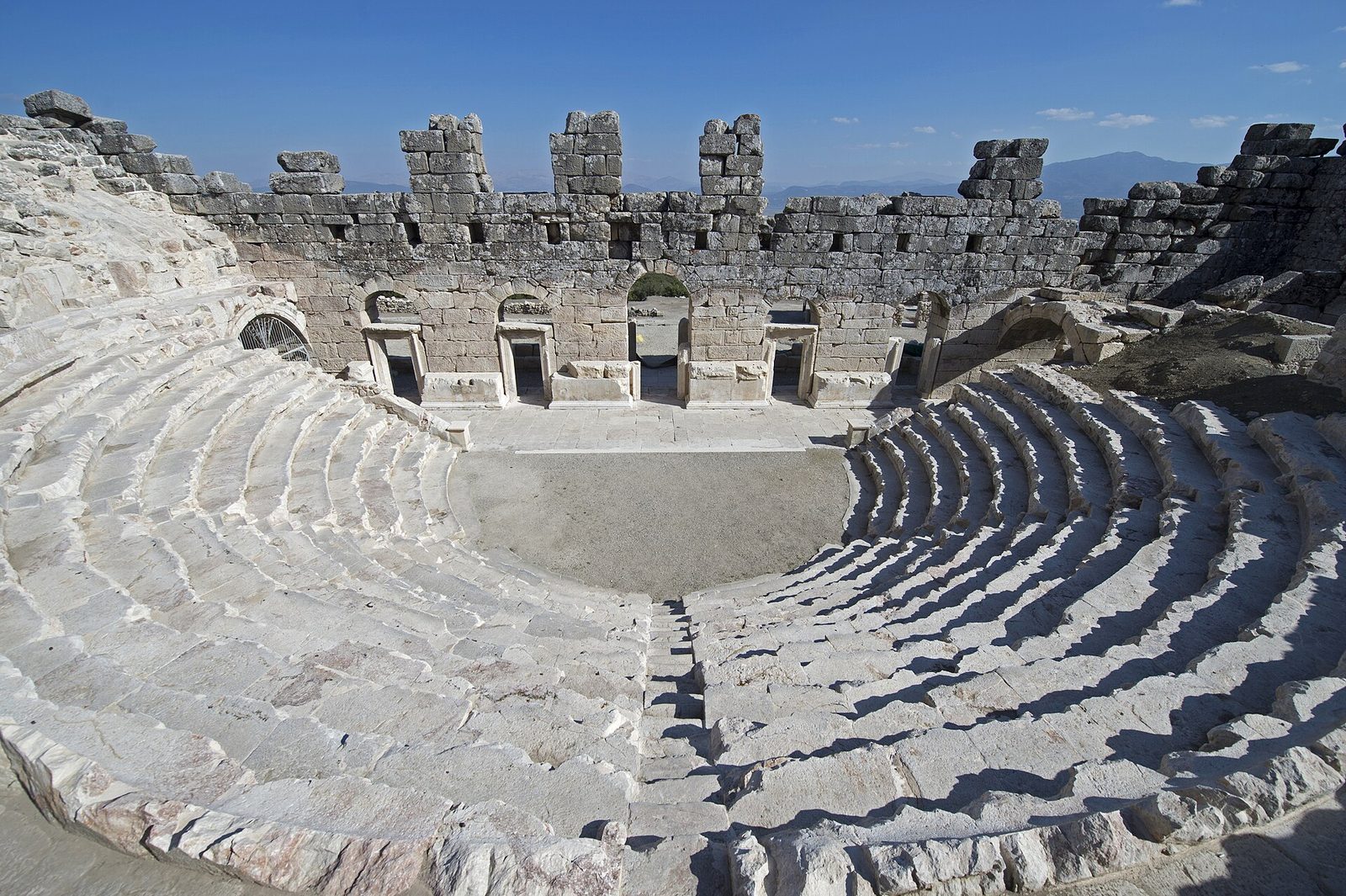
Kibyra’s major theatre is preserved in good condition and measures approximately 81 meters in diameter. Its seating is oriented toward the Cibyratic plain and the mountains of Milyas. Several large buildings stand nearby and are thought to represent temples. Their surviving architectural elements include both Doric and Corinthian orders, two systems of column design used in Greek and Roman architecture.
Odeon and civic buildings
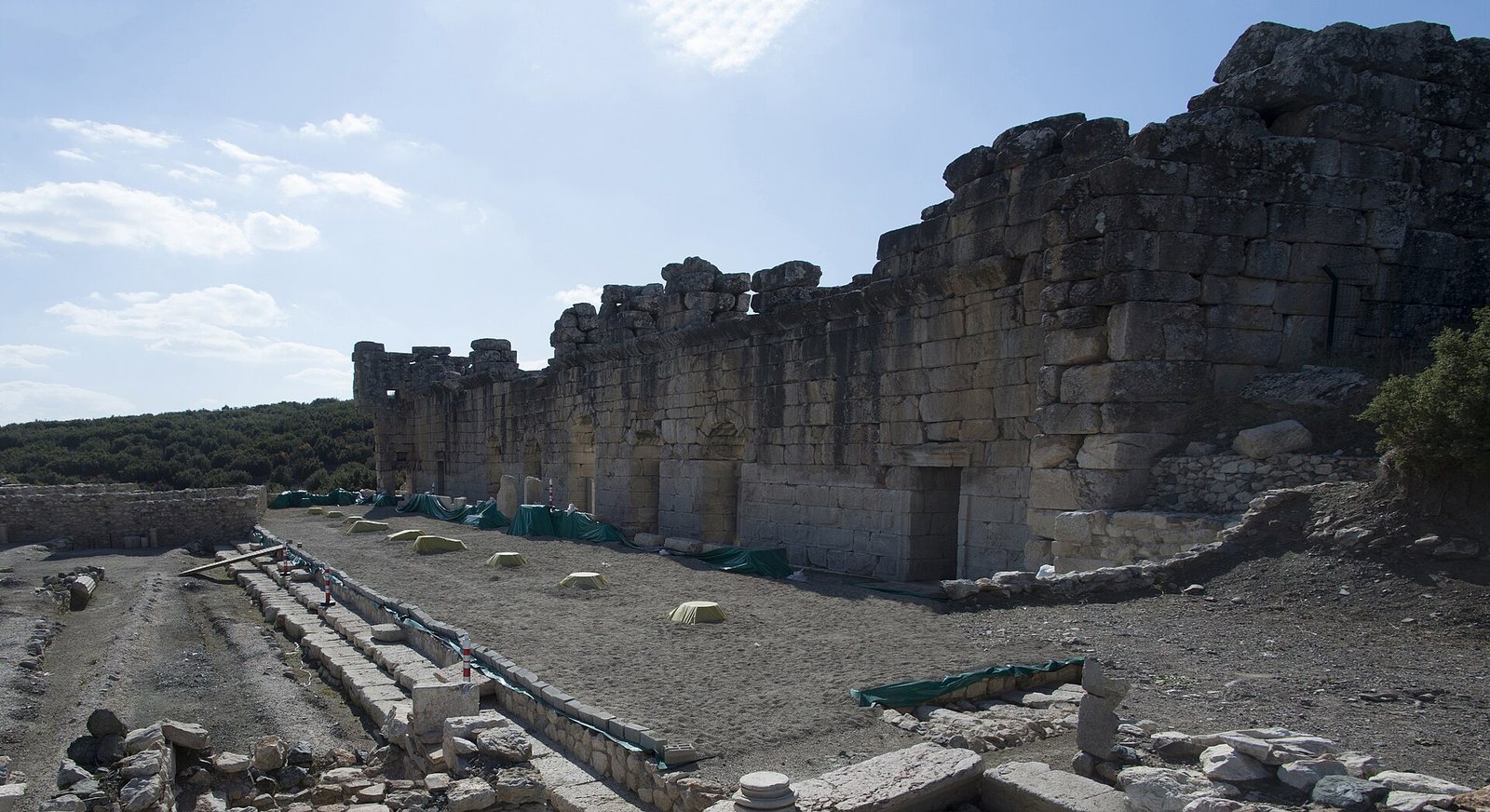
The Odeon, or music theatre, stands in the densely occupied southwestern part of the hill. It was first built in the second half of the second century AD as a bouleuterion, a building for meetings of the city council. A stage was added soon afterward, changing the building into a theatre and courtroom. It then served for important trials held at the Roman legal center of Asia Minor.
The building’s facade was faced with marble and decorated with colored marble columns and cladding. Its orchestra floor measures 9.80 by 5.80 meters and consists of finely cut white, red, purple, and gray marble slabs fitted together in opus sectile, a technique using shaped stone or marble pieces to create geometric or figurative designs. A large Medusa image occupies the center of the floor.
The audience-facing stage facade used thin colored marble slabs, with decorative motifs on its doors and columns. A stoa, or covered colonnade, stood in front of the Odeon with nine columns and a mosaic floor. An inscription on the mosaic dates its construction to AD 249 to 254 and names Aurelius Sopatros and the brothers Klaudius Theodoros as its sponsors.
Stadium and funerary avenue
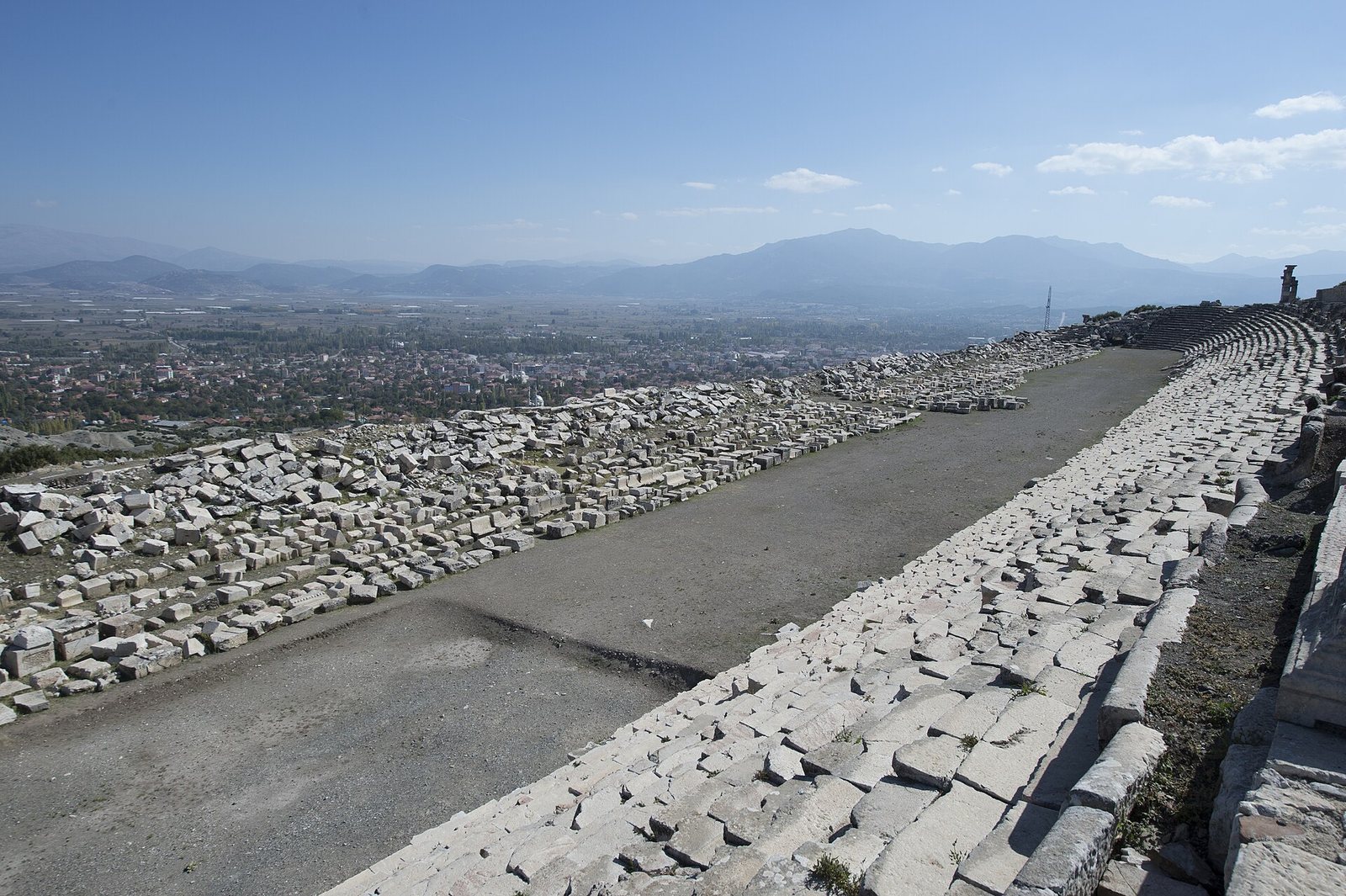
The stadium lies at the lower end of the city’s ridge. It measures approximately 198 meters in length and 24 meters in width and was used for foot races and gladiatorial combats. Extensive friezes showing gladiators were found there.
Part of the hillside was cut away to create the stadium. One side contains 21 rows of seats carved against the slope, curving at the upper end into a theatre-like termination. This section remains well preserved, while vegetation has displaced seats on the hillside. On the opposite side, marble seats rested on a low wall along the edge of a terrace formed by cutting into the hill.
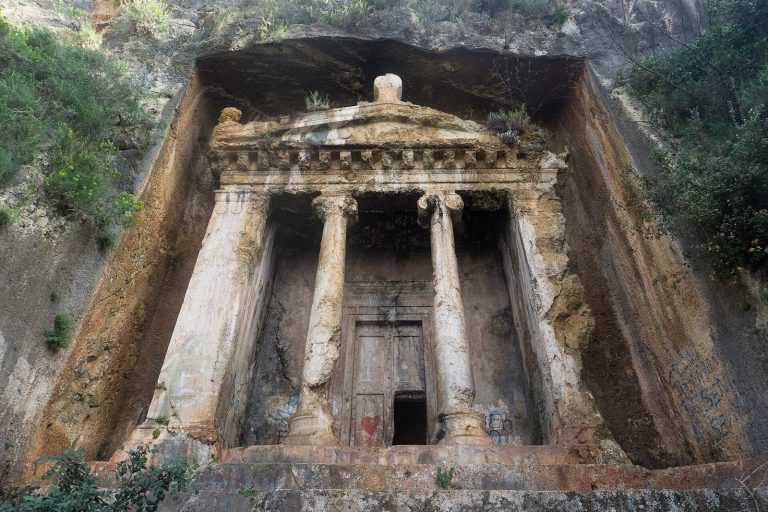
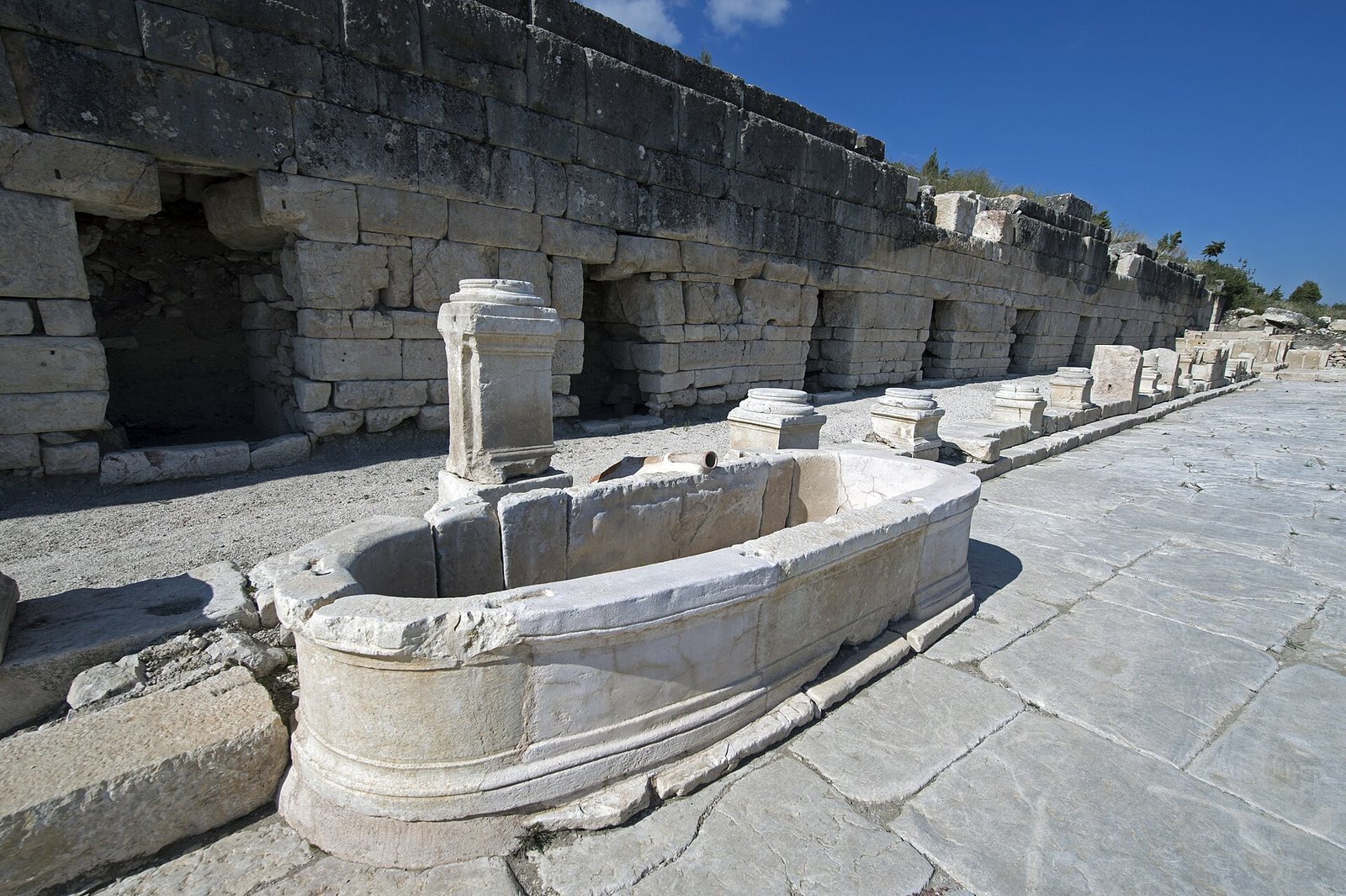
Near the stadium entrance, a ridge running eastward forms a paved avenue bordered by sarcophagi and funerary monuments. A massive Doric triumphal arch once marked the entrance to the avenue and now survives in ruins.
Inscriptions, statues, and burials
Kibyra’s epigraphic corpus contains 448 Greek and Latin inscriptions dating from the second century BC to Late Antiquity, the later Roman period and the transition into the early medieval world. They are collected in IK Kibyra, volume 60 of the Inschriften Griechischer Städte aus Kleinasien series.
Excavations uncovered a bust of Serapis and a statue of Asclepius in 2019. Another statue of Asclepius and the head of a second Serapis bust were found in 2020. These works date to the second century AD. Serapis was a Greco-Egyptian deity whose cult combined Egyptian and Hellenistic traditions, while Asclepius was the Greek god associated with healing and medicine.
In 2021, archaeologists uncovered 30 graves inside a basilica church. In Late Antiquity, a basilica could serve as a Christian church as well as a civic or legal building. Many of the burials are believed to have belonged to members of Kibyra’s important clergy.
Related settlement remains
Uytuptnar, approximately 18 kilometers from Kibyra, contains the remains of an earlier settlement associated with the reported relocation of the Cibyratae. A large settlement on an island in Lake Gölhisar, connected to the mainland by an ancient causeway, has also been proposed as the location of ancient Alimne. This identification remains an interpretation.