Church of the Nativity of Mary, Naxxar: A Baroque Parish Church in Malta
Site at a Glance
- Rating
- 4.6
- Popularity
- High
- Country
- Malta
- Primary era
- Early Modern
- Eras represented
- Early Modern, Modern
- Civilizations
- British, Crusader, Knights Hospitaller
- Site type
- Religious
- Remains
- Church
On this page11 sections
History
The Church of the Nativity of Mary, Naxxar, is a Roman Catholic parish church in Malta, dedicated to the Nativity of Mary, the Christian celebration of her birth. Built in the Baroque style, an ornate European style that flourished from the late sixteenth to the eighteenth century, it was begun in the 1610s and completed in 1630.
Parish and territory
Naxxar was among ten parishes listed in 1436 by Bishop Senatore De Mello. The total was twelve when the parishes of Mdina Cathedral and St Lawrence’s in Birgu were also counted. Naxxar was the first parish dedicated to Our Lady after Mdina’s old cathedral, and Mosta and Għargħur then fell within its territory.
In 1575, the parish had 36 churches under its care: 14 in Naxxar, five in Għargħur, twelve in Mosta, and five in the surrounding area. By the early seventeenth century, its reach extended across northern Malta as far as Mellieħa. Għargħur, Mosta, Mellieħa, and St Paul’s Bay later became separate parishes.
Construction and later development
A larger church was considered necessary when Naxxar had about 1,200 inhabitants. Tommaso Dingli designed the new building, and Father Gakbu Pace served as parish priest during its construction. In 1691, the choir, the area near the altar traditionally used by clergy and singers, and its surroundings were redesigned to plans by Lorenzo Gafà. Archbishop Paul Alphéran de Bussan consecrated the church on 11 December 1732.
During the early twentieth century, side aisles were added and the church received a new façade. The parish celebrates the feast of Our Lady of Victory on 8 September. Naxxar was among the first villages to include statues of Christ’s Passion in its Good Friday procession, which is believed to have begun shortly after 1750.
Remains
Building and exterior
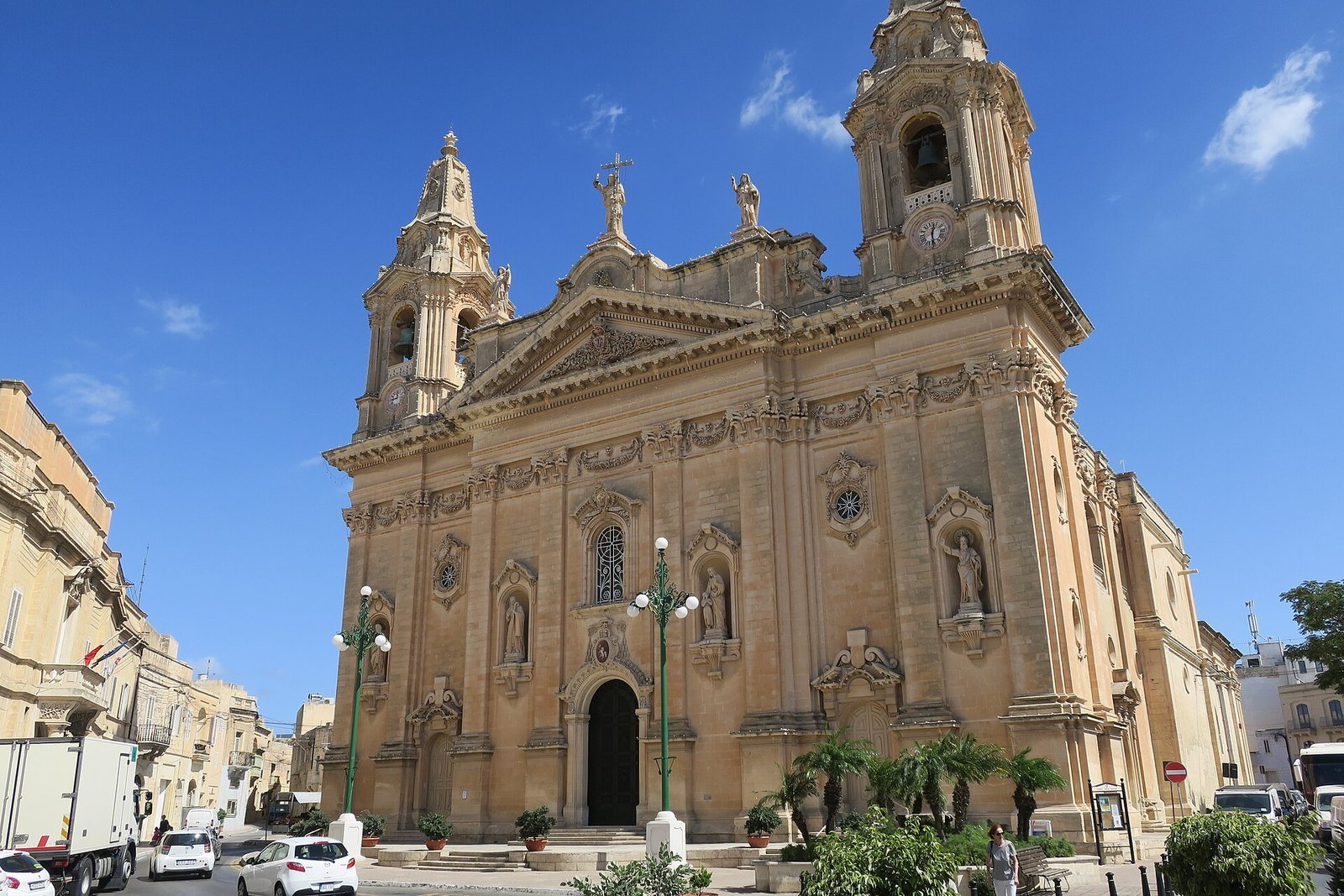
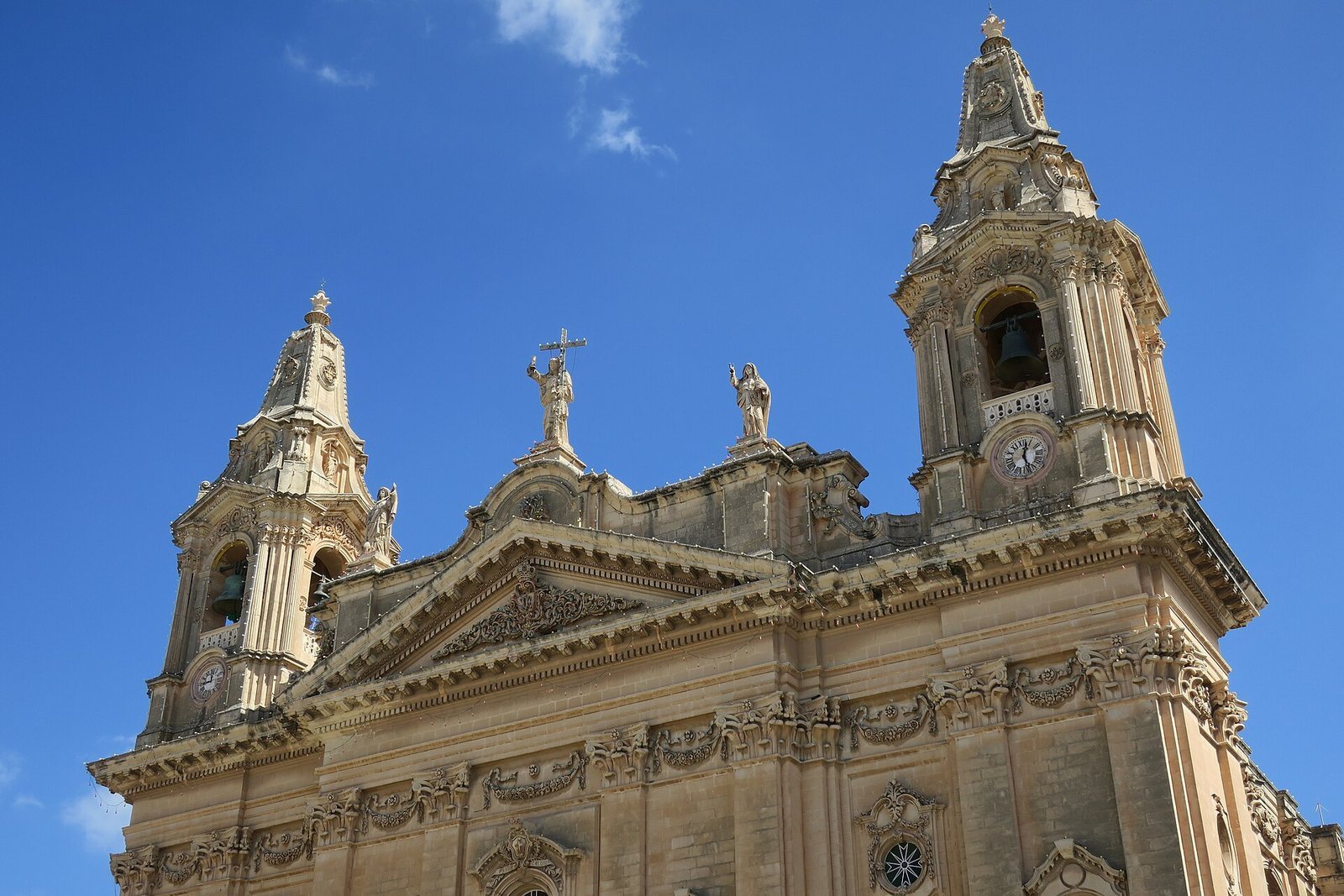
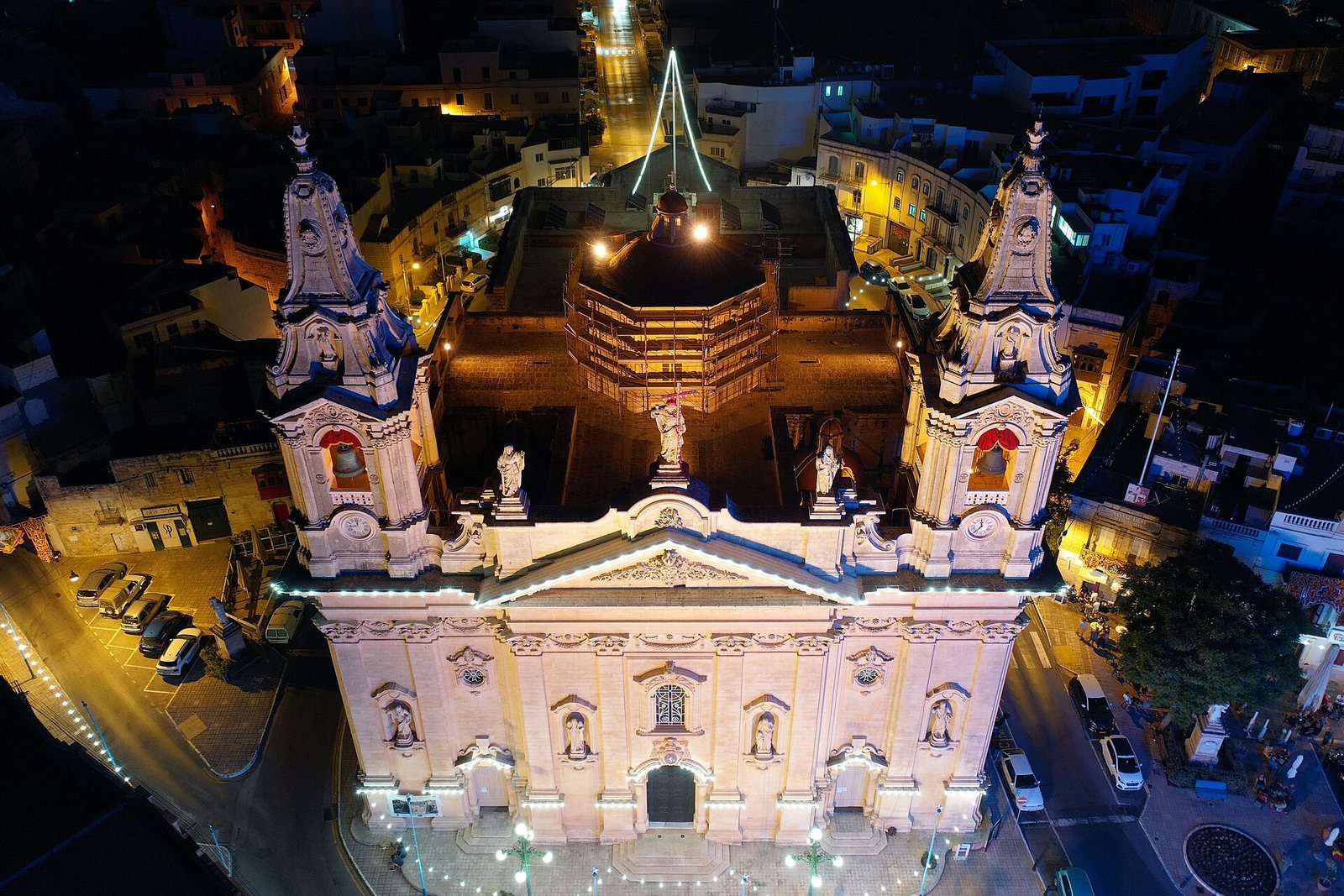
The church is a limestone Baroque building with a cross-shaped plan. Its nave, the main lengthwise space, meets two transepts, the crosswise sections; the exterior has two spires.
Plan and dimensions
The church measures 130 feet (40 m) in length. Its transept is 94 feet (29 m) wide, while the nave measures 30 feet (9.1 m) across.
Façade and entrance
Two clocks appear on the façade. One indicates the time, while the other is a painted clock face fixed at 11:45. The bronze main door, made by Pio Cellini and dated 1913, has four principal panels bearing the arms of Our Lady, patroness of Naxxar, the village, Pope Pius X, and the Zammit family, which paid for the door. Blacksmith Mastru Lucens Agius dismantled, renovated, and cleaned it in 1952, with the Zammit family also covering that work. Angelo Quatromanni made some of the church’s sculptural and façade work.
Interior and furnishings
Paintings
The principal painting depicts the Birth of Mary and is attributed to the school of Mattia Preti. Side paintings of the Flight into Egypt and the Adoration of the Magi are by Stefano Erardi. Works depicting the Madonna and Child, St Cajetan, St Aloysius Gonzaga, Our Saviour, and Our Lady of Sorrows are by the Maltese painter Frangisku Zahra. In the sacristy, a room for storing vestments and objects used in worship, hangs a wooden painting of Our Lady of the Rosary made by Gio Maria Abela in 1595.
Statues and sacred remains
The statue of Our Lady of Victory was brought from Rome. A Maltese craftsman made the statues used in the Good Friday procession. The body of the martyr St Vittorio was brought from Rome on 9 November 1787, from the Catacomb of Calepodius, an underground burial complex, and placed in an altar in the choir.
Bell
The church’s large bell was cast by bell founder Toni Tanti in 1840.