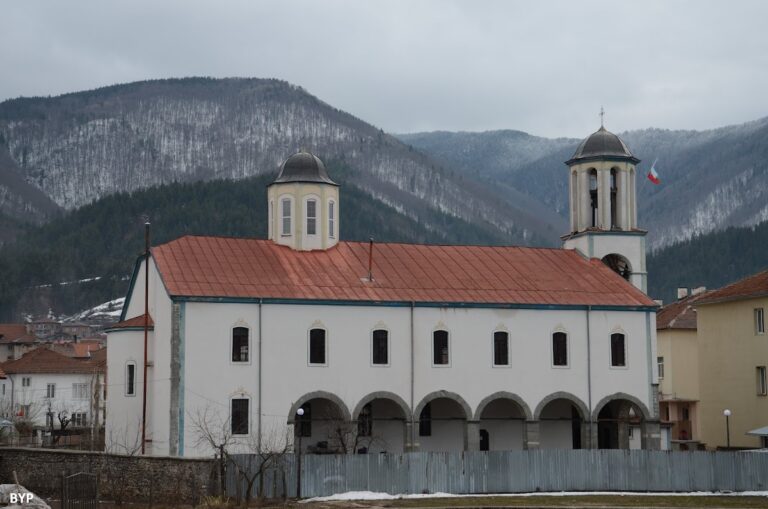
Church of the Holy Trinity in Bansko: A Bulgarian Orthodox Church of the National Revival
Site at a Glance
- Rating
- 4.8
- Popularity
- High
- Country
- Bulgaria
- Primary era
- Modern
- Eras represented
- Modern
- Civilizations
- Bulgarian, Ottoman
- Site type
- Religious
- Remains
- Church
On this page15 sections
History
The Church of the Holy Trinity in Bansko, Bulgaria, is a Bulgarian Orthodox church in the Bulgarian National Revival style. The Revival was a period of cultural and national renewal among Bulgarians under Ottoman rule. Construction began in 1833, the building was finished in 1835, and it was consecrated in 1837. The church came to represent the Revival and Bulgaria’s modern history. Until the Church of Saint Alexander Nevsky was built in Sofia, no Orthodox church in Bulgaria was larger.
Construction under Ottoman rule
Local merchant Lazar German initiated the project and led its construction. A wealthy resident and mayor of the Bulgarian municipality, he was the largest donor and negotiated with Ottoman authorities, whose permission was needed for the work. Those difficult negotiations ultimately cost him his life. Contributions from 270 families and 1,081 individuals helped fund the church, while 350 stonemasons, builders, carvers, and village volunteers took part. The building plot was donated, and Toma Hadzhibena gave land in front of his house.
Ottoman authorities allowed churches to be built only on sites where a church had previously stood. To meet this condition, local residents buried an icon and a cross in a courtyard in the village center. The project coincided with preparations for the Bulgarian Conspiracy of 1835. Built through the combined efforts of the community, the church became a lasting expression of local religious and national life.
The church in Bulgaria’s modern history
On October 5, 1912, during the Balkan War, Peyo Yavorov, a Bulgarian poet and revolutionary who was a voivode, or leader of an armed group, addressed a gathering at the church. He urged those present to remove their fezzes, brimless caps associated with Ottoman-era dress, and declared them free Bulgarians. The speech connected the church with the end of Ottoman rule in Bansko.
The church remains active within the Bulgarian Orthodox Church. It belongs to the Nevrokop Diocese, an ecclesiastical district, and the Razlog archpriesthood, a subdivision within that district.
Remains
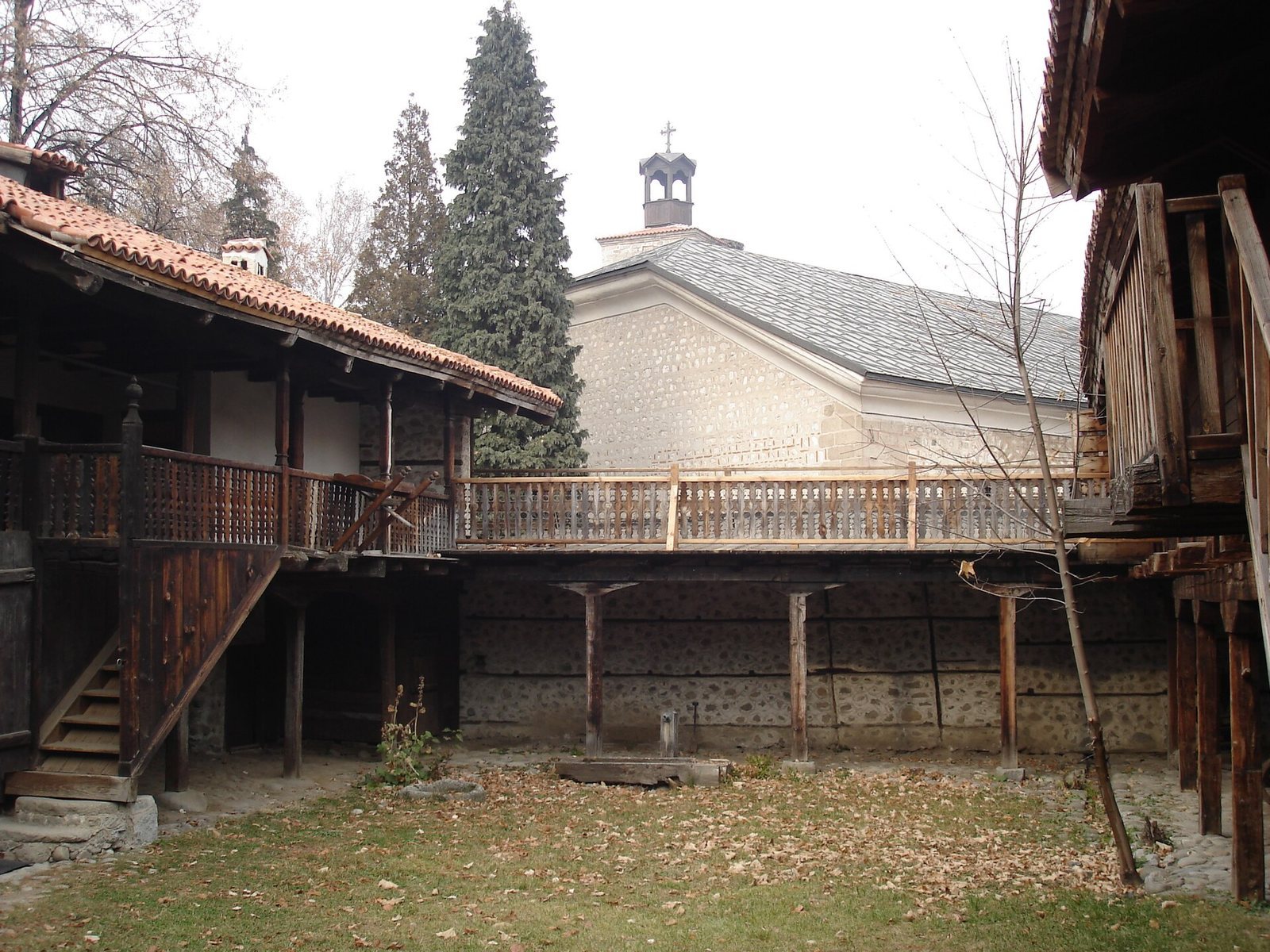
The church stands in Bansko’s central historic area. It is 35 m long and 22.5 m wide, with three aisles, a gable roof, no dome, and an arcaded gallery on the west. Its form is a pseudo-basilica, a basilica-like church without the full elevation of a true basilica.
Church building
Masonry and exterior
The building’s substantial masonry is carefully finished, with walls measuring 1.10 m thick at the foundations. Its proportions make it appear smaller than its actual dimensions. Dressed stone was used for the entrance doors, vaults, and windows.
Interior arrangement
The interior has a Baroque arrangement. Tall wooden columns, plastered and painted, carry arcades that divide the three aisles. A raised cove supports the central aisle’s ceiling, while the wooden cove moldings have elaborate curved shapes. The decoration is organized with flowing transitions and no right-angled joins. A finely interlaced wooden screen stands in the women’s section.
Churchyard structures
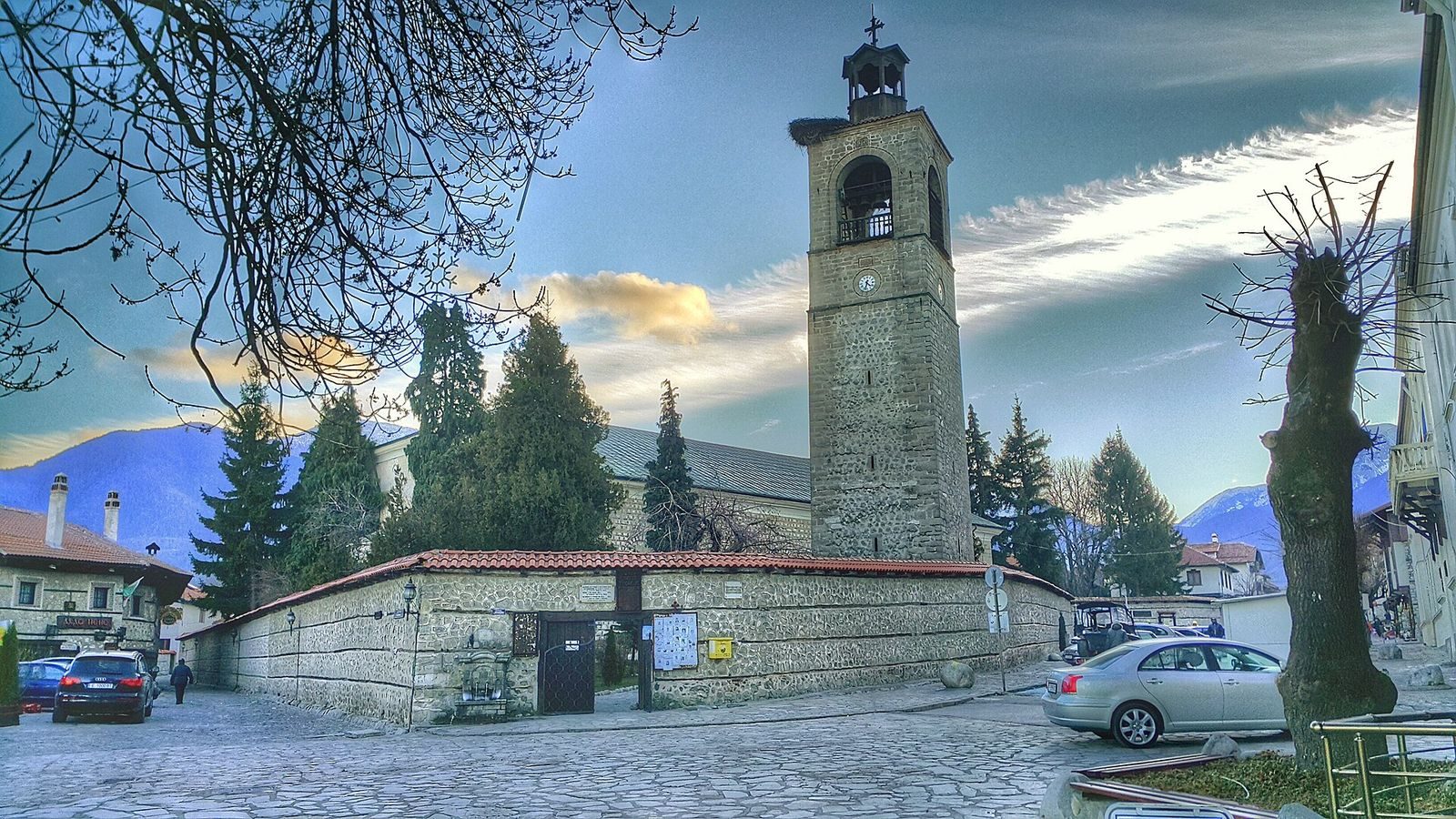
Bell and clock tower
A detached stone tower stands in the northern part of the churchyard. Built in 1850, it is about 30 m high and contains four bells. A clock made by local craftsman Todor Hadzhiradonov was added in 1866. The tower serves both as a bell tower and a clock tower.
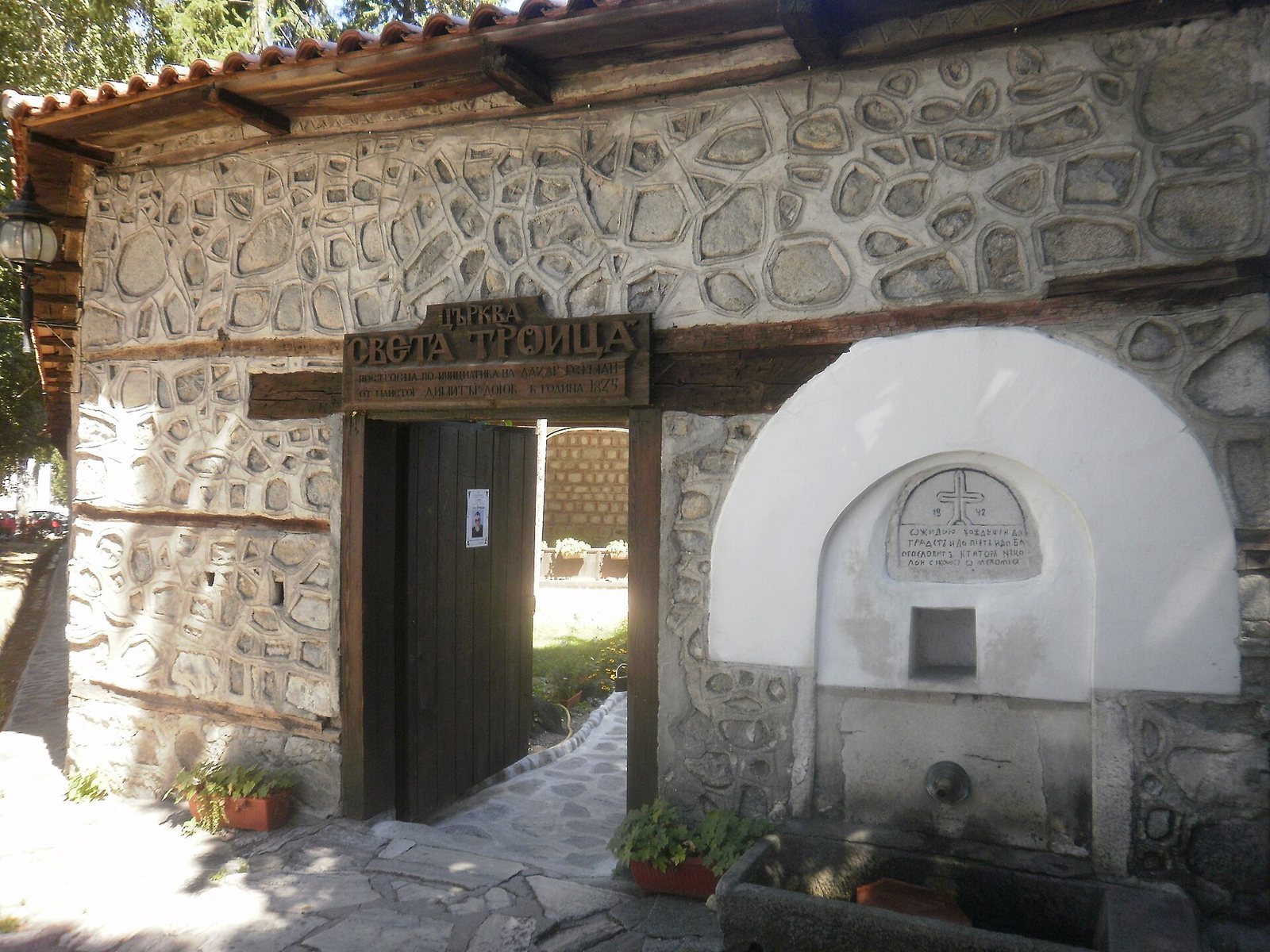
Fountain
A fountain dating to 1842 stands beside one of the church’s side entrances.
Carved and painted decoration
Woodwork by Velyan Ognenov
Velyan Ognenov is credited with the church’s woodcarving and painted ornament, and is thought to have made the iconostasis, the screen separating the altar from the main body of the church, and the pulpit. He painted coloured ornament and geometric designs on uncarved parts of the screen, including its columns and the panels beneath the icons. His decoration also extends to church furniture and interior surfaces, including walls, columns, and panels above the arches of the three aisles.
Paintings by Dimitar Molerov
Dimitar Molerov, a leading painter of the Bansko art school, painted the Crucifixion on the large cross above the iconostasis. From 1839 to 1841 he produced eight large royal icons and other icons for veneration. In 1850 he painted works for the apostolic tier, the row of icons depicting apostles, including a Deesis, a traditional arrangement centered on Christ with the Virgin Mary and John the Baptist, as well as images of Saint Elijah, Saint Luke, Saint Andrew, Saint Bartholomew, Saint Peter, and the Resurrection of Lazarus.
In 1854 Molerov painted Christ in the Tomb in the prothesis niche, the sanctuary area where bread and wine are prepared for the liturgy. His 1860 works included an icon of Christ for the bishop’s throne and an icon of the Holy Trinity for the right-hand icon stand. In 1861 he painted an Ubrus, a cloth bearing an image of Christ’s face, for the royal doors, the central doors through the iconostasis into the altar area. He is also credited with wall paintings above those doors.
Works by Simeon and Georgi Molerov
Dimitar’s son Simeon painted the royal icons of Saint John the Forerunner and Saint Demetrius in 1841. Icons attributed to him for the apostolic tier depict Matthew, Philip, Judas, Simon, Thomas, James, John, and Mark. He also painted the Archangel Michael to the left of the altar and images in the three patronal niches. Simeon’s son Georgi made several icons for veneration, noted for their refined technique.
Other paintings and icons
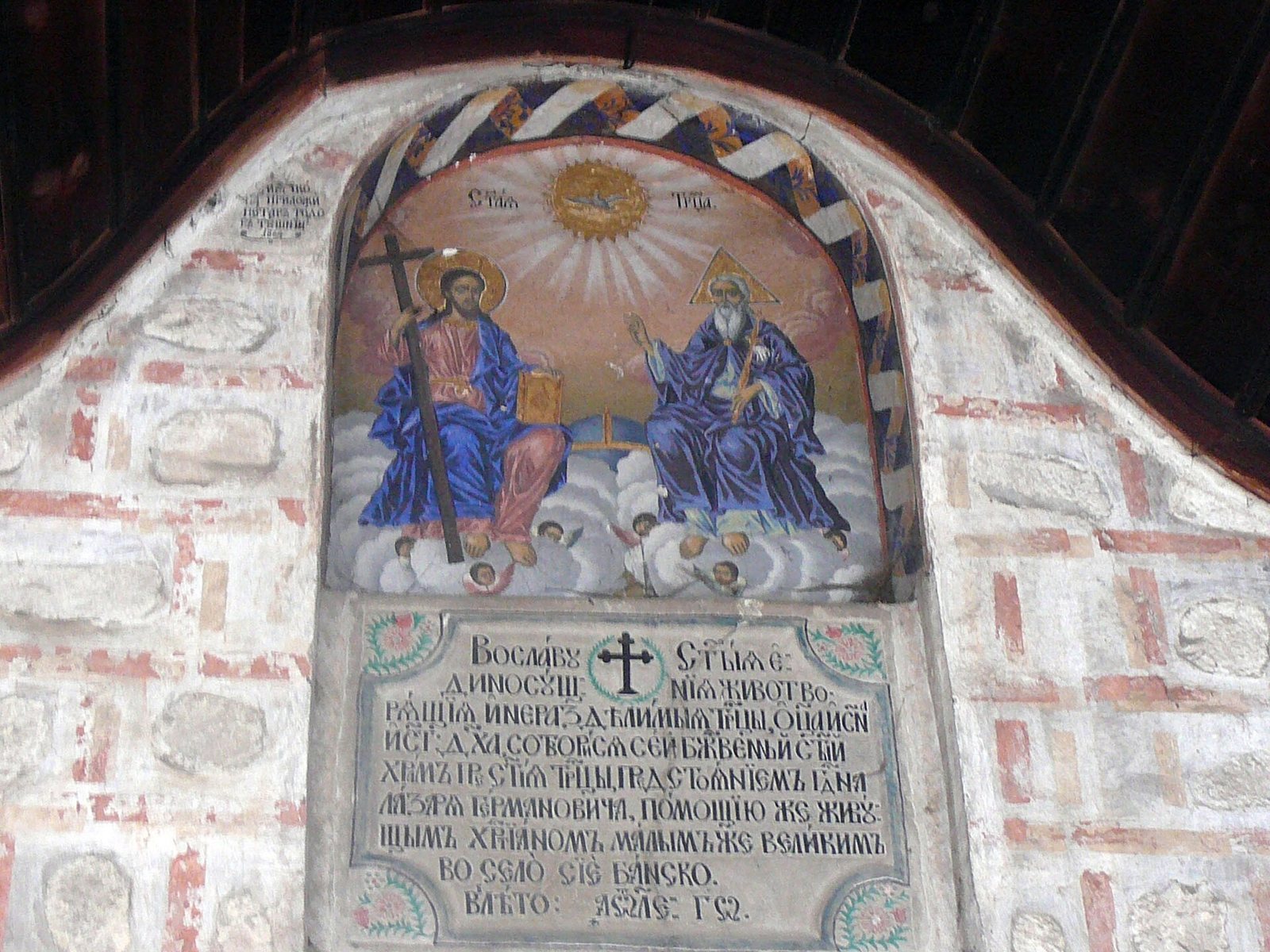
The central exterior niche for the church’s patron contains a painting of the New Testament Trinity. An inscription identifies 1864 as its date and names Peter Tushin as its patron. Bansko painter Dimitar Sirleshtov made the curtain for the northern altar door in 1892. His works also include the two side altar doors, an icon of Saints Cyril and Methodius from 1894, an icon of the Virgin enthroned with saints for the small icon stand, and the apse painting Mother of God, More Spacious than the Heavens, made in 1898.
Icons associated with the church include Toma Vishanov’s early nineteenth-century Resurrection of Christ, Ascension of Christ, and Saints George and Demetrius. Other works by Dimitar Molerov include Saint Nicholas (1840), Annunciation (1841), and Mother of God, More Spacious than the Heavens (1860). Additional wall paintings were made in 1957.