Church of the Finding of the True Cross in Brno: A Capuchin Baroque Church
Site at a Glance
- Popularity
- Medium
- Country
- Czechia
- Primary era
- Early Modern
- Eras represented
- Early Modern, Modern
- Civilizations
- Habsburg, Habsburg Austria, Holy Roman Empire, Margraviate of Moravia
- Site type
- Religious
- Remains
- Church
On this page15 sections
History
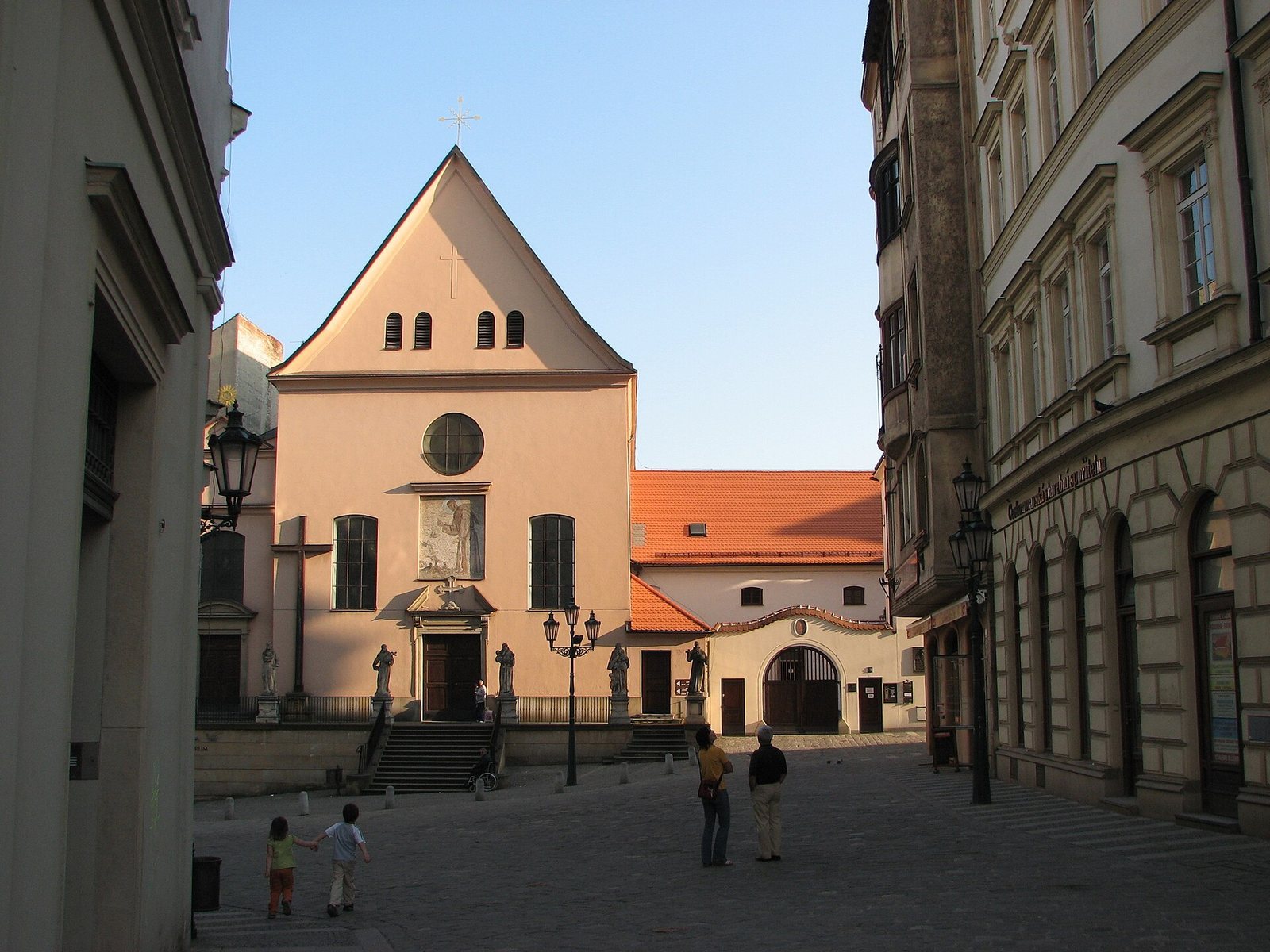
The Church of the Finding of the True Cross in Brno, Czechia, is a Baroque church built by the Capuchins between 1648 and 1656. The Capuchins, a branch of the Franciscan family guided by ideals of poverty and simplicity, established a religious community in the city in the early seventeenth century.
The first monastery and its destruction
The Capuchins arrived in Brno in 1604 at the invitation of Franz von Dietrichstein, the bishop of Olomouc. That spring, they began building their first monastery outside the eastern suburb near Měnín Gate. Its Church of St Francis of Assisi was consecrated in 1606 by Cardinal Dietrichstein.
In March 1645, during the Swedish siege of Brno, the monastery was demolished. City commander Raduit de Souches had ordered buildings outside the walls destroyed so that Swedish forces could not use them. The Capuchins first sheltered in the old town hall, then moved to a burgher’s house beside Bishop’s Court.
Rebuilding at the Coal Market
The order selected a new site at the Coal Market, now Kapucínské náměstí. Count František Magnis donated a plot containing three houses, which were pulled down, and the Capuchins purchased six more nearby houses for their monastery. Construction of the church began in 1648. It is attributed to architect Ondřej Erna, and benefactors included Moravian provincial governor Christoph Pavel of Liechtenstein-Castelcorn and Ferdinand Mencl of Kolsdorf, an assessor of Brno’s royal tribunal. Auxiliary bishop Jan Gobbar consecrated the finished church on 7 May 1656.
The dedication to the Finding of the True Cross may have been prompted by a gift from Princess Polyxena of Lobkowicz, who gave the Capuchins relics of the Cross in 1636. The relics remain in the monastery. Another devotional tradition concerns an image of Our Lady of Passau. Its owner, imperial councillor František Antonín de Cattani, was said to have received miraculous aid through the Virgin’s intercession. Before his death, he left the image to the Capuchins for public veneration.
Repairs and eighteenth-century changes
Six years after the church was completed, its brick vault had to be removed because the walls were badly built and the foundations unstable. A flat wooden ceiling remained for almost a century. In the eighteenth century, builders and architects Moritz Grimm and later his son Franz Anton made major changes to the monastery and church. A choir loft was added in 1747 during celebrations for the canonizations of Fidelis of Sigmaringen and Joseph of Leonessa, and the first permanent organ followed in 1748. In 1753, a chapel dedicated to St Fidelis was added beside the chapel of St Francis, and the church received a new vaulted ceiling.
Modern use and care
Between the world wars, the church gained an electrically powered organ, which required an extension to the choir loft with a front arch. The organ was repaired in 2015. Interior work in 2012 brought new lighting and improved heating, along with a complete repainting; repairs to the façade followed from 2014 to 2017.
The church is a Roman Catholic rectory church in the Diocese of Brno and belongs to the Order of Friars Minor Capuchin. It is protected as a Czech cultural monument. Annual observances include the 7 May anniversary of its consecration, the Feast of Our Lady of the Angels of Porziuncola on 2 August, the Feast of the Exaltation of the Holy Cross on 14 September, its patronal feast, and the Feast of St Francis of Assisi on 4 October. Porziuncola is a chapel associated with Francis of Assisi and the Franciscan tradition; the Exaltation of the Holy Cross celebrates the Cross.
Remains
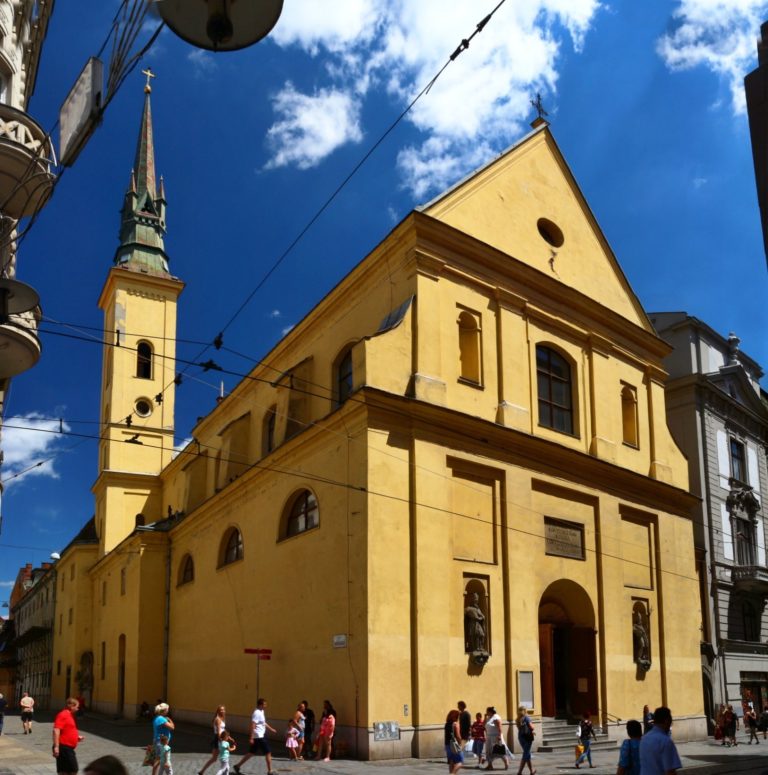
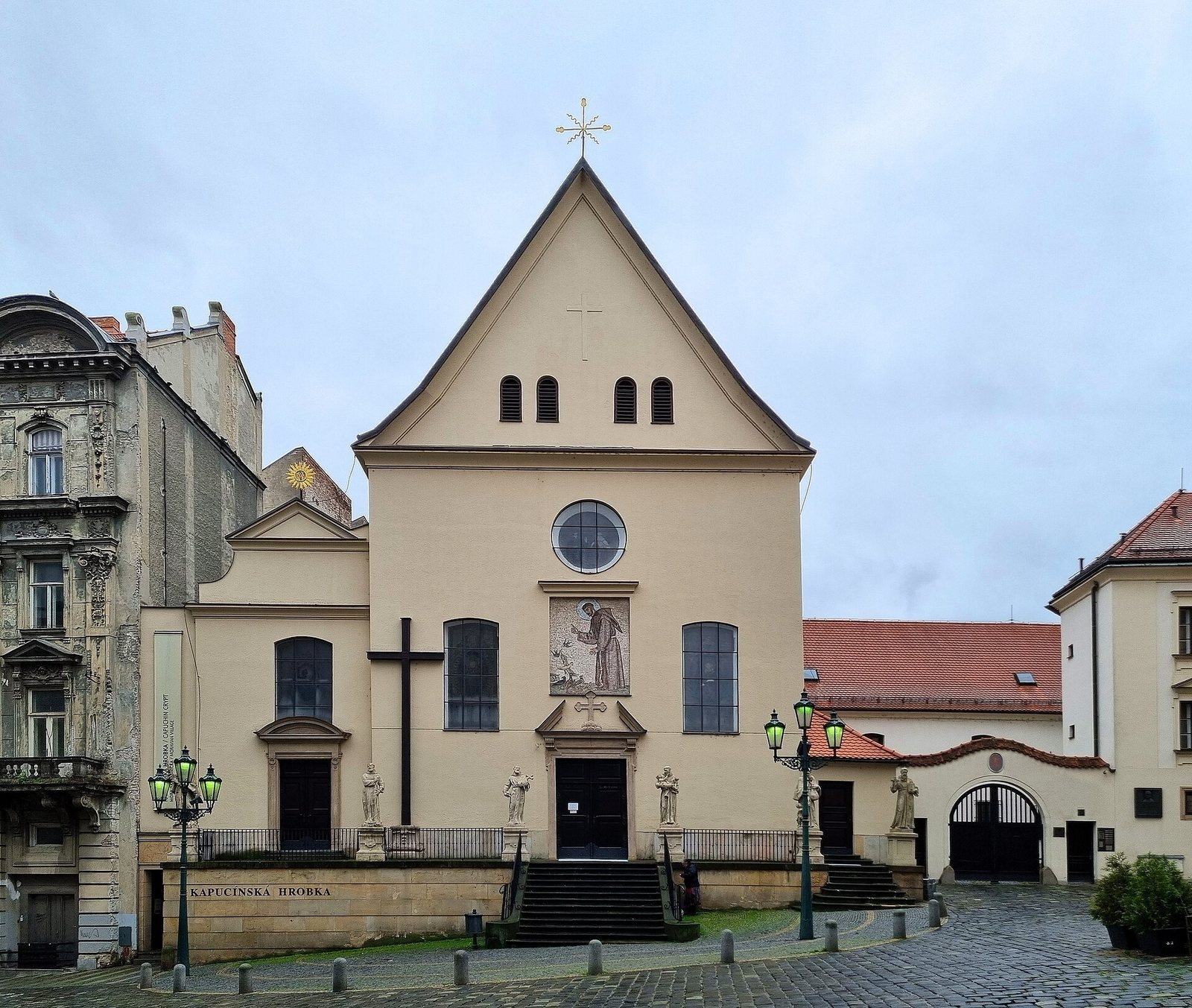
The church has a simple exterior and a compact plan, with a nave and a smaller transept, or crosswise arm, containing two small altars. It follows roughly the contour of a gentle slope rising toward Petrov. Its restrained appearance reflects Capuchin ideals of poverty and simplicity, as well as a common Belgian-Flemish model for the order’s churches and monasteries, designed by Antonio of Pardenone.
Exterior and sculpture
Approach and façade
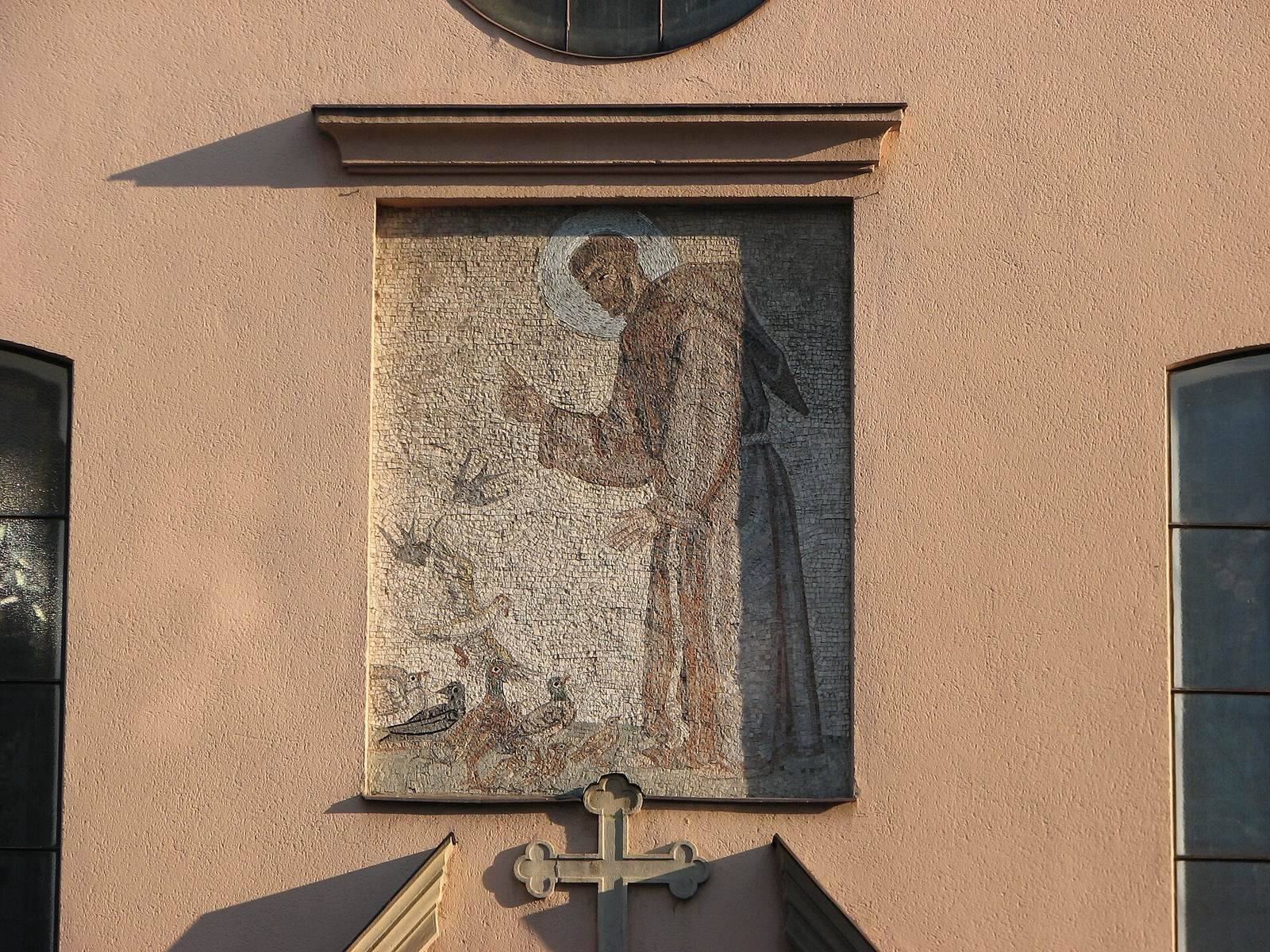
A retaining wall and thirteen steps lead to the main entrance. Above its portal is a mosaic showing St Francis of Assisi preaching to birds, made in 1953 by Jiří Šindler from a design by Vojmír Vokolek. An earlier fresco of the Finding of the True Cross was destroyed by weather.
Terrace statues
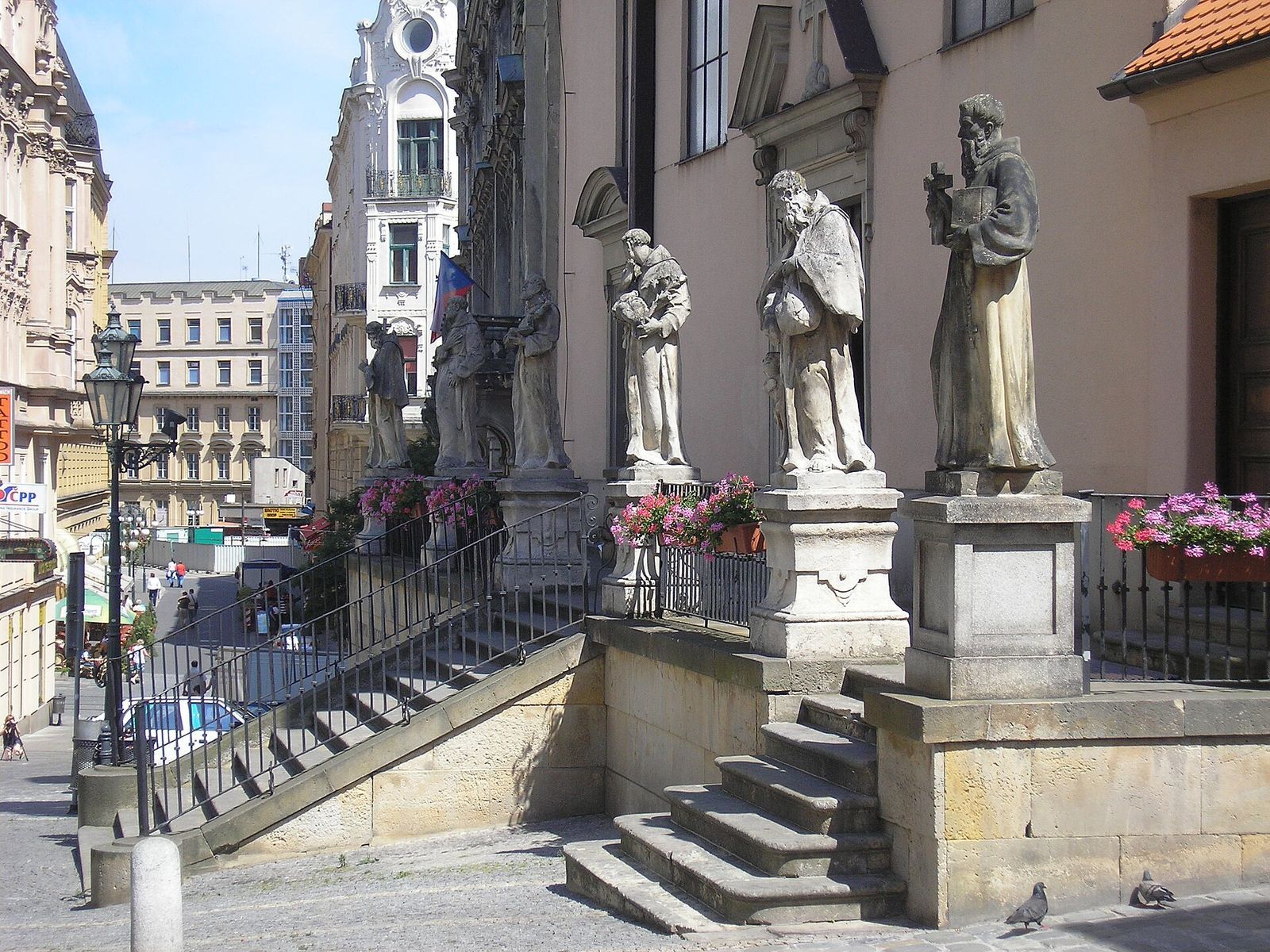
Five statues of Franciscan and Capuchin saints stand on the terrace before the entrance. Made in 1765 by Brno artist Jan Adam Nessmann, they depict Joseph of Leonessa, Fidelis of Sigmaringen, Francis of Assisi, Anthony of Padua, and Felix of Cantalice. A statue of Lawrence of Brindisi by Czech sculptor Čeněk Vosmík was added in 1927.
Interior furnishings and artworks
Main altar and paintings
The main altarpiece, the artwork behind the principal altar, shows St Helena in imperial robes above the discovered Cross. A dead woman is being raised after touching it, demonstrating the Cross’s authenticity in the scene. German painter and writer Joachim von Sandrart made the painting in the mid-seventeenth century; it is regarded as one of Brno’s most important Baroque altarpieces. Narrow paintings of the Capuchin saints Fidelis of Sigmaringen and Joseph of Leonessa flank it. These date to the mid-eighteenth century and may be by an artist working for the order, though their authorship is uncertain. Beneath them, at the entrances to the friars’ choir, are late-seventeenth-century paintings of angels of the Last Judgment and a Guardian Angel.
Altars and chapels
The area around the main altar has altars dedicated to St Joseph and St Anthony of Padua. Side-chapel altarpieces show the Stigmatization of St Francis, the scene of the saint receiving Christ’s wounds, and the Apotheosis of St Fidelis, depicting his glorification. An altar dedicated to Felix of Cantalice was consecrated in 1714; its coat of arms connects its funding to Count Karel Ludvík of Rogendorff.
The side altar of St Fidelis holds an image of Our Lady of Passau, probably made around 1641 as a faithful copy of a celebrated work by Lucas Cranach the Elder. The original, dated 1537, is in Innsbruck Cathedral. The image was once kept in a church in Passau, which gave it its title.
Sculptures and relics
Sculptor Antonín Schweigl made the statues of St Joachim and St Anne. A painted statue of the Virgin Mary and Child, a version of the Madonna of Kłodzko, dates to the first quarter of the fifteenth century and stands on a console to the left. The chapel of St Francis contains a large reliquary, a container for sacred relics, made with hammered metalwork. Barnabáš and Viktorie Orelli donated it in 1751; both were buried in the crypt beneath the church.
Relics of the True Cross are kept in a silver casket decorated inside with embroidery and river pearls.
Stained glass
Some of the church’s Art Nouveau-style stained glass dates from the 1920s, though its maker is unknown. Later windows, made in the 1930s, were probably produced by the Brno workshop of Jiří Říha.
Crypt
The crypt, a burial chamber beneath the church, was used for Capuchin friars and benefactors from 1656 to 1784. Around 200 people were buried there, including approximately 150 friars. Ventilation openings helped naturally mummify some of the bodies, and several original painted Baroque coffins survive. About 40 mummified bodies remain visible, including Baron Franz von der Trenck (1711–1749), a colonel of a pandur regiment, an irregular Central European force. His remains lie in a glass coffin.