Church of the Exaltation of the Holy Cross in Děčín: A Baroque Parish Church
Site at a Glance
- Popularity
- Medium
- Country
- Czechia
- Primary era
- Early Modern
- Eras represented
- Medieval, Early Modern, Modern
- Civilizations
- Austria-Hungary, Habsburg, Habsburg Austria, Holy Roman Empire, Kingdom of Bohemia
- Site type
- Religious
- Remains
- Church
On this page22 sections
History
From chapel to castle church
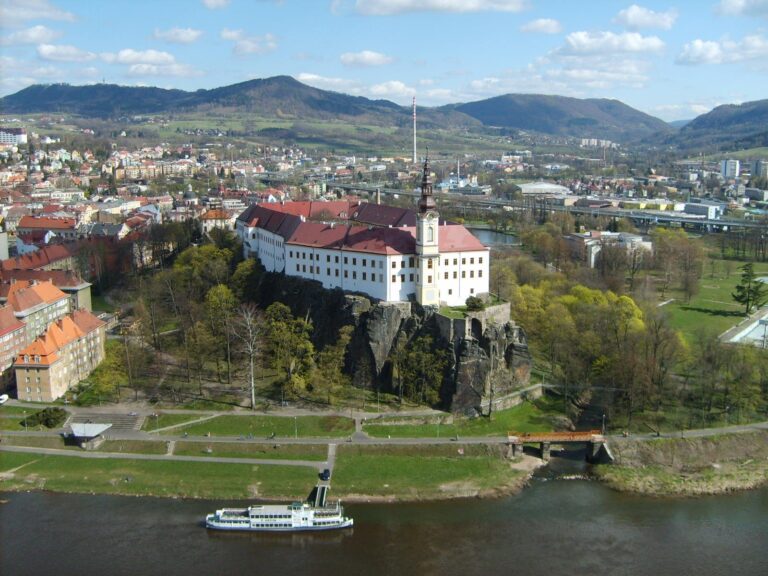
The Church of the Exaltation of the Holy Cross in Děčín, Czechia, is an early Baroque Roman Catholic church conceived as a representative church for the castle. Its dedication refers to the Christian feast commemorating the cross associated with the crucifixion of Jesus.
A tradition places a small chapel dedicated to the Holy Cross beyond Děčín’s eastern town gate in the fifteenth century. The story attributes its construction to Janek of Vartenberk, then lord of the estate. It says that he brought a cross to Děčín after it miraculously stopped his runaway horses from plunging into an abyss. The chapel appears in a written record in 1530.
For the present church, Count Maximilian of Thun-Hohenstein bought and demolished three burgher houses to clear the building site. Construction began in 1665; the church is also dated to 1687–1691. It was completed in 1691, when the estate belonged to Count John Ernest of Thun-Hohenstein, Prince-Archbishop of Salzburg, and consecrated on 15 August that year.
Parish and later development
A major fire in 1749 damaged the church’s decoration and destroyed the decoration of its side altars. Some furnishings were brought from the more severely damaged Church of Saints Wenceslas and Blaise, which could no longer serve as the parish church, and the parish was transferred to the Church of the Exaltation of the Holy Cross. It has served as the parish church since 1826.
For the centenary of the church’s consecration, Count Wenceslas Joseph of Thun-Hohenstein commissioned interior frescoes in 1791. The painter was Josef Kramolín, a former member of the Catholic Jesuit order. Gas lamps remained in use until electric lighting was installed in 1903 using direct current. In 1950, the church was connected to a three-phase alternating-current supply.
The church serves as a parish and deanery church affiliated with the Děčín I parish, the Czech ecclesiastical province, and the Diocese of Litoměřice. A deanery is an administrative grouping of parishes within a diocese, a church jurisdiction led by a bishop. The building has been protected as an immovable cultural monument since 1958.
Modern stewardship
On 14 September 1991, the City of Děčín and the Roman Catholic Church signed declarations establishing shared use of the church. The city retained ownership of the church and the adjoining Chapel of Our Lady of the Snows, including their interior furnishings. The agreement enabled repairs to the previously neglected building, including work on its roof, dome, façade, and surroundings.
Remains
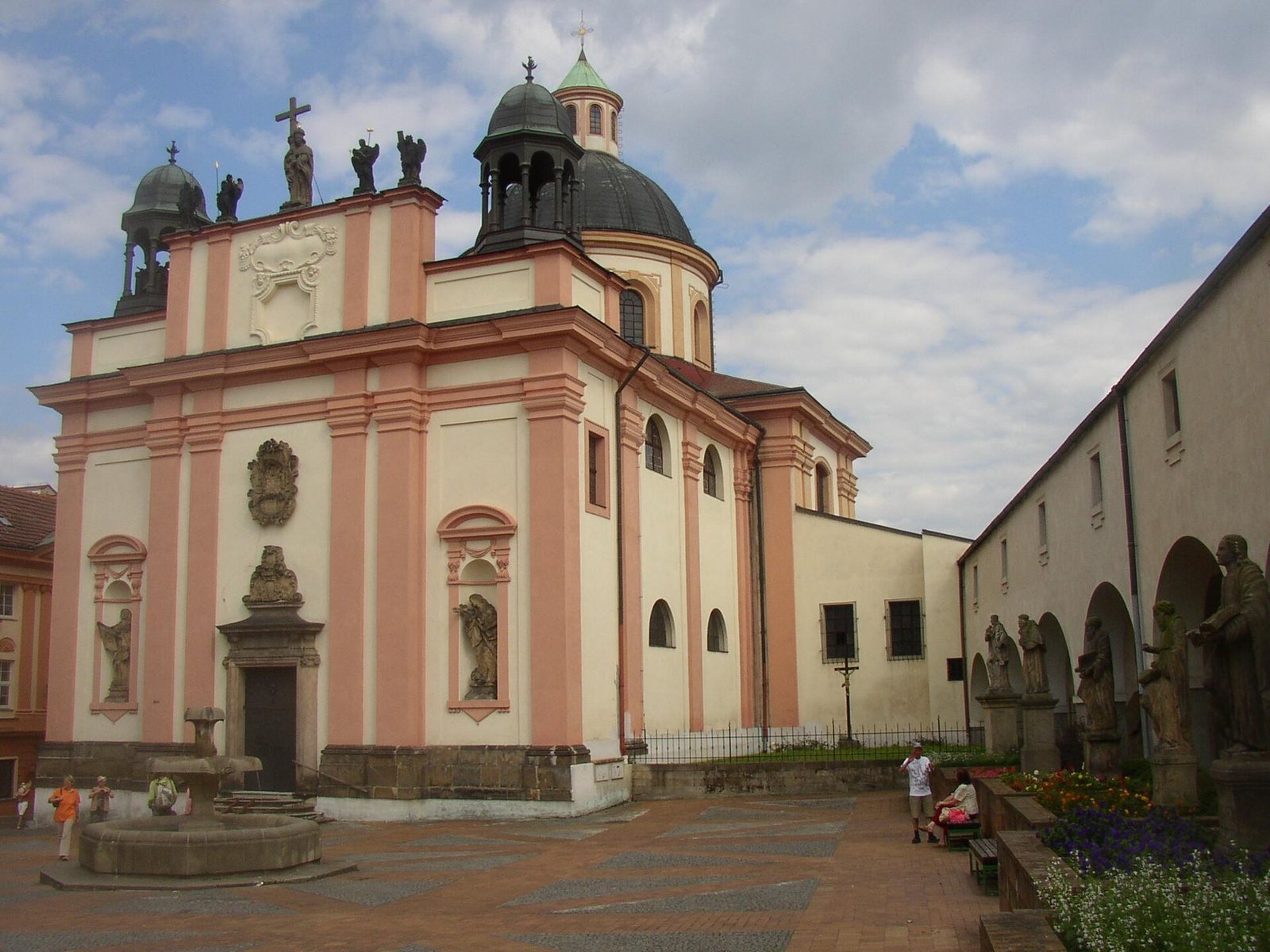
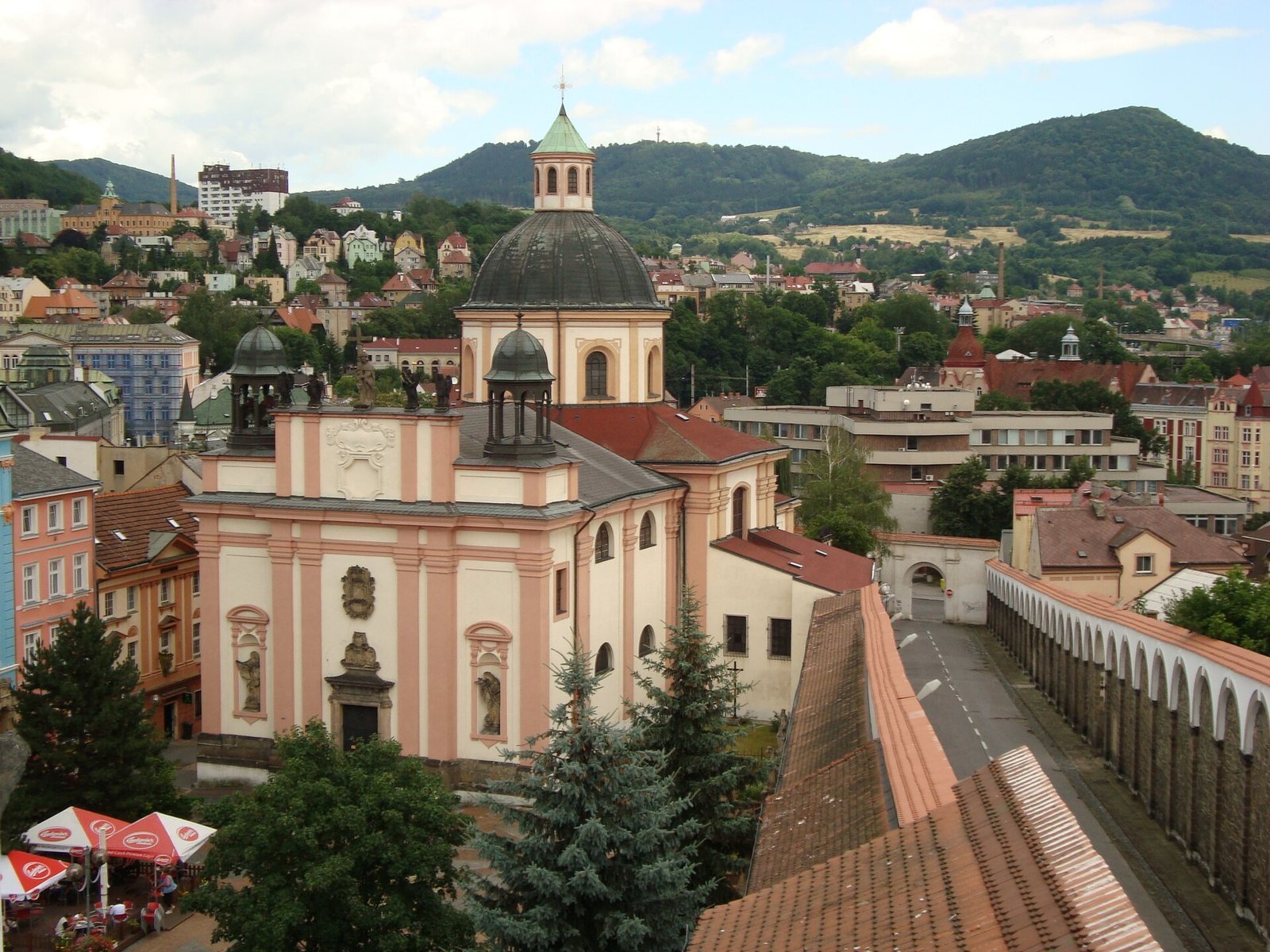
The stone church is oriented east and arranged as a cross, with a long, three-aisled nave intersected by a shorter transept. A dome rises above the central crossing, where the nave and transept meet. The building’s interior combines the church’s large-scale structure with altars, sculpture, paintings, an organ, and furnishings from different periods.
Church plan and exterior
Plan and structure
The church measures 34.5 metres long and 20.5 metres wide. Massive piers divide the aisles, and two elevated galleries run above the side aisles. The dome reaches 39.82 metres to the top of the cross above it. At the western end of the nave is the organ loft; the eastern end finishes in a rectangular presbytery, the area around the main altar. A covered passage links the castle with the south gallery and an oratory, a space set aside for prayer, intended for the church’s patron.
The building’s arrangement and proportions have been compared with St Peter’s Basilica in the Vatican and churches in Salzburg. No written record identifies its architect. An older attribution to J. B. Santini-Aichel is incompatible with the building’s chronology, since he was still a child when construction began. Jan Baptista Mathey is often proposed by comparison with the Conventual Church of St Francis of the Knights of the Cross with the Red Star in Prague.
Western façade
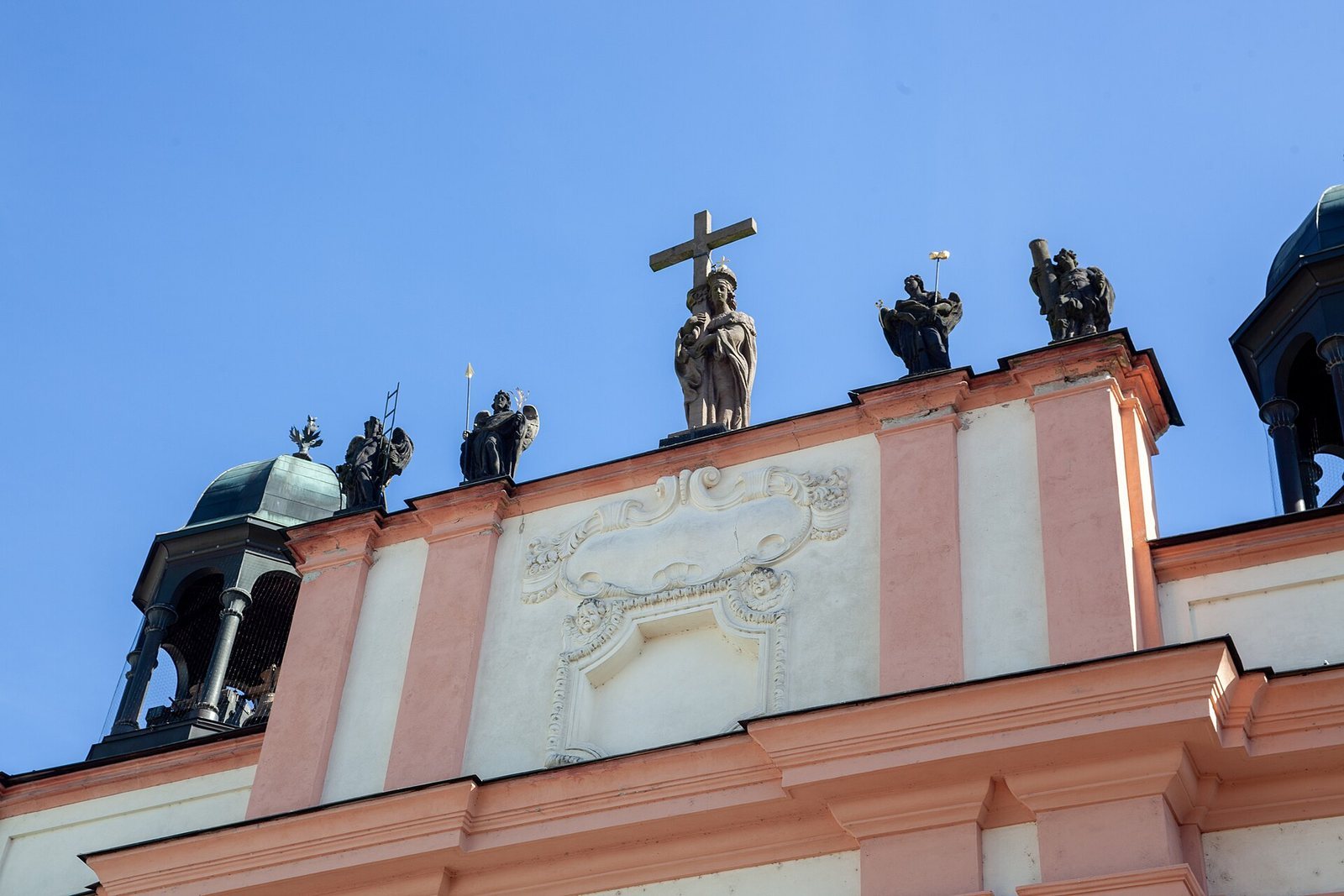
The western façade is arranged in three vertical sections, with pilasters, flat strips resembling columns, niches, and an upper attic. Sandstone statues of Saint Veronica holding the Veil of Veronica and Saint Mary Magdalene occupy the niches. At the centre, Saint Helena holds a cross, flanked by four angels carrying objects associated with Christ’s Passion. Above the main entrance, a sculpted panel displays four coats of arms: John Ernest of Thun-Hohenstein’s arms above those of his three wives. Two small bell turrets were added in the late nineteenth century to a design by Josef Mocker.
Altars and interior furnishings
Main altar
The main altar supports a cross nearly nine metres high, carved by stonemason Santin Maderna from brown Salzburg marble. A marble figure of Christ is accompanied by statues of the grieving Virgin Mary, Saint John the Evangelist, and two angels. Tradition associated with the earlier Holy Cross chapel says that a piece of its wooden cross was incorporated into this crucifix.
Transept altars
Two side altars stand in the transept. On the Gospel side, the Rosary altar has oval paintings of the Sorrowful Mysteries, episodes of Jesus’s suffering and death contemplated in the Rosary, and an original Annunciation painting at its centre. A sculpted princely crown appears above it, with statues of Saint Joseph holding the Christ Child and Saint John of Nepomuk nearby.
On the Epistle side, the altar’s Pietà, a depiction of Mary mourning Christ’s dead body, is by Děčín painter Benedikt Kern. It replaced a work by Karel Škréta destroyed in the 1749 fire. A statue of Saint Felix of Cantalice stands beside it with the words “Thanks be to God” on his sack, while Saint Odilia is shown with eyes on a dish. A glass-sided coffin next to the altar contains a miniature sculpture of Saint Severus, described as a Roman protomartyr, or a community’s first martyr.
Sculpture, paintings, and furnishings
Four white-painted wooden statues of the Evangelists, the traditional authors of the four Gospels, stand on consoles beneath the dome, at the corner pilasters of the crossing. Made around the middle of the nineteenth century, they are in the Romantic style. Four Baroque paintings in the side aisles came from a former Jesuit retreat house. They depict the death of Saint Francis Xavier in two separate works, Saint Aloysius, and the Three Martyrs in Japan.
The Baroque pulpit has a sculptural group showing the Conversion of Saint Paul on its canopy. A relief of a Pietà on its front is flanked by figures of four Church Fathers, influential early Christian theologians. Sculptors Abraham Felix Kitzinger and Josef Fischer of Litoměřice also contributed works to the church. The pews are Baroque.
Family crypt
A crypt, or burial chamber beneath a church, lies under the presbytery floor. It contains the remains of members of the Thun-Hohenstein family. In 1995, cremated remains of family members were transferred there from the family tomb at Děčín-Chrást.
Organ and bells
Organ
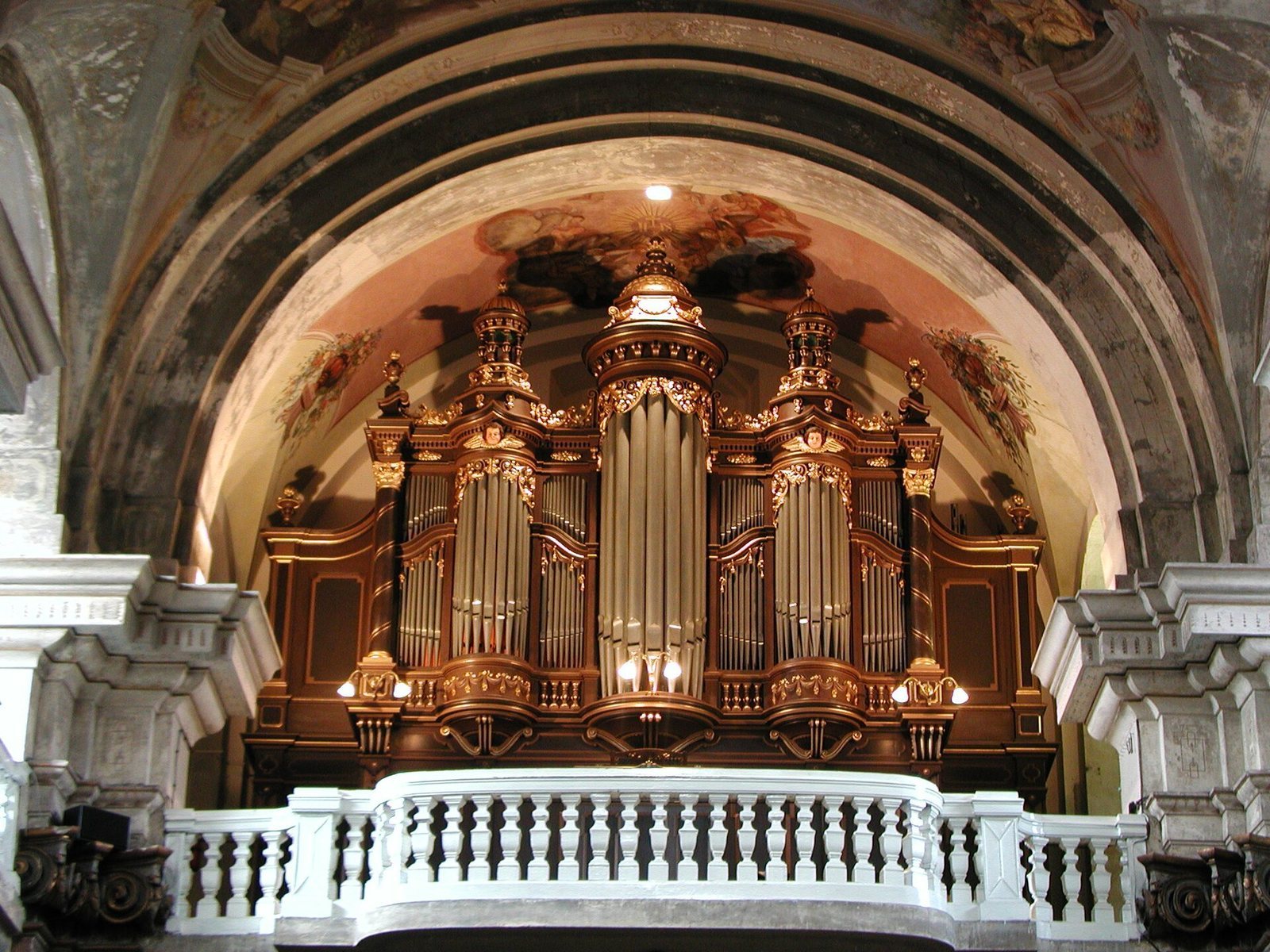
The organ stands in a Baroque case, while its sound arrangement follows the Romantic style. It has 26 sounding stops, each controlling a set of pipes with a particular sound, and 1,658 pipes. The instrument is played from two keyboards and a foot pedal. Its main keyboard uses a semi-pneumatic action assisted by a Barker lever, a pneumatic mechanism that reduces the force needed to play; the second keyboard and pedal operate mechanically.
The first organ was contracted by Johann Caspar Neumann in 1691 and paid for in 1694. A craftsman from Česká Kamenice repaired it in 1708 and 1750. In 1787, an organ made by Tomáš Schwarz was brought from the former Jesuit church in Litoměřice by organ builder Johann Rusch. The estate gave the earlier instrument to the Church of St Wenceslas in Rozbělesy in 1795. Later repairs were carried out by Anton Rusch in 1806, Franz Feller in 1828, and the Feller brothers in 1886.
After Otto and Gustav Rieger visited the church in 1890, they proposed a replacement instrument. Their organ was built in 1891, brought to Děčín by rail, and installed between 15 May and 20 July. The choir loft was enlarged to accommodate it, and the organ was inspected and consecrated on 14 September 1891. Organa carried out its first postwar repair in 1949. Later additions included a pneumatic tremolo and a swell box for the second keyboard. A major reconstruction was completed with a consecration on 20 September 2003. In 2018, organ builder Ivan Bok and colleagues replaced springs in the Barker mechanism, relined the crescendo roller, overhauled the eight-foot clarinet reed stop, and revoiced the string stops, the first keyboard’s cornet, and the second keyboard’s mixture stop.
Fifteenth-century bell
An unknown maker cast the fifteenth-century bell, which has a six-armed crown decorated with masks and a pear-shaped clapper. Its rim is 60 millimetres thick, and it measures 705 millimetres across its lower edge. The bell weighs 225 kilograms without its clapper and suspension, is rung by hand, and has a fundamental tone of c2 at 528 hertz. It shares the northern bell frame with the newer City of Děčín bell.
Wenzel Perner bell
Wenzel Perner cast another bell in 1850. Its smooth, six-armed crown, flat clapper, and 55-millimetre-thick rim distinguish it from the fifteenth-century bell. It measures 755 millimetres across its lower edge and weighs 279 kilograms without fittings. After restoration, its fundamental tone was h1 at 506 hertz. It is now on the terraces of Děčín Castle.
Valentin Lissiack bell
The smallest bell is a 1748 casting by Valentin Lissiack, hung on the church’s north side above the sacristy. It serves as a hand-operated sanctus bell, a small bell rung at parts of the Eucharistic service, and is operated from the sacristy. It weighs 32 kilograms without fittings, measures 360 millimetres across its lower edge, and has a 31-millimetre-thick rim. Its impact tone is cis3 at 1,070 hertz.
City of Děčín bell
The City of Děčín commissioned a new bell, cast in Asten in 2016 by Manoušek & Eijsbouts. It bears the city’s name and its emblem, a two-tailed lion holding a barbel. The bell weighs 134 kilograms, measures 610 millimetres across its lower edge, and has a 40-millimetre-thick rim. Its fundamental tone is e2 at 642 hertz. An electrically operated mechanism moves its forged, baton-shaped clapper, which is hung on leather; rolling bearings sit in cast-iron housings.
Three bells cast in 1927 by Richard Herold of Chomutov were requisitioned in 1942. After the Second World War, the fifteenth-century and Perner bells were hung at the church as replacements, although neither had originally belonged there. All four bells associated with the church were consecrated by Bishop Jan Baxant on 26 November 2016 and rehung on 16 March 2017. The older bells were restored that year by bell founder Petr Rudolf Manoušek, and the Fiala family of artistic blacksmiths made their fittings.
Chapel of Our Lady of the Snows
Chapel and Marian image
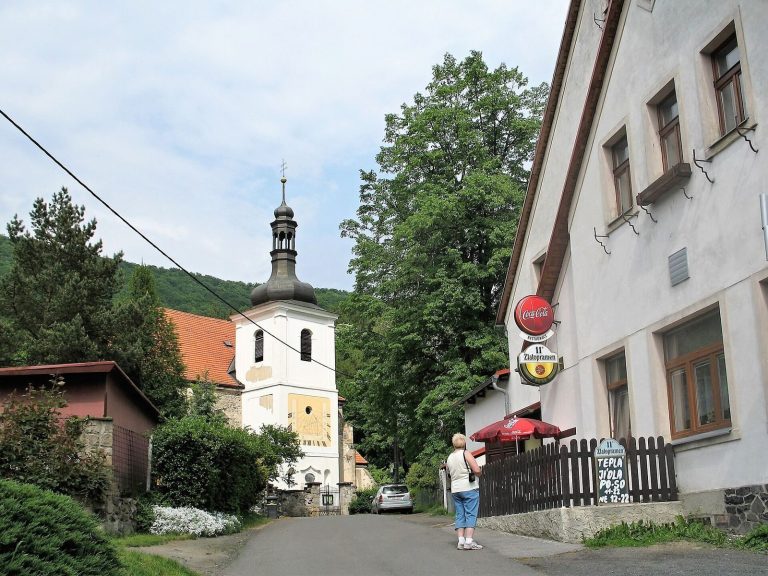
The adjoining Chapel of Our Lady of the Snows stands beside the church and the wall known as Dlouhá jízda. Its plan is unusually trapezoidal. Tradition says that the chapel once stood in the cemetery of the Church of Saints Wenceslas and Blaise and was moved to its present position after the 1749 fire. In 1752, a copy of an image of the Virgin Mary was brought from Santa Maria Maggiore, a major basilica in Rome dedicated to her, and blessed by Pope Benedict XIV. The chapel became a regional pilgrimage site and, in the early twentieth century, was counted among forty Marian pilgrimage sites in the Diocese of Litoměřice.
The image remained on the chapel’s main altar until renovation, electrical work, and redecoration in 1978. Damage by wood-boring insects led to the removal of the main altar and three wooden confessionals, and a new altar table was installed. Roof timbers and the roof structure were repaired in 2006, when a connecting passage between the castle and the church oratory was opened. The Marian image was placed on the restored front wall. Since 2016, the oratory has formed part of the castle exhibition of sacred objects belonging to the Děčín I parish.
Chapel harmonium
The chapel’s furnishings include a one-keyboard harmonium attributed to the builder Schiedmayer. It has eight stops and a pedal with one stop, and was last repaired in 1980.