Church of the Assumption of the Blessed Virgin Mary in Biórków Wielki: A Wooden Parish Church
Site at a Glance
- Popularity
- Low
- Country
- Poland
- Primary era
- Early Modern
- Eras represented
- Early Modern
- Civilizations
- Polish–Lithuanian Commonwealth
- Site type
- Religious
- Remains
- Church
On this page10 sections
History
Parish and construction
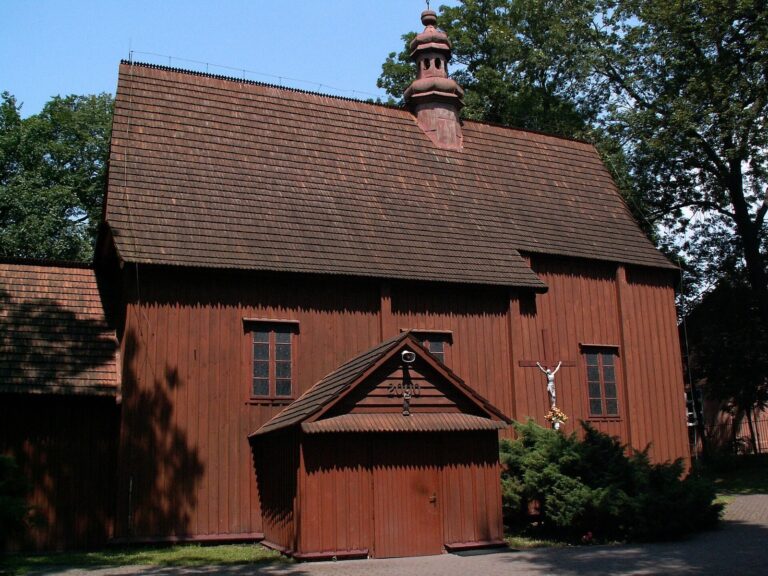
The Church of the Assumption of the Blessed Virgin Mary in Biórków Wielki, Poland, is a wooden Roman Catholic parish church dedicated to the Assumption, the Catholic belief that Mary was taken bodily into heaven. A parish was established here in the fourteenth century, and at least two wooden churches served it before the present building; both were destroyed by fire. Priest Marcin Brzeski oversaw construction of the current church, which began in 1623 and was completed in 1633. It was consecrated in 1664.
Parish use and protection
The church serves as the Roman Catholic parish church and belongs to the Archdiocese of Kraków, a territorial administrative unit of the Catholic Church. Its listed liturgical observances include 15 August and a Sunday before or after 16 July. The church and its bell tower were added to the Małopolskie region’s register of protected monuments on 11 October 1977.
Remains
Exterior buildings
Main church
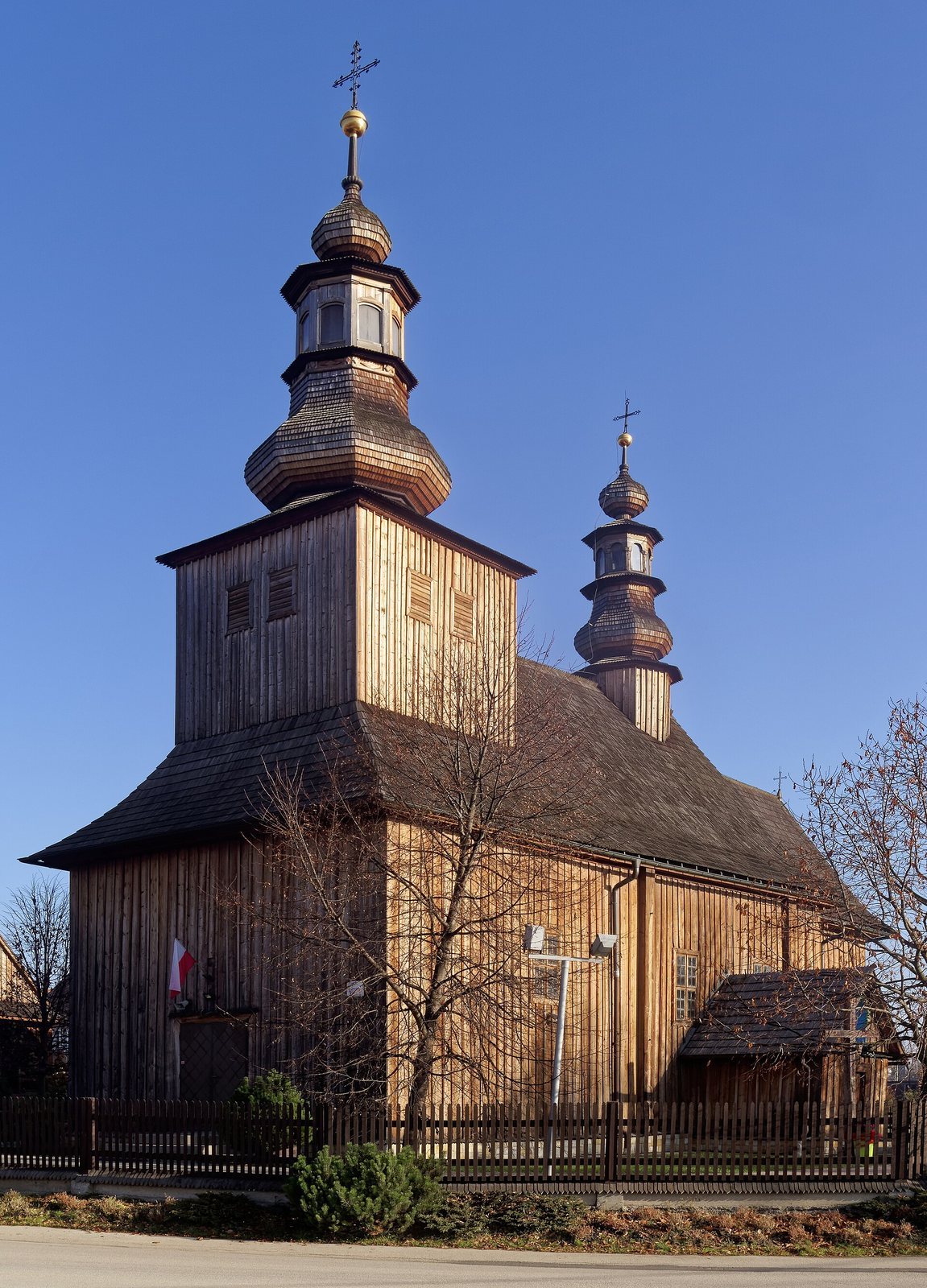
The church is built from horizontally laid logs and clad in vertical boards joined by battens. Its single nave connects to a narrower chancel, the area near the altar, which has an end closed on three sides. A sacristy, a room for preparing services and storing liturgical objects, and a small porch are attached to the building. Shingles cover separate roof sections over the nave and chancel, with a small bell turret above. A Baroque tower, in a European artistic style, was added above the main entrance in the late eighteenth century. It has two domed tops.
Separate bell tower
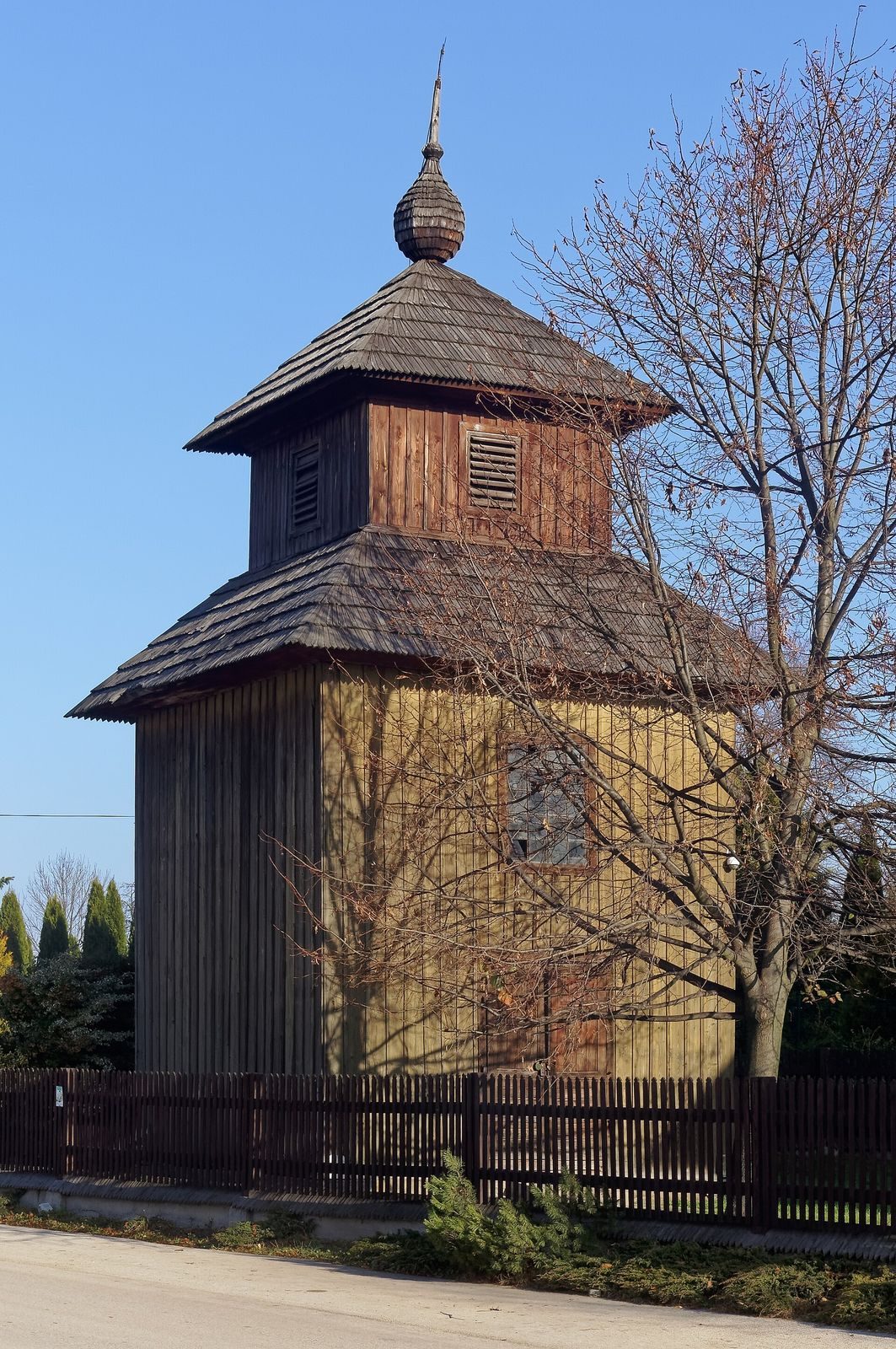
A separate wooden bell tower stands near the church. Its timber-frame structure is covered with vertical boards.
Interior and furnishings
Altars
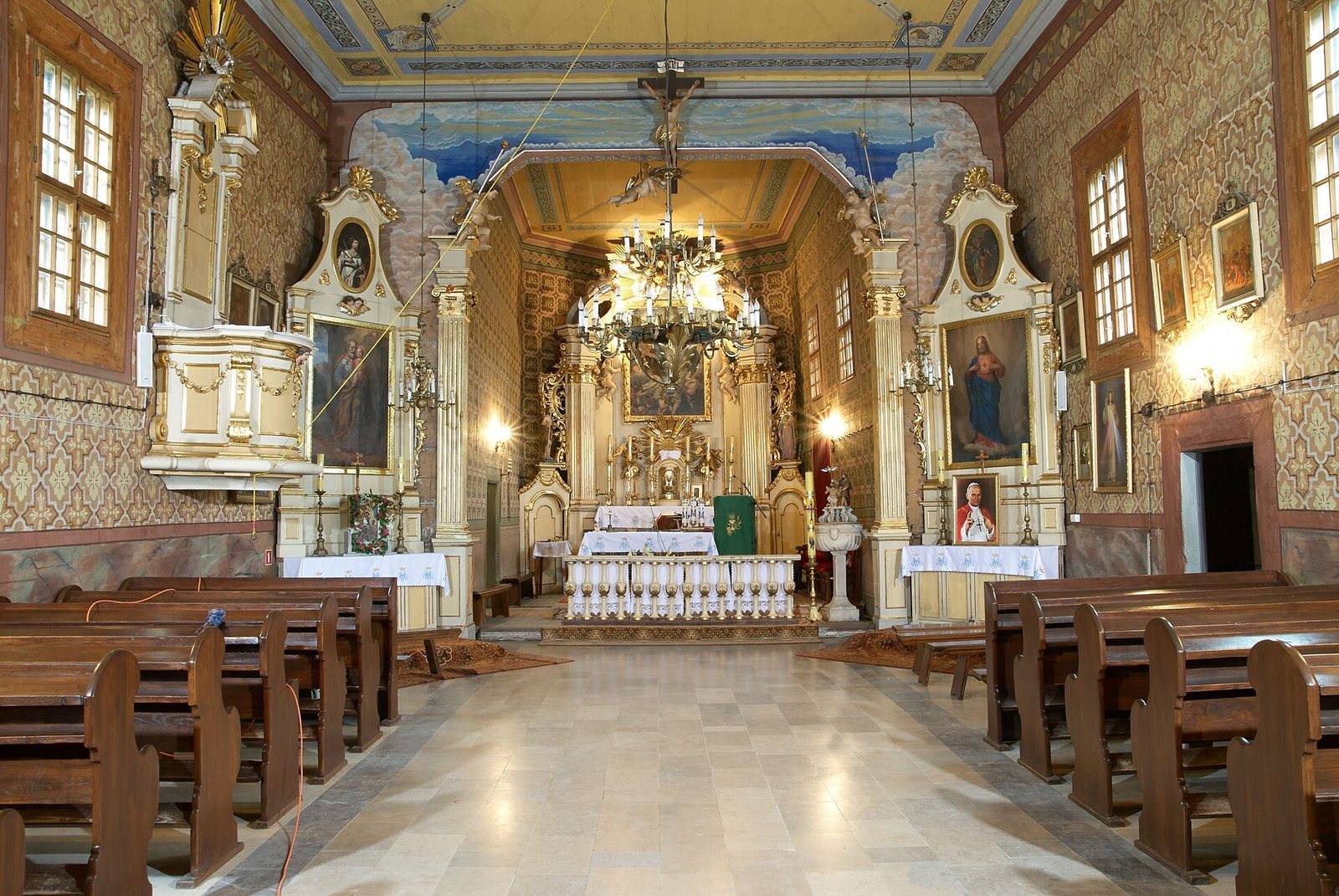
The interior has a Baroque character, with geometric decoration painted in several colors on the walls and flat ceiling. Most furnishings date from the late eighteenth century. The main altar is Rococo, a later and more ornate European style, and holds an image of the Assumption of the Blessed Virgin Mary beneath a silver covering. The image dates to 1779. Two Rococo side altars are dedicated to Saint Joseph, traditionally regarded as Mary’s husband and Jesus’ earthly father, and the Sacred Heart of Jesus, a Catholic symbol of Jesus’ love represented by his heart. The church has three altars in total.
Other furnishings and sacred objects
An eighteenth-century pulpit and baptismal font are among the church’s furnishings; the font’s lid depicts Jesus’ baptism in the Jordan. Two statues show the Risen Christ: one is Gothic, a medieval artistic style, and dates to the fifteenth century, while the other is late Baroque and dates to the eighteenth century. A Baroque crucifix dates to the second half of the seventeenth century. The church also has an organ with nine stops, which select sets of sounds, and one keyboard. A Rococo monstrance, a vessel for displaying the consecrated Eucharistic host for veneration, dates to about 1780.