Church of the Assumption of the Virgin Mary: Gothic Parish Church in Slovakia


Site at a Glance
- Rating
- 4.8
- Popularity
- Very Low
- Country
- Slovakia
- Primary era
- Medieval
- External website
- Open
- Eras represented
- Medieval, Early Modern, Modern
- Civilizations
- Habsburg, Hungarian
- Site type
- Religious
- Remains
- Church
On this page6 sections
History
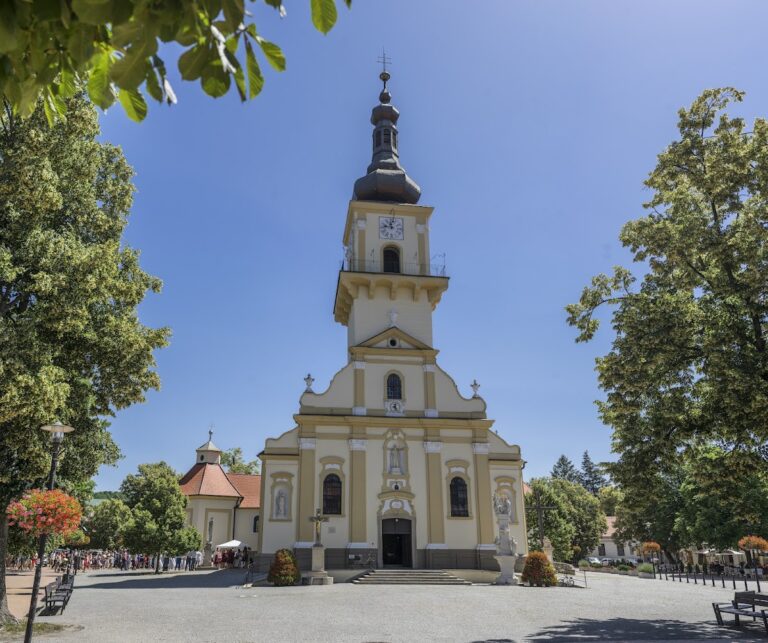
The Church of the Assumption of the Virgin Mary is a Roman Catholic parish church in Plavecký Štvrtok, Slovakia, built in the first half of the fourteenth century in the Gothic style. Its existence or dating is mentioned in a 1333 document concerning the donation of the village. The dedication refers to the Christian belief and feast of Mary being taken into heavenly glory. The parish belongs to the Diocese of Bratislava, within the Western Province and Malacky Deanery.
Medieval church and later rebuilding
The church began as a Gothic building with a single tower. Reconstruction in the seventeenth century changed much of its medieval character. During that work, the vault was rebuilt and the roof was repaired, while the front side retained its Gothic appearance. A further reconstruction took place in the nineteenth century, leaving the present building as a combination of its medieval origin and later alterations.
Twentieth-century changes
In 1922, the church received new bells and was formally consecrated on 11 November that year. The consecration was followed by the establishment of a winter festival. A new organ was installed on 17 December 1925, and the tower roof was covered with sheet metal in 1933.
The rectory, a residence and administrative building associated with a parish church, was built in 1787. Together with the church, it forms part of the parish’s ecclesiastical complex. The church grounds also acquired monuments connected with religious devotion and local memory during the eighteenth, nineteenth, and twentieth centuries.
Remains
Church building
The surviving church is a one-towered Gothic structure whose present form reflects the seventeenth- and nineteenth-century reconstructions. The seventeenth-century work supplied a new vault and included repairs to the roof. The front side preserves the building’s Gothic character, while the rest of the structure expresses the changes made during later rebuilding. The twentieth-century additions include the bells installed in 1922, the organ placed in 1925, and the sheet-metal covering added to the tower roof in 1933.
Rectory and memorials
The 1787 rectory stands as part of the church complex. Three limestone statues from different periods occupy the church grounds. In front of the church, a 1793 cross statue depicts Jesus Christ and the Virgin Mary; it was made by a French sculptor. A statue of the Holy Trinity, the Christian doctrine of one God in three persons, the Father, the Son, and the Holy Spirit, was erected in 1908 with money collected from compatriots in America. The grounds also contain a 1932 memorial to soldiers killed in the First World War, created by the Stupava stonemason and sculptor Weinberger.