Church of St Mary Magdalene in Great Burstead: A Norman Parish Church
Site at a Glance
- Popularity
- Medium
- Country
- United Kingdom
- Primary era
- Medieval
- Eras represented
- Medieval, Early Modern, Modern
- Civilizations
- British, English
- Site type
- Religious
- Remains
- Church
On this page11 sections
History
The Church of St Mary Magdalene in Great Burstead is a 12th-century Norman parish church in Essex, United Kingdom. Norman architecture developed in England after the 1066 conquest and is commonly associated with rounded arches and massive masonry. The church stands in a settlement with Saxon origins and an earlier history of worship.
Saxon settlement and early worship
Saxons under King Æscwine arrived in Essex in 527. Great Burstead grew as a Saxon settlement, and its name combines words meaning “fortified place” and “farmstead.” The village’s raised position, boundary ditch, and stream to the west are consistent with a defensible settlement.
In 653, the missionary Cedd converted Ebba, a local thane, or high-ranking official. After Ebba left following family disputes, Edwy succeeded her. Bishop Earconwald persuaded him to build a church in 669, dedicated to Theodore of Tarsus, Archbishop of Canterbury. Around 680, Cedd blessed a well at the church site and placed a cross there, and a wooden church was built. Its foundations may lie beneath the present building. Sæberht, regarded as the first Christian Saxon king and converted by Mellitus, the first Bishop of London, is said to be buried in the church grounds.
Norman church and medieval use
The present church dates to the 12th century. After the Norman Conquest, William the Conqueror granted 39 lordships, estates held by a lord, in Essex to his half-brother Odo of Bayeux. Great Burstead became Odo’s capital manor, or principal landed estate. By 1147, the lordship belonged to the Cistercian monks of Stratford Langthorne Abbey. Cistercians followed a strict form of Benedictine religious life.
Flooding from the Thames led the monastic community to move to the church in 1338. The monks remained there until 1551. The church underwent further building phases in the later Middle Ages and early 16th century.
The Peasants’ Revolt
During the Peasants’ Revolt, a major English uprising in 1381, insurgents fled toward Billericay at dawn on 28 June after Wat Tyler was killed in London. Richard II’s forces pursued them toward Norsey Woods. There, the rebels hurriedly formed a barricade from wagons, but troops led by Thomas of Woodstock and Thomas Percy rode through it. An estimated 500 Essex men died at Norsey Woods, and many were buried in Great Burstead churchyard.
Mayflower connections
Christopher Martin, a prosperous merchant who later became treasurer of the Mayflower, married Mary Prowe at the church on 26 February 1606. The Mayflower carried English settlers to North America in 1620, and Martin signed the Mayflower Compact, an agreement establishing a framework for the passengers’ community government. He served as churchwarden in 1611–12, later became a Puritan, and was investigated by the church over misuse of church funds at Ingatestone Hall.
Solomon Prowe, Mary’s son from her first marriage, was baptized at the church. He later sailed on the Mayflower and died on 24 December 1620, after the exploration of Plymouth Harbour had been completed.
War graves and the present church
During a German airship raid on 23 September 1916, Royal Flying Corps Second Lieutenant Frederick Sowrey brought down the Zeppelin L 32 near Billericay. The 22 crew members were recovered and placed in a barn. Two days later, they were buried in a prepared site in Great Burstead churchyard. Their remains were exhumed in 1966 and transferred to Cannock Chase German Military Cemetery in Staffordshire.
The church remains an active Anglican parish church in the Diocese of Chelmsford and follows the Anglo-Catholic tradition, which emphasizes liturgy and practices associated with historic Catholic worship. It was listed Grade I in 1955 and is within the Great Burstead Conservation Area, designated in 1983.
Remains
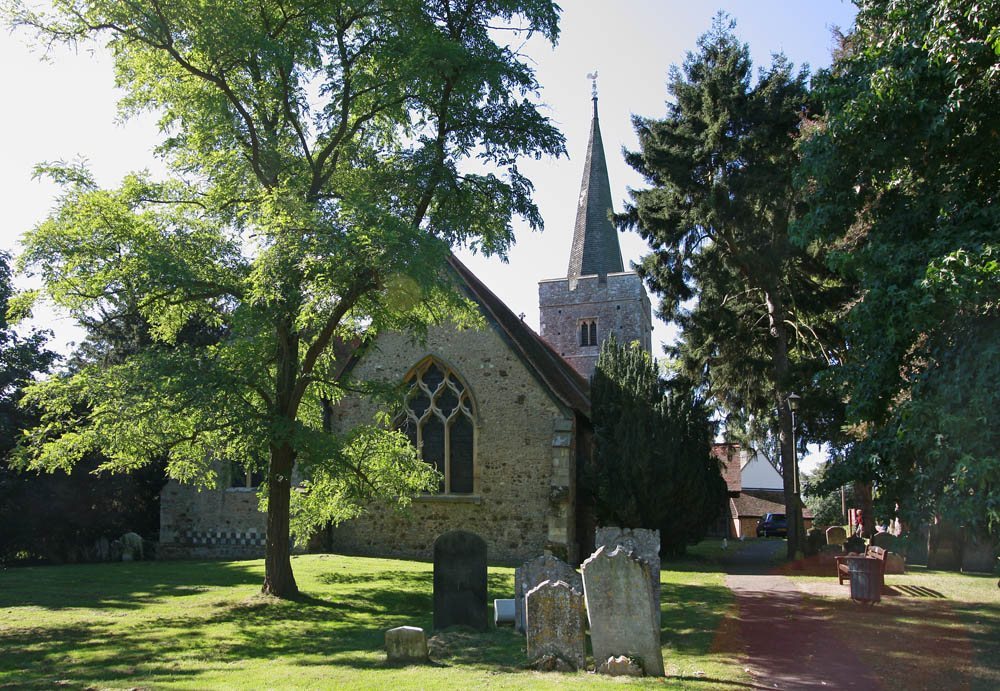
The church is arranged around a 12th-century nave, with a south aisle, a chancel at the northeast corner, a south chapel, and a tower at the west end. Porches stand on both the north and south sides. The churchyard lies about 60 m (200 ft) above sea level, overlooking the Crouch and Thames valleys. The village is in the London Basin, where London Clay is partly overlain by Bagshot Beds. Both geological formations date to the Eocene, an epoch lasting roughly 56 to 34 million years ago.
The nave
The nave measures 44 by 23 ft (13.4 by 7.0 m), and its walls are built of stone rubble, probably obtained locally. A single arrowslit, a narrow opening through which defenders could shoot, is set in the 12th-century north wall. Such openings were not used in early 12th-century Norman castle construction; they came into use later in the century, during the reign of Richard I, known as Richard the Lionheart.
Aisle, chancel, and chapel
The south aisle and the chancel at the northeast corner were added in the 15th century. Paintings from the 14th, 15th, and 16th centuries extend along the aisle’s south wall, and its 15th-century benches have been restored. Added in the early 16th century, the south chapel measures 31 by 16 ft (9.4 by 4.9 m). It contains a 12th-century oak chest that was used to collect funds for the Crusades, medieval military campaigns authorized by Latin Christian authorities, during the reign of Henry I (1100–1135).
West tower and bells
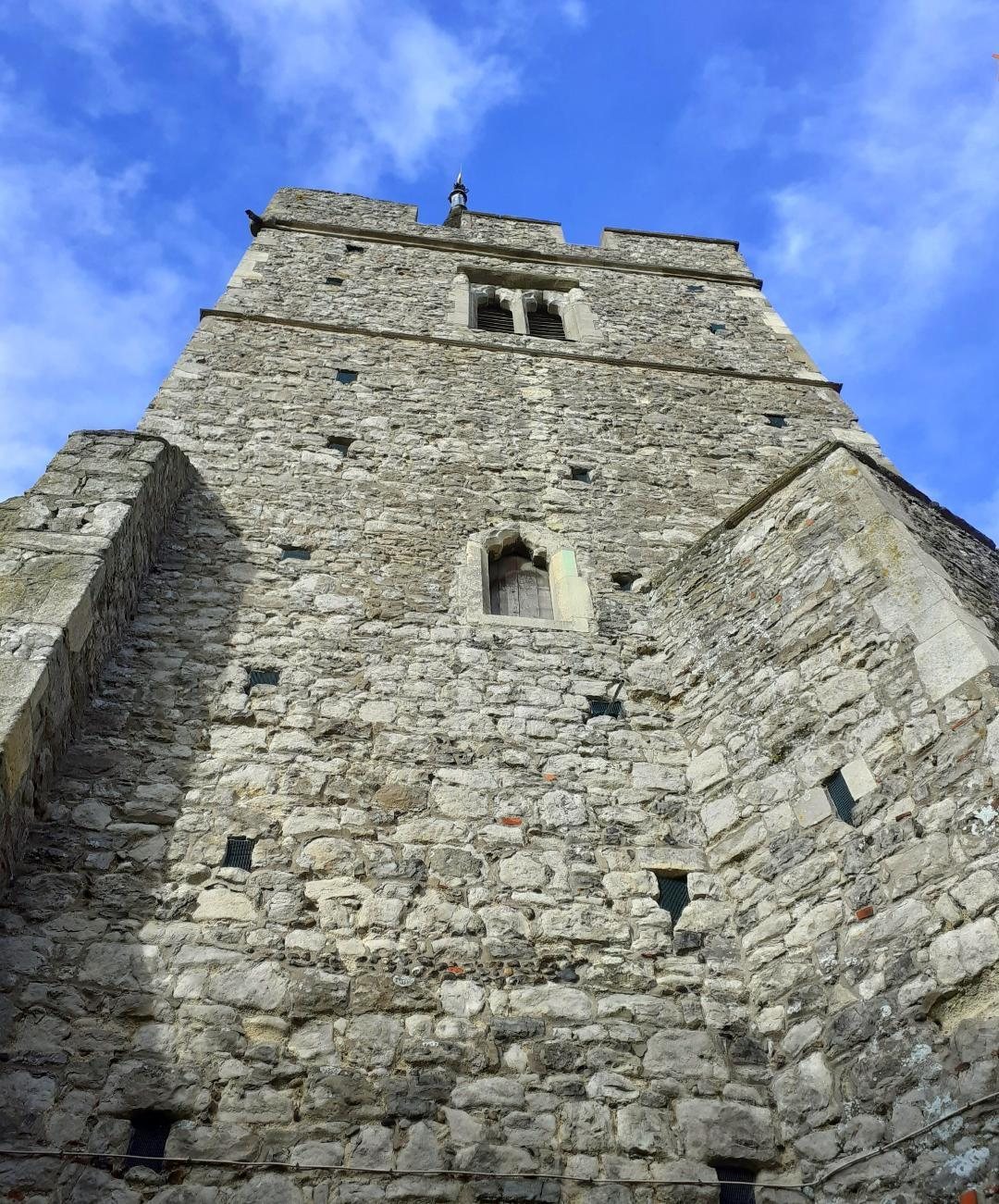
The 14th-century west tower is 14 ft (4.3 m) square and made of ragstone, a hard limestone used for building in southeast England, dressed with limestone. It has three stages, angle buttresses, and a castellated parapet. A shingle-covered spire surrounds a timber spire, and the original putlocks, timbers set into masonry to support scaffolding, remain in place. Five bells hang in an oak cradle, a timber frame that supports bells, dating to 1650. The first bell was cast in London by Balcombe in 1458 and weighs 750 lb. The second and third were cast by Thomas Gardiner at Sudbury in 1724 and 1731, weighing 450 lb and 900 lb respectively. Thomas Meares II cast the fourth at the Whitechapel Bell Foundry in 1814; it weighs 550 lb. The fifth weighs 650 lb. Structural problems with the cradle’s timbers prevent the bells from being rung.
Porches and churchyard tree
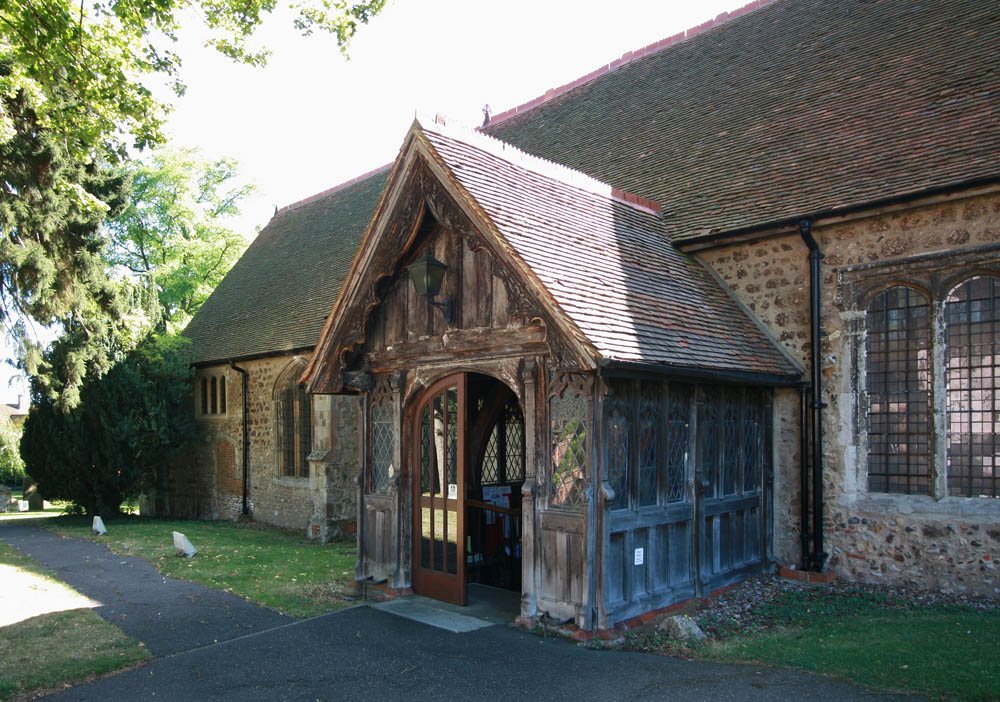
North and south porches were added in the 16th century. Each has a crown-post roof, in which a central upright supports the roof structure. The north porch has heavy oak beams, while the south porch is decorated with carved wood. A yew at the rear of the church is claimed to be the oldest in Essex. It is estimated to be about 800 years old, though that age estimate is unverified.