Chelmsford Cathedral: The Bishop’s Principal Church in Essex


Site at a Glance
- Rating
- 4.7
- Popularity
- Low
- Country
- United Kingdom
- Primary era
- Medieval
- External website
- Open
- Eras represented
- Medieval, Modern
- Civilizations
- British, English
- Site type
- Religious
- Remains
- Cathedral
On this page13 sections
History
Chelmsford Cathedral is the cathedral church of the Anglican Diocese of Chelmsford in Chelmsford, United Kingdom. Formally dedicated to St Mary the Virgin, St Peter and St Cedd, it began as the parish church of St Mary the Virgin around 1200 and developed as a Gothic building. A cathedral is the principal church of a diocese, the administrative territory overseen by a bishop. The church later became the seat of the Bishop of Chelmsford and is part of the Province of Canterbury.
Medieval parish church
The church probably arose with the town around 1200. It was formerly associated with the Catholic Church before becoming an Anglican church. Much of its medieval fabric reflects substantial rebuilding during the fifteenth and early sixteenth centuries, with a further rebuilding phase beginning around 1520.
Rebuilding and cathedral status
In 1800, part of the nave collapsed. County architect John Johnson rebuilt it in the Perpendicular style, the final major phase of English Gothic architecture, known for strong vertical lines and large traceried windows. The upper part of the chancel was rebuilt in 1878.
In 1914, the church became the cathedral of the newly created Anglican Diocese of Chelmsford. Its additional dedication to St Peter and St Cedd followed in 1954. St Peter is one of Christianity’s principal apostles, while St Cedd was an Anglo-Saxon Christian missionary and bishop active in seventh-century England.
Commemoration and modern development
The south porch was extended in 1953 to commemorate Anglo-American friendship after the Second World War and the presence of many United States airmen in Essex. A major interior refurbishment in 1983 introduced or replaced the floor, seating, altar, bishop’s throne, font, and artworks. Two pipe organs were installed in 1994 and 1995.
Modern artistic additions continued in the early twenty-first century. Peter Eugene Ball’s sculpture Christ in Glory was installed above the chancel arch in 2000. In 2004, the cathedral commissioned Mark Cazalet’s Tree of Life and Philip Sanderson’s altar frontal for the Mildmay Chapel. The dedication ceremony was attended by Prince Edward, Duke of Kent.
The cathedral also maintains an institutional and commemorative connection with Thomas Hooker, who served as Chelmsford Town Lecturer from 1626 to 1629. A blue plaque at the cathedral gates commemorates him. Hooker later fled to the New World because of his Puritan views, founded Hartford, Connecticut, and became associated with the development of American democracy.
Chelmsford Cathedral has been listed as a Grade I building since 1949. It is described as the second-smallest Anglican cathedral in England after Derby Cathedral.
Remains
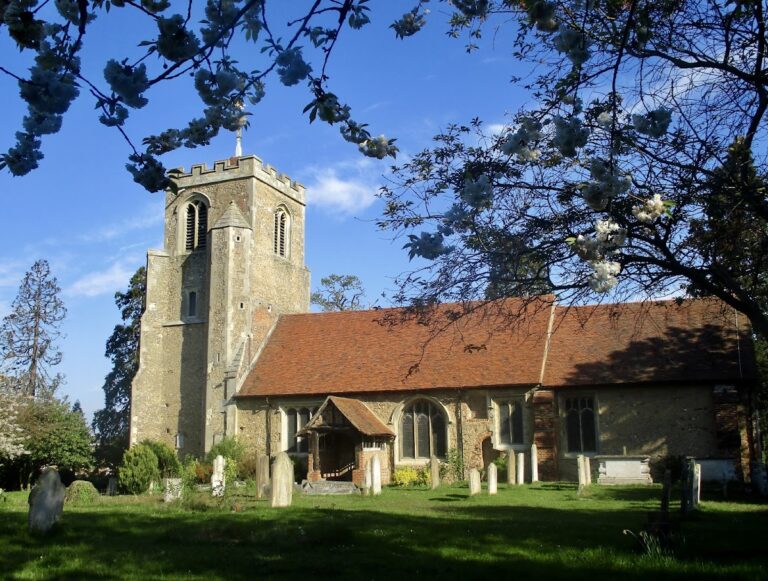
The cathedral is a Gothic building whose fabric combines flint rubble, stone, and brick. Its present form brings together medieval origins, fifteenth- and early sixteenth-century rebuilding, the rebuilt nave and chancel, later additions, and twentieth-century interior work. A tower with a spire rises above the building, while a cathedral graveyard is associated with it.
Tower and bells
The tower contains a ring of thirteen bells. Twelve were cast by John Warner & Sons at Cripplegate and dedicated in 1913. John Warner & Sons was an English bell foundry active during the nineteenth and early twentieth centuries.
Nave and chancel
Nave
The nave rebuilt after the collapse of 1800 retains its Perpendicular design. Its architectural details include Coade-stone piers and tracery beneath a plaster ceiling. Coade stone is a durable artificial ceramic stone used for architectural components.
Chancel and south porch
The upper part of the chancel dates from its rebuilding in 1878. The south porch was enlarged in 1953, and the building also includes a north transept and the Mildmay Chapel. All of the cathedral’s stained-glass windows were installed during the nineteenth and twentieth centuries.
Organs and interior furnishings
Nave Organ
The Nave Organ stands at the west end beneath the tower. Mander Organs built it in 1994 as a four-manual instrument with mechanical action, forty stops, and four manuals with pedal. Its design follows the English nineteenth-century tradition, and its case derives from an instrument by Arthur Hill.
Chancel Organ
Mander Organs built the Chancel Organ in 1995. This two-manual instrument has mechanical action and incorporates nineteenth-century pipework by Hill and Holdich. An electric link allows the Nave Organ’s great, swell, solo, and pedal divisions to be played from the Chancel Organ’s console.
Modern artworks
The interior furnishings include the elements introduced or replaced during the 1983 refurbishment, including the floor, seating, altar, bishop’s throne, font, and artworks. Ball’s Christ in Glory is positioned above the chancel arch, Cazalet’s Tree of Life is in the north transept, and Sanderson’s altar frontal is in the Mildmay Chapel.
Nearby sites