Church of St John the Evangelist, Edinburgh: A Scottish Episcopal Parish Church
Site at a Glance
- Rating
- 4.7
- Popularity
- Medium
- Country
- United Kingdom
- Primary era
- Modern
- Eras represented
- Modern
- Civilizations
- British
- Site type
- Religious
- Remains
- Church
On this page14 sections
History
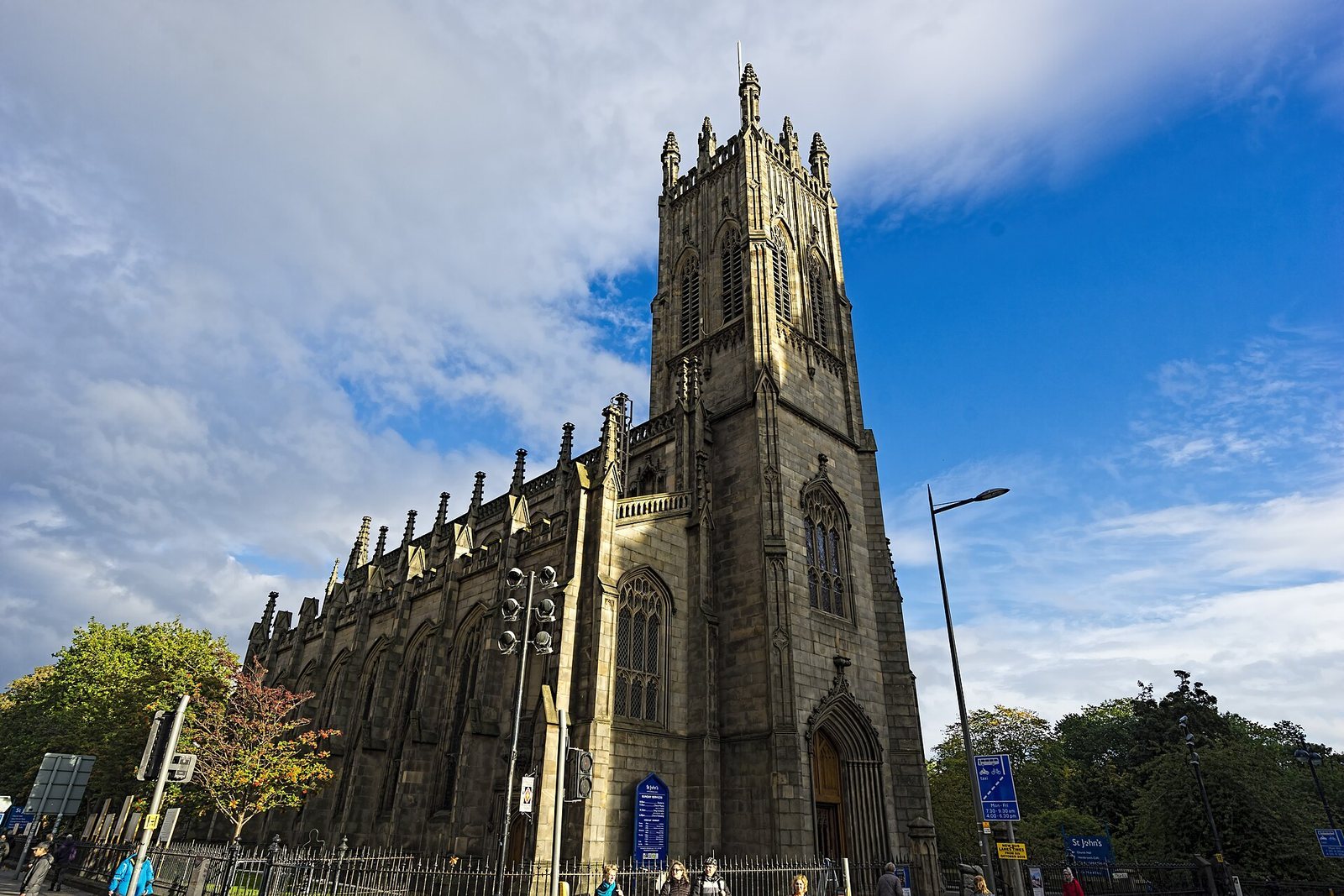
The Church of St John the Evangelist, Edinburgh, is a Neo-Gothic Scottish Episcopal parish church at the west end of Princes Street, where it meets Lothian Road, in the United Kingdom. The Scottish Episcopal Church is the Anglican church in Scotland. Designed by William Burn, the church was built from 1816 and dedicated in 1818.
Congregation and construction
The congregation began in 1792, when Daniel Sandford came to Edinburgh to minister according to Church of England practice. In 1797, a group described as a Qualified congregation moved to Charlotte Chapel. In eighteenth-century Scotland, this term distinguished Episcopal congregations whose clergy had sworn allegiance to the reigning monarch from those who had not. The chapel was enlarged in 1811 and later sold to the Baptists. Shares were sold to finance a new church, with banker Sir William Forbes playing the leading part in the effort.
Burn prepared the design in 1815, at the age of 25, and construction began the following year. The church was dedicated as St John’s Chapel on 19 March 1818, Maundy Thursday, the Thursday before Easter.
Ministry and later history
Sandford served as rector from 1804 to 1830. Edward Bannerman Ramsay joined him as curate in 1827, succeeded him as minister in 1830, and became Dean in 1846. Ramsay remained in office until his death in 1872.
St John’s is part of the Diocese of Edinburgh, a church district overseen by a bishop. It received Category A listed status in 1970, Scotland’s highest listed-building grade, used for buildings of national or international importance. The church participates in Together, an ecumenical grouping that brings different Christian traditions together, with St Andrew’s and St George’s West and St Cuthbert’s. In February 2002, an Ethiopian tabot, a sacred object in Ethiopian Christianity described as a replica of the Tablets of the Law associated with Moses, was found in storage at the church and returned to Addis Ababa.
In 2017, the Scottish Episcopal Church changed its marriage rules to allow clergy, with their congregation’s consent, to opt into same-sex marriage. In September that year, St John’s held the first marriage of a same-sex couple inside an Anglican church in the British Isles, with the rector officiating.
Remains
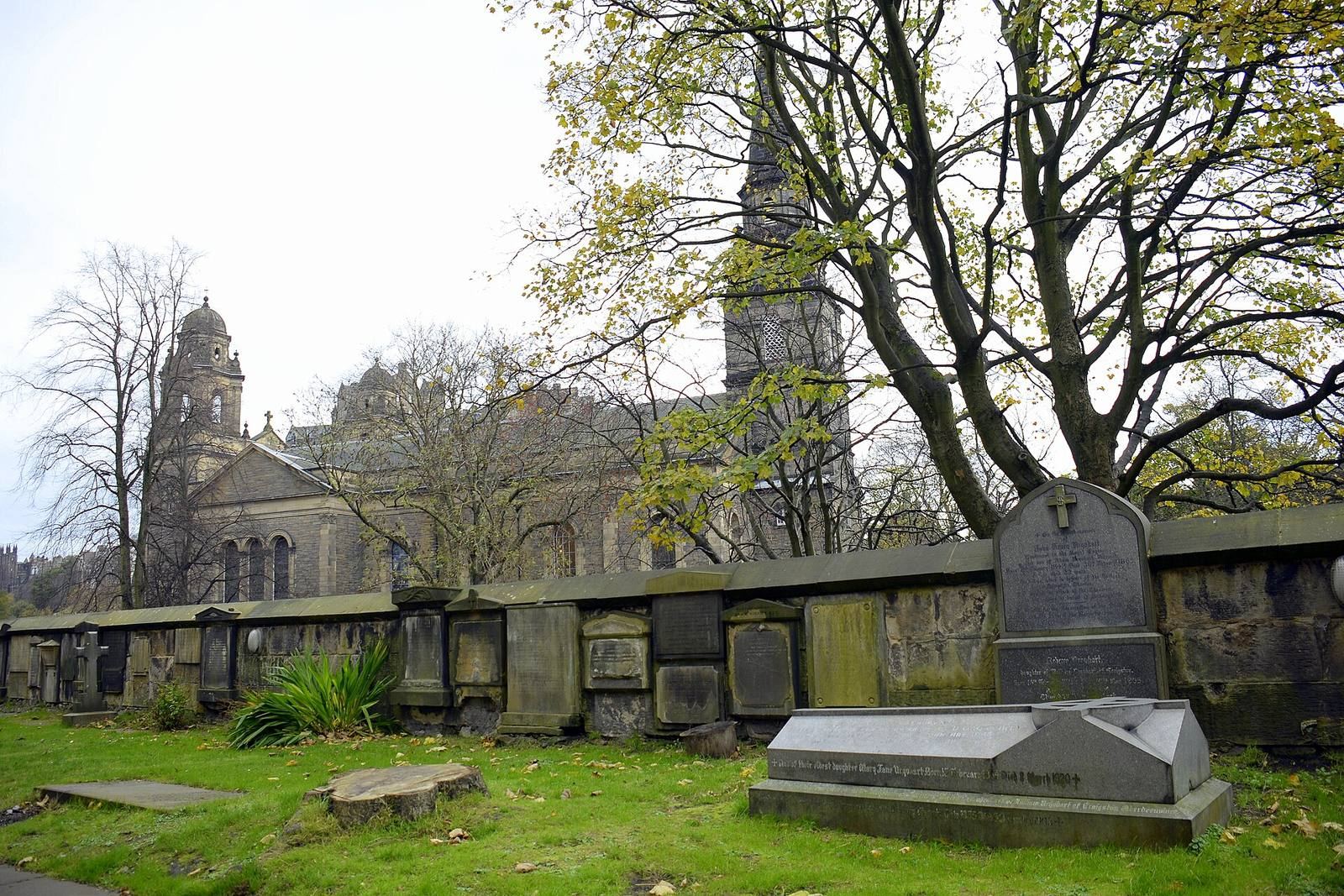
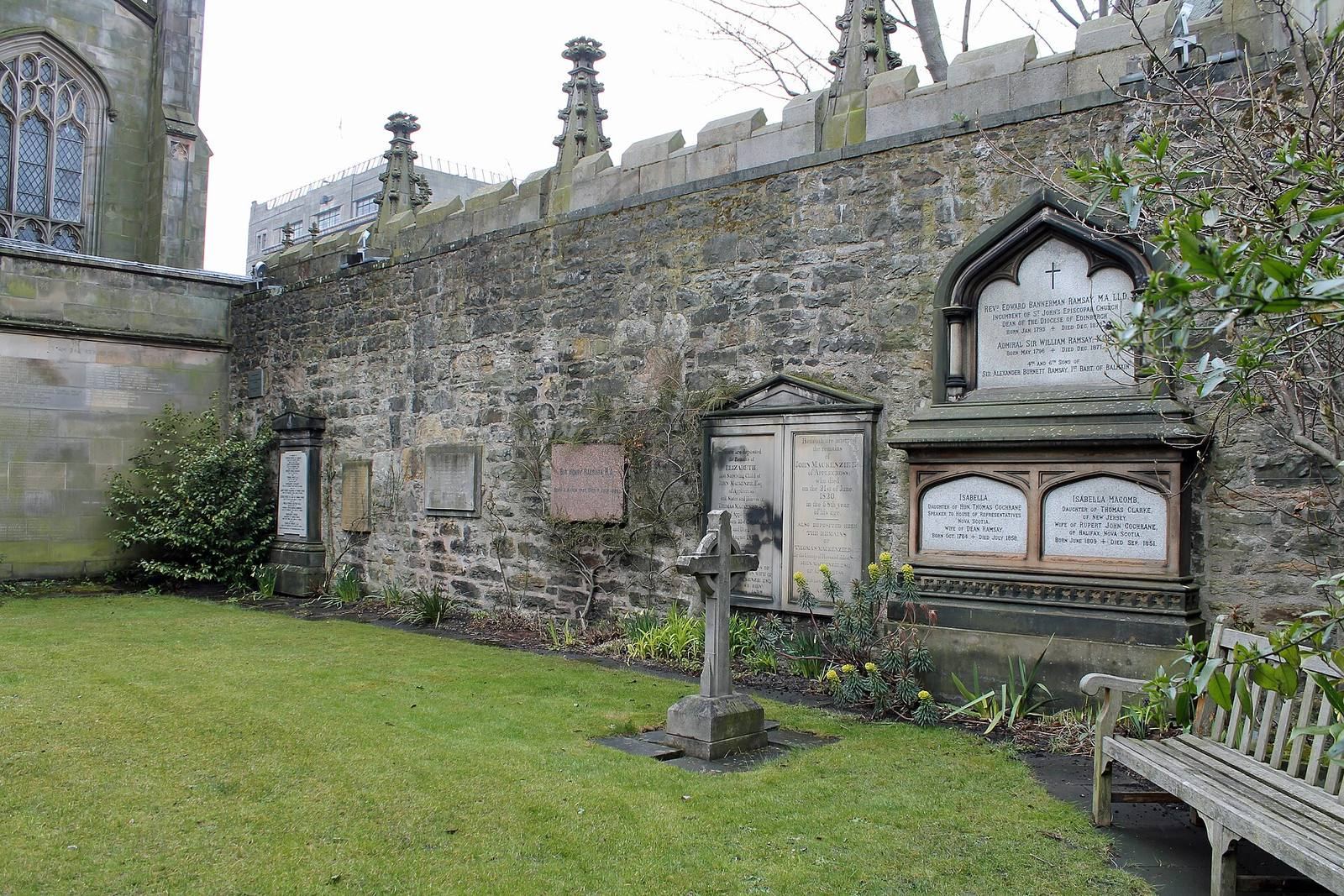
The physical remains include the Neo-Gothic church, its later additions, and a graveyard with monuments and burial markers. The church interior preserves decorative plasterwork, stained glass, and memorials.
Church fabric and interior
Extensions and additions
The sanctuary and chancel were built in 1879-82 by architects John Dick Peddie and Charles Kinnear. John More Dick Peddie and Forbes Smith designed the vestry and hall, added in 1915-16. The church’s south-east corner was extended in 2018.
Ceiling, glass, and chapel furnishings
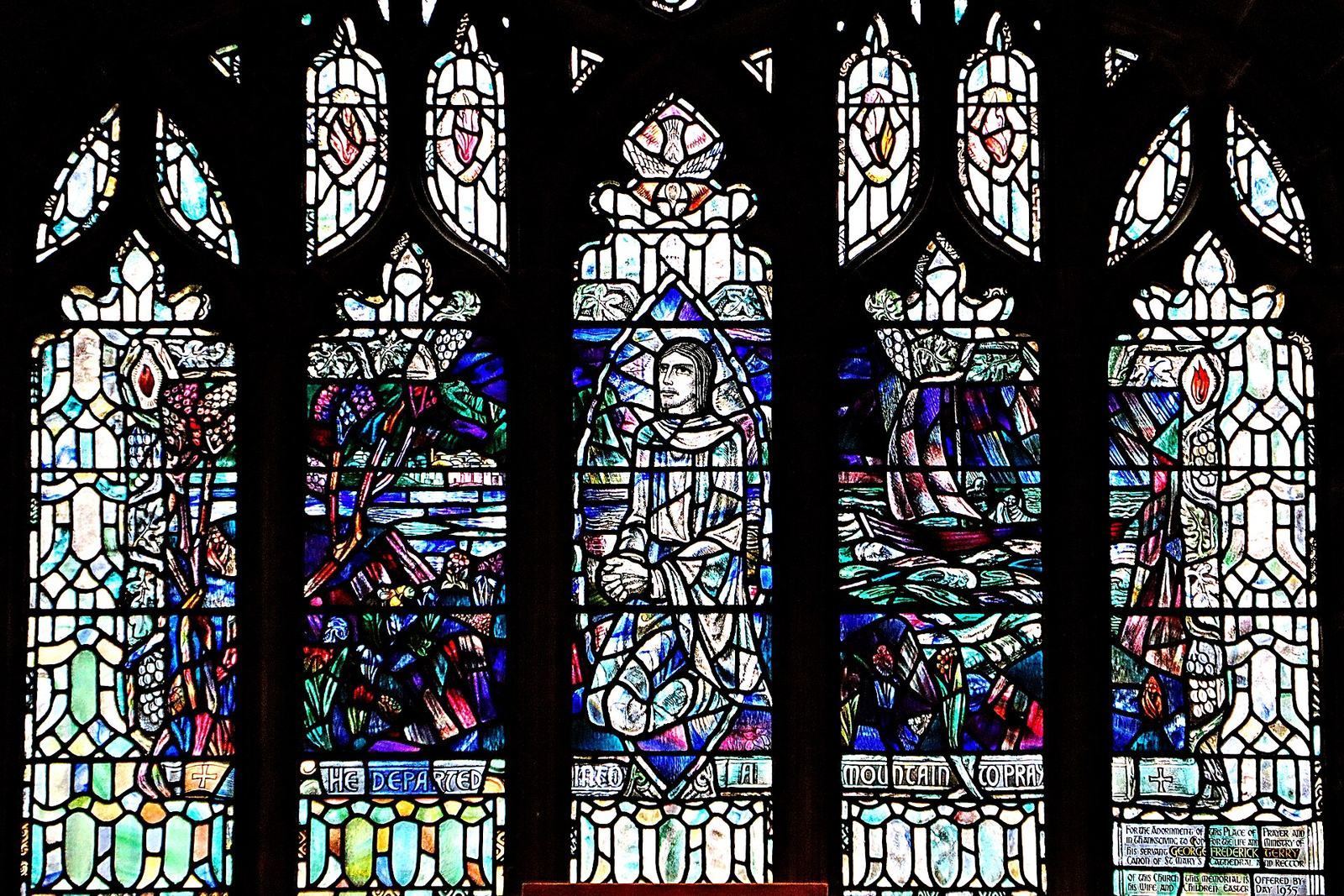
A plaster ceiling forms a pendant fan vault, with ribs arranged in fan shapes and an ornamental feature hanging below. Its design was inspired by the ceiling of the Henry VII Chapel at Westminster Abbey, named for the English king. In 1926, Sir Robert Lorimer designed and oversaw decorative imitation vaulting in connection with the widening of Lothian Road. Most of the stained glass is by Ballantine and Gardiner; William Raphael Eginton made the east window. Walker Todd furnished the morning chapel in 1935.
Memorials and graveyard
Ramsay memorial
A tall granite Celtic cross made in 1878 by architect Robert Rowand Anderson stands facing Princes Street, just east of the church. A Celtic cross has a ring around the crossing of its arms. The monument includes bronze reliefs by Skidmore and commemorates Dean Edward Bannerman Ramsay. Ramsay’s grave is elsewhere in the graveyard and has its own monument.
Other memorials
Inside the church are memorials to General Sir John Campbell, 2nd Baronet of New Brunswick, and the portrait painter Sir Henry Raeburn. Sir Robert Lorimer designed a separate war memorial, added in 1919. A plaque on the left as one enters honours John Stuart Stuart-Forbes, also known as J. S. Hiley. It gives his birth at Rugby on 28 May 1849 and his death in action on 25 June 1876 at the Battle of the Little Bighorn, an engagement in the western United States between the U.S. Army and Native American forces.
Clergy and church connections
The graveyard includes the Reverend Archibald Alison (1757-1839) and his son William Pulteney Alison (1790-1859), Bishop James Walker (1770-1841), Bishop Harry Reid (died 1943), and Daniel Fox Sandford (1831-1906), Bishop of Tasmania and son of the church’s founder. Admiral Sir William Ramsay (1796-1871), Dean Ramsay’s brother, is also buried here.
Public life and law
Among those buried here are Sir William Arbuthnot, 1st Baronet (1766-1829); Thomas Balfour, an MP for Orkney and Shetland; legal author George Joseph Bell (1770-1843); and George Burnett (1822-1890), Scotland’s chief heraldic officer, the Lord Lyon. William Campbell, Lord Skerrington, served as a Senator of the College of Justice in 1908-09, a judicial office in Scotland’s senior courts. Other burials include Alexander Irving, Lord Newton and a law lord; George Moir, a lawyer and essayist; George Young, Lord Young; banker Thomas Kinnear (1796-1830); and Sir James Milles Riddell, 2nd Baronet (1787-1861).
Scholars, writers, and artists
The graveyard contains Daniel Ellis (1772-1841), a botanist; historian William Erskine (1773-1852); metaphysician Sir William Hamilton, 9th Baronet (1788-1856); physiologist Thomas Laycock (1812-1874); and Daniel Rutherford (1749-1819), who discovered nitrogen. Author Catherine Sinclair (1800-1864), artist William John Thomson (1771-1845), and physicist Peter Guthrie Tait (1831-1901) are buried there, as are Tait’s sons John Guthrie Tait and William Archer Porter Tait. A memorial marks Frederick Guthrie Tait, who was buried in South Africa. Lesley Baillie (1768-1843), the subject of Robert Burns’s poem Bonnie Lesley, is also among the burials.
Other burials and grave markers
Other people buried in the graveyard include General Sir Archibald Campbell, 1st Baronet (1769-1843); Major General Nicholas Carnegie of Coates, who died in 1824; James Donaldson (1751-1830), founder of Donaldson’s School for the Deaf; surgeon James Syme (1799-1870); and civil engineer James Walker (1781-1862). The graves also include those of writer William Forbes Skene (1805-1892) and his father James Skene, beneath the chapel, and Sir Hugh Bates Maxwell and Sir William Maxwell, the 9th and 10th Baronets of Calderwood, in the eastern enclosure. Sir William Hamilton’s stone was moved and reused as edging in that enclosure. Malvina Wells (1804-1887) is identified as the only known person buried in Edinburgh who was born enslaved.
Further burials include Thomas Balfour, Sir James Clerk of Penicuik (1812-1870), George Forbes, son of Sir William Forbes, and Aeneas James George Mackay (1839-1911). Also buried here are Charles Kincaid Mackenzie, Lord Mackenzie, General Anthony MacRae (1812-1868), commemorated by a bronze by Sir John Steell, and James Donaldson. The graveyard also contains John Shank More (1784-1861), Macvey Napier (1776-1847), Margaret Outram (1778-1863), widow of Benjamin Outram, and Bouverie Francis Primrose (1813-1898). Anne (1793-1825), sister of Stamford Raffles, Anne Rutherford, mother of Sir Walter Scott, and Sir John James Stuart of Allanbank (1779-1849) are buried there, as are Sir William Stuart Walker (1813-1896) and James Skene’s son William Forbes Skene. Other graves include those of Andrew Duncan (1773-1832), Sir James Clerk, Sir William Hamilton, and William Erskine.