Church of St Helen: An Anglican Parish Church in Ranworth
Site at a Glance
- Rating
- 4.7
- Popularity
- Medium
- Country
- United Kingdom
- Primary era
- Medieval
- Eras represented
- Medieval
- Civilizations
- English
- Site type
- Religious
- Remains
- Church
On this page11 sections
History
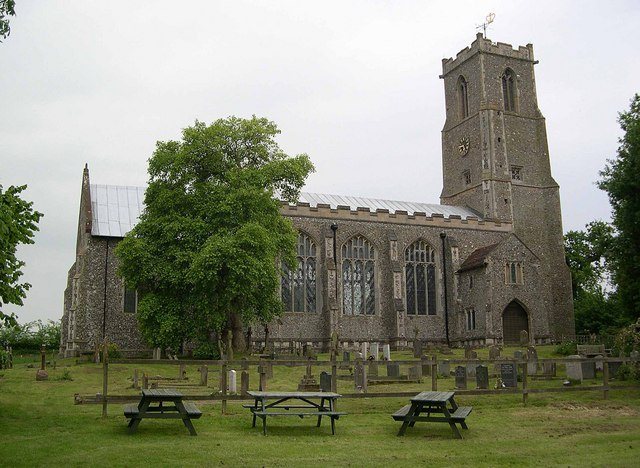
The Church of St Helen is an Anglican parish church in Ranworth, Norfolk, United Kingdom, dedicated to Saint Helen, commonly identified with Saint Helena, the Christian saint traditionally known as the mother of the Roman emperor Constantine. The church is said to have origins in Saxon times, while its construction is generally placed in the 14th century. It began in Decorated Gothic, an English Gothic style followed by the later Perpendicular style. Still active in the parish of Ranworth with Panxworth, it belongs to the Diocese of Norwich and is also known as the Cathedral of the Broads. It is Grade I listed, England’s highest listed-building category, reserved for buildings of exceptional interest.
Medieval church and manuscript
The church commissioned an antiphoner, a book of chants for services, which may be the volume William Cobbe bequeathed to it in 1478. The manuscript survived the English Reformation, the 16th-century break with papal authority that reshaped England’s religious institutions, probably with help from the local Holdych family.
It later passed into private ownership, including that of Henry Huth in the 1850s. The manuscript was bought at auction and returned to the church in 1912.
Restoration and wartime history
Restoration work at the end of the 19th century or beginning of the 20th century was undertaken to prevent the church from collapsing. A fire in 1963 caused little damage to the building overall.
During the First World War, the Reverend Teddy Everard used the church’s field altar. Fourteen men from the parish were killed in the war, and a memorial inside the church commemorates the community’s losses.
Remains
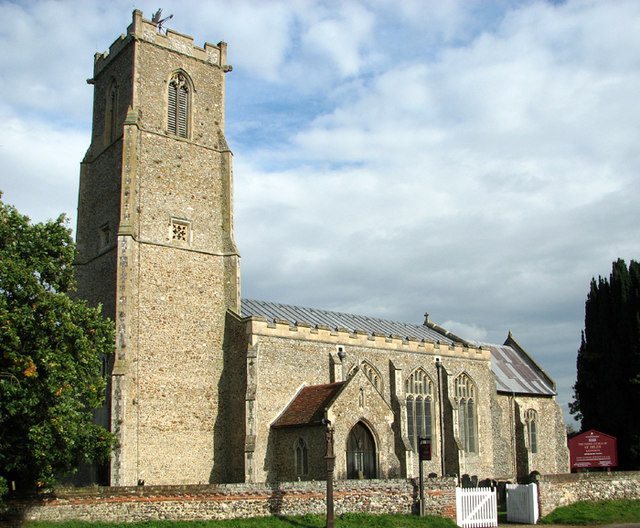
Built of rubble with Clipsham limestone used for dressed stonework, the church is arranged from a three-storey tower at the west end through the nave, which has two porches, to the chancel.
Tower, roofs and furnishings
West tower
The tower rises about 30 metres and contains 89 steps and two ladders leading to a viewing platform. From the platform, Malthouse Broad, Ranworth Broad and the surrounding countryside can be seen.
Roofs and wooden furnishings
Roof beams bear the date 1370. The chancel’s thatched roof was destroyed in the 1963 fire. Wooden furnishings include misericords, carved supports beneath folding choir seats, a pulpit and a medieval cantor’s lectern, a stand for a church singer’s service book or music.
Painted screen and wartime objects
Rood screen
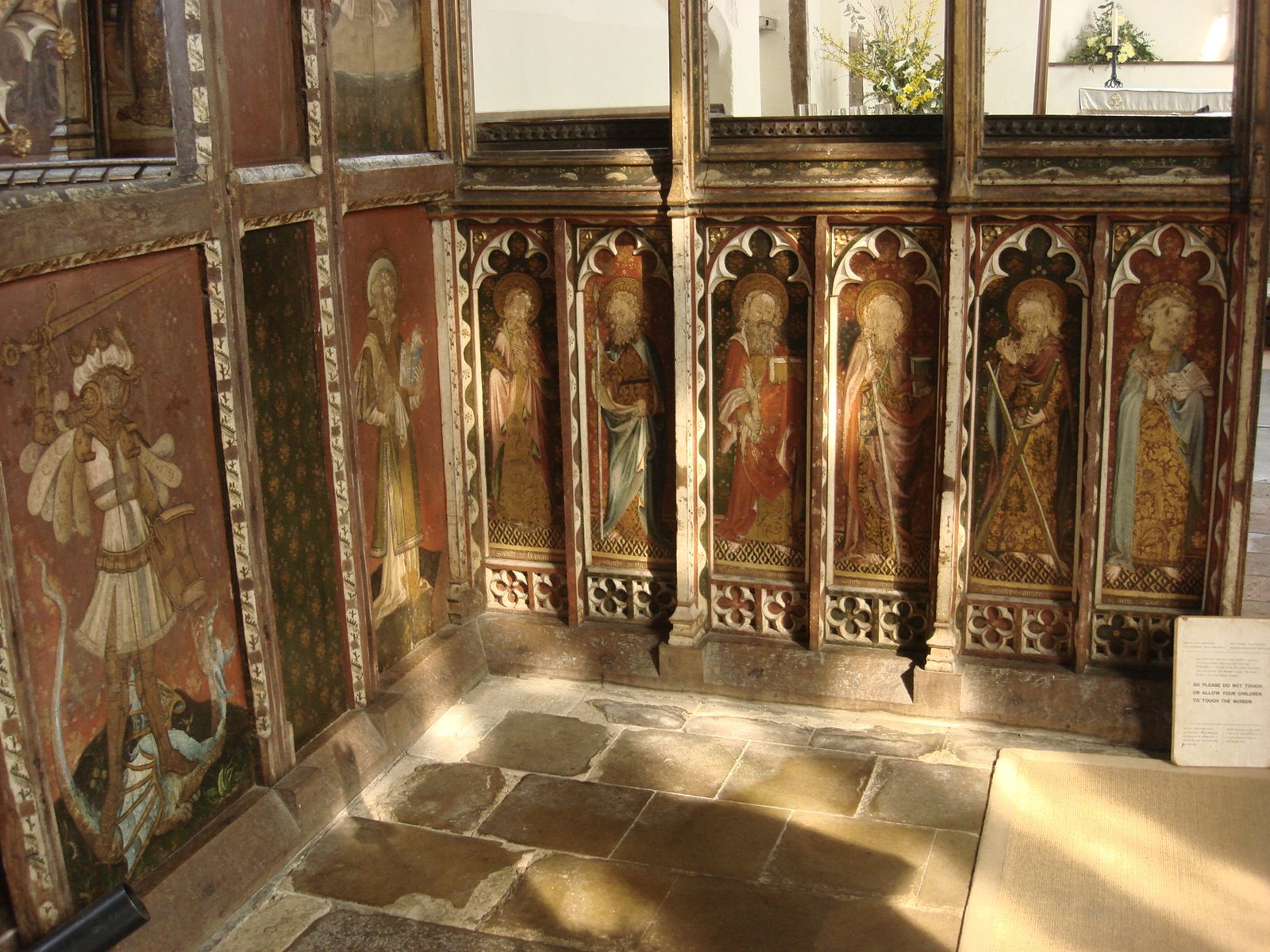
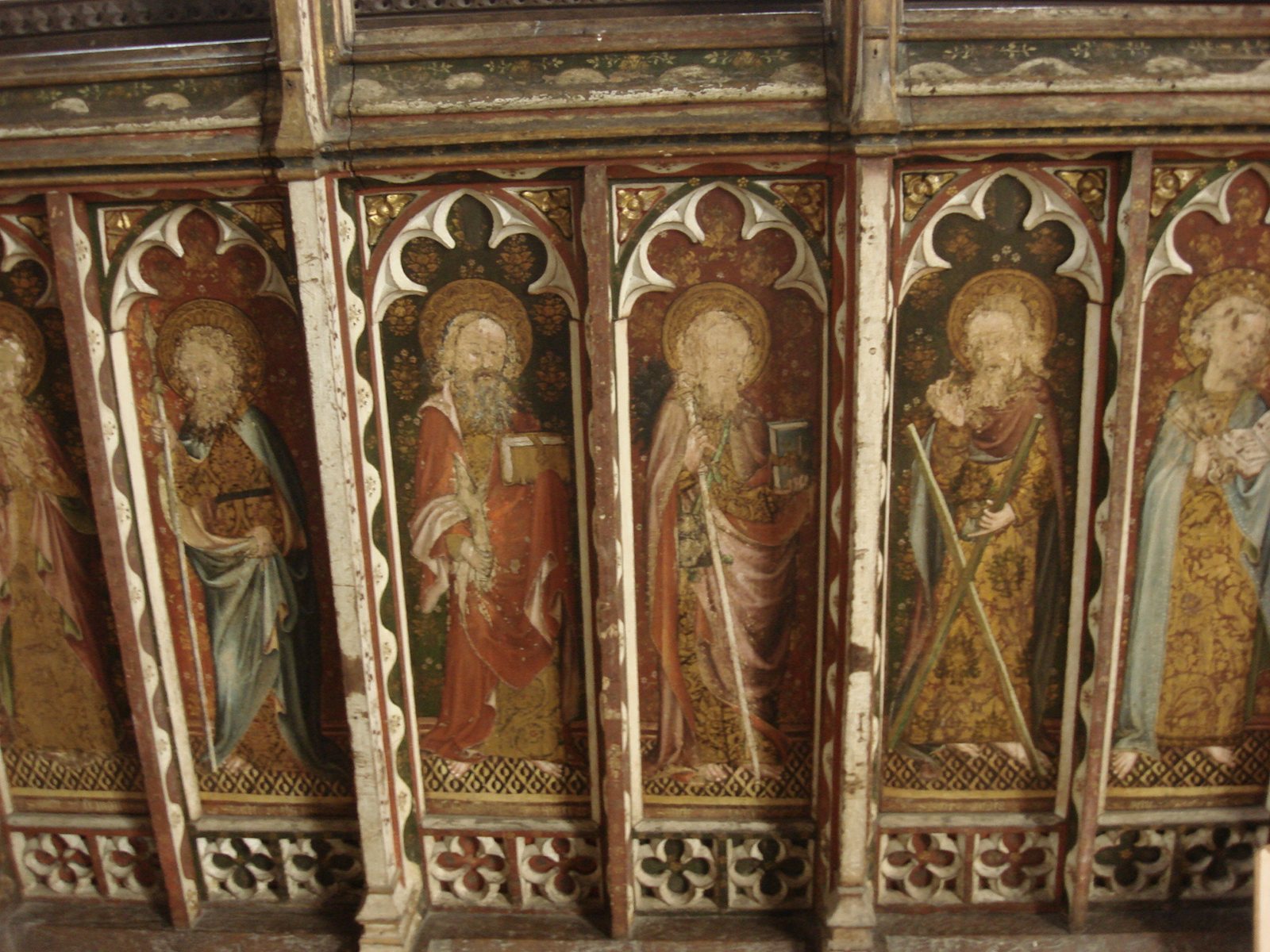
A painted rood screen, a partition between the nave and chancel, spans the nave. Dating to the late 15th century, its central panels depict the twelve apostles in contemporary clothing with their emblems, with Paul shown in place of Matthias. Saint Michael and Saint George appear on the flanking panels. The paintings show suggested Flemish or Spanish influence and have been judged among England’s finest church-screen works. Other panels in the church depict 26 saints and bishops. A crucifixion group believed to have stood above the screen survives at nearby Ludham.
Field altar and memorial
The field altar used by Everard during the First World War remains in the church. A memorial panel commemorates the fourteen men from the parish who died in the war. A field altar is designed for worship away from a permanent church.
Ranworth Antiphoner
The Ranworth Antiphoner is an illuminated service book for the Sarum Rite, a medieval English form of worship associated with Salisbury. Dated to the 15th century and also placed around 1400, it has 285 pages of vellum, a fine form of parchment, with writing and 19 small painted illustrations. It is on permanent display in the church.
The manuscript was once attributed to monks at Langley Abbey, but its illuminations point instead to production by a Norwich workshop. An inserted service for Saint Helen appears out of sequence. The Reverend Enraght proposed that the manuscript was made before 1443, the year the feast of Saint Raphael was instituted, because it contains no feast for that saint. Medieval chant books could be prepared before a buyer was known and personalized later, a practice consistent with late-medieval church investment in books for liturgical music.