Church of Santa María, Ondárroa: A Late Gothic Catholic Church
Site at a Glance
- Rating
- 4.3
- Popularity
- Low
- Country
- Spain
- Primary era
- Medieval
- Eras represented
- Medieval, Early Modern, Modern
- Civilizations
- Crown of Castile, Spanish
- Site type
- Religious
- Remains
- Church
On this page18 sections
History
The Church of Santa María in Ondárroa, Spain, is a Catholic church dedicated to Mary and belongs to the Diocese of Bilbao, a church district overseen by a bishop. Construction began in either 1462 or 1480 and was completed during the following century. Its late Gothic design, a medieval style associated with pointed arches, ribbed vaults, and elaborate window stonework, is close to the artistic tendency linked to Isabella I of Castile and Ferdinand II of Aragon, known as the Catholic Monarchs. The church is not classified as Basque Gothic.
Foundation and construction
The church was built outside Ondárroa’s walls to bring worship nearer to the town’s urban center. Before its construction, worship took place at the Church of the Virgin of Antigua. Its builder is thought to have been a master from Flanders or Burgundy.
Interior remodeling and civic use
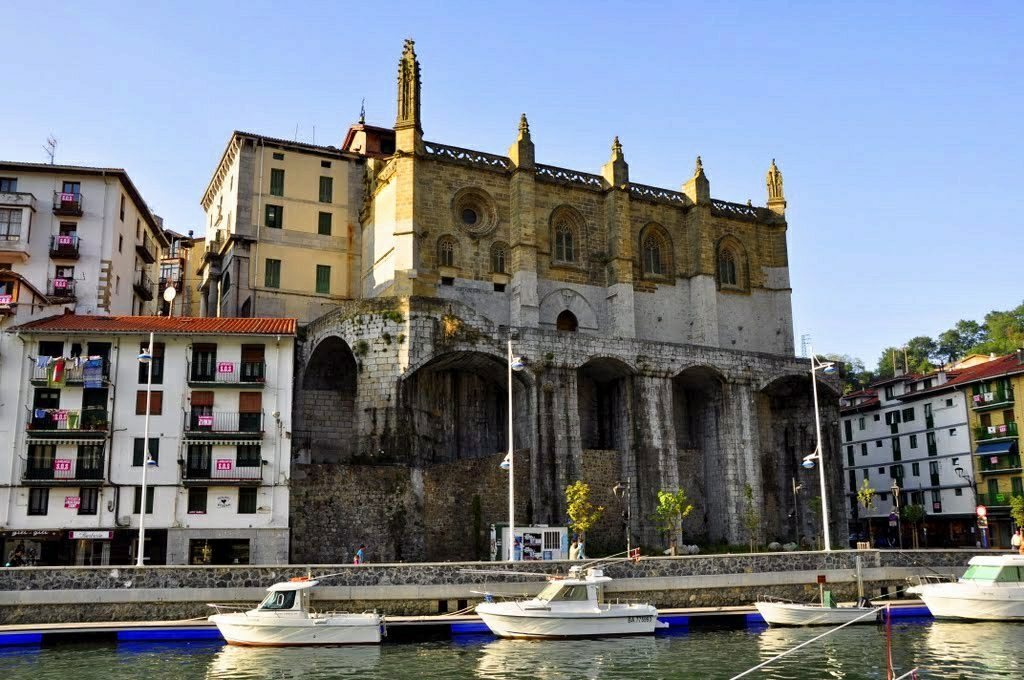
In 1744, the architect Ignacio Ibero directed a comprehensive remodeling of the interior, giving it its present appearance. The earlier church may have had a column-based design, though that reconstruction is uncertain. In 1860, the town hall was added to the church’s western facade. The supporting arches also served a practical maritime purpose: boats were tied to them until the early twentieth century.
A shield of the Kingdom of Castile above the north entrance has been understood as a sign that the Crown protected the church.
Local traditions
Ondárroa retains the custom of sounding a death knell. Formerly rung before a death, it is now usually sounded afterward. A sequence on the large, high-pitched bell is followed by two slower strokes for a woman, three for a man, or five for a member of the clergy.
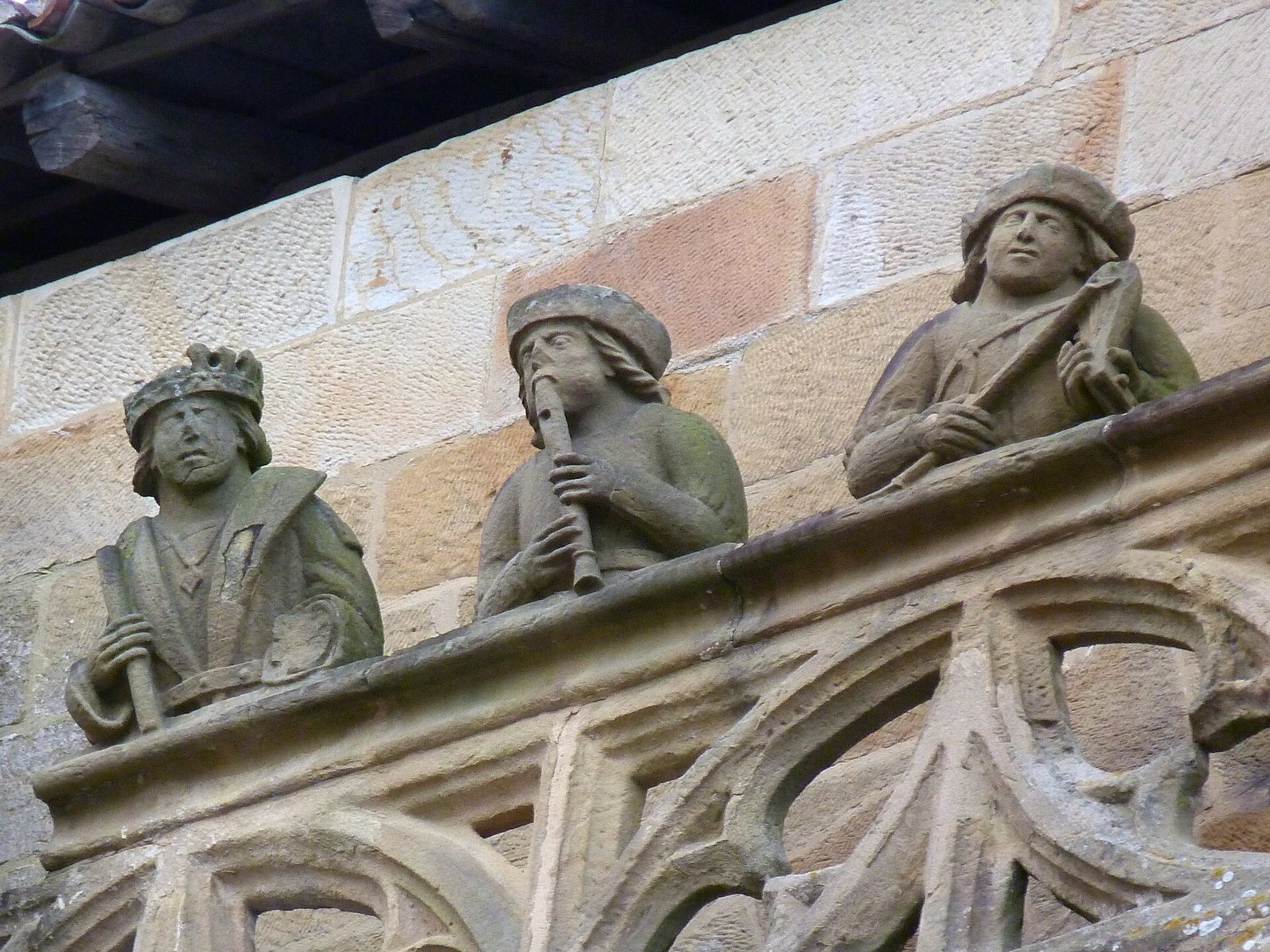
Local legend tells that Leokadi, one of the figures in the church’s sculpted procession, was a woman from the old quarter who was turned to stone as punishment. She is believed to protect local residents. Since the late twentieth century, a festival has begun with her descent from the upper walkway into town and ended with her return. On both occasions, she takes part in a dialogue with a resident that summarizes the year’s events or the festival.
Remains
Exterior and overall form
Setting and structure
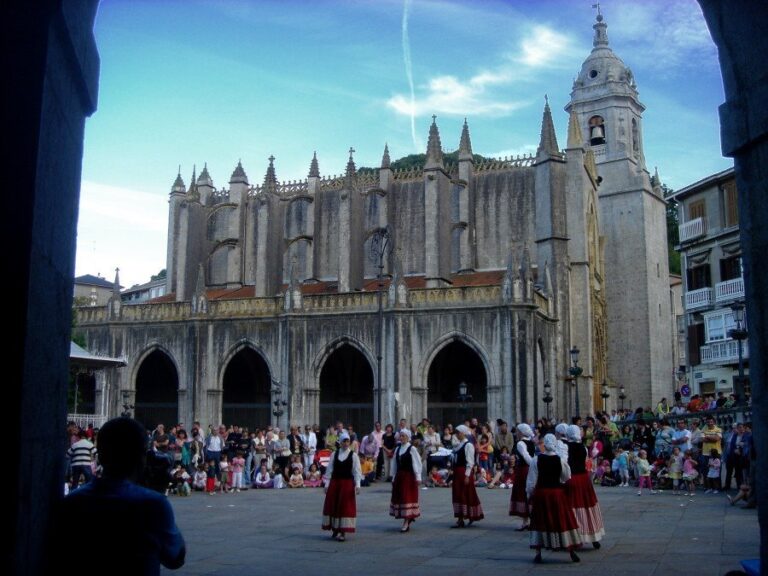
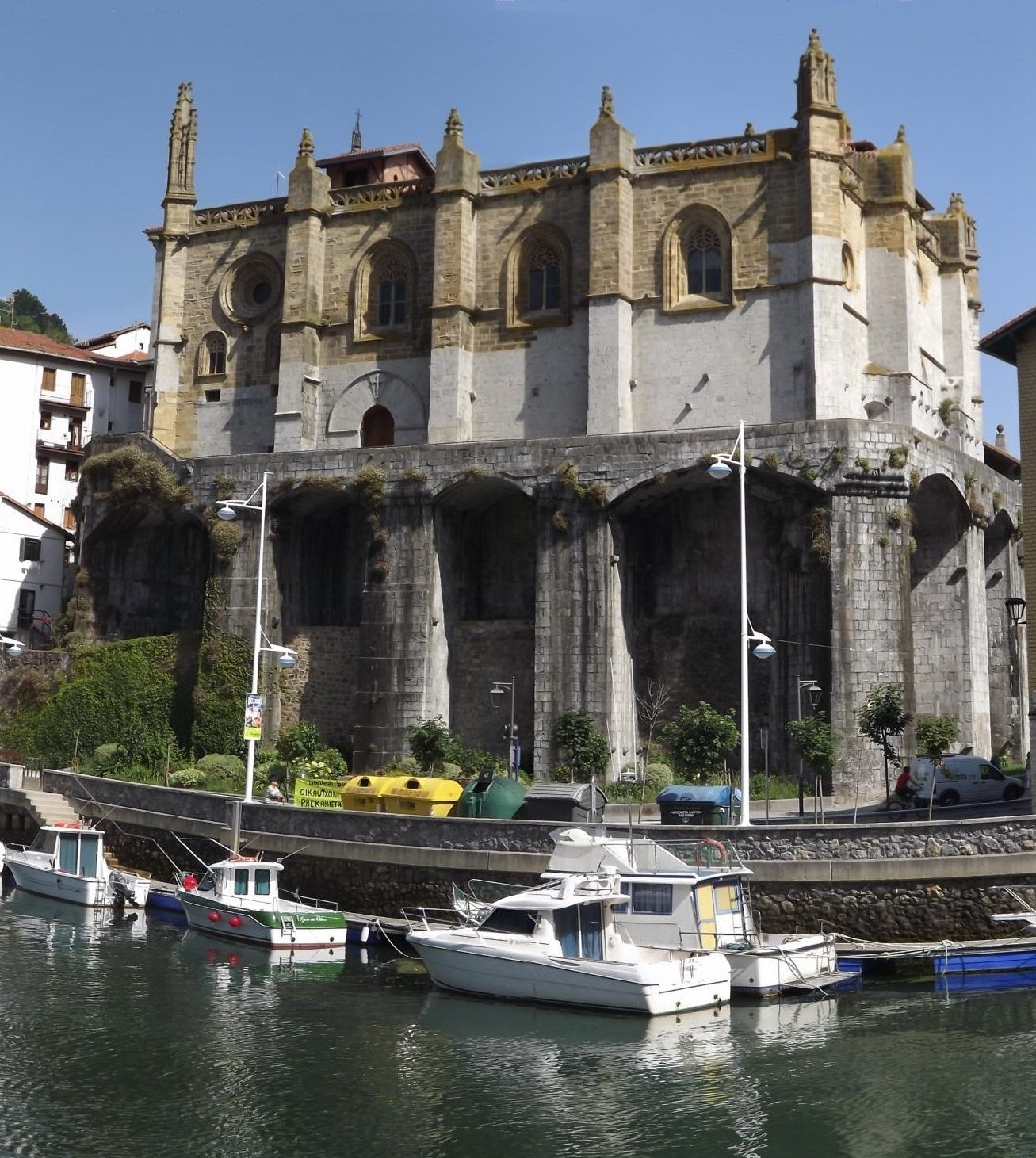
The church stands on a rocky promontory above the Artibai estuary. Its nearly square, high-sided form rises more than 33 metres and is built from carefully cut limestone and sandstone blocks. White limestone forms the lower part and the large supporting arches, while sandstone was used higher up. Iron rings for tying boats remain visible on the supports. A walkway called the Korreta runs around the church, and a second, higher walkway is known as the Kortxela.
Upper walls and carved ornament
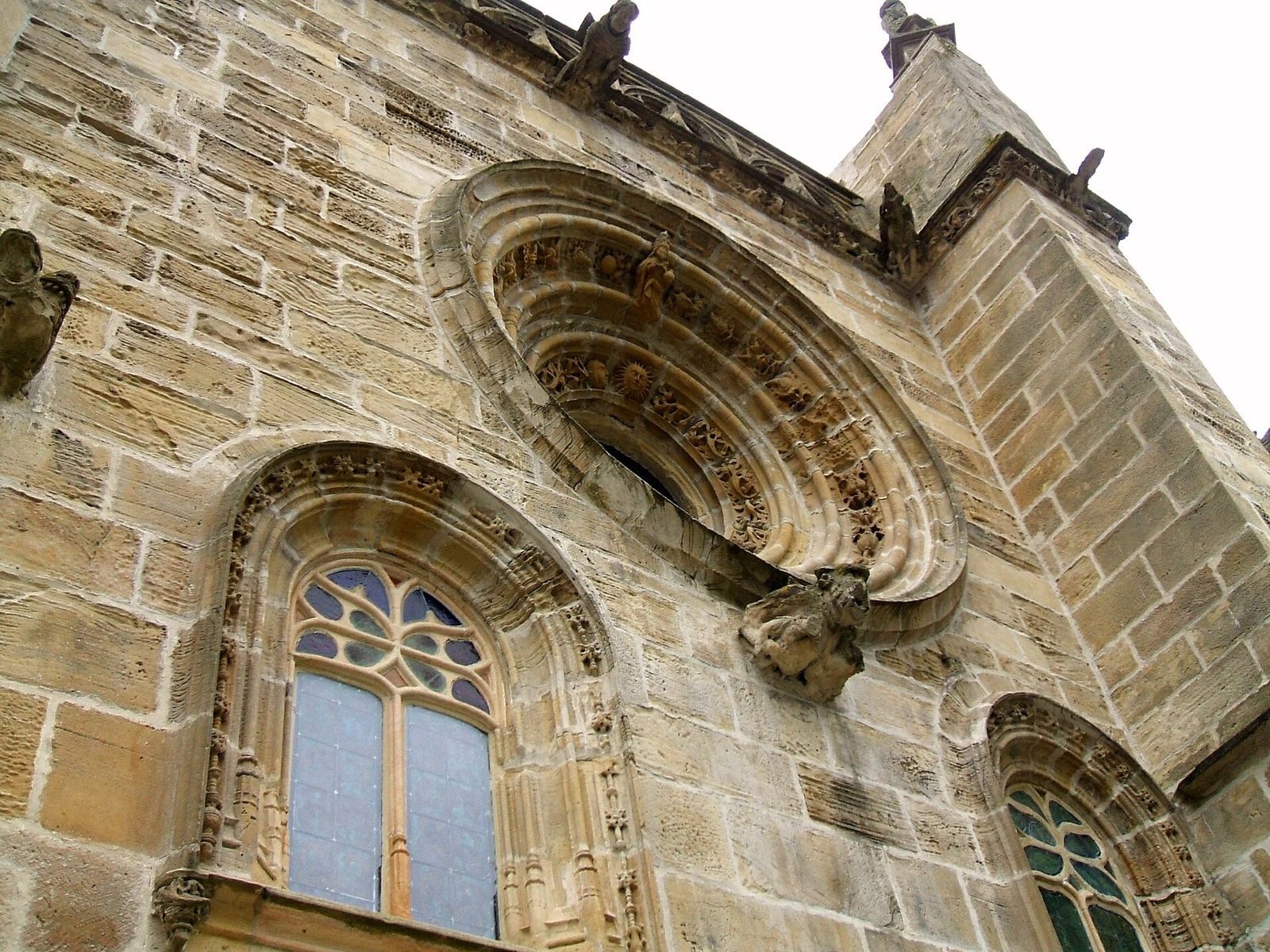
The conspicuous windowed upper section is an outstanding feature of medieval architecture in Biscay. Round and pointed windows, as well as rose windows, carry elaborate Gothic tracery, the ornamental stonework within a window, and carved decoration. Beneath the raised, geometrically decorated cresting, a carved band shows plants and animals. Gargoyles project from the exterior, while human figures appear on the stone railings and on pinnacles above the supporting structures. Some of these figures may once have belonged to another procession.
South and north facades
On the south side, a pointed doorway has a large cross carved into the central stone at the arch’s crown. Three windows and a pointed circular opening sit beneath the cornice. The opening depicts Christ as ruler of the universe, wearing a tiara and holding a globe; the Sun and Moon appear within two surrounding circles.
The north entrance has a pointed arch beneath the Castilian royal shield. Above it, a decorated stone railing is finished with pinnacles and a raised cresting.
East facade procession
Twelve late-medieval figures project from the central section of the railing above the eastern side. Popularly known as the “ghosts of the Kortxela,” they portray a king, a fife player, a rebec player, a male and a female pilgrim, two crossbowmen, a wet nurse, a queen, a monk, a young nobleman, and a knight. Their clothing reflects fashions from late-fifteenth-century Flanders and Burgundy.
Western frontage and bell tower
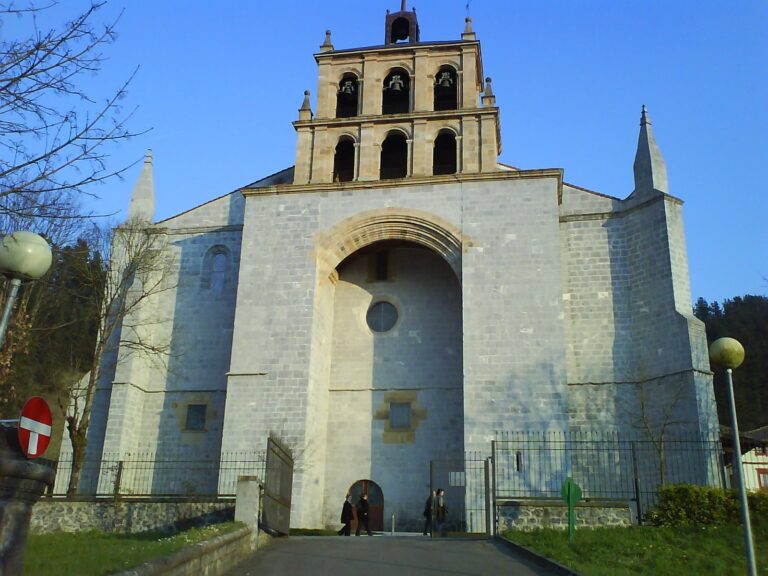
The limestone town hall occupies the western facade. Its frontage includes large arches, a balcony, a shield, and a clock. The bell tower rises behind it on the roof and also contains a siren that signals ships entering the harbor; the number of blasts varies according to their cargo.
The tower holds seven bells. The oldest, called “Saint Clare and the Most Holy Trinity,” was cast in 1667. The largest, “Saint Mary,” measures 129 centimetres across and weighs about 766 kilograms. “Our Lady of the Assumption” is the next largest, measuring 121 centimetres and weighing about 631 kilograms.
Interior and furnishings
Plan and vaults
The interior is arranged in three aisles and four structural sections. The central aisle is taller and wider than the two side aisles. Six large, cross-shaped supports conceal Gothic columns and carry the ceilings. The side ceilings are vaults formed by the intersection of barrel-shaped vaults; the central aisle has a Gothic ribbed vault divided into eight sections.
Main altar
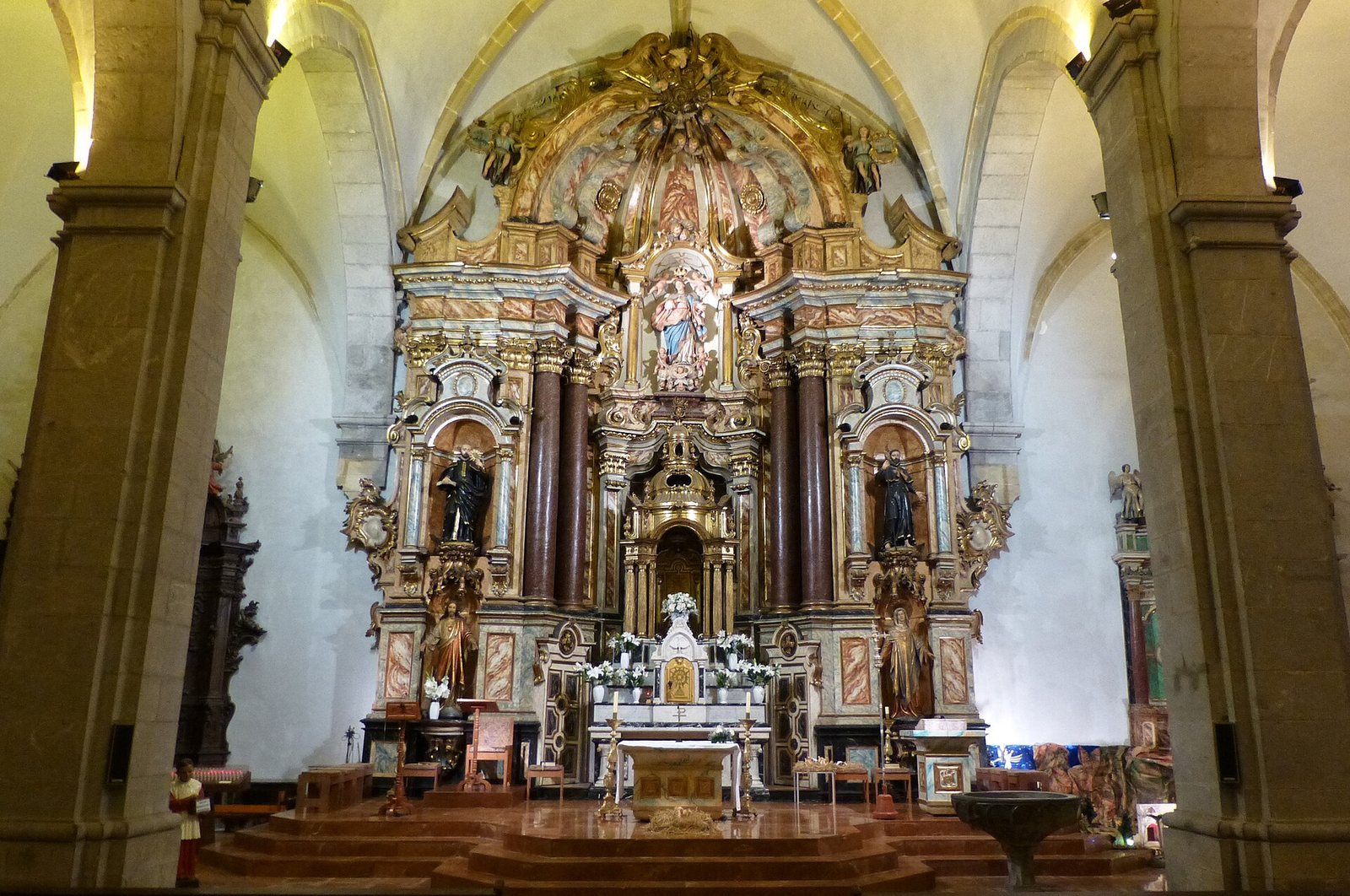
An altarpiece, a decorated structure behind an altar, dominates the main altar. It is made of painted and gilded wood in the Rococo style, an ornate decorative style that developed in eighteenth-century Europe, and has a complex arrangement of inward and outward curves. Large marble columns frame its central section, which contains an image of the Assumption of Mary and figures of Saint Ignatius of Loyola and Saint Francis Xavier. These images, including the Virgin, date to about 1770. Below them are figures of the Sacred Heart of Jesus and the Immaculate Heart of Mary. The structure covers an earlier Gothic stone altarpiece bearing the arms of León and Castile, Biscay, and Ondárroa.
Entrance and baptistery furnishings
Under the choir, to the right of the entrance, is a crucifix. Across from it, in the former baptistery, a relief shows Christ’s baptism in the Jordan. At the foot of this former baptistery stands the Saint Andrew altarpiece, described in a classical style. It includes Saint Catherine of Alexandria, whose carving is similar in style and date to the church’s Saint Michael, and is flanked by figures of Saint Catherine and Saint Anthony of Padua. Nearby are carvings of Saint Anthony Abbot and Saint Raymond Nonnatus.
Altarpieces at the chancel
At the altar end of the church, the side altarpiece on the Gospel side, named for the traditional placement of that Mass reading, is dedicated to Our Lady of the Rosary. Her image stands in the central niche, flanked by praying figures of Saint Dominic of Guzman and Saint Catherine of Siena. Carvings of Saints Cecilia and Lucy are also included. On the front wall, Saint Peter appears in papal clothing with a staff and the Scriptures; Saint Clare of Assisi stands to his right.
On the Epistle side, named for the traditional placement of the other Mass reading, the front-wall altarpiece depicts the Crucifixion, with the Virgin of Sorrows and Saint John beside Christ. A recumbent Christ lies below the altar table, and Saint Joseph holding the infant Jesus crowns the group. The side altarpiece represents souls in Purgatory, understood in Catholic teaching as a state of purification before heaven. Its painting shows the souls reaching upward as angels intercede. Above it is a Hispano-Flemish carving of Saint Michael, combining Iberian and Flemish artistic influences, dated to about 1515.
Font, sacred objects, and wall images
The black-stone Gothic baptismal font, made in the late fifteenth century, measures 1.35 metres across. A Gothic monstrance, a vessel used to display the consecrated Eucharistic host, is kept in the sacristy, a room for vestments and sacred vessels. Its carved decoration resembles the church’s exterior cornice.
An image of Saint Valentine of Berriotxoa is on the Gospel side, and Stations of the Cross are set along the side walls.
Estuary-facing wall
A pointed Gothic doorway in the Epistle-side wall opens onto the Korreta and has a cross carved into the stone at the arch’s crown. Along the wall facing the estuary, the openings contain stained-glass windows. At the foot of the church, two small windows and a rose window occupy the corresponding opening. Figures like those in the eastern procession appear on the supporting pinnacles; some remain on the stone railing, and Gothic gargoyles line the upper edge.