Church of Saints Peter and Paul in Řeznovice: A Romanesque Parish Church
Site at a Glance
- Rating
- 4.8
- Popularity
- Low
- Country
- Czechia
- Primary era
- Medieval
- Eras represented
- Medieval, Early Modern, Modern
- Civilizations
- Austria-Hungary, Duchy of Bohemia, Habsburg, Habsburg Austria, Holy Roman Empire, Margraviate of Moravia
- Site type
- Religious
- Remains
- Church
On this page13 sections
History
The Church of Saints Peter and Paul in Řeznovice is a Roman Catholic parish church in Czechia, dedicated to the apostles Peter and Paul. Its Romanesque core is generally dated to the second half of the 12th century, although an earlier proposal placed it around the turn of the 11th and 12th centuries. The church may have been commissioned after 1160 by Conrad II Otto, a prince of Znojmo from the Přemyslid dynasty. It began as a proprietary church, controlled by a lay patron, and was probably linked by a footbridge to a nearby ruler’s estate, thought to have stood where the present rectory is located.
Early modern changes
Around the middle of the 16th century, the building on the west was demolished and replaced by a Renaissance nave. A porch was added at its southern entrance later, and the bell tower’s roof was altered in the second half of the century. An 18th-century sacristy attached to the eastern apse was demolished in 1893, when a replacement was built on the north side of the nave. Late-19th-century work added an entrance in the western façade and a gallery. A cemetery surrounded the church until 1793.
The slab tradition and modern changes
Local tradition links a stone slab in the church with the Cuman incursion into Moravia in 1304. The Cumans were a medieval Turkic people. In 1677, Bohuslav Balbín described a Christian church near Ivančice and Oslavany where Cuman graves and gravestones bearing carved letters could be seen. In 1954, orientalist Pavel Poucha identified the Řeznovice slab with the one in Balbín’s account. He suggested in 1964 that it might preserve Mongolian writing, while noting that the signs had not been deciphered and that their script and language were uncertain. In 1981, Poucha proposed that the signs were in Uyghur script, adapted to forms of Glagolitic, an early Slavic alphabet. He read part of them as the personal names “Marquz Buqu…”.
Two bells were requisitioned during the First World War. Replacement bells were made in 1950, when the tower was also renovated. The church interior was modified in the 1980s. The building is protected as a cultural monument of the Czech Republic.
Remains
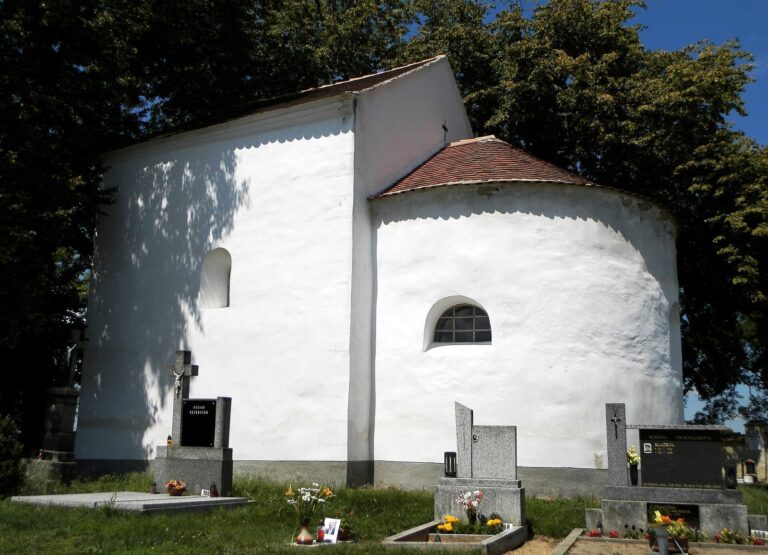
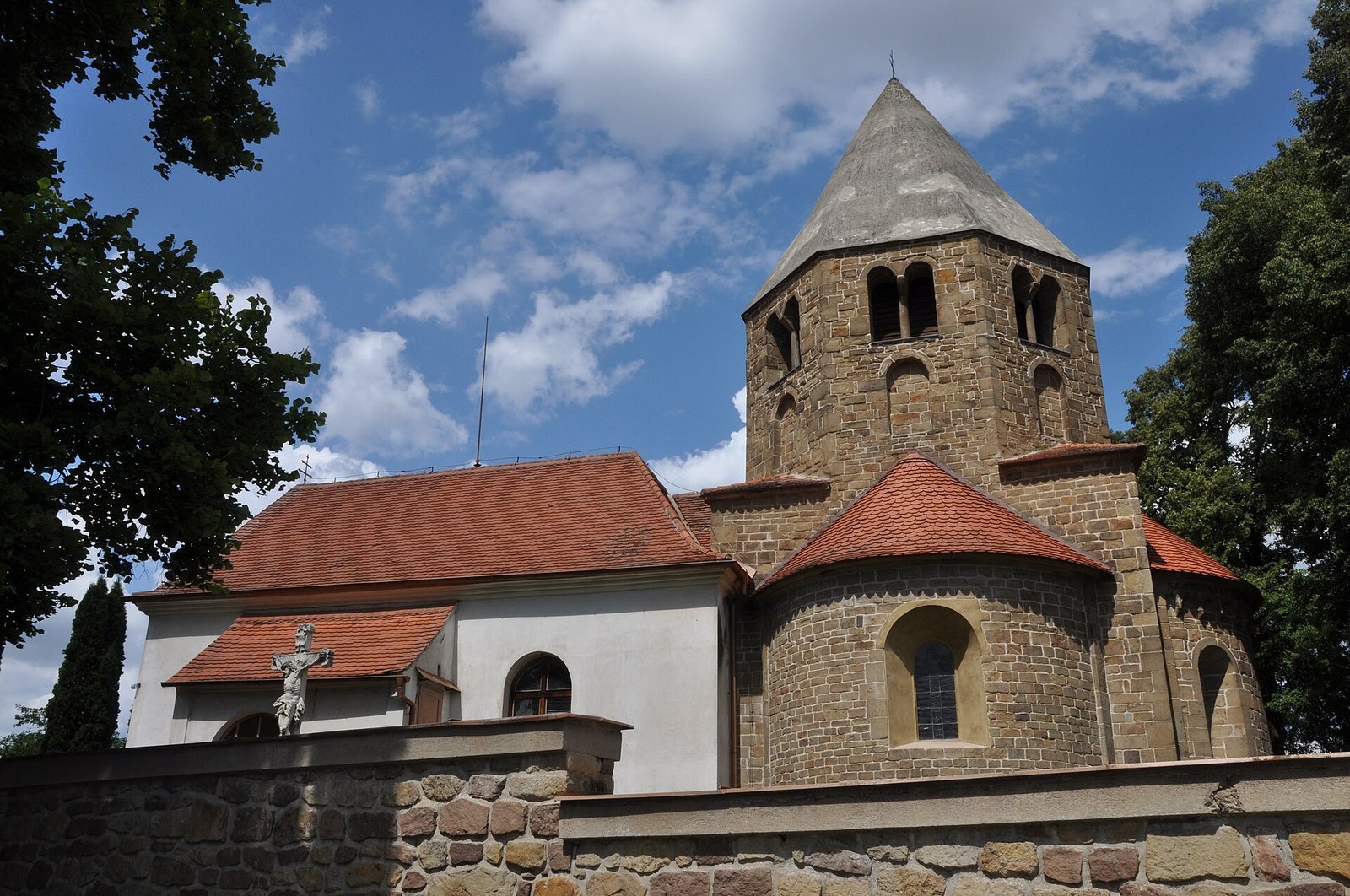
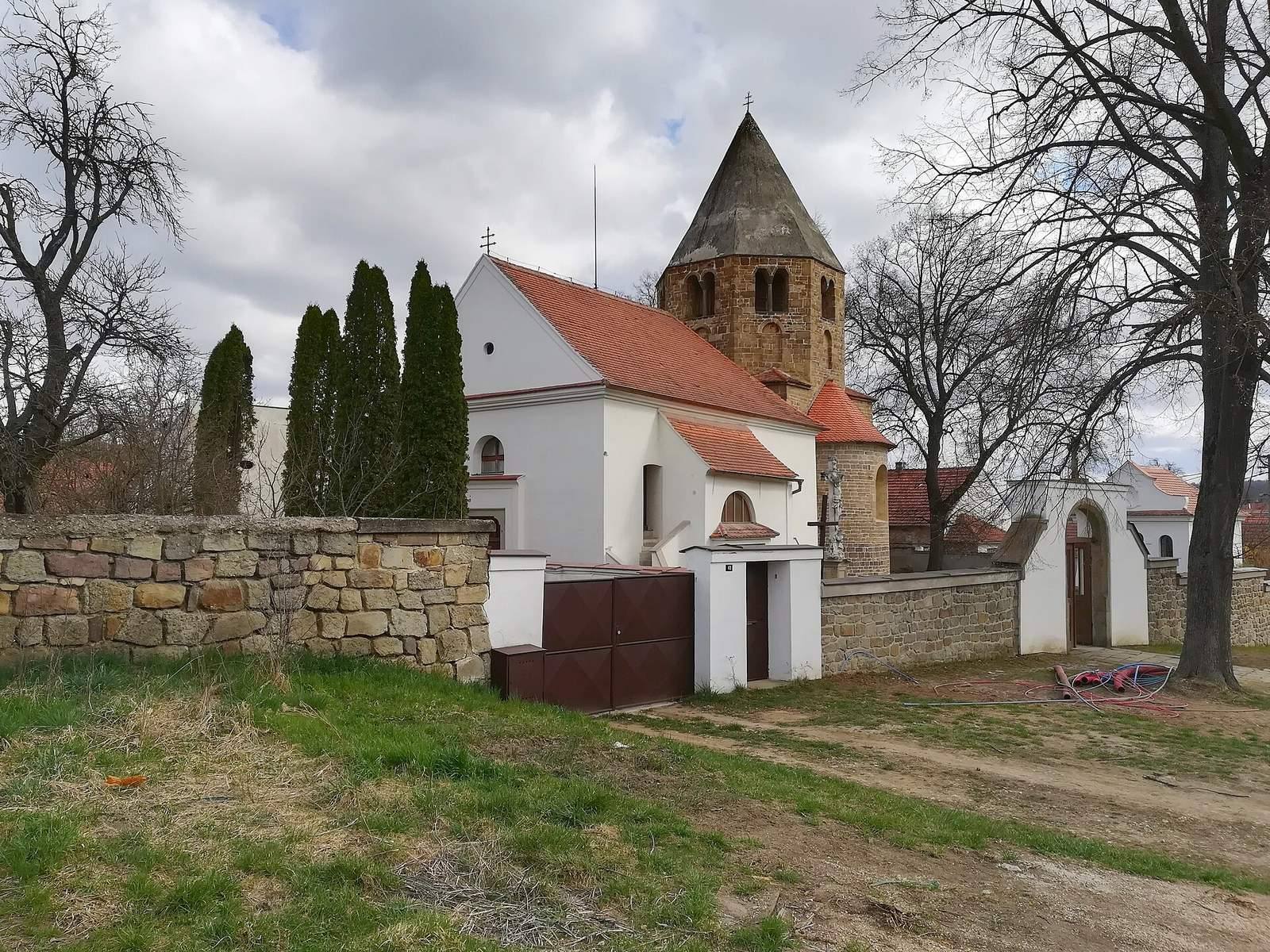
The church brings together a Romanesque core, a rectangular Renaissance nave and later additions. The core centers on a space with three apses, projecting parts of the church, and an octagonal bell tower. The nave occupies the western part of the building, while the present sacristy is attached on its north side.
Romanesque core
Central space and bell tower
The surviving Romanesque structure has a central space with three apses and an octagonal tower. Its masonry crown starts in a pyramid shape and becomes conical toward the top. Three bells hang in the tower. The oldest, dated 1483, is not electrically operated and is not normally rung. An opening in the ceiling for a bell rope preserves evidence of the earlier practice of ringing from inside the church.
Former western building
A small, block-shaped building with a gallery once adjoined the Romanesque core on the west. Its foundations have been found through archaeological work.
Renaissance and later additions
Nave and entrances
The nave has a rectangular plan. Its southern entrance is sheltered by a porch, and another entrance opens in the western façade.
Sacristy and gallery
The present sacristy stands on the north side of the nave. The interior also includes a gallery added in the late 19th century.
Interior features
Stone slab
A stone slab inside the church bears unusual signs along three of its sides.
Furnishings and stained glass
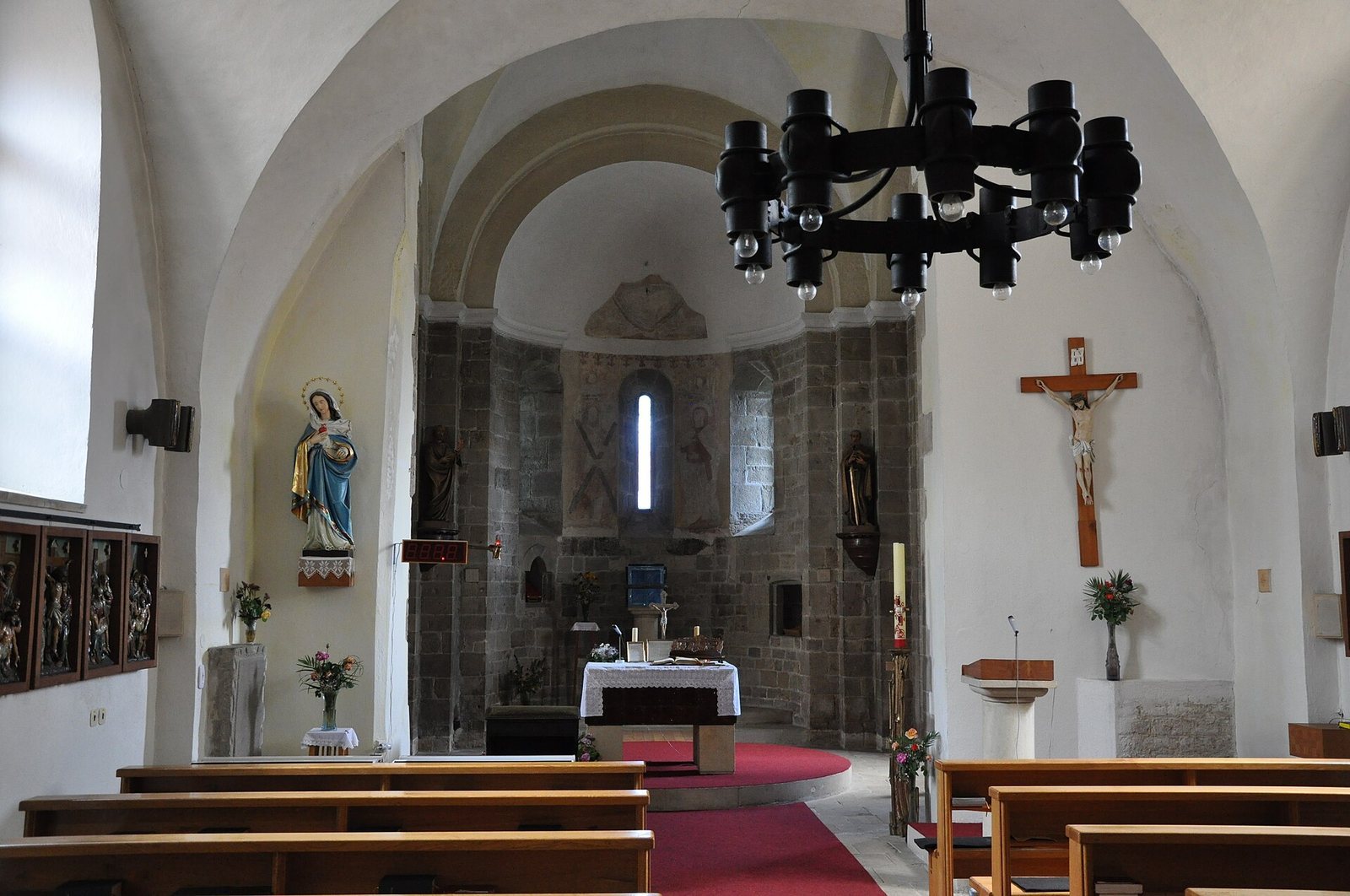
The church’s candlesticks were made by sculptor Otmar Oliva. Jan Jemelka created the stained-glass windows, whose themes draw on Saint Francis of Assisi’s Canticle of the Creatures, a poem of praise associated with the medieval friar.