Cathedral of Archangel Michael, Ryazan: A Historic Orthodox Cathedral
Site at a Glance
- Rating
- 5
- Popularity
- Very Low
- Country
- Russia
- Primary era
- Medieval
- Eras represented
- Medieval, Early Modern, Modern
- Civilizations
- Unclassified
- Site type
- Religious
- Remains
- Cathedral
On this page16 sections
History
The Cathedral of Archangel Michael is an Orthodox cathedral in Russia and the oldest surviving church in Ryazan Oblast. Built in the tradition of early Moscow architecture, its construction is generally placed between the late fifteenth and early sixteenth centuries, although the exact date remains uncertain. It served as the household church of the Ryazan princely family and, from the late fifteenth century, as the burial church of Ryazan bishops and other diocesan hierarchs.
Foundation and early history
The cathedral’s founding date is listed as 1612, but this date does not resolve the building’s earlier history. Proposals have ranged from the reign of Grand Prince Oleg Ivanovich of Ryazan, who ruled from 1350 to 1402, to the early sixteenth century. The dating that became predominant places the surviving structure between the late fifteenth and early sixteenth centuries.
The cathedral is first documented in 1532, when Bishop Jonah II donated a bell for the remembrance of his soul and of the Orthodox Christians who had contributed to the church. Pskov craftsmen cast the bell, which was estimated to weigh 40 poods, a historical Russian unit of about 16.4 kilograms. The cathedral already held an important place in the diocese, and its long-standing role as a burial church continued through later centuries.
Seventeenth- and eighteenth-century rebuilding
The building was repeatedly altered. A stone bell tower listed in the 1638 inventory had been dismantled between 1621 and 1637 on the order of Archbishop Antony and replaced by a wooden tower. Jonah II’s bell was recast with additional copper into a large peal bell, while a German bell was acquired in its place. The cathedral then had chapels dedicated to Boris and Gleb and to Saint Vladimir.
Fires in 1638 and 1647 caused major damage. Repairs after the later fire involved Vasily Kharitonov, a stonemason from Soligalich and the son of Zubov. The upper part of the cathedral was modified, while important fifteenth-century architectural features remained. A new stone bell tower replaced the burned wooden tower in 1651. In 1735, a vestibule was added on the west.
The cathedral also continued to serve as a necropolis for Ryazan bishops, archbishops, and metropolitans. Twenty-two hierarchs are associated with burials there, beginning with Bishop Theodosius, who died in 1481. The buried hierarchs include Simon, Jonah II, Michael II, Gurii Ruzhetsky, Theodoret, Joseph, Antony, Misail, Illarion, Joseph Moravsky, Stefan Yavorsky, Alexius Titov, Gabriel Russkoi, Sergius Krylov-Platonov, Smaragd Kryzhanovsky, Theoktist Popov, Meletius Yakimov, Polyeuctus Pyaskovsky, John Smirnov, and Mitrofan Zagorsky.
In 1799, the remains of Metropolitan Stefan Yavorsky were transferred to the cathedral from Ryazan’s Cathedral of the Dormition. His tomb was discovered on 18 June 1998, and the remains were moved to the Holy Trinity Monastery on 11 September of that year. The white-stone tomb remained in the cathedral. Archbishop Misail, who was killed in 1655, was also commemorated there, and his bloodstained mantle was transferred to the cathedral in 1734.
Nineteenth-century renewal
The cathedral’s deteriorated condition led to the suspension of services until 1819. Merchants Mikhail Zhivago and Vasily Kharin financed a reconstruction that year. Round windows were introduced into the dome, and the upper wall sections and vaults were relaid. In 1830, broad arched windows replaced the earlier narrow openings.
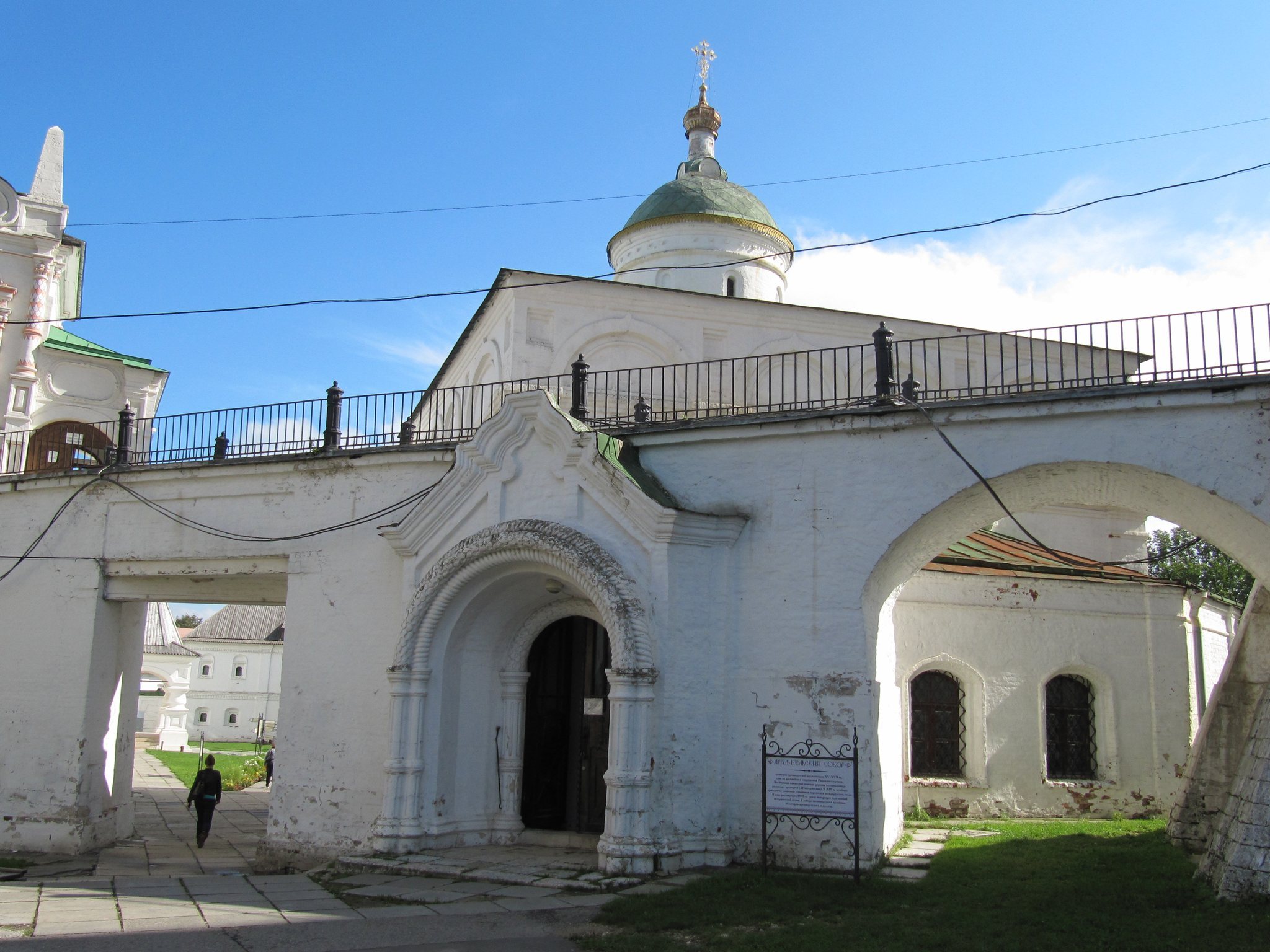
Between 1864 and 1865, a ceremonial northwestern entrance was created through the vestibule under the design of provincial architect S. A. Shchyotkin. A richly ornamented portal was attached to the wall of the bishops’ passage. In 1865, N. V. Shumov painted the interior, designed an iconostasis, and created the parquet floor in the altar and the wooden floor in the church. His original iconostasis no longer survives.
Much of this renewal was financed by donations, including a substantial contribution from the Ryazan merchant Ivan Osminnikov. The work included a new iconostasis with painted icons, a parquet altar floor, a painted wooden floor in the church, and the external stone entrance. A later repair marked the 800th anniversary of the founding of Ryazan and was financed by cathedral churchwarden Vasily Alexander Postnikov. Afterward, the building was called the Church of the Brotherhood of Saint Vasily of Ryazan.
Burials, closure, and return to worship
Until 1865, the burials inside the cathedral were housed in stone sarcophagi. Most were removed because they occupied a substantial part of the interior. The tombs of Misail, Stefan Yavorsky, Archbishop Alexius Titov, and Archbishop Theodoret remained. A stone memorial plaque marking the burial of Metropolitan Illarion, who died in 1673, survives on the southwestern pillar.
Between 21 July, or according to another dating 25 June, and 12 October 1978, floors and burial vaults were opened under the direction of Moscow archaeologist Elena Khvorostova and the supervision of regional cultural authorities. Eighteen episcopal burials were opened, while another count gives 20 of the 22 burials. They were reinterred in the cathedral on 16 November 1978, without their precise new locations being recorded.
During the Soviet period, the cathedral was closed and neglected for an extended period. It was later used as premises of the Ryazan Kremlin Museum-Reserve. In 1974, measurements of the building were made during the Kremlin restoration directed by architect I. V. Ilyenko. The cathedral has since undergone major restoration and holds federal cultural-heritage status as an object of cultural heritage of the peoples of the Russian Federation of federal significance.
The cathedral was returned to the Ryazan Diocese of the Russian Orthodox Church on 12 May 2011, and services resumed. It also contains exhibits from the Ryazan Diocesan Museum, the Church Historical and Archaeological Museum known as the Ancient Repository. That collection originated in an institution opened on 14 January 1914 with liturgical textiles, consecrated altar cloths, sacred vessels, icons, episcopal vestments, charters, portraits, engravings, and household objects. By the end of 1915, it held 1,380 items. After 1917, objects were divided among the State Repository for Valuables, the Ryazan Provincial Museum, and other destinations, while some were destroyed. The revived diocesan museum opened on 17 November 2011 and includes the cathedral and the second and third floors of the western part of the Bishops’ House. Its collection includes 66 icons, among them miraculous and especially venerated images of the Ryazan Diocese, lent to the museum without charge.
Debates over the building’s date
The cathedral’s architectural dating has remained disputed. M. A. Ilyin connected its surviving original forms with early Moscow architecture of the turn of the fourteenth and fifteenth centuries. G. K. Wagner first dated it no earlier than the 1520s, then placed it between the late fifteenth and early sixteenth centuries. Restorers E. V. Mikhailovsky and I. V. Ilyenko proposed a late-fifteenth-century date, considering 1475 the most likely year. A. G. Melnik instead argued for construction between 1522 and 1532 under Bishop Jonah, citing the building’s Italianate Renaissance decoration and comparisons with sixteenth-century churches. The late-fifteenth- to early-sixteenth-century dating later became predominant.
Remains
Plan and exterior
Central church structure
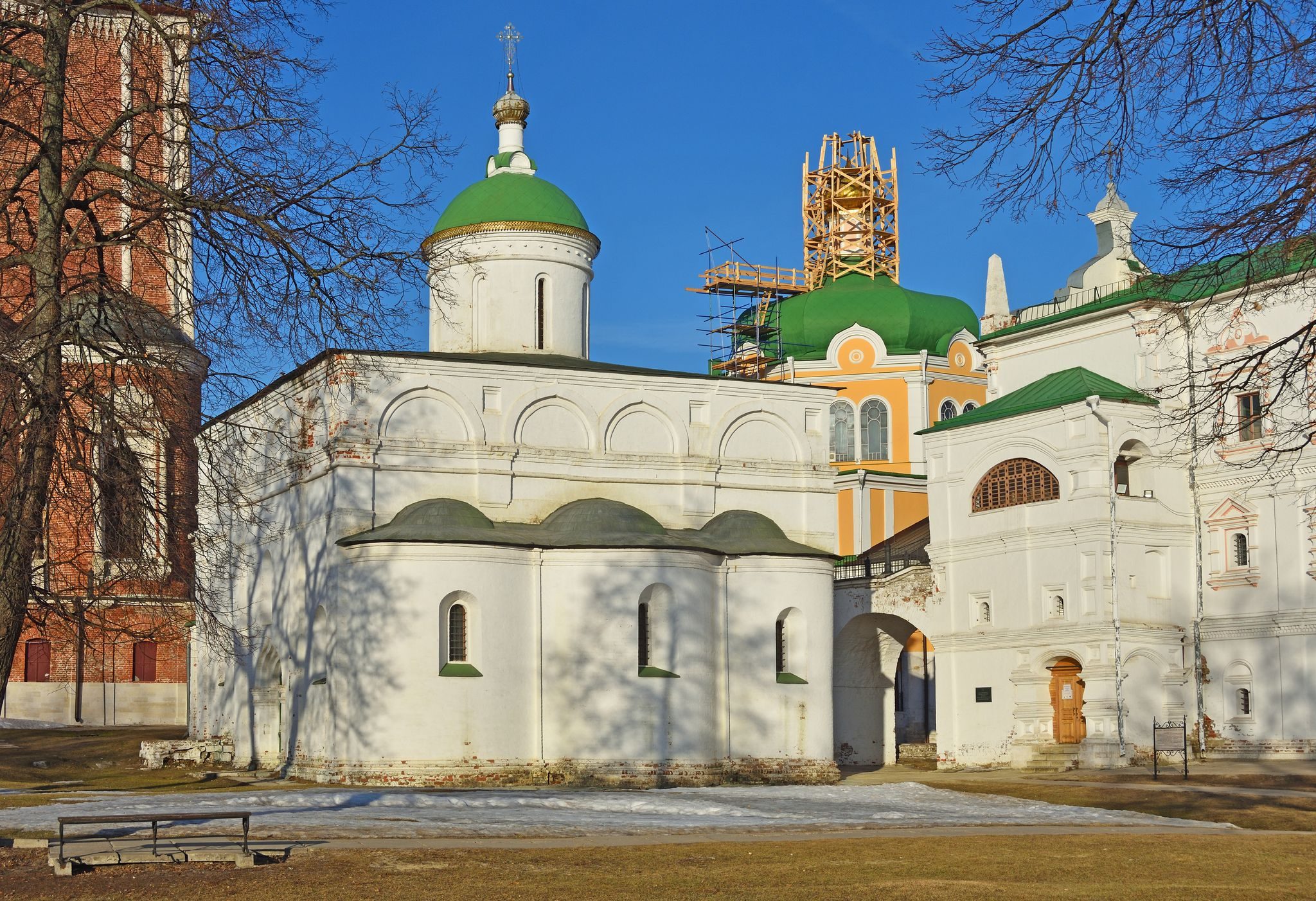
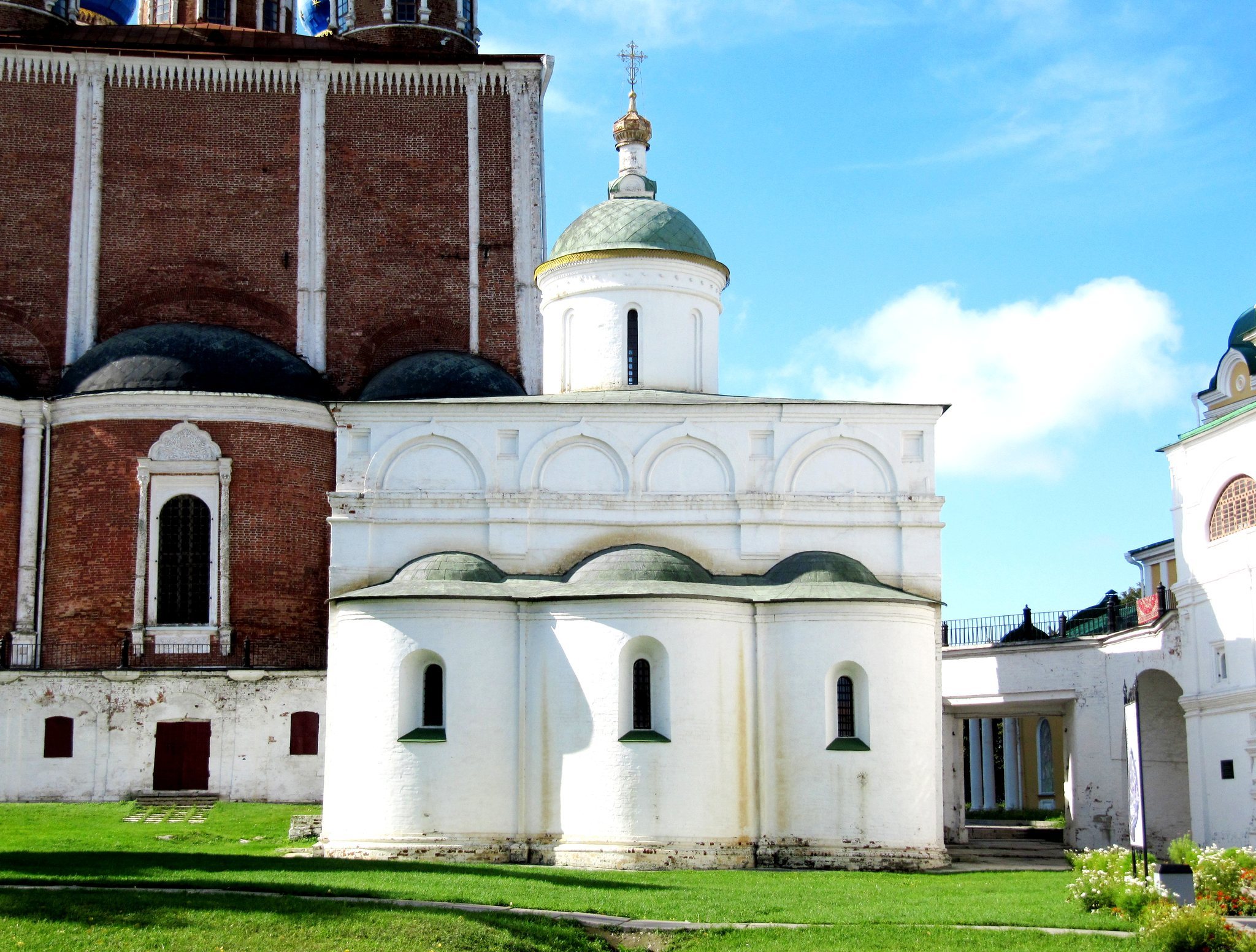
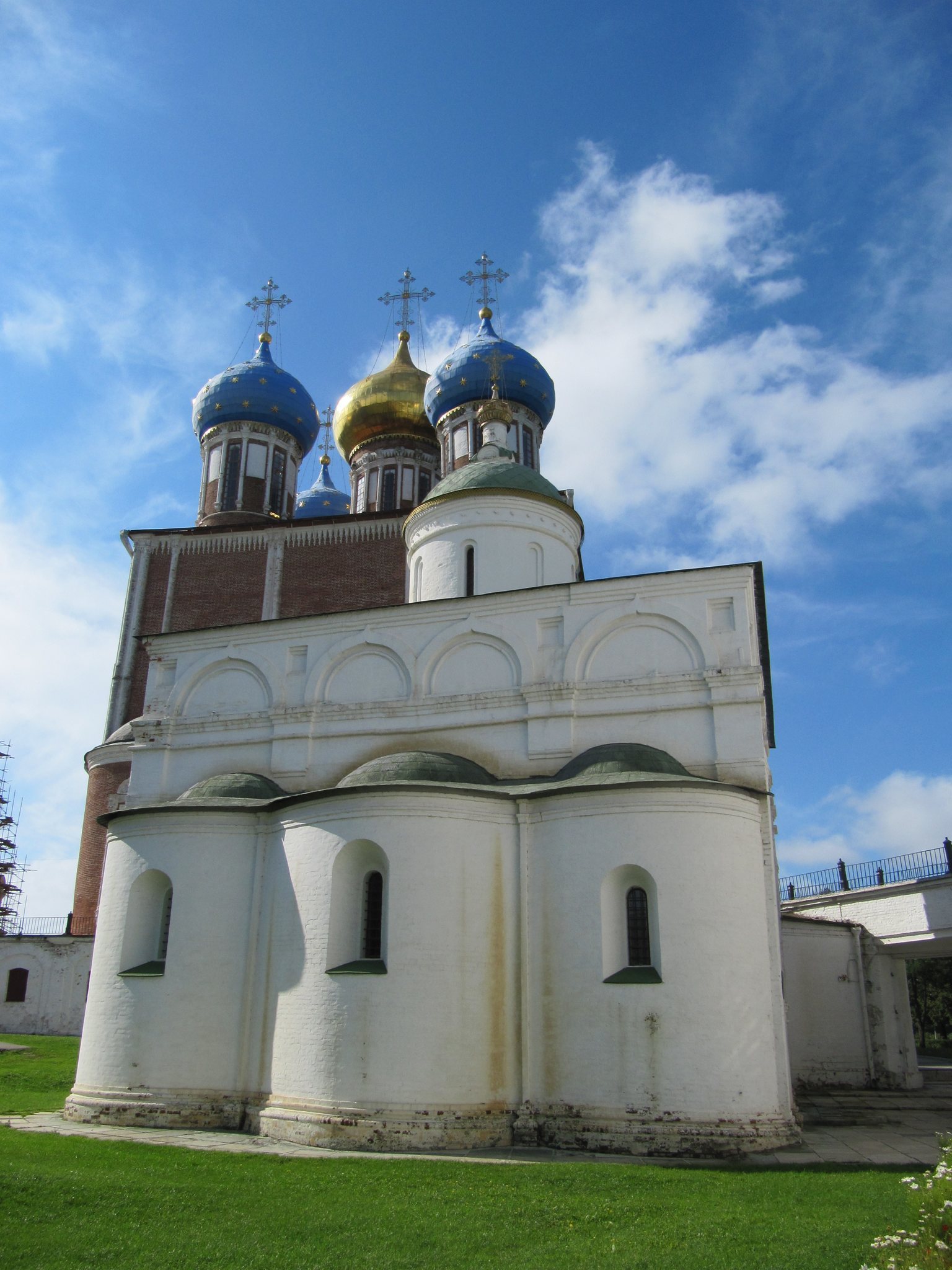
The cathedral is a single-domed, four-pillar church with a centralized masonry plan. Three apses, or rounded eastern sanctuary ends, adjoin the main volume. Flat pilasters divide each facade into three sections. The four interior pillars are shifted toward the east rather than centered within the main cubical space, and both the plinth and western pillars have Attic bases, classical-style moulded bases beneath the supports.
The pillars have upper cornices formed by two projecting shelves, above which runs a further roll-shaped cornice. Capital-like forms with semicircular recesses rise above them. Springing arches rest on these forms and connect the pillars with the walls and with one another. The light drum, the raised section carrying the dome, has no decorative ornament and contains eight narrow arched windows.
Facades and dome
A decorative belt runs at the base of the zakomaras, the curved upper terminations of the Russian church facades. This belt has been described as an entablature, a Renaissance element introduced into Russian architecture by Italian architects. The cathedral’s narrow arched window openings were later supplemented by the broad arched windows opened during the nineteenth-century reconstruction.
Interior surfaces and burials
Floors and heating features
Semicircular tiled stoves from the nineteenth century survive beside the western wall. The floor has had several coverings. Restoration revealed white-stone slabs and triangular ceramic tiles with brown coating arranged in a star pattern. Other phases used patterned metlakh tiles, durable ceramic flooring associated with the nineteenth and early twentieth centuries. The altar received a parquet floor during the nineteenth-century renovation.
Memorial plaque and tomb
A white-stone plaque commemorating the death of Metropolitan Illarion in 1673 is built into the southwestern pillar. In the southern arcosolium of the altar, a recessed arched burial niche, stands the white-stone tomb of Metropolitan Stefan Yavorsky. A former cell icon of the Akhtyrka Mother of God once stood above it.
Icons, paintings, and sacred objects
Icons and wall paintings
The cathedral houses the Feodotyevo icon of the Mother of God, also called the Hodegetria of Ryazan. Regarded as the oldest icon in the museum, it was made by Athonite masters and is described as an exceptionally rare example of pre-Mongol Russian icon painting, the art of Rus before the Mongol invasions of the thirteenth century. Chronicle tradition states that Bishop Euphrosynus of Murom and Ryazan brought it from Mount Athos to the Ryazan land before 1225.
Other icons include a fourteenth-century Saint Nicholas the Wonderworker in the Zaraysk type, described as the first copy of the miraculous Korsun icon. An early-sixteenth-century image of John the Apostle and Evangelist was copied from an ancient Byzantine icon and from the John the Theologian Monastery at Poschupovo. Moscow Armoury masters made icons for the iconostasis of the Transfiguration Cathedral in 1695 on the commission of stolnik I. I. Verderevsky, a stolnik being a rank in the medieval and early modern Russian court service hierarchy. Works by N. V. Shumov are also kept in the cathedral.
The fifteenth-century icon of Saint Paraskeva Friday remained in the cathedral from the eighteenth century until 1923 and was transferred in 1938 to the State Museum of Arts of Uzbekistan. The ancient church icon of Archangel Michael with the Miracle at Khoneh, dated to the fifteenth or sixteenth century, is now in the I. P. Pozhalostin Ryazan State Regional Art Museum.
Shumov’s wall paintings retain an image of Sabaoth, a biblical title meaning “Hosts” used in Christian art for God, surrounded by cherubim on the dome. Four standing archangels occupy the painted arches between the drum windows. The paintings were executed in the glue-painting technique.
Reliquaries
Two glass reliquaries, containers for preserving and displaying sacred relics, were formerly kept in the cathedral. One held 17 relic fragments, including relics associated with Bartholomew the Apostle, John Chrysostom, Vasily of Ryazan, the martyr Christopher, Jonah of Moscow, and Prince Constantine of Murom. The other held 21 Christian relics or devotional objects, including fragments associated with the Burning Bush, the Oak of Mamre, the wood used to sweeten the waters for Moses, Mount Tabor, Christ’s fast, the Holy Sepulchre, Vasily of Ryazan, and the Cross.