Church of Saint Francis of Assisi: A Gothic Wooden Church in Slovakia
Site at a Glance
- Popularity
- Medium
- Country
- Slovakia
- Primary era
- Medieval
- Eras represented
- Medieval, Early Modern, Modern
- Civilizations
- Austrian Empire, Habsburg, Hungarian
- Site type
- Religious
- Remains
- Church
On this page8 sections
History
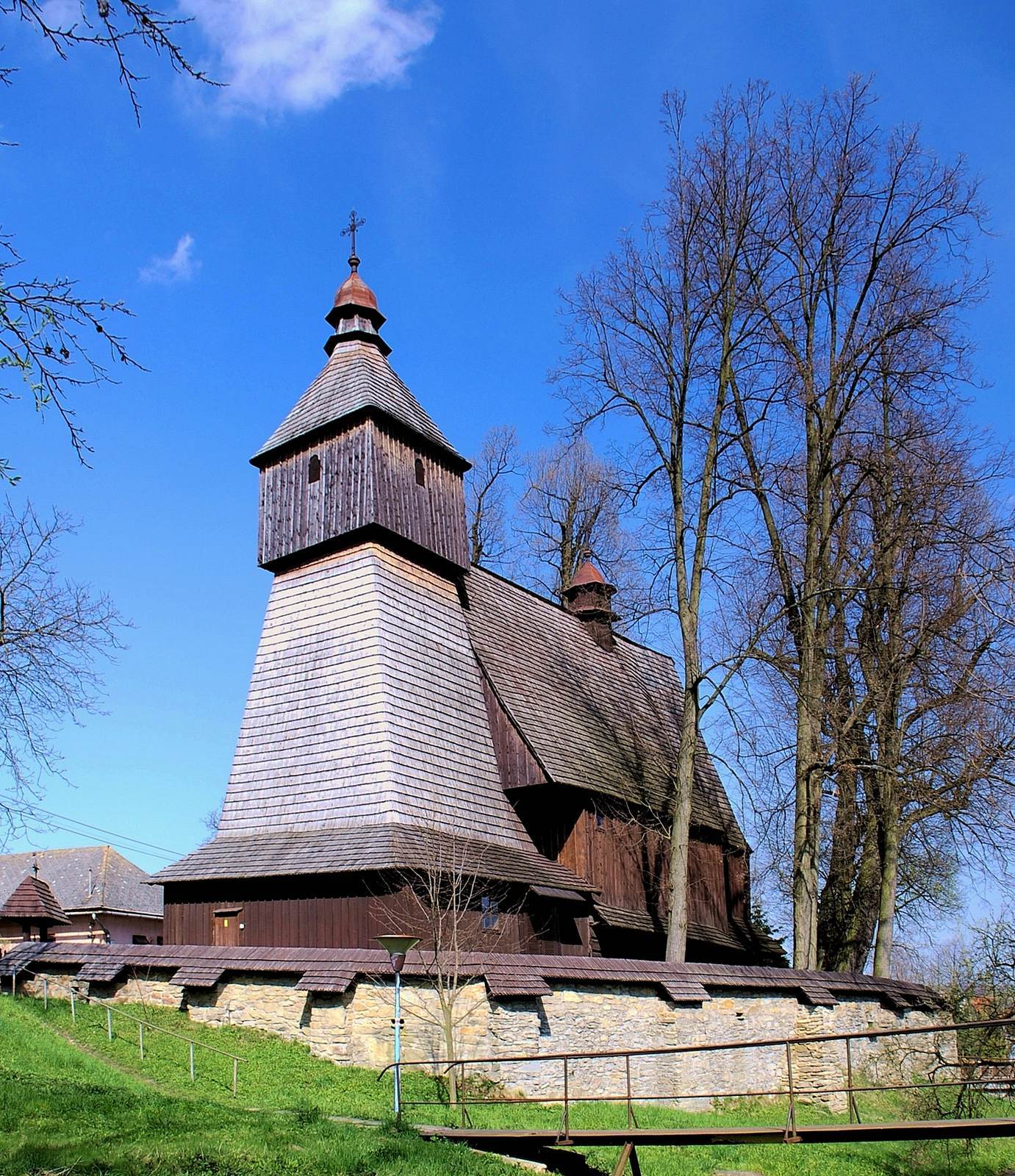
The Church of Saint Francis of Assisi is a wooden church in Hervartov, Slovakia, built in the late 15th century, probably around 1500. Its Gothic design belongs to a major medieval European architectural style. The church is regarded as Slovakia’s oldest and best-preserved Gothic wooden church.
Roman Catholic worship is associated with the church, which also served Evangelical worship. Its interior was altered during the Reformation, the later recatholicization (restoration of Catholic practice after Protestant reform), and under Baroque influence.
In 1968, the church and its enclosing wall became a national cultural monument as part of a group of 27 wooden churches. Restoration work in the 1970s recovered the church’s original paintings, and the principal altar was restored in the second half of the 1990s. On July 7, 2008, the church was inscribed on the UNESCO World Heritage List with seven other churches, as part of the Wooden Churches of the Slovak part of the Carpathian Mountain Area, under criteria iii and iv.
Remains
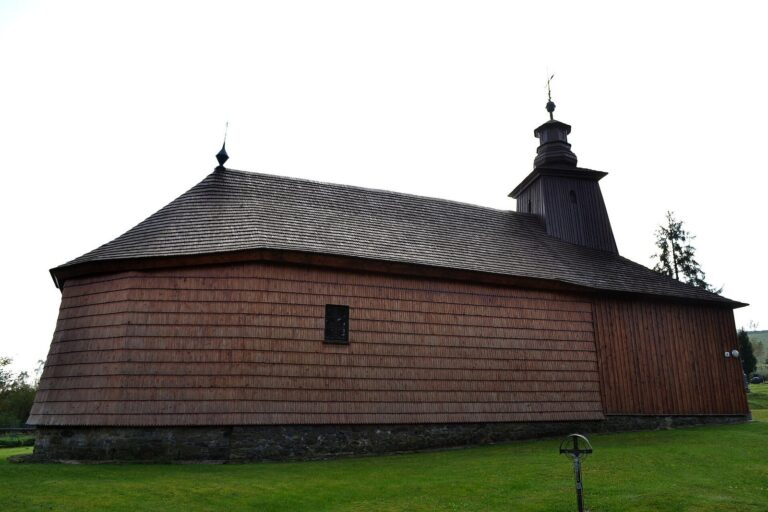
Set below the hills of the Čergov range, the church has a single-nave Gothic plan, with a rectangular main worship space, a polygonal area around the altar, a small sacristy for worship items and service preparation, and a space beneath the tower. Timber construction and its steeply pitched roofs define the building’s form.
Exterior construction
Plan and timber structure
The church is built from local spruce and yew, with yew beams used in its log construction. Its prominent tower is supported by upright posts in a post-and-frame structure. Vertical boards cover the nave and the area around the altar, as well as the tower’s base and projecting upper chamber.
Roofs and enclosure
The nave has a steep gable roof, with an octagonal bell turret set along its ridge. Hand-split wooden shingles cover the roofs over the nave and altar area, the tower’s tent-shaped roof, and its shaft. A stone wall encloses the church, and several large lime trees grow around it. The exterior has remained almost unchanged.
Interior decoration and furnishings
Painted decoration
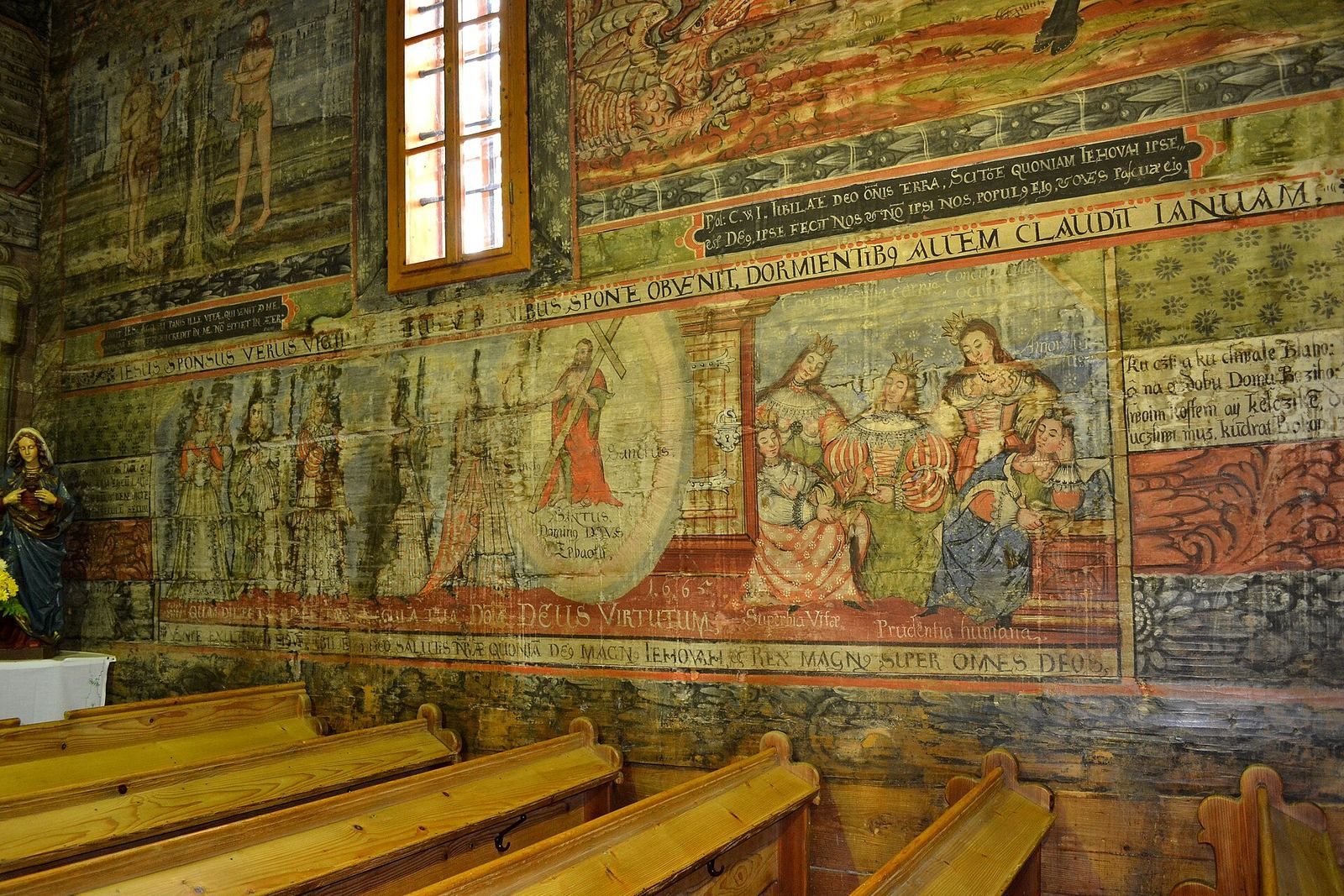
The interior includes Gothic panel paintings and wall paintings dated broadly to the mid-17th century and to 1805. Their subjects include biblical scenes, saints, Adam and Eve, and Saint George fighting a dragon. Multicolored painted decoration on the ceiling is dated to 1596.
Altars and wooden objects
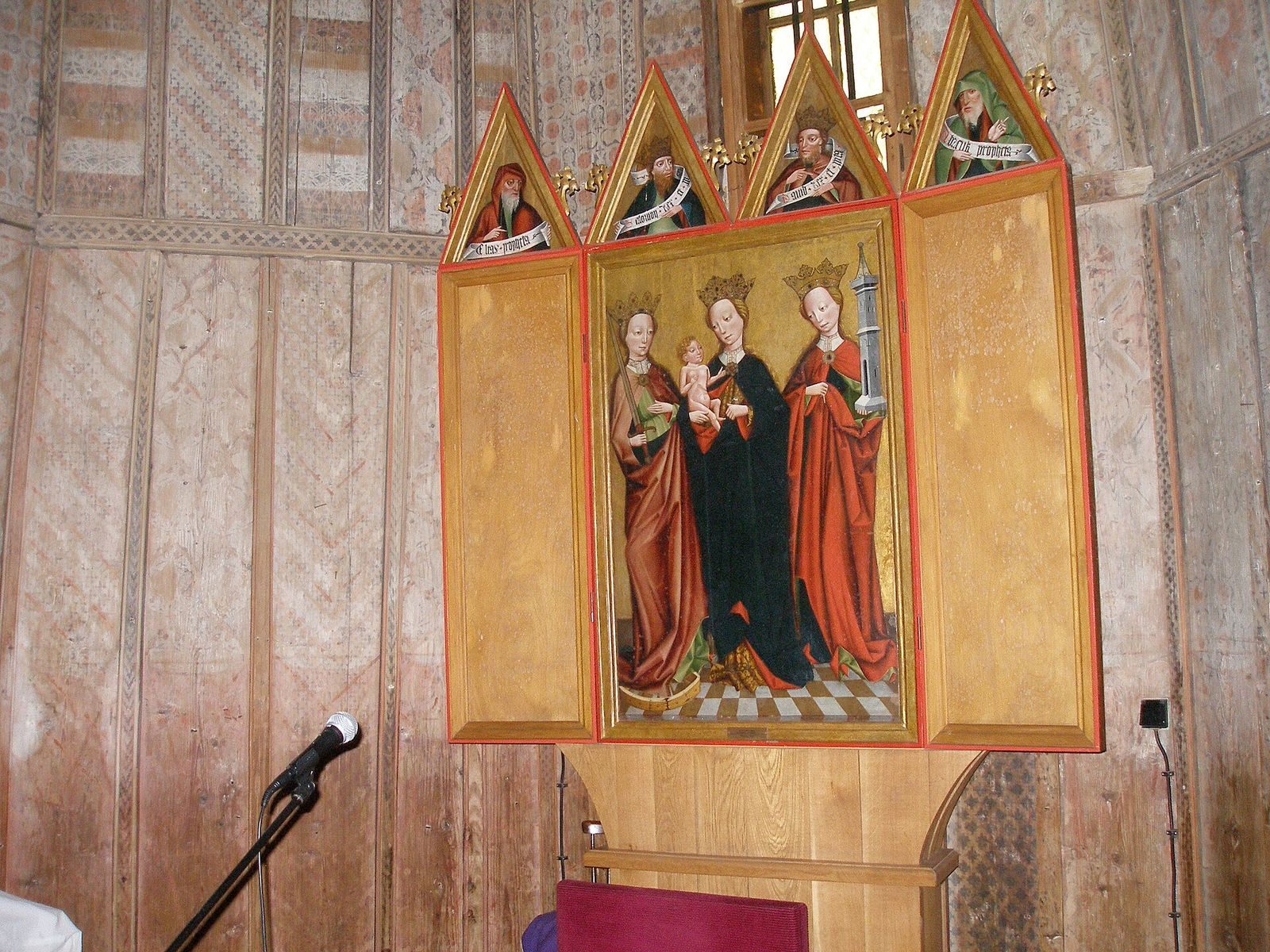
A painted Gothic winged altarpiece, with hinged panels, dates to 1460–1470. The principal altar is dedicated to Saint Catherine, the Virgin Mary, and Saint Barbara. A late-Gothic painting depicts Saint Francis of Assisi, Saint Christopher, and Saint Catherine of Siena; a painting of the Last Supper dates to 1653.
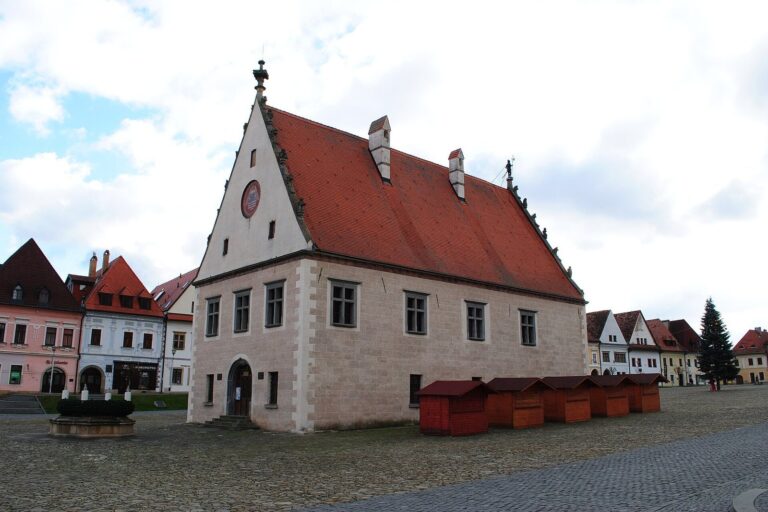
The church’s original altar wings, an early-16th-century wooden tabernacle (a container for the reserved Eucharist), and a portable altar dated 1514 are held in the National Museum in Budapest. A side altar dated 1524 is in Bardejov Town Hall.