Château du Terreau: A Historic Residence in Verosvres, France
Site at a Glance
- Popularity
- Medium
- Country
- France
- Primary era
- Early Modern
- Eras represented
- Medieval, Early Modern, Modern
- Civilizations
- Duchy of Burgundy, French
- Site type
- Domestic
- Remains
- Castle
On this page11 sections
History
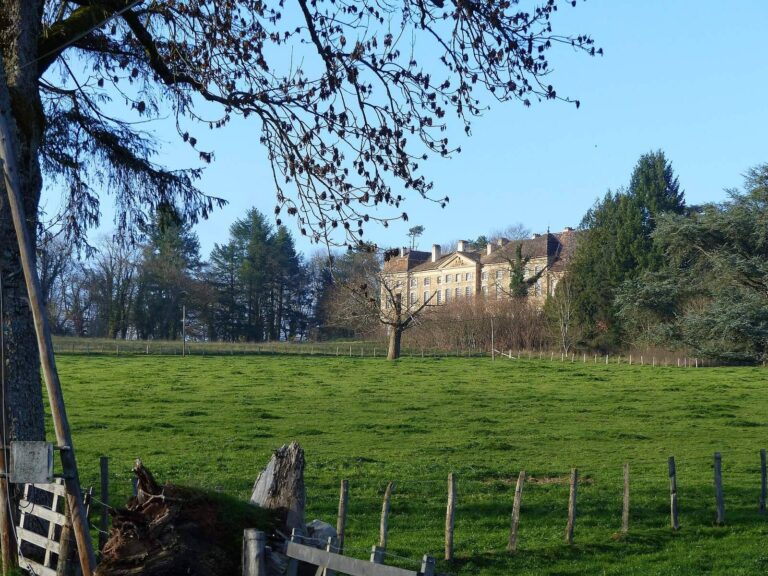
Château du Terreau stands in Verosvres, France. It originated in the 13th century and was almost entirely rebuilt in the 18th century. Over time, the estate passed through the hands of several families who held its land and lordship.
Medieval and early modern ownership
The Lespinasse family held the land in the 14th century. Pierre Dubois d’Andelot acquired it in 1461, and it passed to Pierre Le Roux toward the end of the 15th century.
From the 16th-century pillage to the Thibaud de Noblet family
The château was pillaged in 1570, and a new tower was built in 1594. In the early 17th century, the Thibaud de Noblet family succeeded Pierre Le Roux’s descendants and held the lordship until the end of the Ancien Régime, the political and social order in France before the Revolution.
Rebuilding and revolution
Around 1787, Claude-René-François Thibaud de Noblet, a French nobleman titled Marquis des Prez, rebuilt almost the entire château, leaving the west tower. In 1789, he became an alternate deputy for the nobility of Beaujolais. During several years in exile, he served in the Army of Condé, a force of French royalist émigrés, and lived in England. He returned to France as a marshal of camp, a French general-officer rank, and served as a deputy for Vienne. He died in 1821.
Ownership and restoration after the Revolution
The château was confiscated and sold in turn to Batonnat, Bouiller, and the Marquis de Sommyèvre, who also owned nearby Château de Corcheval. After Sommyèvre’s death in 1836, his daughter, N. du Péage, sold the estate to Jean-François-Prosper Villars, a lawyer and former mayor of Mâcon. Villars undertook restoration work, and his son carried out a complete renovation in the late 19th century.
In the early 20th century, Lucien Villars, who wrote a monograph on the château, succeeded to the estate. He was followed by M. Robert, his son-in-law, a Paris lawyer and son of Admiral Robert. The château and its dependencies, chapel, portal, dry moats, bridge, park, hornbeam walk, and architectural and decorative features received historic-monument protection on 28 December 1984.
Remains
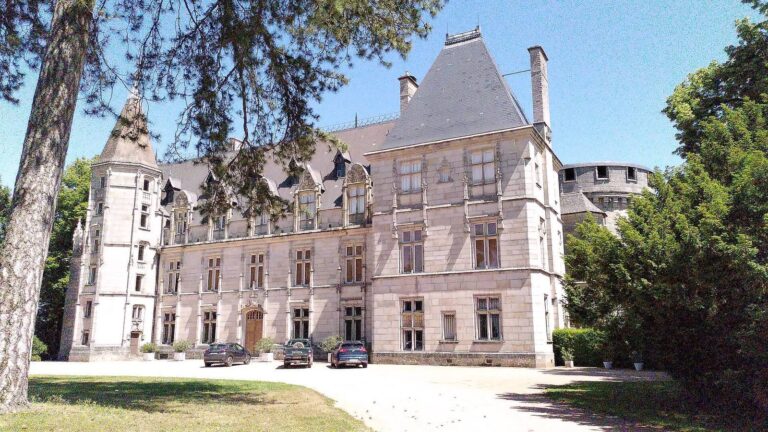
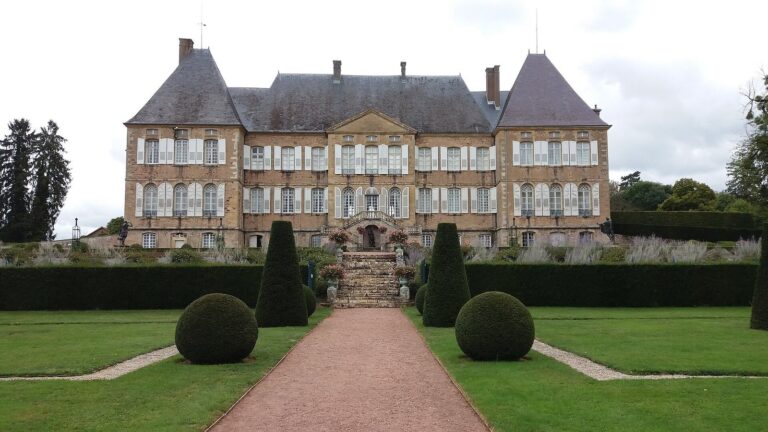
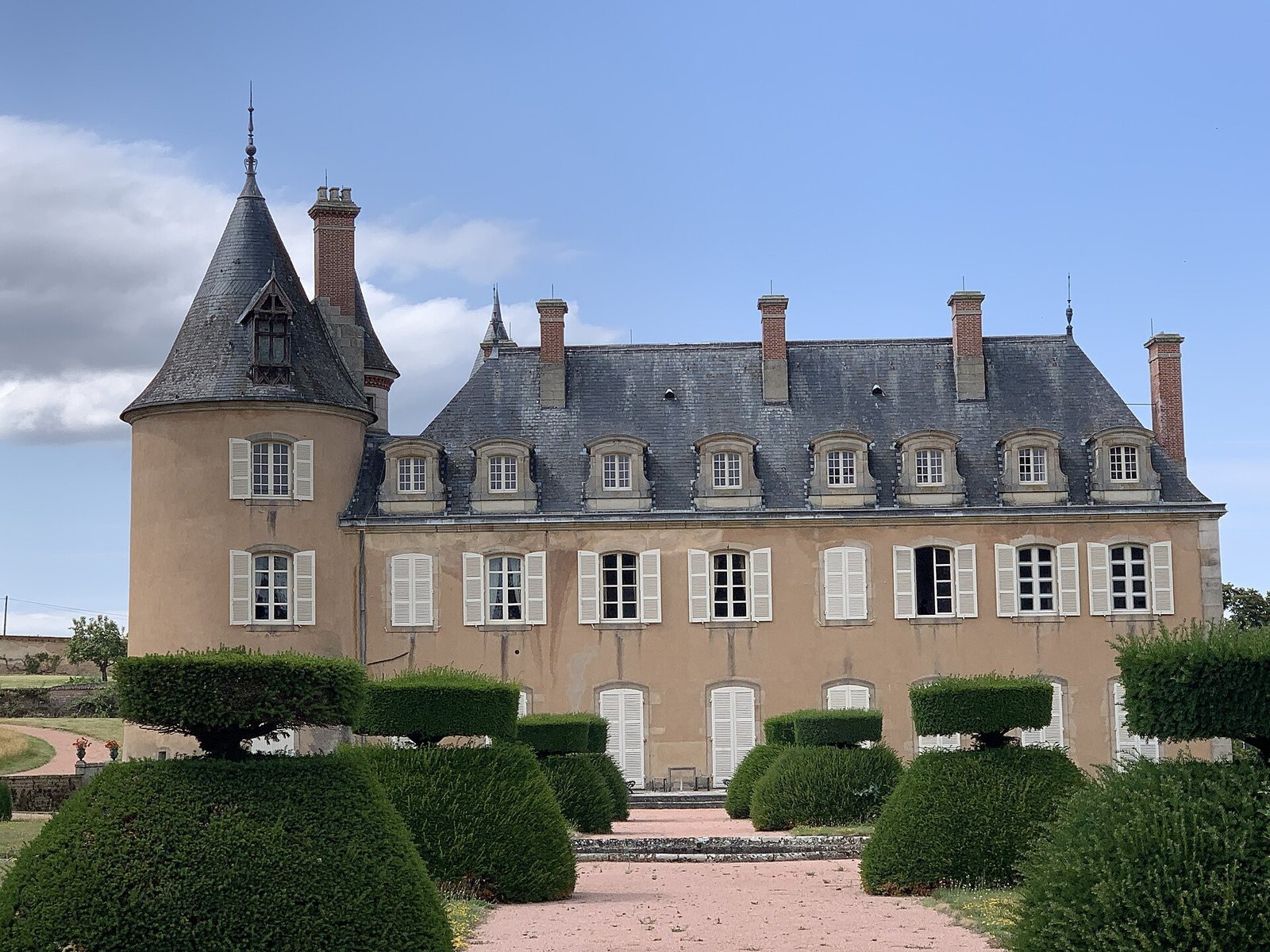
The château’s main residential block and two wings, arranged at right angles, enclose a courtyard. The buildings have hipped roofs, which slope on all sides, a ground floor, an upper floor, and an attic lit by dormers with open gables.
Main block and courtyard façade
On the courtyard-facing side of the main block, a central dormer sits between two pilasters, shallow attached columns that support a curved pediment. Decorative side pieces flank the dormer. Openings on the upper floor have shallow-curved lintels.
West towers and bridge
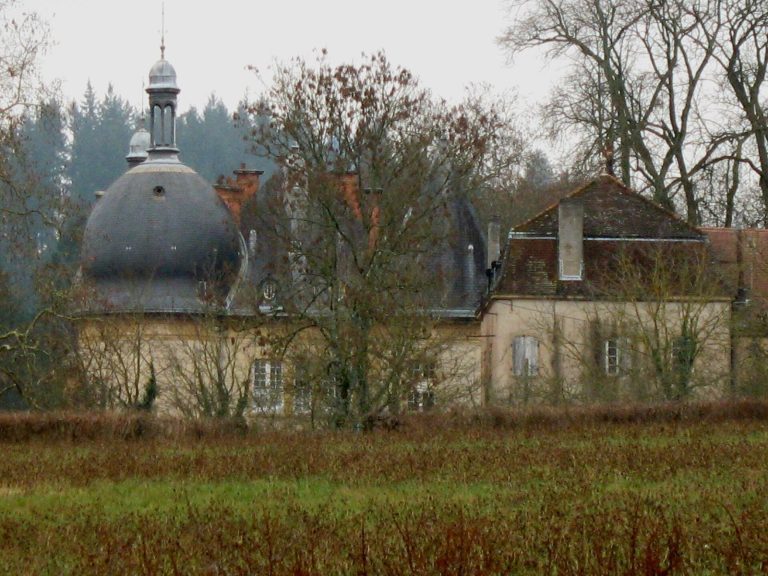
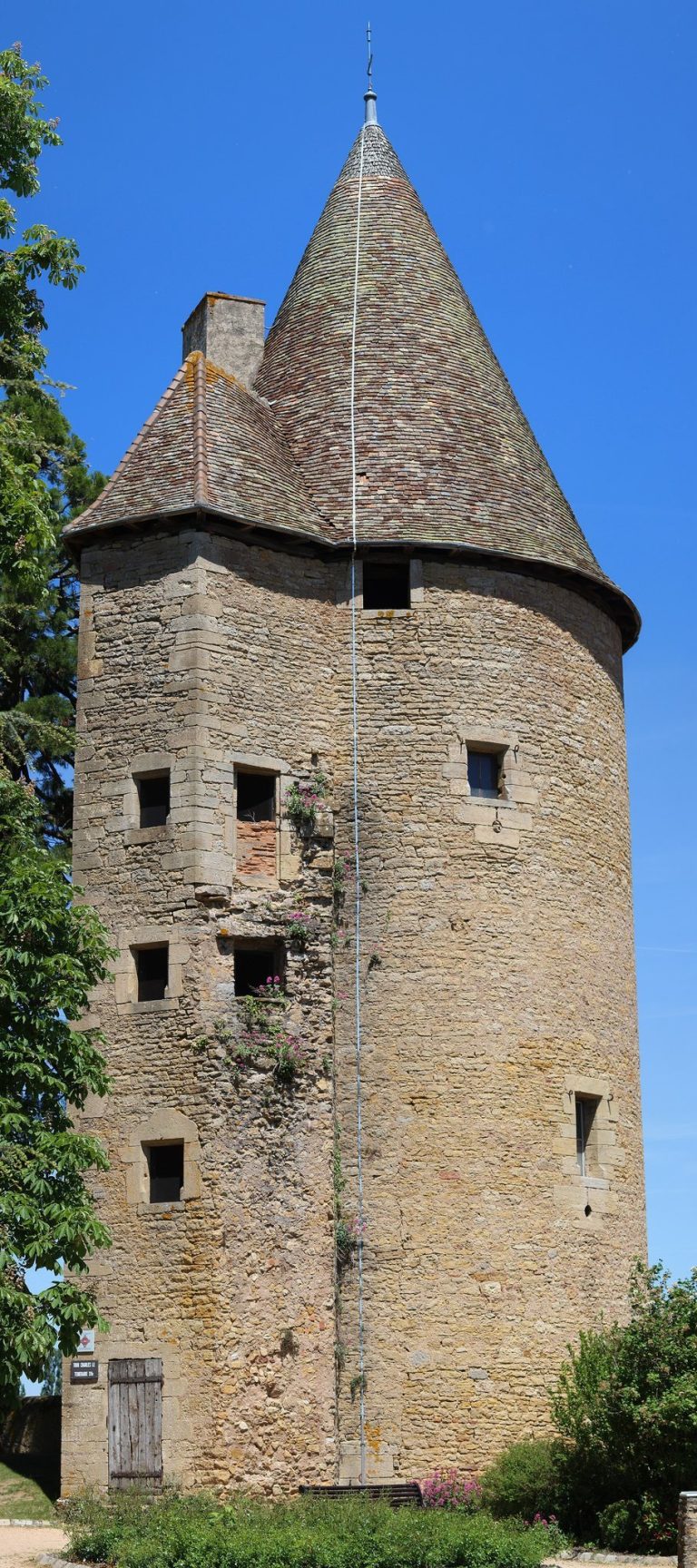
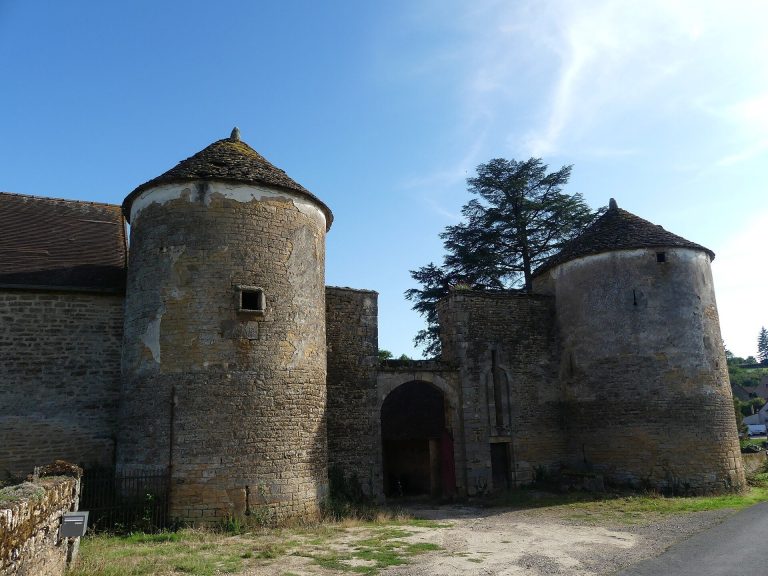
Two round towers at the corners of the west façade survive from the earlier fortress. Their bases slope slightly, and a circular turret adjoins the southwest tower. Both have conical roofs. Between the towers, a balustraded terrace connects to the park by a broad stone bridge.
North pavilion
A 19th-century pavilion adjoins the north wing. It has a basement, two full storeys, an attic storey, and a garret beneath a mansard roof, which has two pitches on each side. On the east side, a tall, round-headed glazed door opens onto a curved balcony with a wrought-iron guardrail.
Entrance and heraldic features
A grille marks the entrance, with a portal at its center. The portal’s piers use rusticated masonry, blocks with deliberately rough faces. Lions above the piers bear the arms of the Thibaud de Noblet and Saulx-Tavannes families. The Thibaud de Noblet shield is divided into four quarters. The first and fourth have a blue chevron and blue band on silver; the second and third show a gold X-shaped emblem on blue, with the emblem’s ends stopping short of the shield’s edges.
Grounds
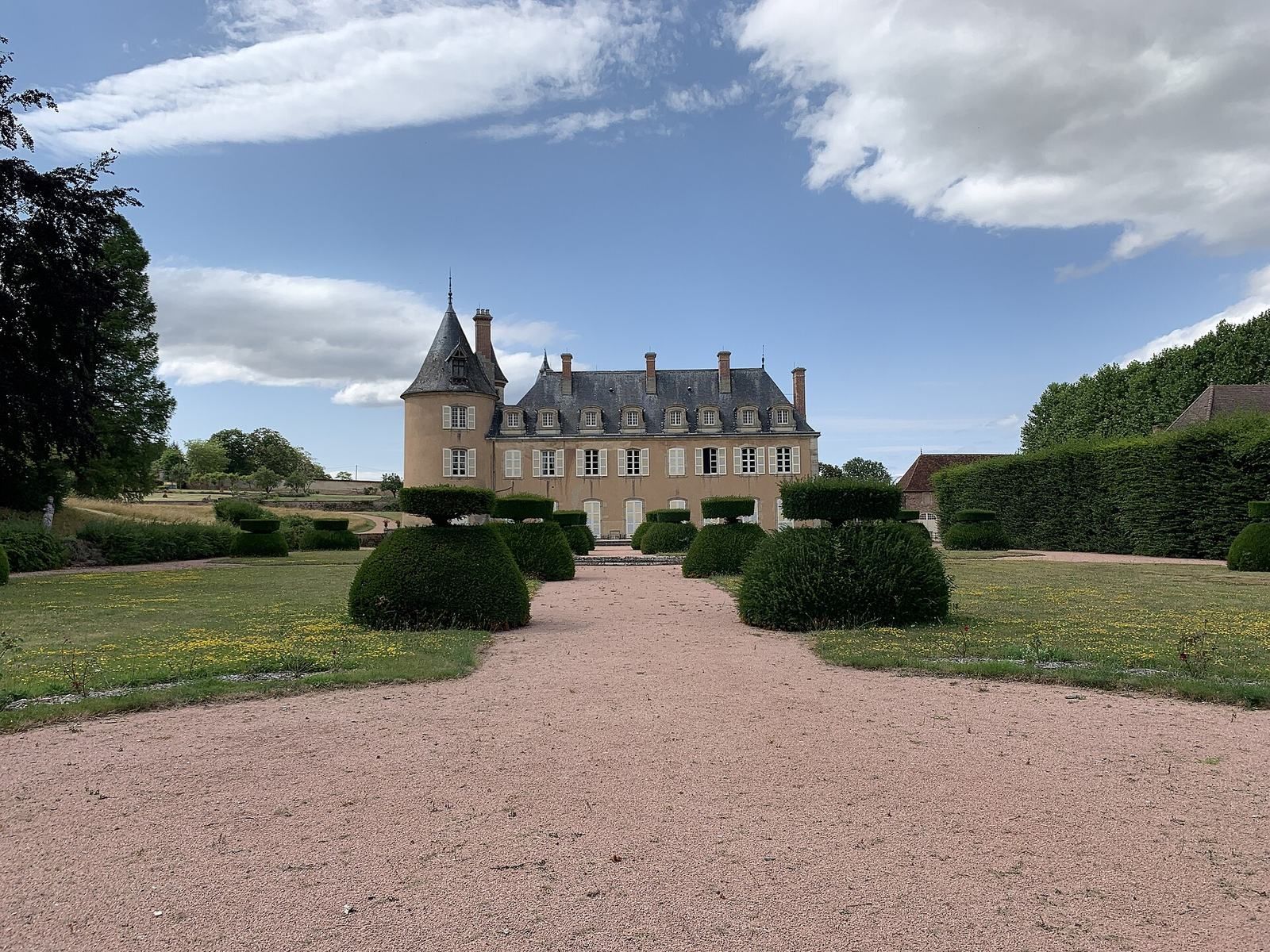
The estate grounds include dependencies, a chapel, a French-style park, and a hornbeam walk, an avenue lined with hornbeam trees.