Château de l’Hermine: Ducal Residence and Fortress in Vannes


Site at a Glance
- Rating
- 4.4
- Popularity
- Low
- Country
- France
- Primary era
- Medieval
- External website
- Open
- Eras represented
- Medieval, Early Modern
- Civilizations
- Duchy of Brittany, French
- Site type
- Domestic
- Remains
- Elite Residence
On this page10 sections
History
Château de l’Hermine is a medieval fortified residence in Vannes, France, commissioned by Duke John IV of Brittany between 1380 and 1385. Built into the city’s southern fortifications, it served as a residence for the Breton dukes and formed part of the political and domestic centre of John IV’s rule after the Breton War of Succession, the dynastic conflict over Brittany involving rival claimant houses and wider English and French intervention.
John IV and the ducal residence
John IV chose Vannes for a princely residence because the city had supported him during the succession war. Construction continued beyond the initial building period until the middle of the fifteenth century. The castle became the principal residence of the dukes of Brittany from the late fourteenth century through the fifteenth century. Its name referred both to the ermine on John IV’s coat of arms and to the chivalric order he founded in 1381.
The castle’s lower court accommodated the working services of the ducal household. These included the Chamber of Accounts, the duchy’s financial and auditing institution, a mint workshop, a bakehouse, a real-tennis court for jeu de paume, and the ducal stables. The Hôtel de Cleiss, purchased from the lord of Largouët and used by the Chamber of Accounts, later served for a time as Vannes town hall. The Moulin des Lices and Chapelle des Lices were added between 1420 and 1425, while the ducal stables were built in the 1440s.
The arrest of Olivier de Clisson
In late June 1387, after the États de Bretagne had met at Vannes, John IV invited Olivier V de Clisson to inspect the partly completed castle. Clisson was a powerful Breton nobleman and Constable of France, a senior military commander who had become a rival of the duke. John IV’s men seized him inside the keep tower and imprisoned him. The duke ordered Jean de Bazvalan, the castle captain, to execute Clisson, but Bazvalan refused to carry out the command. John IV eventually spared his prisoner, and the two men reconciled several years later.
Later tradition connected Clisson’s arrest with the Tour du Connétable, but that tower was not part of Château de l’Hermine and was built after the episode. Its name came from its later use as the residence of the constable of Brittany.
Dynastic ceremonies and declining political importance
Château de l’Hermine remained closely associated with the Breton dynasty. John V, Duke of Brittany, was born there, and his sister Marie of Brittany married John I of Alençon at the castle on 26 June 1398. Francis I, Duke of Brittany, was also born there.
In 1455, Peter II, Duke of Brittany, and his wife Françoise d’Amboise had no children, while Peter’s illness made the succession urgent. To prevent Brittany from passing to foreign hands, he arranged the marriage of his niece Marguerite of Brittany, daughter of his elder brother Francis I, to their cousin Francis, Count of Étampes. The États de Bretagne approved the union at Vannes on 13 November 1455, and the wedding celebrations took place at Château de l’Hermine in November. Marguerite and Francis are also recorded as marrying there on 16 November. Francis became Duke Francis II in December 1458.
In 1458, Francis II moved the Breton capital from Vannes to Nantes. This reduced the castle’s political importance, although it continued to be maintained. King Francis I of France stayed there in 1532 during the États de Bretagne proceedings concerning Brittany’s union with France. That union ended the prospect of Château de l’Hermine serving again as a princely residence.
Dismantling and later buildings
After the castle governor, Sieur d’Arradon, supported César de Vendôme, Duke of Penthièvre and governor of Brittany, against the regent Marie de Médicis, the community of Vannes dismantled part of the castle in 1615 and 1616. Its stones were used to repair the curtain wall leading to Porte Calmont. Sculpted ermine motifs were removed from the castle and the Chapelle des Lices. They were still visible to Dubuisson-Aubenay in 1636, but none remained afterward.
Louis XIV donated the ruins to Vannes in 1697. Stone from the remains was later reused in the port quays and in repairs to municipal buildings. In 1784, Julien Lagorce, a pastry caterer, bought what survived and demolished it. The final destruction was recorded by 1798, and Lagorce built a mansion on the site in 1785. Known as the Hôtel Lagorce, it housed a well-known restaurant during the Consulate, the French governmental regime that ruled from 1799 to 1804.
Lagorce, who later became bankrupt, sold the mansion in 1803 to a merchant from Lorient. It passed through several nineteenth-century owners before the state acquired it in 1876 for the artillery school of the XI Army Corps, which modified the building. From 1960 to 1974, the Hôtel Lagorce housed the departmental treasury. Vannes acquired it in 1976 and later used it for the Law School of Morbihan and cultural and associational activities, including the Cultural Institute of Brittany. The law school subsequently moved to the campus, and the ground floor was arranged as two large exhibition rooms.
Archaeological work has progressively clarified the medieval complex. Excavations in 2000 revealed the extent of the ducal stables, and investigations by INRAP, France’s national institute for preventive archaeological research, in 2023 uncovered further remains of the castle and its associated installations.
Remains
Fortress and ducal complex
The medieval castle was both a defensive and residential building, integrated into the southern walls of Vannes. These fortifications more than doubled the city’s area, from 5 to 12 hectares, across land that was largely subject to the tides. The castle belonged to a wider ducal complex with extensive dependencies and a park extending from La Garenne to the Étang au Duc.
Contemporary and later descriptions present the fortress as attractive as well as strongly defended. Jean Froissart called it “very beautiful and very strong,” while Bertrand d’Argentré described a small princely building with one main residential block, numerous small towers, and two large external towers. The lower court contained the household’s administrative and service facilities, including the Chamber of Accounts, mint workshop, bakehouse, real-tennis court, and stables.
Chapels, mill, and service buildings
The complex expanded beyond its principal residence. The Moulin des Lices and Chapelle des Lices were constructed between 1420 and 1425, and the ducal stables followed in the 1440s. Together with the lower court, these buildings formed the practical and institutional setting of the ducal household. The Hôtel de Cleiss, another building used by the Chamber of Accounts, later became Vannes town hall for a period.
Surviving medieval fabric
By the eighteenth century, two large residential towers survived in heavily reduced form. The eastern tower retained part of its height, and its first level was used as an icehouse. The surviving medieval fabric was later demolished, while stones from the castle entered the port quays and municipal repairs.
Archaeological discoveries
The 2023 excavations exposed walls more than 5 metres thick, confirming the defensive character of the construction. They also revealed remains of the residential building, a ceremonial staircase, coloured stained glass, finely decorated ceramic tiles, latrine remains, and a watermill. These discoveries add material evidence for the castle’s residential, ceremonial, defensive, and service functions.
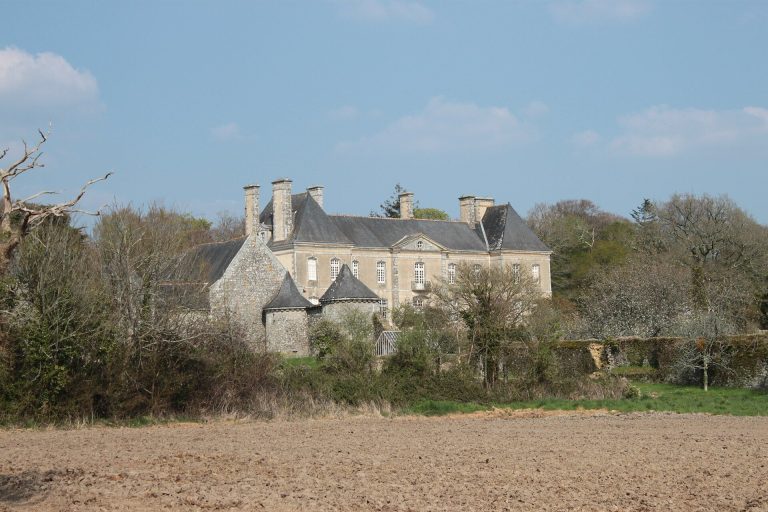
The Hôtel Lagorce, built on the site in 1785, is a later eighteenth-century mansion and is architecturally unrelated to the medieval fortress. It is nevertheless commonly called Château de l’Hermine because local memory has preserved the name of the ducal castle.