Château de Châteauneuf-sur-Loire: A Royal Fortress and Historic Residence in France
Site at a Glance
- Rating
- 4.6
- Popularity
- Very Low
- Country
- France
- Primary era
- Early Modern
- Eras represented
- Early Modern
- Civilizations
- French
- Site type
- Domestic
- Remains
- Castle
On this page14 sections
History
Château de Châteauneuf-sur-Loire is a historic French royal and aristocratic residence in France whose origins lie in an eleventh-century fortress built by King Henry I. Known as “Château Neuf,” meaning “New Castle,” it was successively occupied by at least three castles or residences and later became the centre of the Marquisate of Châteauneuf.
Medieval royal residence
The medieval castle was used at different times by Kings Louis VI, Louis VII, Louis IX, and Charles IV. It was also associated with members of the French royal family. Blanche, daughter of Charles IV, was born there in 1328, while Jeanne, daughter of King John II, was born at the castle in 1343. Blanche later married Philippe de Valois, Duke of Orléans, who stayed at Châteauneuf, as did his successor Charles in 1403.
From royal possession to aristocratic château
In 1498, Louis XII gave the castle to his wife, Jeanne de Valois, after repudiating her. During the sixteenth century, the property belonged to Giovanni Caracciolo, an Italian-born nobleman who had fled Italy in 1529 and became Marshal of France in 1544. He died in 1550, and the property apparently later passed to his children. Three of them died at the castle, in 1555, 1569, and 1586.
By 1644, Châteauneuf belonged to Michel Particelli, Superintendent of Finances, a senior financial office within the French monarchy. It subsequently passed to his daughter Marie, who had married Louis I Phélypeaux de La Vrillière in 1635. La Vrillière became Marquis of Châteauneuf, and Marie was buried in a mausoleum in a local church in 1681.
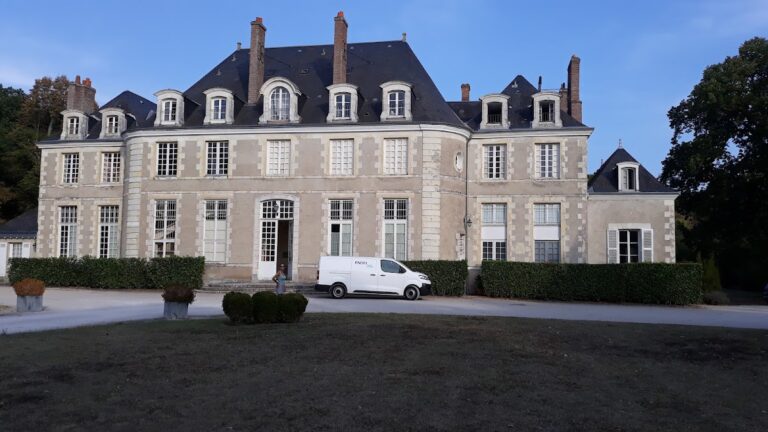
The present château was developed during the seventeenth and eighteenth centuries on the site of the royal predecessor. Construction began in the seventeenth century, and a surviving pavilion was built toward the end of that century. The residence served as the administrative and social centre of the marquisate.
The Duke of Penthièvre and the Revolution
The heirs of Louis Phélypeaux de Saint-Florentin, Duke of La Vrillière, sold the castle to the Duke of Penthièvre in 1783. A member of the Bourbon royal family, Penthièvre altered the interiors and transformed the grounds. He dried and levelled the moat on three sides, incorporated those areas into the gardens, and retained its southwestern section within the park. A lime-tree avenue was planted to shade his daughter-in-law, the Princess of Lamballe, who was executed in 1792.
The château was looted during the French Revolution. Between 1792 and 1794, Benoît Lebrun, an architect from Orléans, acquired the property and ordered the demolition of much of the complex. He retained the rotunda, gallery, orangery, service buildings, and entrance pavilions. Lebrun died at the property on 29 September 1819.
Municipal use and preservation
Eulalie Lebrun’s heirs remained at the castle until 1925. The municipality of Châteauneuf-sur-Loire purchased it in 1926 and installed schools and the town hall in the surviving buildings. Parts of the château and its principal surviving components received French Monument historique protection in 1927 and 1942. This legal designation protects important historic buildings, structures, and sites.
The former stables have housed the Musée de la Marine de Loire since 1962. The museum presents navigation on the Loire through technical objects, ship models, paintings, lithographs, engravings, photographs, representations of people and everyday customs, and an important collection of Nevers faience. Its holdings comprise about 3,000 documents and 1,500 items, together with a documentation centre. The museum is recognized as a Musée de France under the law of 4 January 2002, a status carrying public-service and conservation obligations.
The Loire Valley, including the château, was inscribed on the UNESCO World Heritage List in 2000. The park’s later history also reflects changing ideas about landscape design. Its seventeenth-century formal garden was influenced by André Le Nôtre, the principal designer of the French formal landscape tradition, while René Charles Huillard d’Hérou remodelled it as an English-style landscape park in 1821.
The General Council of Loiret acquired the park in 1934 and continued its development. In 2010 and 2011, a further seven hectares were improved to rehabilitate wetlands and connect paths with the Loire. A reconstructed Temple of Love, originally erected in the park during the eighteenth century, was made by students of the Henri Gaudier-Brzeska secondary school and inaugurated on 14 February 2009. The additional seven-hectare park area opened in September 2011, forming a transition between the historic park and the Loire.
Remains
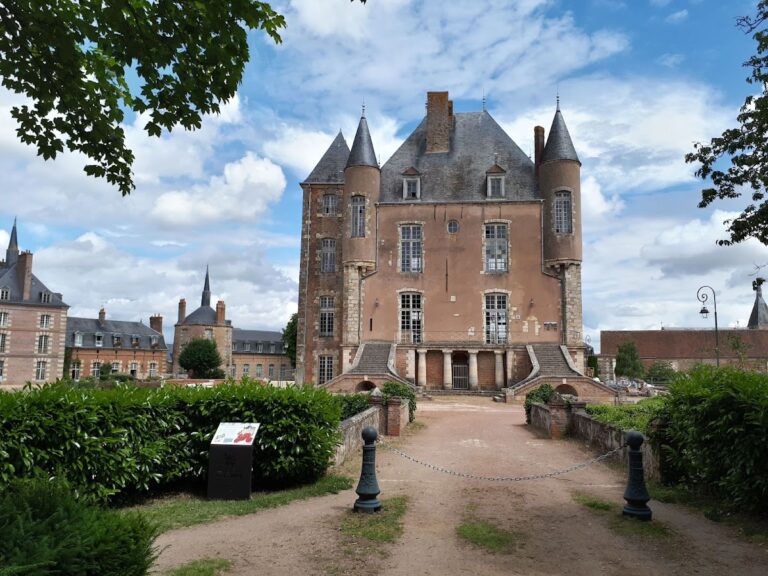
The surviving complex stands in the centre of Châteauneuf-sur-Loire, at the angle of the Places des Douves and Aristide-Briand, near the northern bank of the Loire. It is the remnant of a much larger residence. The principal surviving elements include an octagonal pavilion, a polygonal rotunda with a domed roof, a gallery, former stables, service buildings, an entrance gate, entrance pavilions, an orangery, wings of the former castle, and the large southeastern Clock Pavilion.
Château buildings
Entrance ensemble
The entrance ensemble consists of a gate flanked by two pavilions. The gate complex and square entrance towers are identified as sixteenth-century features, while much of the surviving main construction belongs to the seventeenth and eighteenth centuries. Together, these elements preserve the layered development of the residence from its earlier castle phase into the later château.
Rotunda, gallery, and pavilions
The polygonal rotunda is covered by a dome and forms one of the principal retained structures after the Revolutionary demolitions. A gallery, the octagonal pavilion, the southeastern Clock Pavilion, the castle wings, and service buildings survive as parts of the later residence. Sections of the seigneurial buildings were constructed from yellowish limestone quarried at Apremont-sur-Allier. Flat-bottomed boats carried the stone along the Allier and then the Loire.
Former stables
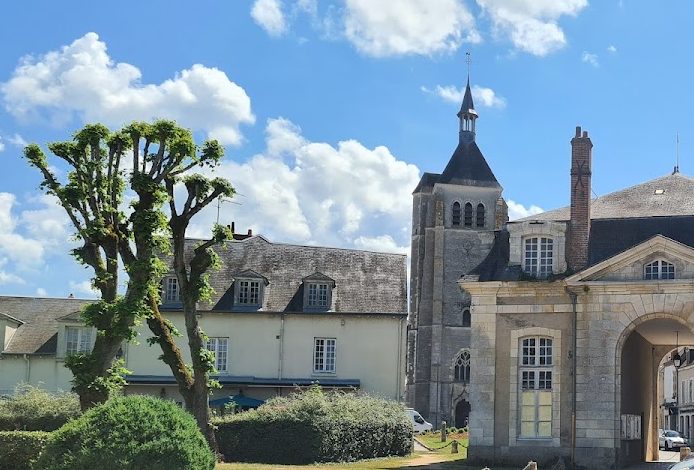
The former stables stand opposite the main facade and now contain the Musée de la Marine de Loire. Their continued use for horses helped preserve them when other parts of the castle were demolished. A section beside the rotunda was later converted into the town hall, with substantial changes to its earlier form.
Moat and park
Moat and watercourse
The original moat surrounded the castle. Three sides were dried, levelled, and incorporated into the gardens, while the southwestern section remains within the park. A small winding watercourse connects the moat area with the banks of the Loire, preserving part of the relationship between the former defensive boundary and the surrounding landscape.
Formal and landscape gardens
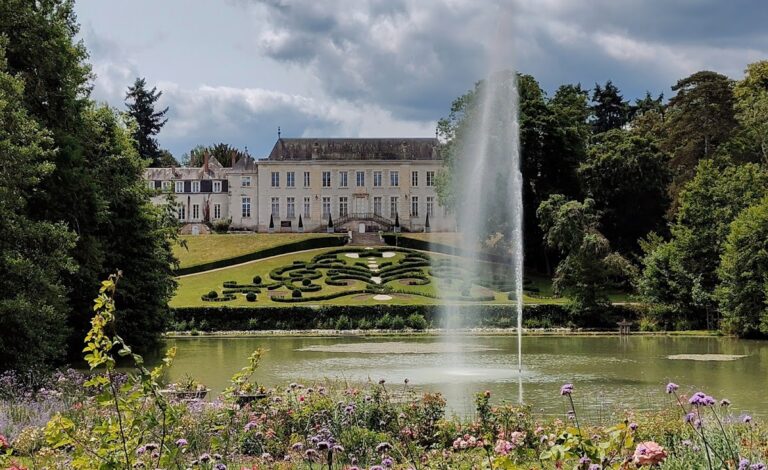
The park covers approximately 22 hectares. Traces of the formal garden remain in front of the orangery, together with box-lined paths, fruit trees, an iris garden, wooded areas, and seasonal woodland plants such as daffodils, primroses, yellow anemones, squills, cyclamens, and crocuses. Its botanical planting includes an approximately 800-metre rhododendron avenue, tree-form azaleas, giant magnolias, tulip trees, lime trees, cedars, beeches, ashes, oaks, ginkgos, Japanese pagoda trees, osage oranges, Virginia tulip trees, bald cypresses, and hornbeams. A Japanese pagoda tree and a Virginia tulip tree have been listed in the French register of notable trees since June 2009.
Wetland extension
The wetland extension contains several ponds fed by water from the nearby river, reed beds, and native plants including great willowherb, yellow loosestrife, and purple loosestrife. Two-hundred-year-old oaks and bald cypresses grow there, with the cypresses developing pneumatophores, specialized roots that project above waterlogged soil to facilitate gas exchange. A looped walk includes about 700 metres of wooden walkways and a pontoon crossing a body of water.
The park continues to serve botanical and environmental purposes. Educational panels explain wetland biodiversity and support awareness of the designated sensitive natural environment. Its documented fauna includes about 68 bird species, among them European robins, Eurasian nuthatches, hawfinches, short-toed treecreepers, and great spotted woodpeckers, as well as squirrels, insects, amphibians, and reptiles.
Nearby sites