Château d’Haroué: An Eighteenth-Century Château in France


Site at a Glance
- Rating
- 4.4
- Popularity
- Medium
- Country
- France
- Primary era
- Early Modern
- External website
- Open
- Eras represented
- Medieval, Early Modern
- Civilizations
- Duchy of Lorraine, Holy Roman Empire
- Site type
- Domestic
- Remains
- Castle
On this page10 sections
History
Château d’Haroué is an eighteenth-century château in France, built as a residence in the village of Haroué in Lorraine between 1720 and 1729. Also called Château de Craon, it should not be confused with the Château de Craon in Mayenne. Its design combines French classicism with retained elements of the medieval castle that once occupied the site.
Medieval Origins and the Beauvau-Craon Estate
A medieval castle formerly stood at Haroué, and its four towers and moat were incorporated into the later château. The earlier stronghold had belonged to Marshal François de Bassompierre, a French military commander and diplomat who lived from 1579 to 1646.
Marc de Beauvau-Craon acquired the property in the early eighteenth century and commissioned the architect Germain Boffrand to create the present residence. Boffrand was an influential French architect associated with classical and Baroque design. Marc de Beauvau-Craon served as Constable of Lorraine and later became Viceroy of Tuscany. The château remains privately owned and occupied by his descendants.
Interiors, Inheritance, and Protection
The château’s later furnishings include objects connected with the Bourbon Restoration, the period after Napoleon’s fall when the monarchy was restored in France, principally from 1814 to 1830. Some furniture and paintings came from a grant that Zoé Talon, Comtesse du Cayla, received at the Château de Saint-Ouen in 1820. They entered the Beauvau-Craon family after the 1825 marriage of her daughter Ugoline to a member of that family.
Several elements were classified as monuments historiques, a French heritage category for buildings and objects recognized for historical or architectural importance, by decree of 27 June 1983. The château, its park, and the Madon valley across Affracourt, Bralleville, Haroué, and Les Mesnils-sur-Madon have also been protected since 3 July 1990. On 23 March 2021, the owners and the Centre des monuments nationaux signed a partnership concerning public access, cultural and educational development, and the château’s enhancement.
Remains
Château and Medieval Framework
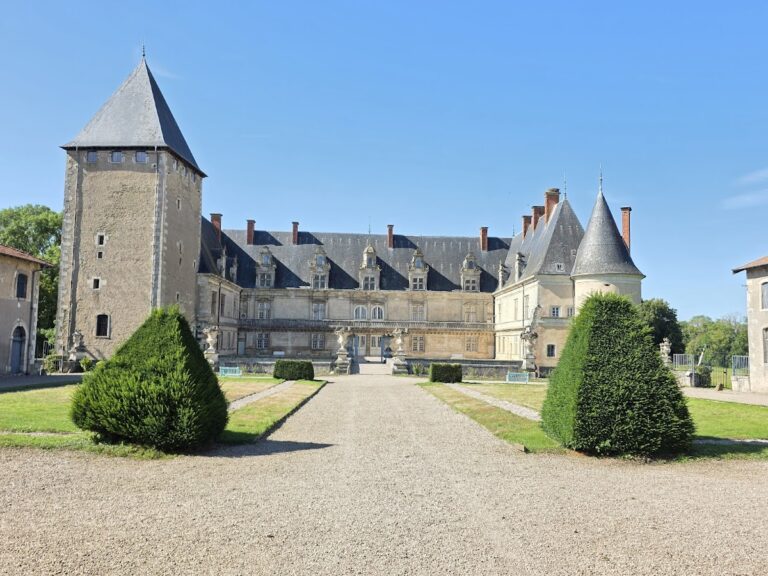
The château retains four lateral towers and the surrounding moat from the medieval site. Across this older framework, the eighteenth-century composition is arranged around a prominent central main block with projecting side sections on the side facing the ceremonial courtyard. Separate high roofs and varied volumes bring medieval and Renaissance references into a classically organized design.
The exterior includes chimney-like towers, high roofs, rusticated corners, pronounced symmetry, large windows, and a triangular pediment above the entrance portal. The courtyard façades have heavy, almost Baroque forms. Sculptural decoration appears along the moat parapets. Four bridges cross the moat, and several towers are incorporated into the buildings rather than standing independently.
Architectural Tradition and Park
A tradition associates the château’s components with the structure of the year: 365 windows with the days, 52 chimneys with the weeks, 12 towers with the months, and four bridges with the seasons. These numerical associations form part of the way the building has been described over time.
The park was designed by the architect and decorator Emilio Terry together with the landscape designers Achille Duchêne and Henri Duchêne. It forms part of the protected château setting and extends the site beyond the buildings into the surrounding designed landscape.
Decoration and Furnishings
Ironwork, Painting, and Sculpture
Jean Lamour designed the château’s gates, balconies, and stair railing. One tower received painted decoration by Pillement, while Barthélemy Guibal produced the statuary. A music salon in one of the towers was later given Chinoiserie decoration, a European style inspired by adapted Chinese artistic motifs.
Restoration-Period Furniture
The interiors contain Restoration-period furnishings from several rooms. Dining-room furniture is attributed to Pierre-Antoine Bellangé and dated 1821–1822. The château also retains billiard-room furniture, along with salon furniture made of fully gilded beechwood and covered with its original green silk upholstery brocaded in white, also attributed to Bellangé. Bedroom and bathroom furniture forms part of the surviving interior collection.
Chandeliers
Two chandeliers are associated with the protected furnishings. One is a basket-shaped chandelier with 36 lights, made of gilded bronze and cut crystal and attributed to Pierre-Philippe Thomire, with a date of 1821–1822. The other has 24 candle branches and is made of gilded bronze, copper, and tin; it is attributed either to Thomire or to Lucien François Feuchère. It includes an Argand lamp, an oil lamp with a cylindrical wick and glass chimney, with five burners and a reflector.