Château d’Écouen: A French Renaissance Princely Residence and Museum


Site at a Glance
- Rating
- 4.6
- Popularity
- Medium
- Country
- France
- Primary era
- Early Modern
- External website
- Open
- Eras represented
- Early Modern, Modern
- Civilizations
- French
- Site type
- Domestic
- Remains
- Palace
On this page19 sections
History
Château d’Écouen is a French Renaissance princely residence in France, begun in 1538 and completed in 1555 on the site of a fortress that had occupied the hilltop since at least the twelfth century. Its position overlooked the agricultural Plain of France and the historic commercial and military routes towards Paris. The château was commissioned by Anne de Montmorency, a leading nobleman and royal official who served Francis I and Henry II as Constable of France, the kingdom’s senior military commander.
From Fortress to Renaissance Residence
Anne de Montmorency inherited the fortress in 1515. He ordered the medieval stronghold to be demolished and replaced with a princely residence capable of receiving the king. The new building drew on Italian palaces encountered during the Wars of Italy, a series of conflicts in which French rulers and armies intervened in the Italian states, and followed the general plan of the royal Château de Chambord.
The original design was prepared by an unidentified architect. Building records have been lost, leaving the exact sequence of construction and decoration uncertain. Montmorency initially supervised the work closely, particularly after he lost royal favour in 1541. Following Henry II’s accession in 1547, the plan and decoration were altered to include royal apartments, turning Écouen into a semi-royal residence.
Artists and Royal Occupation
Jean Goujon was active at Écouen from about 1547, while Jean Bullant was engaged around 1550 to complete the north wing and construct the portico of the south wing. Bullant also contributed to the decoration and became especially associated with the château’s classical colonnades and monumental stairways. Philibert Delorme is likewise associated with the building, although the precise division of responsibilities remains uncertain. The possible involvement of Nicolò dell’Abbate is also uncertain.
Montmorency brought together prominent French and European artists, including Bernard Palissy, Masséot Abaquesne, and Léonard Limosin. The decoration was planned as a luxurious ensemble of stained glass, sculpture, paving, paneling, painting, marble, goldsmiths’ work, tapestries, ceramics, enamels, and fountains. These commissions made the residence an important setting for French Renaissance art while accommodating the ceremonial requirements of the royal court.
Écouen soon became one of Henry II’s preferred residences, and an entire wing was reserved for his frequent stays. In June 1558, the château hosted the marriage of Henri de Montmorency, Anne’s younger son, to Antoinette de La Marck. Henry II also promulgated the Edict of Écouen there. The measure ordered the execution without trial of Protestants considered responsible for disturbances and preceded the French Wars of Religion, the prolonged conflicts between Catholics and Protestants in France.
Montmorency Decline and Condé Ownership
Anne de Montmorency was killed in 1567 while commanding the royal army at the Battle of Saint-Denis. His son François de Montmorency died at Écouen on 6 May 1579. The family’s fortunes changed decisively in 1632, when Henri II de Montmorency, Anne’s grandson, was executed for rebellion against Cardinal Richelieu. The senior Montmorency line then became extinct. Louis XIII confiscated the château and granted it to Charlotte d’Angoulême, whose descendants later transferred the estate to the Bourbon-Condé family, a cadet branch of the French royal Bourbon dynasty.
Jules Hardouin-Mansart designed the park associated with the Condé ownership. In 1787, the Condé family demolished the original east wing and entrance portal. The work removed numerous frescoes and other works of art, although some fragments were later found in the forest and in the town.
Revolutionary and Educational Uses
During the French Revolution, the state confiscated the château. It was successively used as a hospital, a military prison, and a meeting place for a patriotic club. In 1805, Napoleon established a house of education of the Legion of Honour at Écouen for the daughters of decorated persons. A lower replacement wing was built in 1807.
After the Bourbon Restoration, Louis XVIII returned the estate to the Condés. The house of education was re-established at Écouen around the middle of the nineteenth century under Louis Napoléon Bonaparte and remained there until 1962. Eugène de Beauharnais created the Fontaine Hortense in the park during the nineteenth century. The château entered the French list of historic monuments in 1862, and the entire estate received classification in 2007.
The Musée national de la Renaissance
When the house of education left in 1962, the château was transferred to the Ministry of Cultural Affairs. André Malraux selected it for the national Renaissance collections partly because its large rooms could accommodate the 75-metre-long David and Bathsheba tapestries, and partly because the architecture itself represented French Renaissance art.
After extensive restoration and conversion, the Musée national de la Renaissance opened at the château in 1977. Its first galleries opened in October that year, and the complete museum opened in 1982. Thirty-two exhibition rooms present Renaissance furniture, metalwork, ceramics, glass, enamels, paintings, textiles, tapestries, arms, and sculpture. The museum is administered under the Ministry of Culture, while the building belongs to the Grand Chancellery of the Legion of Honour.
Much of the museum’s collection came from the Musée de Cluny, whose Renaissance holdings had outgrown its display space. Additional works were transferred from the Louvre and other institutions, while purchases and donations expanded the collection. The museum combines reconstructed interiors with Renaissance works that mostly originated elsewhere. Much of Château d’Écouen’s original furniture was dispersed during the Revolution, and part of it is now held by the Musée Condé in Chantilly. Founded in 1970, the Société des Amis du Musée national de la Renaissance au château d’Écouen supports preservation, scholarly activity, and the enlargement of the collections.
Remains
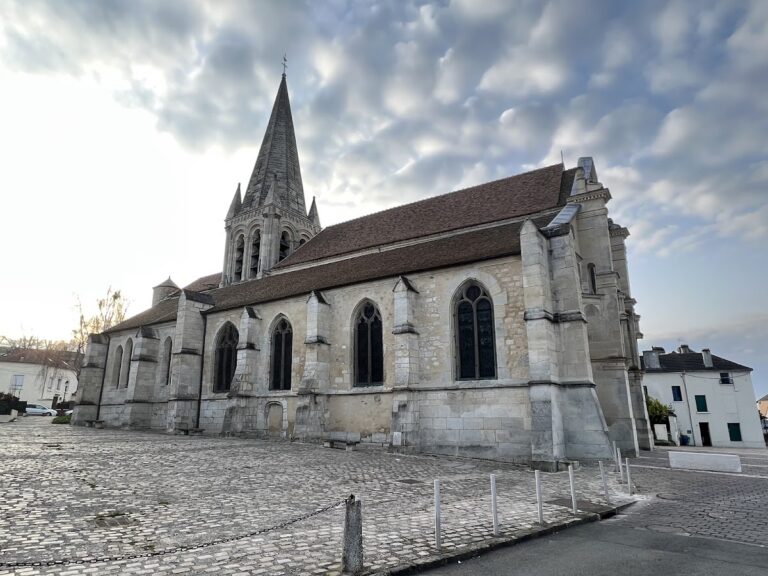
Château d’Écouen stands on a hill above the Plain of France. The building occupies a terrace and was originally enclosed by a fortified wall with bastions and a false moat, defensive features probably intended to express Montmorency’s office as commander of the army. The main structure forms a rectangle around a central courtyard, with square corner pavilions. Two three-storey residential wings are connected by a lower entrance wing, and the upper levels of the three principal wings are crowned by rows of lucarnes, or projecting dormer windows.
Wings and Courtyard
Residential Wings
The south wing contained the private apartments and chapel of Anne de Montmorency and Madeleine of Savoy. The north wing was reserved for royal guests, with the queen’s suite on the first floor and the king’s suite above it. Each residential wing originally had a monumental central staircase leading to the upper-floor apartments. The north-wing staircase was enlarged when the royal apartments were incorporated into the plan, prompting Bullant to add interior peristyles, or colonnades around the courtyard, to the north and south wings so that the façades remained balanced.
Courtyard Peristyles
The courtyard peristyles use classical column orders and niches intended for sculpture. They are early French Renaissance features influenced by Italian architecture, including forms associated with Bramante. The exterior peristyle of the north wing covers the loggias of the monumental staircase. It has a classical pediment, large windows, column orders, and horizontal bands of sculptural decoration. The royal entrances bear Henry II’s crescent emblem and the rainbow emblem associated with Catherine de Medici, his queen. The royal wing is more richly ornamented than the remainder of the château.
Entrance Wing
The present entrance wing is a lower Neoclassical replacement for the demolished east entrance and was completed in 1807 by Antoine-François Peyre. The château’s façades combine features associated with the first Renaissance, the later Renaissance, and a more triumphant classicism. Each façade was designed individually rather than as part of a uniform treatment, and the north façade is especially prominent from the Plain of France.
Interiors and Chapel
Some original interior decoration remains in the château, including ornamental friezes, carved woodwork, stained glass, paneling, busts, painted leather hangings, and twelve painted fireplaces. The fireplaces date mainly from the reign of Henry II. Their subjects include the story of Solomon and the Queen of Sheba and the Tribute to Caesar, surrounded by mythological figures, animals, fruit, and vegetables. Frescoes with polychrome heraldic designs based on Montmorency’s arms contrast with the more restrained, largely gray decoration of the stained glass.
Royal Apartments
Sections of the original polychrome faience floors, made from tin-glazed earthenware, survive in the royal apartments, including the king’s bedchamber and salon. Masséot Abaquesne, a ceramicist from Rouen, received the commission around 1549 to 1551. Original carved wood paneling remains in parts of the king’s apartments and in the Constable’s library above the chapel. The panels combine Montmorency emblems with Moorish and arabesque designs.
The king’s bedchamber retains painted monograms of Henry II, including the crescent emblem. Its painted fireplace presents a biblical scene below the king’s coat of arms, which two cherubs hold. Two tapestries from the David and Bathsheba series are also associated with the room. Other documented rooms include the Great Hall of the King, the Constable’s apartment, and the room of Madeleine of Savoy.
Chapel
The chapel occupies the ground floor of the south wing. Its original furnishings, stained glass, and paneling were removed during the Revolution, and the stained glass and paneling are now at the Château de Chantilly. The chapel retains an arched rib-vaulted ceiling painted with the coats of arms of Anne de Montmorency and Madeleine of Savoy.
The museum displays an altarpiece of gilded carved wood with painted enamel panels showing biblical scenes by Léonard Limosin. The chapel also contains an early copy of Leonardo da Vinci’s Last Supper, painted in Milan between 1506 and 1509 by Marco d’Oggiono, a pupil of Leonardo. The work hung in the chapel during Montmorency’s residence at Écouen.
Gardens and Park
The northeast side of the quadrilateral was formerly bordered by a garden. A trace of a garden niche survives in the retaining wall of the access terrace, while the garden had disappeared by at least the late seventeenth century. Bernard Palissy was commissioned to create a grotto in 1556, but the work was never completed. Nineteenth-century chroniclers placed it near the Fontaine Madame.
The park associated with Jules Hardouin-Mansart was organized around two perpendicular axes crossing before the west façade. It included avenues of trees, belvederes, circular features, a west terrace with a lawn parterre, or formal ornamental garden arrangement, divided into three sections, and a tree-lined ceremonial approach from the village. A late nineteenth-century plan introduced a jeu de paume, an early racket sport and forerunner of modern tennis, together with a ballroom. Restoration during the 1970s sought to recover the park’s historic appearance, including its avenues and parterres.
Collections Displayed at Écouen
The museum’s Renaissance collections are arranged in six principal categories: furniture; the decorative arts of fire, including ceramics, stained glass, glass, and enamels; metalwork; painting; wool and silk arts, including tapestries and lace; and sculpture. The displays place objects alongside reconstructed rooms, allowing the surviving architectural fabric to be read together with works of the period.
Tapestries and Ceramics
Ten Brussels tapestries depicting David and Bathsheba were made in the early sixteenth century and measure 75 metres in total. Their biblical subject is presented through sixteenth-century costumes and settings that evoke court life. They may have belonged to Henry VIII of England. The museum also displays two mid-sixteenth-century tapestries from the Fructus Belli series, based on designs by Giulio Romano. The scenes depict soldiers being paid, and Ferrante Gonzaga, Duke of Guastalla and commander in the service of Emperor Charles V, commissioned the series in 1544.
Renaissance ceramics from France, Italy, the Ottoman world, and elsewhere include works by Masséot Abaquesne and Bernard Palissy. The collection includes 522 Ottoman faience pieces, mainly made at Iznik during the second half of the sixteenth century. A faience triptych showing the Flood and the embarkation on the Ark was made by Abaquesne around 1550. Sections of Écouen’s original ceramic pavement remain in situ.
Enamels and Stained Glass
The Limoges enamel collection includes religious and mythological subjects. Limosin made the enamel scenes on the chapel altarpiece, while Pierre Courteys’s signed and dated works of 1559 include a large portrait of Mercury. A stained-glass portrait of Francis I in prayer was made by Nicolas Beaurain around 1551 to 1556. Henry II commissioned it in 1549 for the Sainte-Chapelle at Vincennes, and the surviving section entered the museum after most of that chapel’s windows were destroyed during the Revolution.
The museum also displays a stained-glass scene of Saint Paul being driven from the Temple in Jerusalem. Louis Pinaigrier and Nicolas Charnus made it in the first third of the seventeenth century for the Church of Saint-Paul in Paris, which was destroyed in 1797.
Metalwork and Mechanical Arts
Displayed metalwork includes gilded ceremonial spurs made for Francis I between 1515 and 1525, a ceremonial Italian rondache, or round shield, made for Charles V in 1555 and decorated with silver and gold, and a neck-defense plate bearing figures of Mars and Minerva. Renaissance scientific instruments and mechanical devices include astrolabes, clocks, globes, a celestial sphere dated 1502, sundials, and automatons.
The mechanical model ship known as the Nef of Charles V was made around 1590 and is attributed to Hans Schlottheim. Its clock activates seven mechanisms, sounds the quarter hours, moves mechanical figures, and fires miniature cannons. The ship originally belonged to the Elector of Saxony’s cabinet of curiosities. An astrolabic clock attributed to the Lyon clockmaker Jean Naze indicates the time, the sun’s course, the moon’s phases, and the positions of the stars. Another device, made around 1547 to 1559, bears Henry II’s emblems and is thought to have been an early coding device.
A gilded-silver and coral statuette of Daphne by Wenzel Jamnitzer, made between 1569 and 1576, depicts the nymph’s transformation into a laurel tree from Ovid’s Metamorphoses. The collection also includes a goldsmith’s stretching bench dated 1565, designed by Leonhard Danner for Augustus I of Saxony. Together with the reconstructed interiors and surviving decoration, these works make Château d’Écouen both a monument of French Renaissance architecture and the setting for a broad museum of Renaissance arts.
Nearby sites