Auberoche Castle: A Medieval Stronghold and Feudal District Centre
Site at a Glance
- Popularity
- Medium
- Country
- France
- Primary era
- Medieval
- Eras represented
- Medieval
- Civilizations
- Duchy of Aquitaine
- Site type
- Military
- Remains
- Castle
On this page12 sections
History
Auberoche Castle was a medieval stronghold at Le Change in Périgord, France, positioned above the Auvézère valley. Its earliest tower is dated to about 990, while the surviving Saint Michael’s Chapel is a 12th-century Romanesque building. The castle later became the seat of a territorial district and a centre of authority over routes through the surrounding valleys.
Origins and episcopal authority
A chronicle written around 1182 credited Bishop Frotaire, whose tenure ran from 976 to 991, with the decision to establish a fortified stronghold at Auberoche. The tower has been dated to about 990, but soundings in two areas found no occupation earlier than the 12th century. The foundation date therefore remains uncertain. One interpretation is that an early origin was asserted to bolster the bishops of Périgueux’s claims to the site.
The bishops’ strongholds formed part of a strategy to control waterways and routes across central Périgord. Norman raids in the ninth and tenth centuries, which particularly affected churches and monasteries, may have helped prompt this approach. In 1040, Bishop Geraud de Gourdon granted Auberoche as a fief, or land held in return for loyalty or service, to the Viscount of Limoges. The grant secured the viscount’s support in Geraud’s conflict with Count Aldebert II of Périgord. That dispute followed Geraud’s condemnation and destruction of coinage issued by Aldebert’s father, Count Hélie II.
A feudal and administrative centre
Between 1154 and 1157, the Viscount of Limoges acknowledged the Bishop of Périgueux as Auberoche’s overlord. The castle became the centre of a châtellenie, a territorial and administrative district organized around a castle, and a base for the viscounts’ political and economic authority near Périgueux. The district is known from the 13th century and may have taken shape during the century before.
By 1365, the district covered about 25,000 hectares across three cantons and included fifteen parishes. Its territory controlled routes along the Auvézère and Manoire valleys toward Périgueux. A provost, an official administering the district for its lord, is recorded in 1257. By 1289, the castle served as a centre for weights and measures, and a salt toll was collected there during the 14th century.
Knights attached to the castle appear in records from the early 12th century. A village grew below the stronghold in the late 12th or early 13th century, probably in connection with it. The settlement may have become a parish centre by the middle of the 13th century, and its church of Saint Matthew is mentioned in 1279. It is unclear whether the village developed on its own or through encouragement from the castle’s owners. In 1287, the district was also named in connection with homage, a formal acknowledgment of a lord’s authority, to Arthur II of Brittany, who held the Viscounty of Limoges through his marriage to Marie de Comborn.
Auberoche in the Hundred Years’ War
During the Hundred Years’ War, a prolonged series of conflicts between the English and French crowns, English forces captured Auberoche in 1345. After taking Bergerac in August, an English-Gascon force led by Henry de Grosmont, Earl of Derby, advanced into Périgord and overcame the French resistance at the castle. Derby left a garrison under Franque de Halle, Alain de Finefroide, and Jean de Lindehalle. The Battle of Auberoche, fought on 23 October, was a major land battle of the war and brought the first English-Gascon campaign in Guyenne to a close.
After Derby’s force returned toward Bordeaux, Count Bertrand de L’Isle-Jourdain gathered regional lords and besieged Auberoche. The French encirclement prevented movement into or out of the castle, while four siege engines brought from Toulouse hurled stones at its walls each day. The garrison tried to alert Derby with a message sewn into a servant’s clothing. The messenger was caught and catapulted back over the walls. Two illuminations in the chronicle of Jean de Wavrin depict the episode.
Derby and the English commander Gautier de Mauny assembled a relief force. Derby summoned Richard de Stafford and Étienne de Tombey from Libourne and the Earl of Pembroke from Bergerac, but Pembroke did not join them. Although outnumbered, the English surprised the French commanders at dinner and captured them. The French troops then stopped fighting, and Auberoche remained in English hands under the command of Alexander de Caumont.
In 1346, the castle district returned to French royal possession. In November, King Philip VI sold it to Cardinal Talleyrand-Périgord; Charles de Blois, Duke of Brittany, and his wife Jeanne, Countess of Penthièvre and Viscountess of Limoges, confirmed the sale. The cardinal authorized his brother, Roger-Bernard, Count of Périgord, to receive the acts of homage owed by the district’s inhabitants.
Conflict and the castle’s dismantling
After Roger-Bernard died in 1361, the county passed to his son Archambaud V. Archambaud exempted Périgueux from a tax for nine years in 1368, then later sought to collect it again. The city’s consuls challenged his right to do so, arguing that the king alone could levy the tax. Archambaud assembled troops in seven castles around Périgueux, including Auberoche. In 1383, his soldiers pillaged Le Change and burned its church.
Archambaud was captured in 1394 and sentenced to exile the following year. A 1398 sentence called for him to lose his county and be executed, but the king pardoned him. Archambaud went to England and died there in 1399. His son Archambaud VI recovered the county, apart from Périgueux, and the conflict continued. After Archambaud VI was exiled and his lands confiscated, the county and Auberoche passed to Louis, Duke of Orléans, who took possession of the district in 1400. On Louis’s death in 1407, it passed to his son Charles, captured at Agincourt in 1415 and held in England for 25 years.
Archambaud VI returned to France with English troops in 1412 and seized Auberoche in 1415, making it his headquarters. He made a will at the castle in 1425, leaving his possessions to his sister Eléonor de Périgord. He later withdrew to Montignac, where he died in 1430, leaving a garrison commanded by Captain Audry Jamard. Jean de Blois, Lord of Aigle, had besieged Auberoche in 1428; the castle fell in 1430 after a garrison soldier betrayed it. Consuls of Périgueux sought its destruction as a way to end the legacy of a conflict that had devastated Périgord for nearly forty years. They raised a household tax and paid Jean de Blois to demolish the castle. The work was completed in 1431, with the chapel spared.
Later ownership and rediscovery
Through his 1470 marriage to Françoise de Blois-Bretagne, Countess of Périgord and Viscountess of Limoges, Alain d’Albret acquired those territories. In 1512, King Jean III of Navarre sold the Auberoche district to Alain’s father. In 1600, King Henri IV sold it to Jean Foucauld, Lord of Lardimalie, who was already governor of Périgord and the Viscounty of Limoges and held the title Baron of Auberoche. Without its castle, the district was gradually divided during the 18th century, and the fortress ruins became difficult to discern.
In the 19th century, journalist Henry Ribadieu proposed that Auberoche had been at Caudrot in Gironde. Archival records and archaeological investigations instead supported its location at Le Change in Périgord. Saint Michael’s Chapel was classified as a historic monument in 1960, and major restoration work in 1967 saved it from ruin.
Remains
The castle occupied a high, steep position above the Auvézère on the eastern edge of the Périgord limestone plateau, about 16 kilometres east of Périgueux. At Le Change, the river cuts deeply into the limestone, bending around two broad meanders and forming ridges with flattened tops. Its banks rise 50 to 80 metres above the river, while tributary valleys offer the easier approaches. The stronghold stood beside a route through the valley, with its elevated position providing natural defensive advantages.
The stronghold
Tower and rocky spur
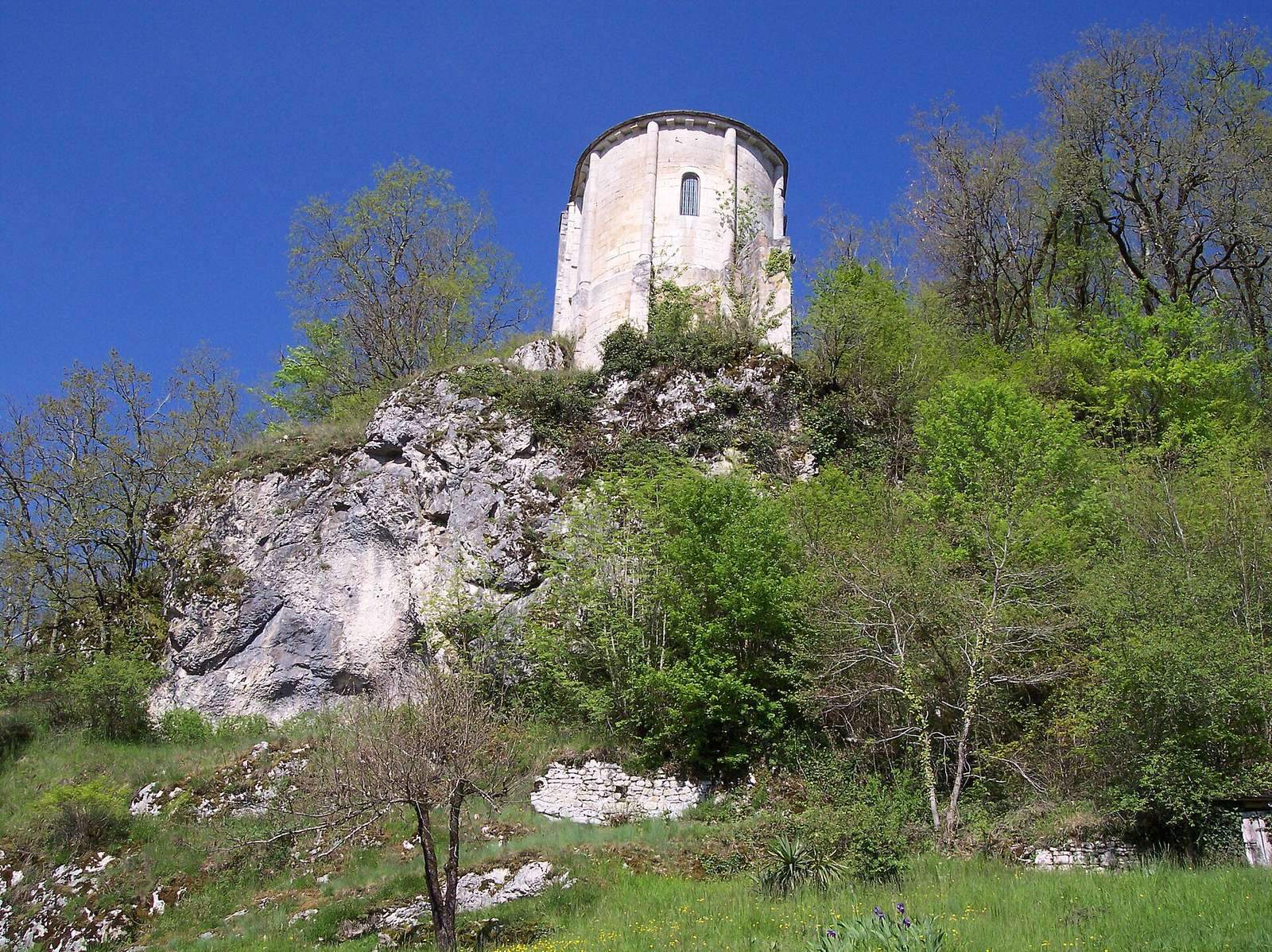
The stronghold began with a tower on the right bank of the Auvézère, at the first meander. It stood on a rocky projection shaped from Bathonian limestone by the river and its tributaries. The river valley formed the main escarpment to the east, and another valley cut interrupted the slope to the south. A smaller tributary cleft shaped the western side, while a narrow passage linked the spur with the plateau to the north. Unlike earlier castles often raised on earthen mounds and built in wood, Auberoche used its naturally elevated position and stone construction from the outset.
Residence and enclosure
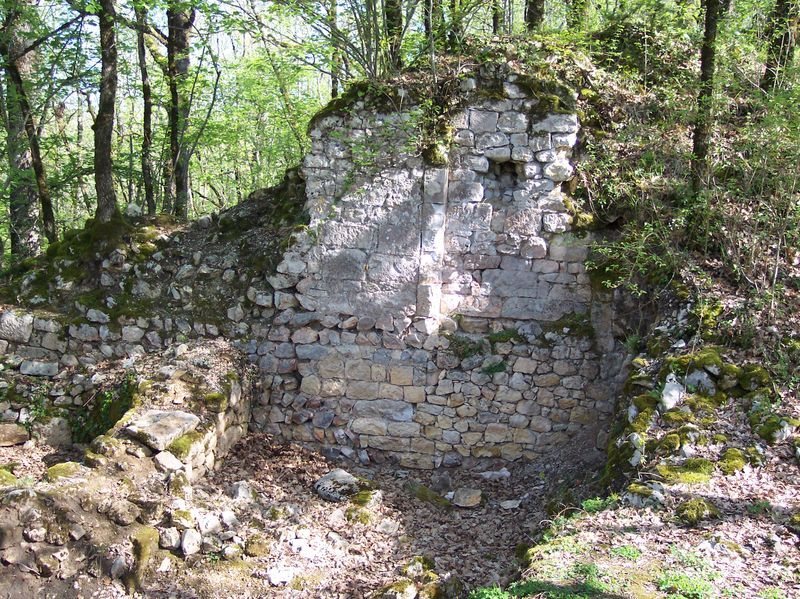
The lordly residence, probably built during the 12th century, stood on a flat-topped mound overlooking the rocky spur. The mound may have been partly constructed by people and may conceal earlier traces of occupation. Soundings revealed an old storage pit that had gone out of use by the 12th century. Later occupants installed a fire area and then a fireplace. The residence was demolished in 1430.
The enclosure appears to have been built in a single campaign, at the same time as the earliest occupation of the residence it surrounded. Its approximate course can still be traced in the site’s topography, and the castle’s footprint appears to have remained much the same between the 12th and 15th centuries. Investigations of the residence and enclosure indicate abandonment and destruction in the early 15th century.
Terraced settlement
The village occupied artificial terraces on the western slope below the castle. Excavation identified two dwellings, more than 70 metres apart: one high on the slope and the other near its base. Material from their foundations indicates that they were built at about the same time. The terraced area may have held twenty to thirty homes as the settlement spread across the slope in the late 12th and early 13th centuries. The dwellings were abandoned around the time the lordly residence was demolished and the enclosure levelled. Rural inhabitants later reused the seigneurial site, with pottery indicating that this occupation ended by the close of the 15th century.
Saint Michael’s Chapel
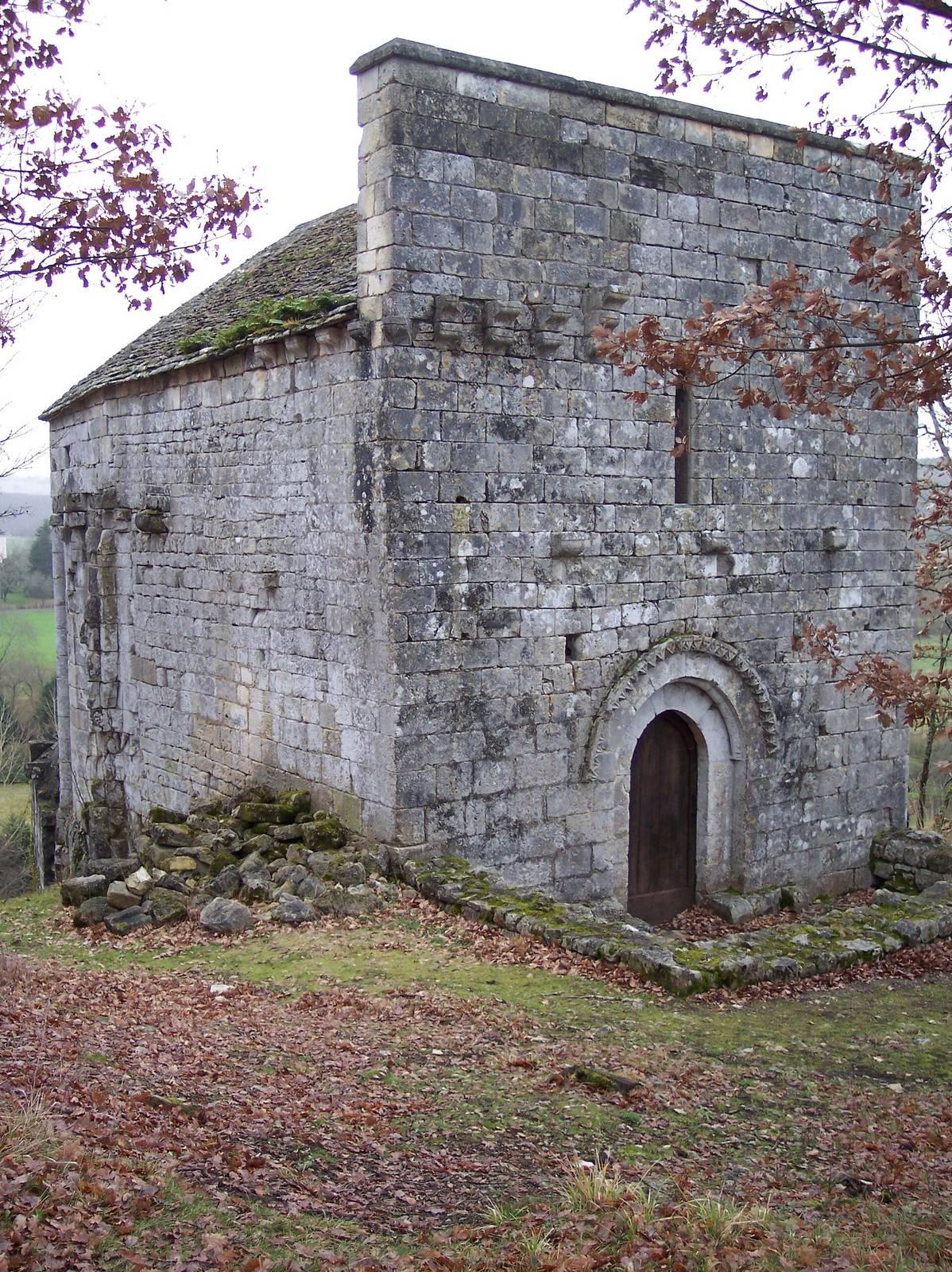
The 12th-century Romanesque chapel dedicated to Saint Michael is the castle’s surviving building. Its rounded apse, a semicircular space projecting from the end of a church, is marked by column-shaped buttresses. The entrance has a simply carved band following the curve of the arch, decorated with diamond points. The apse and its half-dome vault, a rounded covering over the space, once carried wall paintings. Drawings made in 1855 by the Aquitanian archaeologist and draughtsman Léo Drouyn show their appearance.
The chapel’s roof was renewed entirely in stone slabs during the 1967 restoration. An alternative identification names Saint George rather than Saint Michael as its dedicatee. This reading has been associated with the Hundred Years’ War and may have expressed allegiance to the English Crown through the cross of Saint George, an early English emblem.